
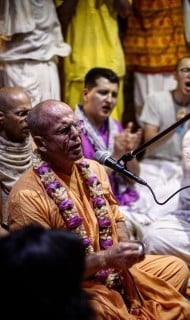
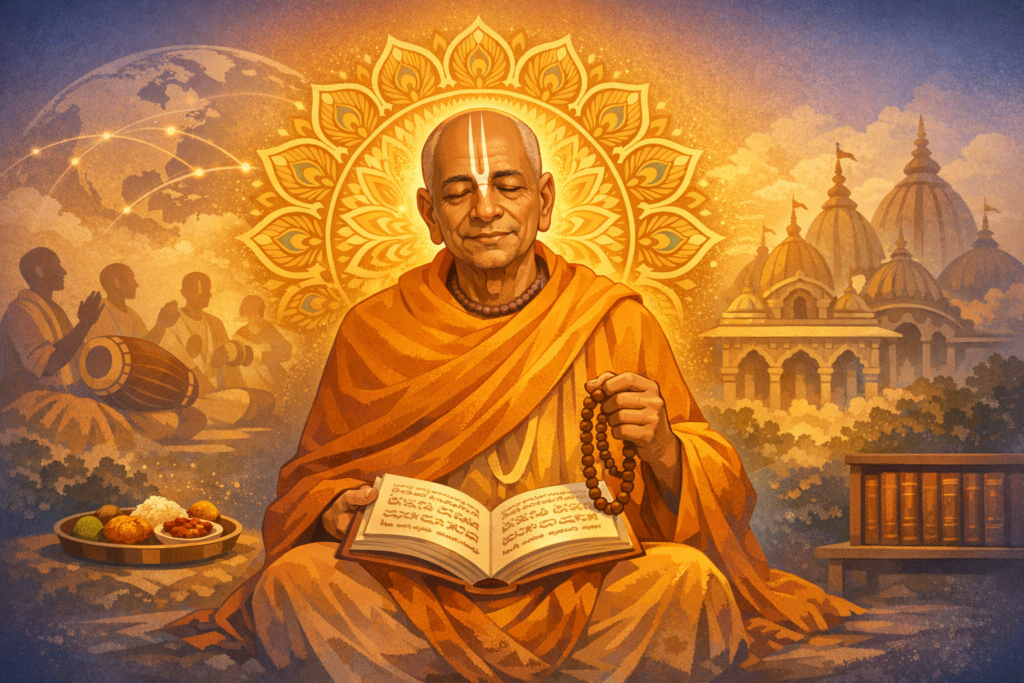
“Increase the quality of your chanting. Increase the quantity of your chanting.” This concise guidance, rooted in the bhakti tradition of Gaudiya Vaishnavism, distills a complete sādhanā architecture: refine attention and feeling (quality), and stabilize disciplined repetition (quantity). When coupled with sustained study of Srimad Bhagavatam, Caitanya Caritamrita, and the time-tested prayers composed by acaryas, the practice matures into a coherent path that is contemplative, scriptural, and relational—addressing heart, intellect, and daily conduct together.
Quality in chanting (japa) is best understood as attentional precision and devotional alignment. Technically, it involves clear enunciation of each syllable, steady breath, relaxed yet upright posture, and one-pointedness (ekagrata). Practitioners listen to the mantra as it is uttered, maintaining gentle vigilance so the mind returns to sound whenever it wanders. Over time, this yields consistency (niyama), inner steadiness, and a felt sense of sincerity (shraddha) and feeling (bhava) that guards against mechanical repetition.
Quantity addresses rhythm and resilience: the measured accumulation of rounds using a mālā (often 108 beads), a sustainable pace, and a schedule that survives the pressures of ordinary life. The optimal sequence usually begins with modest counts and adds volume gradually to prevent vocal strain and attention fatigue. Quantity without quality can drift into rote practice, while quality without stable volume can remain fragile; the two reinforce each other when grown in tandem.
Classical sources describe three modes of mantra recitation: vācika (audible), upāṁśu (whispered), and mānasa (mental). Audible japa supports beginners by engaging hearing (śravaṇa) and speech (kīrtana). Whispered practice quiets the environment while retaining tactile cues. Mental japa, though subtle, demands the strongest attentional control. Rotating among these modes can maintain freshness and prevent plateaus.
In Gaudiya Vaishnavism, “Hare Krishna” kīrtana and japa exemplify this method. The repeated, attentive invocation of the Names centres awareness, dissolves distraction, and nurtures relational intimacy with the Divine. As quality deepens, the mantra becomes not only a practice but also a place of refuge—accessible at any moment of the day.
Scriptural study (svādhyāya) grounds chanting in a living canon and lineage. Daily reading of Srimad Bhagavatam and Caitanya Caritamrita builds a shared vocabulary of meaning—cosmology, ethics, and devotion—through which experience can be interpreted without sentimentality or speculation. Study benefits from an iterative cycle: careful reading (śravaṇa), reflection (manana), and contemplative assimilation (nididhyāsana). This triad ensures that practice and understanding evolve together.
Acaryas have written so many prayers, and these compositions function as precise templates for inner speech. Texts such as the Śikṣāṣṭakam and other bhakti stotras calibrate the heart: they teach how to ask, how to thank, how to confess, and how to remember. Reading the prayers of acaryas while chanting situates the practitioner in paramparā (lineage), aligning individual aspiration with the well-tested insights of realized teachers.
Prayer may also be direct and unadorned. The teaching affirms that the Divine responds to sincerity in any register. When the heart spontaneously pleads—“Krishna, help. Krishna, save me”—that authenticity itself is prayer’s power. Both modes are upheld: Krishna will hear when one reads the prayers of acaryas, and Krishna will hear when one speaks from the core of personal need.
This integrated model resonates across the dharmic family. In Sikh tradition, Naam Simran focuses attention on the Divine Name; in Buddhist practice, mantra recitation (for example, “Om Mani Padme Hum”) cultivates compassion and clarity; in Jain practice, the Namokar Mantra honours the qualities of perfected beings. While metaphysical emphases differ, the shared disciplines of sacred sound, ethical refinement, and scriptural remembrance create profound common ground that strengthens intertradition unity.
Contemporary research on mantra practice and contemplative repetition broadly converges on several observations: reduced stress reactivity, improved attentional stability, and positive shifts in affect regulation. Studies report markers consistent with parasympathetic activation (for example, increased heart-rate variability) and reduced rumination. Group kīrtana additionally appears to support social bonding and uplift mood. While methodologies vary, the pattern aligns with centuries of dharmic testimony that sacred sound can steady the mind and soften the heart.
Practical methods reliably elevate quality. Begin with a minute of quiet breathing; relax the shoulders and lengthen the spine. Chant at a conversational pace that allows every syllable to be heard and felt. Keep the mind anchored in sound; when attention drifts, return to the mantra without judgment. If the voice tires, move to upāṁśu or mānasa japa temporarily. Periodically assess the session: Was pronunciation clear? Was attention steady? Was there warmth of feeling, or did the mind move restlessly? These micro-assessments gently steer improvement.
Scriptural study benefits from a modest but unwavering schedule. A daily, time-bound reading of Srimad Bhagavatam or Caitanya Caritamrita—followed by two or three sentences of reflection—keeps the engagement active rather than passive. Cross-referencing commentaries by acaryas, noting recurring theological motifs, and tracking questions for future study cultivate a scholarly habitus that complements devotional practice.
Prayers of acaryas function as a calibrated vocabulary of devotion. Reading them aloud each day trains emotional articulation, much like scales train a musician’s ear. Over time, personal prayer begins to echo their cadence, yet remains fully one’s own. Thus, lineage forms do not suppress individuality; they refine it.
A simple daily sequence integrates the whole: brief centering; dedicated japa at an attainable count; study of Bhagavatam or Caitanya Caritamrita; a set prayer from the acaryas; and, finally, a spontaneous petition in ordinary language. This arc honours both form and freedom, ensuring that the heart’s immediate cry—“Krishna, help. Krishna, save me”—is held within the wisdom of tradition.
Common obstacles are well known and addressable. Restlessness yields to shorter, more frequent sessions; dullness to a slightly brisker pace and better sleep hygiene; doubt to comparative reading and dialogue; dryness to alternating audible and whispered japa, or a short kīrtana before silent practice. Morning hours (brahma-muhūrta) often offer the highest signal-to-noise ratio for attention, while evening reading consolidates insight.
Ethically, these disciplines converge on ahimsa, humility, gratitude, and service (seva). As chanting purifies speech and thought, and as scripture clarifies values, interpersonal conduct typically grows gentler and more truthful. In this way, personal sādhanā quietly strengthens social fabric—an outcome unanimously affirmed across Hinduism, Buddhism, Jainism, and Sikhism.
Unity, then, is not an abstraction but a shared method: disciplined sound, reflective study, and honest prayer. Increasing the quality and the quantity of chanting while immersing in Srimad Bhagavatam, Caitanya Caritamrita, and the prayers of acaryas creates a balanced, lineage-anchored practice. It is academically coherent, experientially deep, and hospitable to all dharmic seekers. And at its centre remains the disarming assurance that sincere prayer—in the language of scripture or in the plainest words of the heart—is heard.
Inspired by this post on Dandavats.





Leave a Reply
You must be logged in to post a comment.