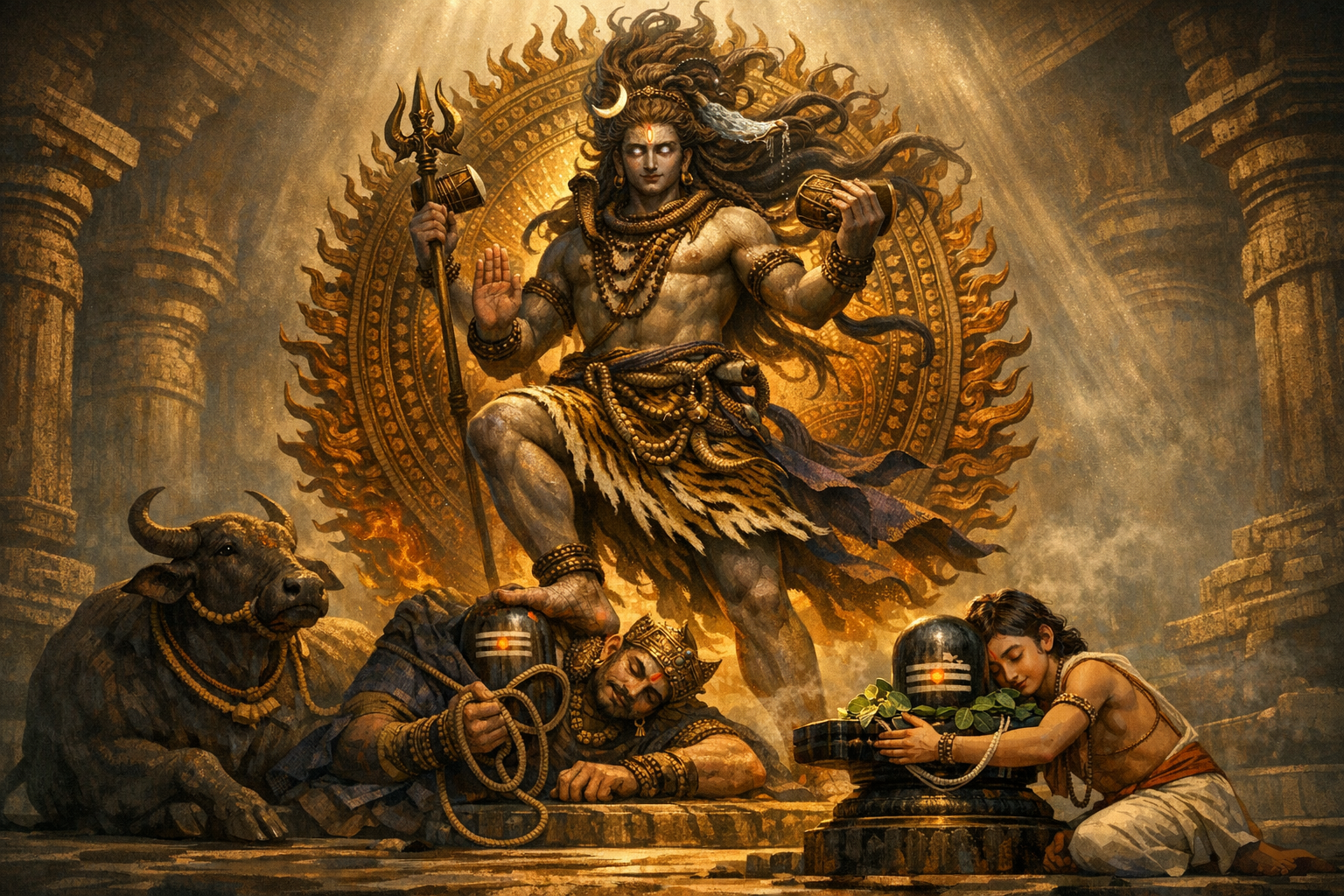
Kalantaka Shiva stands within the Shaiva canonical tradition as a commanding revelation of divine sovereignty over death (mrityu) and time (kala). As an iconographic and theological figure, Kalantaka (literally “ender of Kala”) communicates Lord Shiva’s power to interrupt the ordinary sequence of mortality, reestablish cosmic order (rita/dharma), and console devotees with the assurance that the Self (atman) is not subject to decay. This form, revered across Shaivism and referenced in Tantric praxis, has inspired centuries of temple art, ritual, and philosophical reflection.
The etymology clarifies the doctrinal promise: “Kala” denotes both time and Yama, the deity presiding over death; “antaka” indicates termination. Kalantaka therefore symbolizes the transcending of chronological finitude and the subordination of death to a higher law. In the wider Indic imagination, this does not abolish cosmic rules but reveals their deeper teleologymortality is bounded, while consciousness (cit) remains unbounded.
Purana literature preserves the classic narrative matrix for this form. In accounts found across the Shiva Purana, Linga Purana, Skanda Purana, and related texts, the sage Markandeya, destined to die at sixteen, embraces a Shivalinga and takes refuge in Shiva. When Yama’s noose encircles the linga by mistake, Shiva erupts from the stone, appearing as Kalantaka, subduing Yama, and liberating the devotee from the decree of early death.
Crucially, the narrative neither endorses anarchy in the moral cosmos nor a permanent abolition of Yama’s office. Rather, Shiva’s intervention exemplifies mercy aligned with law: the dharmic order is clarified, compassion is enthroned above retribution, and devotion (bhakti) combined with knowledge (jnana) is affirmed as a pathway to fearlessness. The story’s pastoral force has sustained households and temples alike in their understanding of suffering and impermanence.
Within the Mahamrityunjaya tradition, the resonance of Kalantaka is immediate. Daily recitation of the mantraTryambakaṁ yajāmahe sugandhiṁ puṣṭivardhanam, urvārukamiva bandhanān mṛtyor mukṣīya mā’mṛtātserves as liturgical and contemplative remembrance that mortality is not the final horizon of life. Kalantaka Shiva is thus recognized as Mrityunjaya (“victor over death”), and this mantra remains a touchstone for healing rites, longevity prayers, and rites of passage.
Iconographically, Kalantaka belongs to Shiva’s ugra (formidable) spectrum, yet it is a compassionate intervention. Agamic and Shilpa Shastra conventions describe a vigorously dynamic body, matted locks flying, the third eye radiant, the crescent moon and river goddess Gaṅgā sometimes visible in the jatamukuta, and a commanding gaze that both protects and corrects. The vitality of the form speaks to an energy that interrupts entropy.
Attributes vary by region and epoch. In South Indian bronzes, Kalantaka commonly holds the trishula (trident), damaru (hourglass drum), fire (agni), and occasionally a noose (pāśa) or antelope (mṛga), with gestures of protection (abhaya) and boon-bestowal (varada). The trident visually encodes the mastery over the triadstime (past, present, future), gunas (sattva, rajas, tamas), and existential constraints. The damaru evokes the pulse of creation and the beat of time itself.
The compositional field frequently includes four essential motifs: Yama, the buffalo (Yama’s vahana), the young devotee Markandeya, and the Shivalinga that anchors the story. Yama may be shown fallen, reeling, or subdued under Shiva’s foot; the buffalo underscores the inevitability of death in the mundane sphere; Markandeya appears clasped to the linga or kneeling in gratitude; and the linga itself functions as the axis where divine compassion meets supplicant faith.
Artists emphasize motion through swirling hair, taut musculature, and a prabhavali (flaming aureole) that implies time’s ring mastered by consciousnessan echo, though not identical, to the visual logic of Nataraja. Jewelry, serpent ornaments, and tiger skin garments accentuate Shiva’s liminality, bridging cremation ground symbolism with royal regalia, ascetic ferocity with household guardianship.
South Indian lost-wax (cire perdue) bronzes of the Chola era particularly refined Kalantaka’s kinetic grace, balancing anatomical realism with metaphysical suggestion. The same artistic milieu that produced magnificent images for Brihadeeshwara Temple (Thanjavur) and Gangaikondacholeesvarar Temple transmitted an idiom in which divine energy moves like flameprecise yet unbounded. Kalantaka bronzes from this period remain canonical touchstones in museums and temple treasuries.
Regional stone reliefs, stucco, and wooden panels across temple corridors further localize the theme. While stylistic vocabularies shiftOdishan sculptural density, Karnataka’s narrative registers, Tamil Nadu’s high bronzesthe essential triad remains: Shiva’s protective intervention, Yama as necessary but subordinated functionary, and the devotee as beneficiary of grace. The language of the image is pan-Indic.
Ritually, Kalantaka’s living heartland includes the Amritaghateshwarar–Abirami Temple at Thirukadaiyur (Tamil Nadu), where the Markandeya narrative is held in continuous remembrance. Life-cycle ceremonies seeking longevityespecially Shashtiabdapoorthi (completion of sixty years) and Sathabhishekam (eighty-first year)draw pilgrims who associate Kalantaka’s blessing with extended life and renewed purpose under dharmic commitments.
In temple liturgy, abhishekam for Shiva as Mrityunjaya often employs water, milk, honey, and curds, accompanied by bilva leaves and recitation of stotras that link iconographic sight (darshana) to sonic worship (mantra). Panchopachara or Shodashopachara offerings connect the worshipper’s finite rhythms to the unhurried cadence of the eternal, reframing time as sacrament rather than threat.
Tantric hermeneutics clarifies the deeper semiotics of the scene. The pāśa (noose) signifies the binding force of ignorance (avidya) and habitual conditioning (samskara), while the trishula resolves triadic tensions into an integrated awareness. Agni purifies the residues of fear; the damaru re-synchronizes the practitioner with a primordial rhythm that lies beneath anxiety. Kalantaka is not mere victory against an external adversary; it is the end of the inner tyrantfear itself.
Philosophically, Kalantaka articulates a non-dual intuition upheld in multiple Shaiva schools: the Self (atman) is not a product of time and therefore not extinguished by time. Death concerns the composite of body-mind (sthula–sukshma), not the luminous witness-consciousness. The icon declares, in visual terms, the teaching many Upanishadic and Tantric passages elaborate verbally.
For devotees navigating illness, bereavement, or uncertainty, the image becomes pastoral theology in metal and stone. The scene suggests a disciplined courage: accept impermanence, revere cosmic law, and yet meet inevitable transitions with a mind anchored in the deathless. In households across India and the diaspora, this is not abstract metaphysics but practical consolationtimely, repeatable, and communal.
Strikingly, the core intuition of Kalantaka resonates across dharmic traditions. In Buddhism, narratives of subduing Māra translate fear and craving into opportunities for awakening; in Jain philosophy, the vast time-cycles contextualize individual mortality within a moral cosmos oriented to kevala jnana (liberated knowledge); in Sikh tradition, the very name “Akal” (the Timeless) and the remembrance of “Akal Purakh” place the seeker before the reality beyond time. Such convergences affirm a rich civilizational unity without erasing the distinct paths each tradition charts.
Kalantaka and Nataraja share a metaphysical grammar yet remain distinct. Where Nataraja performs the five acts (creation, preservation, dissolution, concealment, grace) through cosmic dance, Kalantaka addresses a focused theological emergencydeath’s overreachdemonstrating that divine grace reorders the sequence of cause and effect without violating the ultimate justice that sustains the universe.
From an art-historical perspective, the posture over Yama is a compositional masterstroke: it arrests the viewer’s gaze at the precise junction where law meets mercy. Museum holdings worldwide preserve this pose because it renders metaphysics legible to the eyes. The viewer intuits that what is strongest is also what is kindest, and that fear dissolves in the face of truthful power.
Temple tradition often places ugra murtis under careful ritual disciplinespecific timings for alankara, discrete sanctums or niches, and festivals that celebrate the benevolent outcome of fearsome interventions. This aligns with the theological logic: formidable forms protect, correct, and then yield the stage to auspicious calm, as the devotee returns to life with renewed dharmic clarity.
For contemporary practice, Kalantaka offers three practical contemplations. First, recollect the mantra daily to transform anxiety into attentive presence. Second, contemplate the trishula as the harmonization of all triads encountered in work and family life. Third, meditate upon the subdued Yama as a symbol that fear is educablestrong but teachablewithin the larger classroom of the sacred.
In a society seeking holistic well-being, Kalantaka Shiva invites an ethic of courage, compassion, and responsibility. Time is honored rather than dreaded; death is contextualized rather than denied; and the devotee is empowered to live purposefully. This synthesisart, ritual, and philosophycontinues to make Kalantaka one of the most pastorally resonant and theologically profound forms in the Shaiva repertoire.
Ultimately, Kalantaka is a testament to the unity-in-diversity that characterizes the dharmic world. Each tradition preserves language, ritual, and imagery uniquely, yet a shared orientation to the Timeless sustains mutual respect and learning. In contemplating Kalantaka, communities discover not only a conqueror of death, but a healer of fear and a bridge among spiritual paths.
Inspired by this post on Hindu Blog.