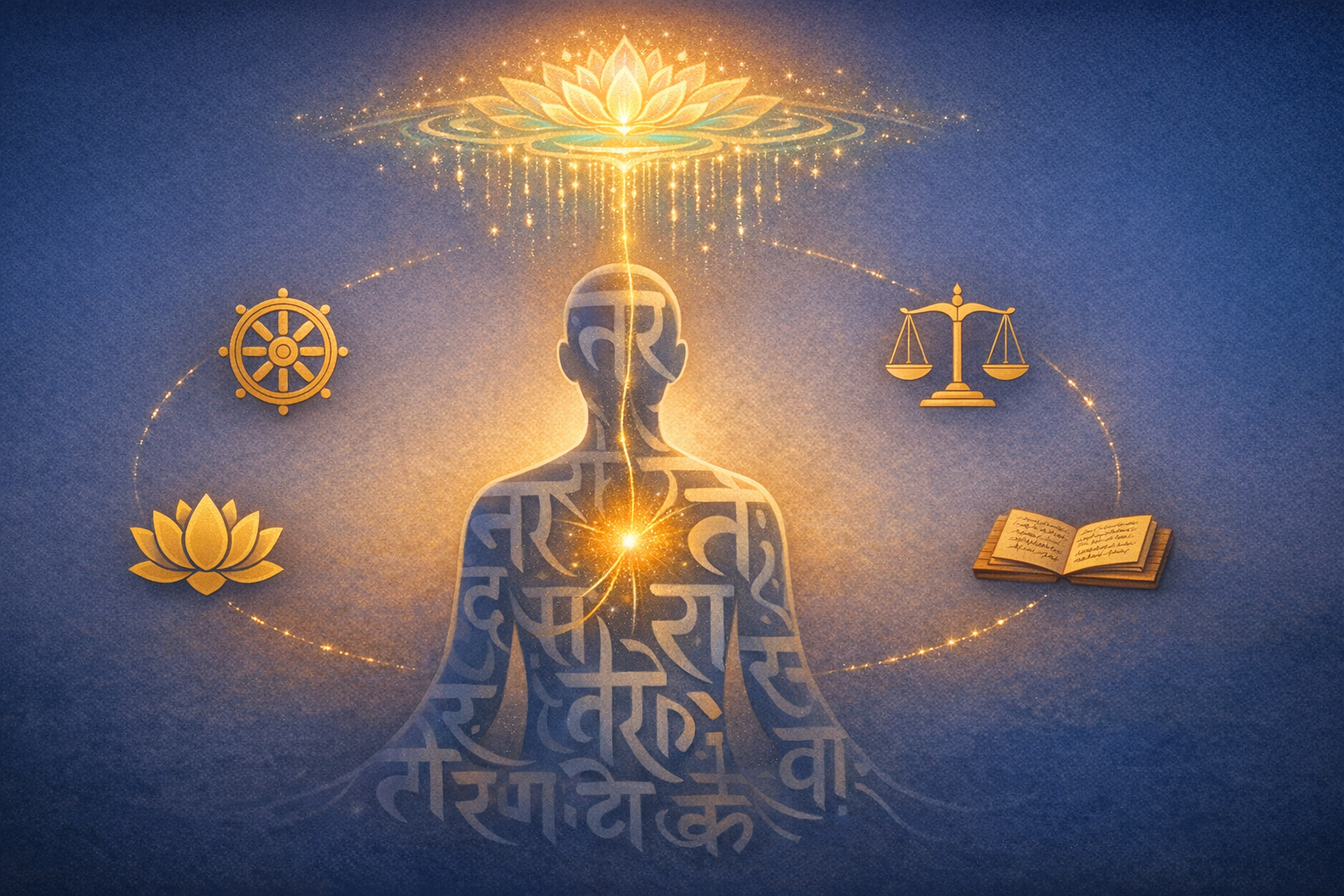
In Hinduism, the Sanskrit term “nara” names the human being in a way that is at once linguistic, scriptural, and philosophical. Far beyond a simple label, it crystallizes insights about agency, responsibility, and spiritual possibility under the twin pillars of dharma and karma. Understanding why humans are called nara clarifies how Hindu thought frames human life as uniquely capable of ethical choice and transformative realization.
Etymologically, nara derives from the ancient Indo-Aryan root nṛ/nara meaning “man, person,” well attested in the Vedic corpus and classical Sanskrit. Many philologists connect it to the Proto-Indo-European root *h₂ner- ‘man’, with close cognates in Avestan (nərə-) and Old Persian (nara-), and resonances with Greek anēr/andros. This deep linguistic lineage situates nara within a pan-Indo-European vocabulary of human identity.
In Sanskrit grammar, nara is formally masculine, yet in epic and philosophical registers it often functions generically for “human being.” Its feminine counterpart is nārī (“woman”), and the zero-grade stem nṛ appears in compounds such as nṛ-loka (“the human world”) and nṛ-pa (“protector of humans,” i.e., king). These usages show how nara underwrites a rich network of social, political, and ethical meanings.
Derived forms make the human reference explicit: narendra (“lord of humans”), narapati (“ruler of humans”), narottama (“best among humans”), and the theophoric Narasiṁha (“man-lion”), an avatāra of Viṣṇu. Such compounds keep the semantic core of nara visible in names, titles, and devotional vocabulary across time.
Classical Sanskrit also employs manuṣya and manuja for “human” (both linked to the culture-hero Manu), and puruṣa for “person,” ranging from an individual to the cosmic Person depending on context. Among these near-synonyms, nara typically highlights the situated, embodied agent who deliberates, acts, and bears consequences—precisely the locus where dharma and karma acquire lived meaning.
Scriptural usage reflects this emphasis. The Mahābhārata and Purāṇas repeatedly use nara to mark ethical responsibility, vulnerability, and possibility. In Dharmaśāstra and epic exhortations alike, formulae such as “a nara should act according to dharma” treat nara as the paradigmatic moral subject—the one for whom right conduct, social order, and spiritual goals are at stake.
Across the Itihāsa-Purāṇa tradition, the celebrated pair Nara–Nārāyaṇa embodies the abiding bond between the human seeker (nara) and the divine ground (Nārāyaṇa). Vaishnava interpretation further identifies Arjuna as Nara and Kṛṣṇa as Nārāyaṇa in the Mahābhārata, so that the teaching of the Bhagavad Gītā models an enduring companionship of human effort and divine guidance.
Traditional etymologies of Nārāyaṇa reinforce this relationship. One reading analyzes Nārāyaṇa as the “abode/refuge (ayana) of all beings (nārāḥ),” while another traces nārāḥ to the primordial waters. Either way, the human—nara—stands oriented to a sustaining source, grounding both ethical life and spiritual aspiration in a larger ontological horizon.
Philosophically, nara denotes a being endowed with buddhi (intelligence), icchā (intention), and kartṛtva (agency). These faculties yield adhikāra—the fitness to undertake dharma—and explain why human birth is consistently praised as rare and precious. The human capacity for discernment (viveka) and steadiness (dhṛti) renders life a field for growth rather than mere survival.
Within Hinduism’s doctrine of karma—the moral law of cause and effect governing intentional action—nara carries distinctive responsibility. Classical accounts often distinguish sañcita karma (the accumulated stock), prārabdha karma (the portion now fructifying), and kriyamāṇa or āgāmi karma (new actions shaping the future). Because a nara can reflect and choose, present conduct can mitigate prārabdha’s impact and create more auspicious conditions ahead.
These dynamics are legible in everyday life: honesty builds trust and opens opportunities; cruelty erodes relationships and rebounds as suffering. Rather than a mechanical fatalism, karma can be understood as an educative feedback loop—one through which nara gradually aligns intention, action, and outcome with dharma.
Guidance for this alignment is abundant. The yamas and niyamas in Yoga set ethical and personal disciplines; the four puruṣārthas (dharma, artha, kāma, mokṣa) organize life’s aims; and the Bhagavad Gītā integrates karma-yoga, jñāna-yoga, and bhakti-yoga into a coherent path. These frameworks help the human agent move from right action to liberating insight and devotion.
Correspondingly, texts praise the naradeha—the human embodiment—as especially suited to mokṣa. The widely echoed sentiment “durlabhaṁ mānuṣaṁ janma” (human birth is difficult to obtain) urges purposeful practice over drift, reminding that the window for transformation is finite and valuable.
This focus on the human agent resonates across the wider dhārmic family. In Buddhism, Pāli and Sanskrit sources speak of the human realm (manussa, nara) as the optimal plane for cultivating sīla (ethics), samādhi (concentration), and paññā/prajñā (wisdom), with karma (kamma) shaping saṁsāric continuity. Despite differences regarding selfhood, intentional ethics remains central.
Jain philosophy similarly underscores the human state as the prime opportunity for samvara (stoppage of karmic influx) and nirjarā (shedding of karma), guided by ahiṁsā and anekāntavāda (many-sidedness). Here, too, nara/nārī as moral agents interact with karma—conceived in Jainism as fine matter—to free the jīva from bondage.
Sikh teachings affirm the dignity and responsibility of the human (manukh) under Hukam (the divine order), integrating karma with grace. Through nām-simran, kirat karo, and vand chhako, the human journey becomes disciplined, service-oriented, and communally grounded. Across Hinduism, Buddhism, Jainism, and Sikhism, ethical intentionality is a shared cornerstone, even amid distinct metaphysical vocabularies.
Symbolically, the avatāra Narasiṁha places nara within a vision of balanced strength: human courage mobilized to protect dharma, tempered by compassionate restraint. The image suggests that human possibilities bloom when instinct and reason, power and mercy, interpenetrate in right measure.
In contemporary culture, the nara lexeme persists in personal names and honorifics—Narendra, Nārāyaṇa, Narottama—quietly reminding communities that leadership, devotion, and excellence are measured against ideals of humane conduct. Revisiting the semantic heart of nara can recentre public ethics on responsibility, empathy, and long-term consequence.
Usage also merits clarity: although grammatically masculine, nara in moral and philosophical contexts functions inclusively for “human being.” The paired form nara-nārī explicitly acknowledges both men and women, while the broader discourse consistently valorizes universal human capacity for discernment and liberation.
In sum, nara operates on three interwoven planes: linguistic (a venerable Indo-Aryan word for “human”), scriptural (a persistent marker of ethical agency across Veda–Purāṇa–Itihāsa), and philosophical (the bearer of dharma and karma, capable of mokṣa). Recognizing this triad not only explains why humans are called “nara” in Hinduism; it also highlights a shared civilizational insight—common to Hinduism, Buddhism, Jainism, and Sikhism—that the human vocation is to turn freedom into wisdom and compassion.
Inspired by this post on Hindu Blog.