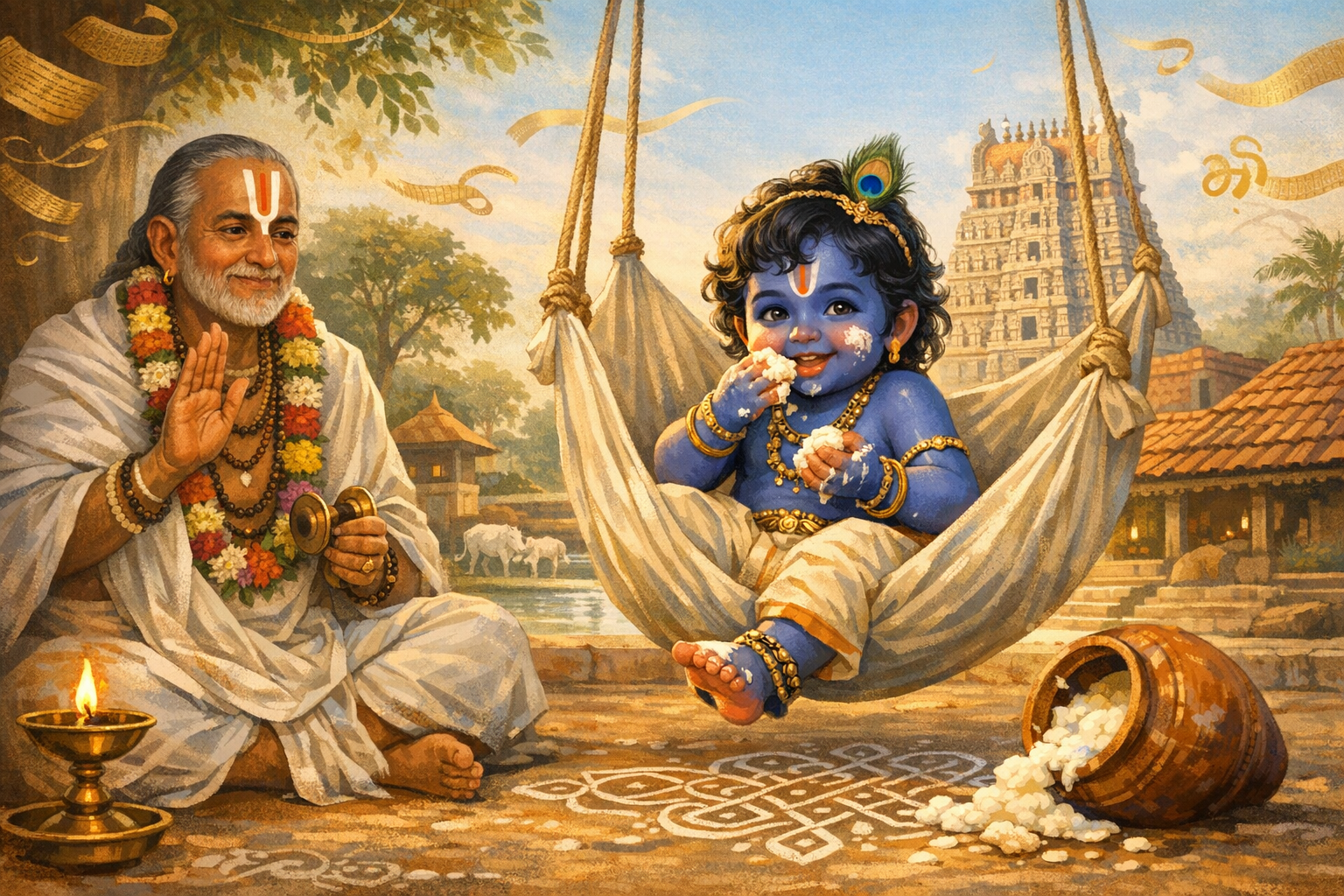
Across the subcontinent, the cradle-songs of Bāla-KṛṣṇaKrishna as a mischievous, butter-smeared childremain among the most cherished images of devotion. While many associate these tender scenes with the celebrated Braj poetry of Surdas, the thematic cradle of this devotion in a sustained vernacular form is found earlier in South India, in the Tamil corpus of the Āḻvar saints, most prominently Periyāḻvār.
The Āḻvars (literally “those immersed” in the divine) composed an extensive Tamil devotional canon between roughly the 6th and 9th centuries CE, now revered as the Nālāyira Divya Prabandham. Writing in a refined vernacular centuries before many North Indian bhakti luminaries, they articulated an intimate, emotionally layered devotion to Viṣṇu and Kṛṣṇa that set durable patterns for later pan-Indic bhakti.
Within this constellation, Periyāḻvār (traditionally identified with Viṣṇucitta of Śrīvilliputtūr, c. 8th–9th century CE, though exact dating remains debated) stands out for foregrounding vātsalya-bhāvathe mood of parental lovetoward the divine. His works, notably Tiruppallāṇḍu and Periyāḻvār Tirumoḻi, present the Lord not only as the cosmic protector but also as the child one longs to cradle, scold, feed, and bless.
Periyāḻvār’s Tiruppallāṇḍu opens with a striking inversion: rather than pleading for protection from the deity, the devotee pronounces an auspicious benediction upon the Lord“many years” to the divine. This rhetorical reversal collapses distance between human and divine, making affective proximitynot metaphysical hierarchythe axis of devotion. Theologically, such a move naturalizes intimacy and sets the stage for the child-Krishna theme to flourish.
In Periyāḻvār Tirumoḻi, Krishna’s infancy and boyhood are rendered with vivid, domestic immediacy: anklets tinkling as the child crawls across courtyards; hands perfumed with churned butter; a face streaked with curd; and the playful transgressions that provoke Yashodā’s mock-scolding. These scenes are not ornamental. They are vehicles for a pedagogy of love, where ultimate reality is encountered in the rhythms of care, correction, nourishment, and play.
Poetically, the Tamil craft heightens this intimacy through sensuous detail, deft simile, and cadences that echo lullabies and work-songs. The tonal palette toggles between wonder and worryanxious, protective love that blesses the Lord against imagined harm, and delighted awe at a divinity who allows such closeness. In this aesthetic, bhakti is not only a doctrine; it is a household practice of attention.
The child-Krishna strand in Periyāḻvār is intertextually anchored in older Sanskrit narratives. Harivaṃśa and the Bhāgavata Purāṇa (Skandha 10) already recount the Lord’s infancy and boyhood. Yet the Āḻvars offer one of the earliest and most sustained vernacular elaborations of these lilās in the subcontinent, prefiguring later North Indian emphasis while retaining a distinctively Tamil domestic ethos.
The South–North flow should be read as a dynamic conversation rather than a contest. Sri Vaiṣṇava theology and temple liturgy, especially from the time of Rāmānuja (11th–12th centuries), elevated the Tamil Divya Prabandham to parity with the Sanskrit Veda in lived practice. Recitations during the Ādhyayanotsavam and other festivals institutionalized these poems, allowing their moods, images, and meters to circulate widely via pilgrim, monastic, and mercantile networks.
Material culture reinforces this diffusion. Chola-period bronzes of Navanīta Kṛṣṇa (the butter-thief) and temple murals translate Periyāḻvār’s intimacies into portable, visual devotion. In performance traditionsfrom Tamil Bhāgavata Mela to later Kathak and RāslīlāBāla-Kṛṣṇa’s playfulness acquires theatrical body, ensuring that textual rasa becomes shared, sung experience.
By the 15th–16th centuries, North Indian bhakti in Braj Bhāṣā reaches a brilliant flowering. Surdas, within the Vallabha (Puṣṭimārga) Vaiṣṇava stream, renders Krishna’s childhood with unsurpassed sweetness, giving the subcontinent durable idioms of maternal scolding, complaints about stolen butter, and tender exculpations by playmates. The Sur Sāgar’s Bal-līlās, though fluid across manuscripts and oral recensions, consolidate a sensibility long nurtured in earlier Tamil and Sanskrit sources.
Rasa theory helps situate these developments. Later Gaudiya authors, especially Rūpa Gosvāmin in Bhakti-rasāmṛta-sindhu, systematize bhakti’s relational moodsśānta, dāsya, sakhya, vātsalya, and mādhurya. Periyāḻvār’s corpus anticipates this taxonomy on the ground, centering vātsalya as a primary devotional grammar and thereby normalizing theologically what would soon be codified aesthetically.
Crucially, this “South before North” chronology is not a hierarchy but a map of reciprocal enrichment. Tamil poets give the subcontinent an early, vernacular, affect-rich template for encountering the divine as child. Sanskrit purāṇic narratives supply pan-Indic mythic scaffolding. North Indian bhakti then elaborates these moods into mass devotional practice through kīrtan, pilgrimage circuits, and temple networks. Each region energizes the others.
The social consequences of this devotional grammar were profound. By locating ultimate truth in household texturesfeeding, tending, lullabyingbhakti displaced purely scholastic or courtly access to the sacred. The Āḻvars themselves come from diverse social locations, signaling a widening spiritual commons that later sants and poets across the subcontinent would deepen in their own vernaculars.
These currents converse fruitfully with other dharmic traditions as well. Jain communities celebrate Janma Kalyāṇaks with stavan and song that cherish the infancy of Tīrthaṅkaras as moments of cosmic hope. Buddhist devotional cultures across Asia sing cradle-like hymns to Bodhisattvas endowed with boundless compassion. Sikh kīrtan, while aniconic and non-idolatrous, suffuses the Name with familial tenderness; the Gurus repeatedly honor Hari, Govind, and the compassionate Protector in modes that welcome everyday love into the highest devotion. The shared thread is clear: all four traditions valorize a direct, heart-centered relationship with the sacred that dignifies ordinary life.
For many families todayacross Tamil, Braj, Bengali, Marathi, and other linguistic worldsthe child-Krishna idiom remains an entryway for children and elders alike. Bedtime tales of butter thefts, festive cradling of the Lord during Janmāṣṭamī, and seasonal singing from Tiruppāvai to Rāslīlā sustain a transgenerational pedagogy where delight, discipline, and devotion reinforce one another.
At the level of literary history, Periyāḻvār’s achievement is thus double. He gives a Tamil poetics of the intimate divinemetered, image-rich, and performable. And he stabilizes a theological paradox at bhakti’s core: the omnipotent becomes willingly vulnerable, so that love, not awe, is the highest knowing. The child, not the conqueror, becomes the exemplary revelation.
Reading Periyāḻvār alongside Surdas yields further insight. Both imagine a mother’s voice that overflows into the devotee’s voice, collapsing aesthetic distance. Both normalize divine transgression as a tutor of compassion. Yet the textures differ: Tamil domesticity leans into protective blessing (pallāṇḍu), while Braj play foregrounds village gossip, complaint, and defense. Together they offer a rounded phenomenology of loveconcern and play, benediction and tease.
Chronology invites careful nuance. Child-Krishna narratives predate both poets in pan-Indic Sanskrit. What the Āḻvars contribute is an early, sustained vernacularization of those narratives, embedding them in regional meters, household idioms, and temple liturgy. In this sense, South India becomes the “cradle” where an accessible, intimate bhakti grammar is incubated and then shared widely.
The transmission mechanisms were concrete. Temple recitation lineages (ārāyars), itinerant singers, merchant guilds, and scholastic exchanges linked Kaveri basin shrines with western Indian ports and the Gangetic plain. As these circuits matured, child-Krishna devotion accrued new melodies, dialects, and iconographies, adapting to local foodways, festivals, and family structures while conserving core emotional truths.
Aesthetically, the child-Krishna idiom democratizes sanctity. It authorizes laughter in worship and permits caregivers to recognize their labor of love as theology in action. The butter bowl becomes an altar; the cradle, a sanctum; the lullaby, a liturgy. This reframingemergent in Periyāḻvār, amplified in Surdasremains one of the subcontinent’s most inclusive spiritual gifts.
For contemporary readers and listeners, the enduring appeal lies in its dialog with everyday emotions. Worry, tenderness, pride, and exasperation are not suppressed but transfigured. In this register, devotion is psychologically honest and relationally capacious, a mode as suited to a crowded urban kitchen as to a sanctum’s hush.
Finally, seen through a dharmic-unity lens, the story is larger than any one tradition. A shared civilizational wisdomacross Hindu, Buddhist, Jain, and Sikh lineagestrusts that the sacred meets persons where they live: in song, care, and ethical relationships. That is the deeper continuity the child-Krishna idiom illuminates, even for communities that neither image the divine nor narrate these specific lilās.
The historical claim can thus be stated with clarity and generosity. Long before the great bhakti poets of North India gave the world their celebrated verses, Tamil Āḻvarsespecially Periyāḻvārhad already lit the flame of personal, passionate devotion to Viṣṇu and Kṛṣṇa in an intimate, domestic key. Later North Indian traditions received, reframed, and magnificently expanded this inheritance. The result is a pan-Indic devotional ecology in which love leads, language serves, and households become sanctuaries.
In tracing the arc “from Tirumoḻi to Surdas,” one encounters less a sequence of replacements than a widening confluence. Text, temple, and tune collaborate across regions and centuries to keep the cradle of devotion gently rockingreminding all that the play of the Divine Child is the schooling of the human heart.
Inspired by this post on Hindu Blog.