
In Hindu thought, the question of sexual pleasure is not treated merely as a biological curiosity. It is placed inside a far larger philosophical frame: the movement of beings through birth, desire, attachment, action, consequence, death, and rebirth. The provocative claim that humans would not have procreated without sexual pleasure becomes meaningful only when read through this wider understanding of samsara, dharma, karma, and moksha.
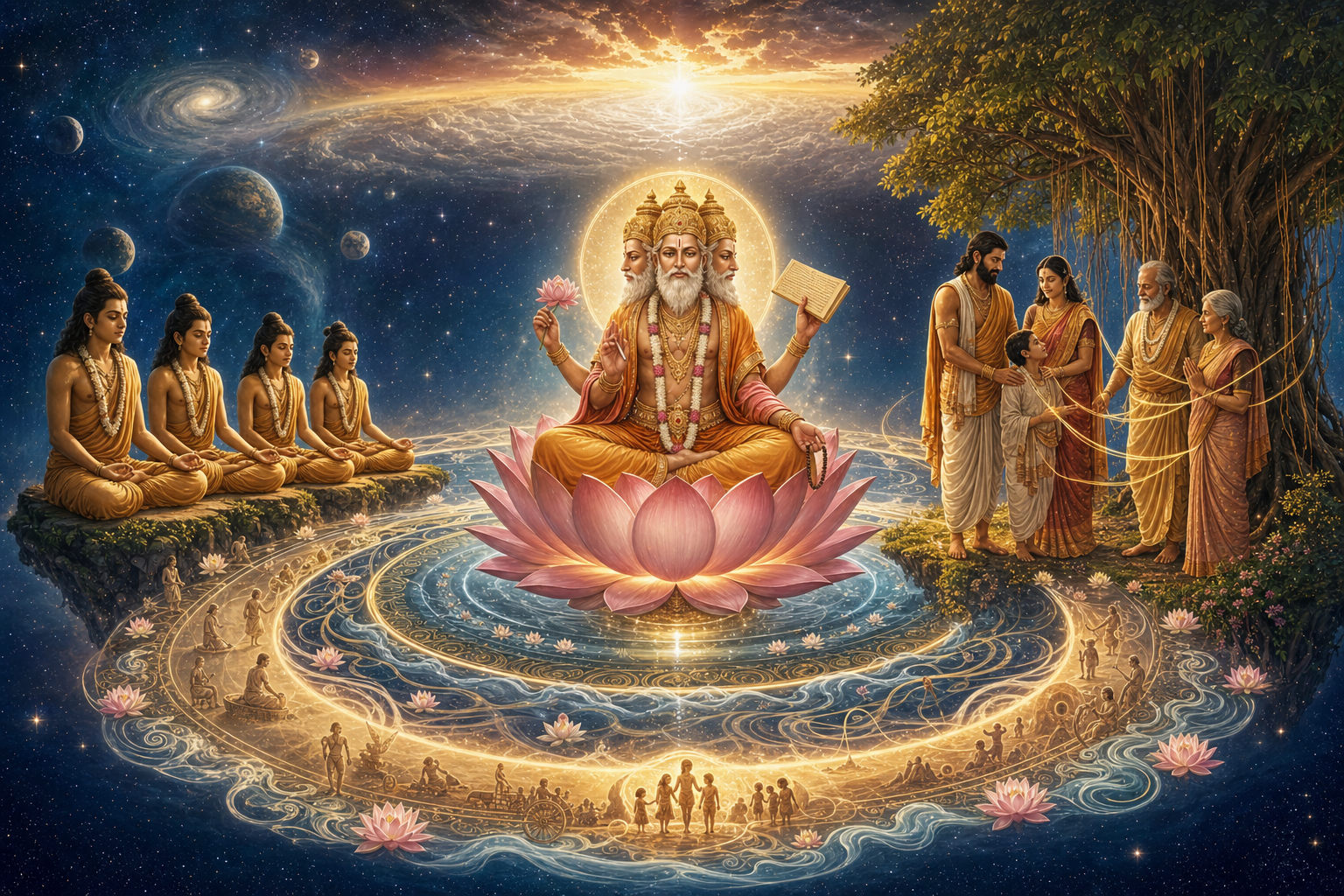
The Puranic imagination begins with a striking problem. Brahma, the creator, brings forth beings, but the first beings do not immediately accept the task of multiplying the world. Creation exists, yet continuity hesitates. Life has appeared, but life does not automatically bind itself to reproduction. This hesitation is crucial because it reveals a profound Hindu insight: embodiment alone does not guarantee attachment to embodied life.
Several Hindu scriptures describe Brahma producing mind-born sons, sages of great spiritual clarity, who are asked to extend creation. Among the most famous are the Kumaras: Sanaka, Sanandana, Sanatana, and Sanatkumara. These beings are not driven by ordinary worldly ambition. They are associated with knowledge, renunciation, and spiritual insight. When asked to participate in procreation, they refuse, choosing the path of tapas, brahmacharya, and liberation instead of worldly multiplication.
This refusal is not an act of rebellion in the modern political sense. It is a metaphysical refusal. The sages understand that birth brings entanglement. To be born is to enter a field of hunger, memory, pleasure, pain, identity, longing, obligation, and decay. For one who has already glimpsed the higher truth, the cycle of reproduction may appear less like a duty and more like a continuation of bondage. Their choice represents the path of nivritti, the inward movement away from worldly expansion and toward moksha.
Brahma’s difficulty, therefore, is not simply administrative. It is philosophical. If the highest beings choose liberation over multiplication, how will the universe continue? If consciousness naturally inclines toward freedom when it understands the nature of samsara, what will persuade embodied beings to remain invested in life, family, offspring, social order, and future generations?
Hindu tradition answers this question with remarkable realism. Desire becomes one of the forces through which creation sustains itself. Sexual pleasure, attraction, emotional bonding, family affection, and the longing for continuity all become woven into the fabric of worldly life. This does not mean that Hinduism reduces human existence to desire. Rather, it recognizes that desire is one of the mechanisms through which prakriti moves beings into action.
The Sanskrit term kama is central here. Kama is often translated as desire, pleasure, or sensual enjoyment, but in the classical Hindu framework it is not automatically sinful. It is one of the four purusharthas, the recognized aims of human life, along with dharma, artha, and moksha. This classification is important. Hindu philosophy does not demand that ordinary householders despise pleasure. It asks that pleasure be disciplined by dharma, balanced with responsibility, and ultimately understood in relation to spiritual freedom.
This is where Hindu thought differs from both crude indulgence and crude rejection. Pleasure is not treated as the supreme purpose of life, but neither is it dismissed as meaningless. It is powerful, necessary, dangerous, binding, creative, and educative. It can build families, generate affection, preserve lineages, and support social order. It can also deepen attachment, intensify ego, and keep beings revolving within samsara.
The householder stage, or grihastha ashrama, shows this balance clearly. Hindu dharma does not imagine society as sustained only by renunciates. The grihastha supports children, elders, guests, students, ascetics, rituals, charity, and social continuity. Without householders, the other ashramas cannot function. Therefore, procreation within dharma is not treated as a fall from spirituality; it is treated as a necessary and sacred responsibility for those called to that path.
At the same time, the stories of the sages preserve an uncomfortable truth. If every being possessed complete detachment, worldly reproduction would lose its urgency. The desire for offspring depends, in part, on identification with the body, lineage, name, memory, and future. The liberated sage has moved beyond these concerns. The ordinary person has not. The world continues because most beings remain touched by desire, affection, hope, fear, and incompleteness.
The Puranic accounts of Brahma, the mind-born sages, the Prajapatis, and later acts of creation should therefore be read as layered teaching stories. They are not merely mythological episodes about ancient personalities. They dramatize a tension that every thoughtful person can recognize: the pull between spiritual freedom and worldly participation. The human heart often wants both. It longs for transcendence, yet it also seeks companionship, intimacy, children, belonging, and continuity.
In this sense, sexual pleasure functions as part of maya, not because it is unreal in a simplistic sense, but because it makes the temporary feel compelling. Maya does not merely deceive; it gives form, color, urgency, and emotional intensity to existence. Through maya, the finite appears precious. A child, a spouse, a home, a lineage, and a social identity become deeply meaningful. These meanings are not worthless, but they are not ultimate.
The doctrine of samsara helps explain why Hindu scriptures speak so carefully about desire. Desire generates action, action produces karma, and karma shapes future experience. Sexual desire can produce birth, and birth becomes the doorway through which the jiva re-enters embodied existence. Thus, pleasure is not isolated from metaphysics. It becomes one of the links in the chain that binds beings to repeated becoming.
Yet Hinduism does not make the simplistic claim that birth is only a curse. Human birth is also described as rare and precious because it offers the possibility of self-realization. The same embodied life that binds can also liberate. The senses may distract, but they may also be disciplined. Family may create attachment, but it may also teach sacrifice, service, patience, compassion, and responsibility. Dharma transforms ordinary life into a field of spiritual training.
This is why dharmic traditions contain both the renunciate ideal and the householder ideal. The Sanatana Dharma framework is broad enough to honor the sage who refuses procreation and the householder who raises children with discipline and devotion. The same civilizational wisdom also finds resonances in Buddhism, Jainism, and Sikhism, where desire, attachment, discipline, compassion, and liberation are examined with seriousness, though through different theological and philosophical languages.
Buddhist teachings analyze craving as a cause of suffering. Jain philosophy emphasizes restraint, non-attachment, and the purification of karma. Sikh tradition honors disciplined household life while warning against enslavement to lust, ego, and possessiveness. Hindu thought holds these insights within its own vocabulary of kama, dharma, samsara, and moksha. Together, the dharmic traditions remind humanity that desire must be understood, refined, and governed rather than blindly worshipped.
The emotional force of the Hindu story lies in its honesty. It does not pretend that people create families only through abstract duty. It recognizes that attraction, pleasure, tenderness, and longing are part of the human condition. Many readers can understand this from ordinary life. People rarely make life-altering commitments through philosophy alone. They are moved by love, desire, fear of loneliness, hope for continuity, and the deep wish to be remembered.
From a technical philosophical perspective, this insight can be described as the difference between biological reproduction and existential investment. A body may be capable of reproduction, but a person must still be drawn into the project of life. Sexual pleasure helps create that draw. Emotional attachment sustains it. Social dharma regulates it. Spiritual knowledge eventually questions it. This sequence explains why Hindu scriptures can speak of procreation as sacred while also treating renunciation as higher for those prepared for it.
The story also challenges modern assumptions. Contemporary culture often separates pleasure from responsibility, while puritanical systems sometimes separate spirituality from embodied life. Hindu philosophy resists both extremes. Kama without dharma becomes disorder. Dharma without compassion becomes rigidity. Renunciation without maturity becomes evasion. Household life without self-reflection becomes bondage. The tradition asks for discernment rather than slogans.
When the earliest sages refuse to multiply, they reveal the logic of liberation. When creation continues through desire and household life, it reveals the logic of samsara. Both are necessary to understand the Hindu worldview. The universe is not sustained by abstract principle alone; it is sustained by attraction, action, duty, ignorance, wisdom, sacrifice, and grace. Human life stands at the crossing of all these forces.
The claim that humans would not have procreated without sexual pleasure should therefore be understood as a theological and psychological observation, not as a crude reduction of human life. Pleasure is one of the incentives through which embodied beings accept the burdens of continuity. Without it, many would choose comfort, solitude, meditation, or liberation over the demanding labor of family life. With it, life renews itself, even as it remains bound to impermanence.
Hindu stories preserve this tension with unusual depth. They do not shame creation, but they do not romanticize bondage. They do not condemn pleasure, but they do not mistake it for freedom. They honor the householder, but they also bow to the renunciate. They allow human beings to see procreation as part of cosmic order while remembering that the final aim of life is not endless multiplication, but awakening.
In the end, the lesson is subtle and demanding. Desire keeps the world moving; wisdom shows where movement ends. Sexual pleasure draws beings into relationship, family, and continuity; dharma gives those bonds ethical form; spiritual insight reveals their limits. The Hindu understanding of samsara is powerful precisely because it includes all three truths at once: life is sacred, desire is binding, and liberation remains the highest horizon.
Inspired by this post on Hindu Blog.





Leave a Reply
You must be logged in to post a comment.