
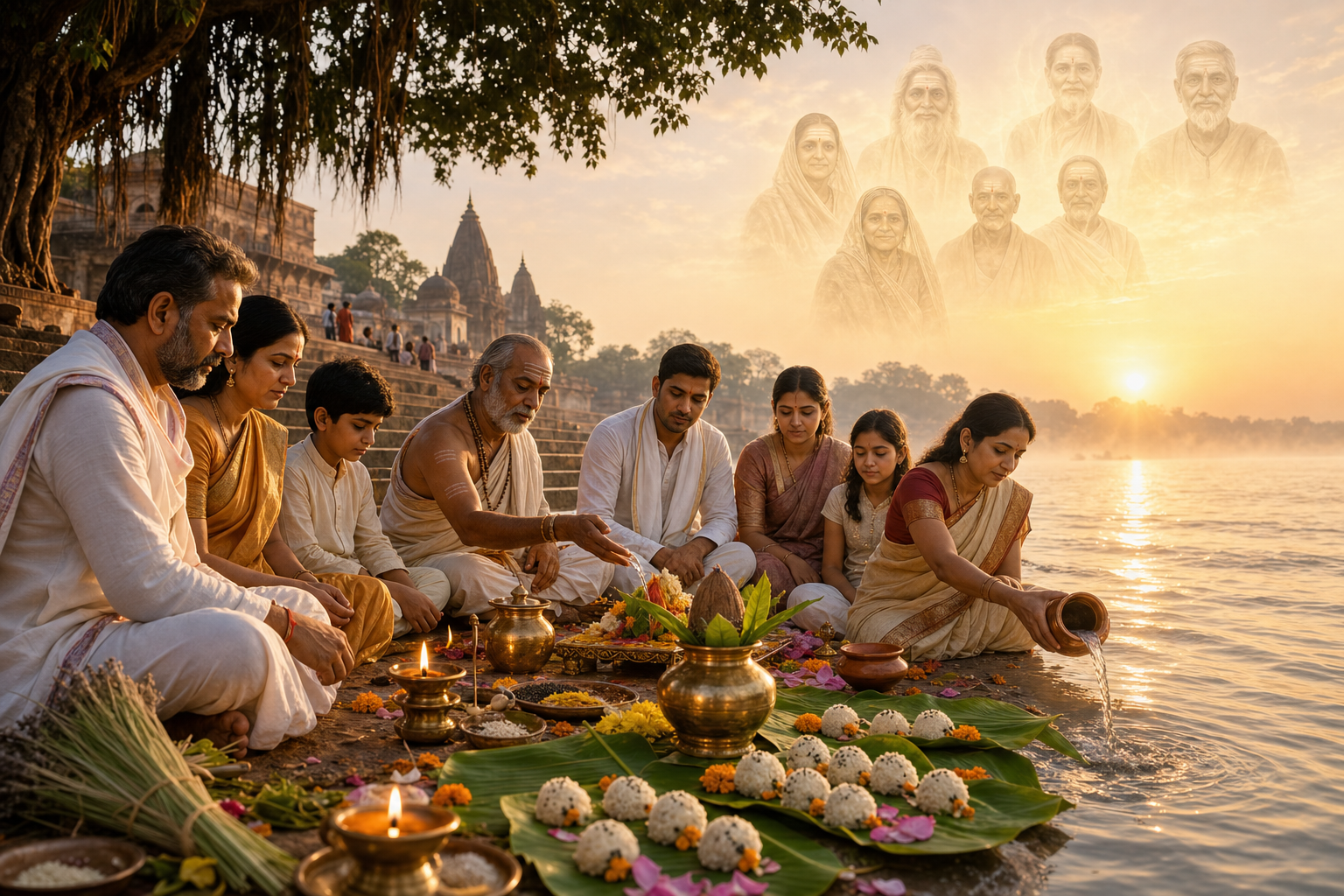
Sanghata Shraddha occupies a distinctive and deeply moving place within Hindu Dharma because it responds to one of the most painful realities of human life: the departure of many persons together. The Sanskrit word sanghata carries the sense of a group, collection, or coming together, while shraddha derives from shraddha, meaning reverent faith, sincerity, and heartfelt offering. Together, the term points to a sacred rite of collective remembrance performed when several departed beings are remembered through a shared ritual framework rather than through isolated observances alone.
In Hindu rituals connected with death, memory is never treated as a merely emotional act. It is also ethical, cosmological, and familial. Shraddha expresses the living person’s recognition that life is received through lineage, nourishment, culture, language, values, and unseen blessings. This is why the traditional idea of Pitru Rina, the debt owed to ancestors, remains central to the practice. The living do not stand alone; they stand within a stream of parents, grandparents, teachers, protectors, community elders, and unknown forebears whose lives made the present possible.
Sanghata Shraddha becomes especially relevant in situations where many people die in the same event, the same period, or under conditions where individual rites are difficult, delayed, incomplete, or impossible. Such circumstances may include natural disasters, epidemics, accidents, war, displacement, famine, community tragedy, or collective loss within a family. The rite gives the living a dharmic way to respond when grief is too large to be held by one household alone and when remembrance must expand from the personal to the communal.
The importance of this rite is not simply procedural. It affirms that no departed being should be left without reverence because of scale, confusion, social disruption, or the absence of complete information. In many families, the most painful question after sudden collective death is whether the departed received proper rites, prayers, and remembrance. Sanghata Shraddha answers that anxiety by placing compassion, intention, offering, and sacred discipline at the center of the response.
Classical Hindu thought understands death as a transition rather than an absolute severance. The body returns to the elements, but the subtle journey of the departed is treated with seriousness. Rituals such as antyeshti, pindadana, tarpana, and shraddha are traditionally understood as acts that support the onward movement of the departed soul and maintain harmony between the living family and the ancestral realm. Sanghata Shraddha stands within this wider ritual universe, but its emphasis falls on collective responsibility and collective healing.
In the Dharmashastra, Grihya Sutra, Purana, and regional ritual traditions, Shraddha is repeatedly associated with gratitude, food offering, water offering, mantra, dakshina, and remembrance. The details vary across sampradayas, regions, family lineages, and priestly traditions, but the underlying principles remain recognizable. The departed are honored, the ancestors are invoked, offerings are made with sincerity, and the living accept that continuity between generations must be preserved through dharma.
The emotional depth of Sanghata Shraddha lies in its refusal to reduce mass death into an abstraction. When many depart together, public language often speaks in numbers: casualties, victims, losses, totals. Hindu ritual language restores personhood. Each departed being is approached as someone who had a place in the web of relations. Even when names are unknown, the rite can be performed with inclusive intention, acknowledging all those who have left their bodies and seeking peace for their onward journey.
This is why collective remembrance has a powerful place in community life. A family may perform Sanghata Shraddha for relatives who departed in the same tragedy. A village, temple, trust, or dharmic institution may arrange it after a calamity that affected many households. In some cases, descendants may perform it for ancestors whose rites were interrupted by migration, conflict, poverty, or historical upheaval. The act is not driven by fear alone; it is shaped by reverence, restoration, and responsibility.
The ritual logic of Shraddha is often misunderstood in modern discourse because it is viewed narrowly as a ceremony for the dead. In a fuller dharmic reading, it is also a discipline for the living. It teaches humility before lineage, restraint before grief, generosity in memory, and a profound awareness that human life is interdependent. Food is offered because nourishment sustains the chain of life. Water is offered because water carries purity, continuity, and release. Mantra is recited because sound sanctifies intention and gives form to remembrance.
In Sanghata Shraddha, the collective dimension adds another layer. The rite reminds society that grief should not become isolated. A person may mourn a parent, child, spouse, teacher, or friend privately, but when many lives are lost together, dharma asks the community to gather, remember, and uphold one another. This collective act prevents memory from becoming fragmented and ensures that the departed are honored within a shared moral and spiritual field.
The usual elements associated with Shraddha may be adapted in Sanghata Shraddha according to local custom and guidance from a qualified acharya or purohit. These may include sankalpa, invocation of the departed and the ancestors, offering of water through tarpana, offering of pindas, recitation of mantras, feeding of Brahmanas or worthy recipients, charity, and prayers for peace. The sankalpa is especially important because it states the intention, the persons or group for whom the rite is performed, and the spiritual purpose of the observance.
Where individual names are known, they may be included. Where names are unknown, incomplete, or too numerous, the sankalpa may refer to the departed collectively. This point is crucial in the context of disasters, wars, or historical tragedies where records may be lost. Hindu Dharma gives deep importance to correct form, but it also recognizes intention, compassion, and the guidance of tradition. The living should not abandon remembrance simply because perfect information is unavailable.
Pindadana, when included, symbolizes nourishment and support for the departed. The pinda, generally formed from rice and other prescribed substances according to custom, is not merely a symbolic object. It represents the living family’s offering of care, continuity, and obligation. In a collective rite, pindas may be offered individually or collectively depending on the tradition followed. The exact method should be determined by the family’s parampara and competent ritual guidance.
Tarpana, the offering of water, carries equal significance. Water is among the most universal and sacred substances in Hindu rituals. It purifies, connects, and carries intention. When water is offered with mantra and reverence, the act becomes a disciplined expression of remembrance. In Sanghata Shraddha, tarpana can become especially moving because it allows the living to include many departed beings within one stream of prayerful offering.
Feeding and charity are also central to the spirit of Shraddha. The offering made to the departed is extended into the world through hospitality, dana, and care for living beings. This reflects a wider dharmic principle: remembrance should produce compassion. A family that honors its ancestors is also expected to uphold generosity, self-restraint, and service. In collective Shraddha, charitable acts may be directed toward the poor, students, monks, temple service, gau seva, community kitchens, or other worthy causes, depending on local tradition and capacity.
The timing of Sanghata Shraddha depends on context. Some rites may be connected to the immediate post-death period, while others may be performed on appropriate tithis, during Amavasya, during Pitru Paksha, or on anniversaries of collective tragedy. In practice, families and communities should consult their acharya because rules differ by region, sampradaya, and circumstance. The most responsible approach is to respect inherited tradition while also recognizing the compassionate purpose behind the rite.
Pitru Paksha deserves special mention because it is widely regarded as a sacred period for ancestral remembrance. During this fortnight, many Hindus perform Shraddha, tarpana, and related offerings for ancestors. Sanghata Shraddha performed during such a period may carry particular emotional and ritual significance, especially when a family wishes to include several departed relatives or remember those whose individual rites were not properly completed.
Yet Sanghata Shraddha should not be reduced to Pitru Paksha alone. Collective loss often arrives without regard for calendars. Dharma therefore balances sacred timing with compassionate necessity. When families face sudden tragedy, the first need is to perform the appropriate rites with steadiness, dignity, and guidance. Later observances may continue on annual tithis or during ancestral periods, allowing grief to be ritually integrated over time.
From a psychological and social perspective, the rite provides a structured language for grief. Modern society often struggles with collective mourning. Public memorials may be brief, institutional, or political. Sanghata Shraddha offers something different: embodied remembrance through water, food, mantra, fire, gesture, silence, and community presence. It allows sorrow to be expressed without chaos and reverence to be enacted without spectacle.
Many families know the quiet difficulty of unresolved mourning. A photograph remains garlanded, a name is spoken softly, an empty seat at a festival is noticed by everyone but explained by no one. Ritual does not erase grief, but it gives grief a sacred direction. In Sanghata Shraddha, this direction becomes collective. The sorrow of one household is held by the discipline of dharma and the support of the community.
The rite also preserves historical memory. Communities that have endured displacement, violence, famine, or epidemic often carry memories that are not fully recorded in books. Collective Shraddha can become a way of honoring those who suffered without turning remembrance into bitterness. This is especially important for a dharmic society committed to unity among Hinduism, Buddhism, Jainism, Sikhism, and other Indic traditions of ethical remembrance. The aim is not hostility toward any group; the aim is dignity for the departed and moral clarity for the living.
Across dharmic traditions, remembrance of the departed appears in different forms. Hindu Shraddha, Buddhist merit dedication, Jain prayers shaped by non-attachment and compassion, and Sikh remembrance through ardas and seva all express a shared civilizational sensitivity: the dead are not forgotten, and the living must respond with humility. The ritual forms differ, but the ethical center is similar. Memory becomes a path toward gratitude, compassion, and disciplined living.
This broader dharmic perspective is valuable because it prevents ritual identity from becoming narrow or divisive. Sanghata Shraddha is specifically rooted in Hindu ritual practice, yet its spirit can be understood within a larger Indic reverence for continuity, duty, and remembrance. It does not ask society to collapse all traditions into one form. It asks each tradition to honor its own path while recognizing the shared human need to mourn, bless, and remember.
There is also a theological subtlety in the concept of collective rites. Hindu Dharma recognizes both individuality and interdependence. Each jiva has its own karmic journey, yet no person lives entirely apart from family, society, nature, and the sacred order. Sanghata Shraddha reflects this balance. It honors the departed collectively without denying the uniqueness of each life. It recognizes shared destiny without erasing personal identity.
For this reason, the rite should be performed with care rather than mechanical haste. The external procedure matters, but the inner disposition matters equally. Shraddha without shraddha becomes empty form. The person performing the rite should cultivate purity of intention, gratitude, humility, and steadiness. Even when sorrow is intense, the ritual asks the living to act with composure, because composure itself becomes an offering.
Common misunderstandings should also be addressed. Sanghata Shraddha is not a substitute for all individual rites in every circumstance. Where individual antyeshti and Shraddha can be performed properly, they should not be neglected. Rather, Sanghata Shraddha is appropriate where collective remembrance is required, where multiple departed persons are to be honored together, or where circumstances have made separate rites difficult or incomplete. Its use should be guided by tradition, not convenience alone.
Another misunderstanding is that Shraddha is motivated by fear of ancestors. While some popular explanations emphasize appeasement, the deeper dharmic framework is rooted in gratitude and harmony. Ancestors are not treated as objects of superstition; they are honored as part of the sacred continuity of life. The rite acknowledges that the living have duties toward those from whom they have received existence, culture, and blessings.
It is also important to avoid turning ritual into social display. Sanghata Shraddha is most meaningful when conducted with dignity, simplicity, and sincerity. Lavish expenditure is not the measure of reverence. A modest rite performed with discipline, correct guidance, and genuine feeling carries greater dharmic value than a grand event driven by prestige. The essential elements are faith, remembrance, offering, and ethical conduct.
In contemporary life, many families live far from ancestral villages, family priests, and traditional ritual spaces. Migration has changed how rites are performed. Sanghata Shraddha may therefore be arranged in temples, homes, pilgrimage centers, community halls, or sacred riverbanks, depending on the circumstances. What matters is that the rite remains anchored in parampara and not reduced to a vague memorial service. The ritual grammar of Hindu Dharma should be preserved even when the setting changes.
Digital life has also changed memory. Condolences now appear on phones, photographs circulate online, and public grief may move quickly from one event to another. Sanghata Shraddha offers a needed counterbalance. It slows remembrance down. It asks people to sit, invoke, offer, listen, and share silence. In a world of rapid distraction, such ritual attention is itself a form of sacred resistance to forgetfulness.
The rite has particular relevance after collective tragedies because it can help communities move from shock toward responsibility. After the initial grief, questions often arise: how should the departed be remembered, how should families be supported, how should children understand the loss, and how should the community preserve dignity without remaining trapped in sorrow. Sanghata Shraddha does not answer every social question, but it establishes a sacred foundation for healing.
For younger generations, understanding Sanghata Shraddha can also open a wider appreciation of Hindu rituals. Many modern readers encounter ritual through fragments and assume it is merely inherited custom. A closer study reveals philosophical depth. Shraddha connects metaphysics with family duty, grief with generosity, memory with food, and personal sorrow with cosmic order. It is a practical theology enacted through the body and the community.
The concept of Pitru Rina is especially instructive here. Debt to ancestors does not mean bondage to the past. It means honest recognition that human freedom rests upon inherited gifts. Language, land, family stories, devotional practices, ethical habits, and cultural memory are not self-created possessions. They are received. Sanghata Shraddha becomes a way of returning gratitude when many lives must be remembered together.
This sense of gratitude should also shape how the living behave after the rite. The best offering to ancestors is not ritual alone but a life aligned with dharma. Truthfulness, compassion, care for parents and elders, protection of family harmony, service to society, and respect for sacred traditions all extend Shraddha into daily conduct. A person who performs the rite but lives without responsibility has missed its deeper teaching.
In many traditional households, ancestral remembrance is woven into ordinary life through Amavasya tarpana, annual Shraddha, festival offerings, and family stories. Sanghata Shraddha belongs to this larger culture of memory, but it becomes necessary when loss exceeds the ordinary rhythm. It allows a family or community to say, with ritual seriousness, that all who departed together remain held within sacred remembrance.
The rite also encourages humility before uncertainty. No living person fully knows the subtle journey of another being. Ritual does not claim to control that journey in a crude sense. Rather, it offers support through dharma, prayer, and intention. This humility protects the rite from dogmatism. Sanghata Shraddha should be approached as sacred service, not as an occasion for rigid judgment about the departed or their families.
Where different family branches, castes, sects, or communities are involved, sensitivity becomes essential. Collective rites should not become sites of hierarchy or exclusion. The dharmic spirit calls for order, but also compassion. When many have died together, the dignity of remembrance should take precedence over social vanity. The ritual should unite the living in reverence rather than divide them through secondary disputes.
This point is particularly important for a society seeking harmony across dharmic traditions. Hindu Dharma has always contained many sampradayas, regional practices, and philosophical schools. Buddhism, Jainism, and Sikhism have their own distinctive disciplines of memory, prayer, renunciation, seva, and ethical life. A mature dharmic culture does not flatten these differences; it honors them while cultivating shared respect. Sanghata Shraddha can be understood in that spirit of reverent plurality.
At the practical level, anyone considering Sanghata Shraddha should begin by clarifying the purpose of the rite. Is it being performed for family members who died together, for a community tragedy, for unknown departed persons, for ancestors whose rites were neglected, or for a historical remembrance? This clarity allows the sankalpa to be framed properly and prevents confusion in the ritual procedure.
The next step is to consult a qualified acharya, purohit, or trusted family tradition-bearer. Because Hindu rituals are not uniform across all regions, local practice matters. What is appropriate in one tradition may differ in another. The role of the ritual guide is not merely to recite mantras but to align intention, timing, materials, offerings, and procedure with dharma.
Families should also prepare inwardly. The rite is not only an event to be scheduled. It asks participants to enter a state of reverence. Cleanliness, simplicity of dress, mental steadiness, avoidance of frivolity, and a spirit of forgiveness can all support the sanctity of the observance. When children are present, elders may gently explain that the rite is an expression of gratitude and love for those who have departed.
After the ritual, remembrance should continue in wholesome ways. Families may preserve names, stories, photographs, charitable commitments, or annual observances. Communities may maintain memorial days, educational activities, or acts of seva. In this way, Sanghata Shraddha does not end at the ritual site. It becomes the beginning of a more disciplined culture of memory.
The enduring relevance of Sanghata Shraddha lies in its ability to hold together theology, grief, community, and ethics. It teaches that the departed are not to be forgotten, that the living are not helpless before sorrow, and that collective loss requires collective reverence. In a time when human life is often measured statistically, this rite restores sacred particularity and communal responsibility.
Ultimately, Sanghata Shraddha is a profound expression of Hindu spirituality and cultural continuity. It does not deny grief; it sanctifies it. It does not erase tragedy; it places tragedy within the wider order of dharma, remembrance, and compassion. When many depart together, the living gather not only to mourn but to offer, to remember, to heal, and to reaffirm the sacred bond between generations.
Inspired by this post on Hindu Blog.
