Tag: Hindu Stories

  • Again Become Mouse: A Powerful Bhagavatam Parable on Ego, Desire, Fear, and True Growth

    Again Become Mouse: A Powerful Bhagavatam Parable on Ego, Desire, Fear, and True Growth

    This essay retells the widely shared Bhagavatam parable “Again become mouse” and analyzes its enduring relevance for self-assessment. It shows how external upgrades without inner transformation intensify fear, inflate ego, and erode gratitude. Drawing on Srimad Bhagavatam’s ethical psychology—and resonances from Buddhism, Jainism, and Sikhism—it proposes an integrative, dharmic path where power follows purification. Readers…

  • Acharya Periyavachanpillai and the ‘Dull-Headed’ Disciple: When Guru’s Grace Unlocks Genius

    Acharya Periyavachanpillai and the ‘Dull-Headed’ Disciple: When Guru’s Grace Unlocks Genius

    This essay explores a classic Sri Vaishnava teaching story—Acharya Periyavachanpillai guiding a so-called “dull-headed” devotee—to illuminate how Guru’s Blessings align with disciplined effort to unlock understanding. It situates the episode within the Ramanujacharya lineage, drawing out doctrinal themes such as śabda-pramāṇa, bhakti, and prapatti. It then shows how mantra, seva, and structured study purify the…

  • From Boulder to Breakthrough: How Obstacles Become Opportunities in Dharmic Practice

    From Boulder to Breakthrough: How Obstacles Become Opportunities in Dharmic Practice

    A timeless parable about a king, a boulder, and a hidden reward demonstrates how initiative and service turn obstacles into opportunities. Interpreted through dharmic lenses—Hinduism, Buddhism, Jainism, and Sikhism—the story converges on ethical action (dharma), selfless service (seva), and resilient optimism (chardi kala). The analysis links Karma Yoga and mindful effort with modern research on…

  • The Donkey’s Silence at Krishna’s Birth: Textual Evidence, Folk Memory, and Sacred Symbolism

    The Donkey’s Silence at Krishna’s Birth: Textual Evidence, Folk Memory, and Sacred Symbolism

    A widely told folk variant claims a donkey brayed during Devaki’s earlier births yet fell silent at Krishna’s birth—sometimes after Vasudeva’s quiet prayer that no sound betray the child. Canonical sources such as the Bhagavata Purana and Harivamsa do not mention a donkey, focusing instead on a divinely wrought hush: chains loosened, doors opened, and…

  • Tripura’s Death-Reviving Nectar and Shiva’s Cosmic Arrow: Power, Ethics, and Dharmic Unity

    Tripura’s Death-Reviving Nectar and Shiva’s Cosmic Arrow: Power, Ethics, and Dharmic Unity

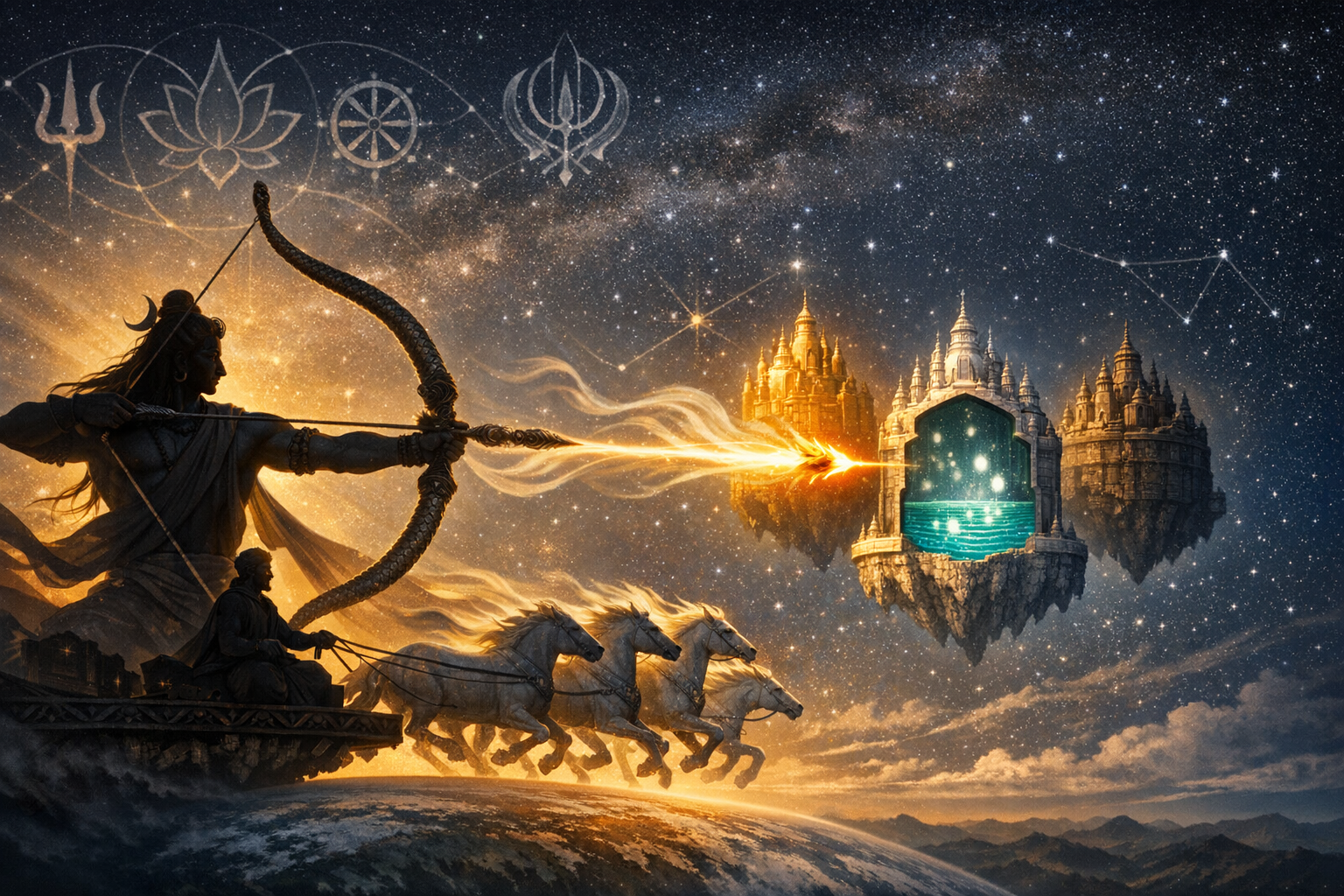
    This long-form, research-informed retelling examines the Purāṇic episode of Tripura, three mobile fortresses granted by Brahma to the asura brothers and sustained by a sacred reservoir of death‑reviving nectar. It outlines how Shiva’s single cosmic arrow—released at a rare celestial alignment—resolved a conflict made otherwise insoluble by continual revivification. Drawing on Shiva Purana, Linga Purana,…

  • Oppiliappan Temple’s Sacred Vow: Vishnu’s Marriage to Bhumi Devi and the Saltless Offering

    Oppiliappan Temple’s Sacred Vow: Vishnu’s Marriage to Bhumi Devi and the Saltless Offering

    Oppiliappan Temple at Thiruvinnagar near Kumbakonam enshrines Vishnu’s sacred marriage to Bhumi Devi and preserves a distinctive liturgical vow: all offerings are prepared without salt. This long-form study situates the temple among the 108 Divya Desams, explains the Markandeya-based sthala-purāṇa, and interprets the saltless naivedyam as a pedagogy of grace, humility, and ecological restraint. It…

  • Shiva Purana Timeless Tales: Daksha Yajna, Markandeya’s Grace, Neelakantha’s Compassion

    Shiva Purana Timeless Tales: Daksha Yajna, Markandeya’s Grace, Neelakantha’s Compassion

    This in-depth exploration of the Shiva Purana presents three profound narratives—Daksha Yajna and Sati, Markandeya’s deliverance through Mrityunjaya grace, and Shiva as Neelakantha during the Samudra Manthana—set within their textual, historical, and philosophical contexts. It clarifies how Puranic storytelling operates as both scripture and contemplative guide, uniting ritual, devotion, and ethics. Readers gain a nuanced…

  • Devaki’s Six Sons and Krishna’s Grace: The Harivamsa Tale of Curse, Karma, and Redemption

    Devaki’s Six Sons and Krishna’s Grace: The Harivamsa Tale of Curse, Karma, and Redemption

    This long-form exploration synthesizes Harivamsa, Mahabharata, and Purana traditions to explain why Devaki’s first six sons were slain by Kamsa and how Krishna’s grace ultimately redeemed them. Readers gain a clear map of the narrative’s variants, from the Shadgarbha’s primordial transgression and curse to their rebirth in Mathura and liberation after Kamsa’s fall. The essay…

  • Srirangam’s Divine Design: How Lord Ranganatha Chose Kaveri as His Eternal Abode

    Srirangam’s Divine Design: How Lord Ranganatha Chose Kaveri as His Eternal Abode

    Sri Ranganathaswamy Temple at Srirangam is celebrated as Bhooloka Vaikuntham, where architecture, theology, and ritual converge around Lord Ranganatha’s divine choice to reside by the Kaveri. Drawing on Skanda Purana’s Sriranga Mahatmyam, temple chronicles, and Alvar hymns, this comprehensive account explains how the murti traveled from Vaikuntha to Ayodhya and, through Vibhishana, found a permanent…

  • Why Kamsa Spared Devaki and Vasudeva: Prophecy, Pitru Dosha, and the Tyrant’s Dilemma

    Why Kamsa Spared Devaki and Vasudeva: Prophecy, Pitru Dosha, and the Tyrant’s Dilemma

    A prophecy at a wedding foretells that Devakī’s eighth son will slay Kamsa, forcing the tyrant into a chilling moral and political calculus. Drawing on the Bhagavata Purana, Dharmashastras, and later Jyotisha-based exegesis, the analysis explains why Kamsa kept Devakī and Vasudeva together rather than separate them. The prophecy’s literal wording, fear of grave sins…

  • When a Republic Fell: Kamsa’s Coup, Mathura’s Sudharma, and the Price of Lost Dharma

    When a Republic Fell: Kamsa’s Coup, Mathura’s Sudharma, and the Price of Lost Dharma

    Mathura’s fall from republican equilibrium to Kamsa’s tyranny illustrates how coups dismantle not only rulers but also institutions such as the Sudharma council that once mediated power through counsel and custom. Drawing on the Bhagavata Purana, Vishnu Purana, Harivamsa, and the Arthasastra, the narrative analyzes the mechanics of usurpation, alliance with Magadha, and the militarization…

  • Sahasramukharavana’s Fierce Tapas: Decoding the Thousand-Headed Ravana’s Cosmic Power

    Sahasramukharavana’s Fierce Tapas: Decoding the Thousand-Headed Ravana’s Cosmic Power

    Sahasramukharavana, the thousand-headed Ravana, expands the Ramayana’s ethical and metaphysical concerns through the language of tapas, number symbolism, and cosmic sovereignty. The figure is situated in later and regional narrative ecologies, where a thousand heads and two thousand hands encode cognition and agency magnified to the edge of hubris. Anchored in the wider Indic use…

  • Kapal‑Muni in Bhagat Maalaa: Unifying Hindu, Buddhist, Jain, and Sikh Wisdom Today

    Kapal‑Muni in Bhagat Maalaa: Unifying Hindu, Buddhist, Jain, and Sikh Wisdom Today

    This article examines the Kapal‑Muni motif within the broader Bhagat Maalaa/Bhaktamal tradition as a didactic lens on impermanence, ego, and compassion. It clarifies how skull‑cup symbolism functions ethically rather than sensationally, inviting readers to privilege inner transformation over outward austerity. The discussion surveys convergences and distinctions across Hindu Śaiva and Vaishnava currents, Sikh teachings centered…

  • Why Bathing Women Hid from Vyasa but Not Shuka: A Deep Dive into Gaze, Purity, and Dharma

    Why Bathing Women Hid from Vyasa but Not Shuka: A Deep Dive into Gaze, Purity, and Dharma

    A classic Hindu teaching story contrasts how women bathing in a pond responded to Vyasa and to his son Shuka, and it reveals a layered ethic of consciousness and context. The narrative illustrates how a jivanmukta’s non-objectifying gaze fosters ease, while a revered householder’s presence naturally elicits social modesty. Read through Advaita, bhakti, and yoga…

  • 15 Timeless Tales from Srimad Bhagavatham: Devotion, Dharma, and Transformative Wisdom

    15 Timeless Tales from Srimad Bhagavatham: Devotion, Dharma, and Transformative Wisdom

    Srimad Bhagavatham (Bhagavata Purana) unites devotion, wisdom, and ethical action through narratives that are as practical as they are profound. This long-form guide curates 15 celebrated tales—from Dhruva’s tapas and Prahlada’s fearlessness to Ambarisha’s forbearance and Krishna’s Govardhan-lila—each situated in its Skandha context. Readers gain both narrative clarity and theological depth, including the power of…

  • Ravana, Ganesha, and Shiva’s Atmalinga: Decoding the Gokarna Legend, Symbolism, and Dharma

    Ravana, Ganesha, and Shiva’s Atmalinga: Decoding the Gokarna Legend, Symbolism, and Dharma

    The legend of Shiva’s Atmalinga and Ravana—central to the Gokarna Mahabaleshwar Temple tradition—explains how Ganesha redirected immense power to uphold dharma without violating Shiva’s boon. It frames the Atmalinga as Shiva’s undivided essence and shows that vows ethically constrain even divinely granted power. Ravana’s devotion is honored, yet the narrative cautions against concentrating absolute power…

  • When Power Bows to Wisdom: Kanha and Bahudi Yogini’s Yogic Duel Beyond Siddhis

    When Power Bows to Wisdom: Kanha and Bahudi Yogini’s Yogic Duel Beyond Siddhis

    The Kanha and Bahudi Yogini episode, preserved in the Mahanubhava tradition’s Lilacharitra and resonant with the Nath sampradaya, poses a classic dharmic lesson: siddhis may impress, but wisdom liberates. Presented with historical context from medieval India and anchored in Yoga philosophy, it maps the path from ethical foundations (yama–niyama) through meditative absorption (samadhi), showing why…

  • Divine Justice and Fallen Kings: How Hindu Scriptures Enshrine Honor for Women

    Divine Justice and Fallen Kings: How Hindu Scriptures Enshrine Honor for Women

    Ancient Hindu scriptures deliver a consistent warning: mistreating women is adharma that invites downfall—of men, dynasties, and entire realms. Drawing on the Mahabharata, Ramayana, Bhagavata Purana, and Dharmashastra, this analysis shows how narratives like Draupadi’s humiliation, Ravana’s abduction of Sita, Amba’s denial of agency, and Ahalya’s deception culminate in moral and political collapse. Legal traditions…

  • Thirunangur’s Eleven Divya Desams: How Shiva–Vishnu Harmony Shaped Tamil Nadu’s Sacred Landscape

    Thirunangur’s Eleven Divya Desams: How Shiva–Vishnu Harmony Shaped Tamil Nadu’s Sacred Landscape

    Thirunangur near Sirkazhi hosts eleven closely clustered Divya Desams uniquely linked to a single sacred event in which Shiva’s Rudra Tāṇḍava leads Vishnu to manifest in eleven forms. This long-form guide situates the temples within Tamil Nadu’s Kaveri delta, clarifies the puranic and Āḻvār foundations of the tradition, and shows how Shaiva–Vaishnava harmony is lived…

  • Unveiling Brahma’s Wedding at Pushkar: Cosmic Timing, Gayatri’s Grace, and Yajna Power

    Unveiling Brahma’s Wedding at Pushkar: Cosmic Timing, Gayatri’s Grace, and Yajna Power

    Brahma’s marriage to Gayatri at Pushkar weaves together sacred geography, śrauta ritual law, and cosmic timing to explain why the Jagatpita Brahma Mandir and Pushkar Lake command exceptional sanctity. Drawing on Padma Purāṇa, Skanda Purāṇa, and regional memory, the narrative shows how the patnī-samyāja completes yajña, why muhūrta matters, and how Gayatri embodies both mantra-śakti…