
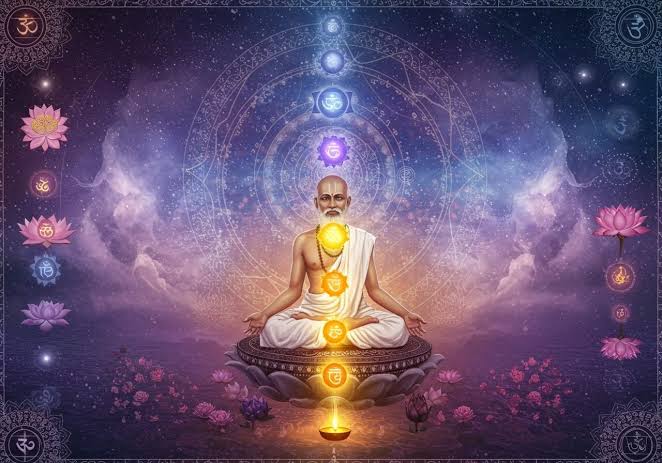
Moksha occupies a central place in Hindu philosophy because it addresses the deepest question of human existence: what remains when the body, possessions, social identity, pleasure, grief, success, and failure are all seen as temporary? In the scriptural imagination of the Upanishads, the Bhagavad Gita, the Mahabharata, the Ramayana, the Smritis, and the Puranas, moksha is not presented as a distant reward granted after death alone. It is the consummation of spiritual knowledge, ethical purification, devotion, disciplined action, and inward freedom. It is the state in which the individual soul is released from bondage because ignorance has been removed and the true nature of the self has been realized.
In this sense, moksha is more comprehensive than a simple escape from the cycle of birth and death. It includes freedom from avidya, or ignorance; freedom from compulsive desire; freedom from sorrow rooted in false identification; and freedom from the inner bondage created by ego, attachment, aversion, and restlessness. Worldly life has legitimate aims, including livelihood, family duty, social contribution, learning, and ethical prosperity. Yet the scriptures repeatedly indicate that these aims remain incomplete unless they are integrated with self-knowledge and Dharma. Human life becomes spiritually meaningful when it turns inward and asks not merely what one can acquire, but what one truly is.
The Upanishadic foundation of moksha is especially profound. The Shvetashvatara Upanishad says, “esha paro mokshah, sa esha parama gatih.” Meaning: “This Supreme Brahman is the highest liberation; He is the ultimate destination.” This statement frames liberation not as an external object, place, or possession, but as the highest realization of Brahman, the Supreme Reality. The seeker does not gain moksha by adding something artificial to the self; rather, the seeker removes ignorance and recognizes the truth that was always present beneath the layers of mistaken identity.
The Mundaka Upanishad expresses the same vision through the declaration, “sa yo ha vai tat paramam brahma veda brahmaiva bhavati,” meaning, “One who knows the Supreme Brahman becomes Brahman itself.” The language is not merely devotional or poetic; it is metaphysical. It indicates that knowledge of Brahman is transformative because it removes the illusion of separateness. To know Brahman is not to hold a concept about Brahman in the intellect, but to awaken to the deepest reality of consciousness. The mahavakya “tat tvam asi” from the Chandogya Upanishad gives this insight its most concise expression by revealing the profound unity between the individual self and Brahman.
This is why moksha is often described as self-knowledge. The problem of bondage is not that the self is actually chained in an absolute sense; the problem is that the self is misidentified with the body, mind, senses, emotions, memories, and social roles. A person may say, “I am anxious,” “I am successful,” “I am defeated,” or “I am incomplete,” and such statements feel emotionally real in ordinary life. Yet Vedanta asks whether these changing states can be the final truth of the self. The body changes, the mind changes, desires change, relationships change, and even deeply held opinions evolve. The witness of these changes points toward a subtler identity, and the inquiry into that identity becomes the beginning of liberation.
The Bhagavad Gita gives this inquiry a systematic practical form. It does not reduce moksha to abstract speculation, nor does it present renunciation as mere withdrawal from life. In Gita 18.66, Lord Shri Krishna says, “sarva-dharman parityajya mamekam sharanam vraja. aham tvam sarva-papebhyo mokshayishyami ma shuchah.” Meaning: “Abandon all duties and take refuge in Me alone; I shall free you from all sins, do not grieve.” This celebrated verse is often understood as the culmination of surrender, where the seeker releases egoistic dependence on limited identities and takes refuge in the Divine as the supreme ground of life.
The Gita’s teaching is subtle because it does not encourage irresponsibility. Shri Krishna speaks to Arjuna in the middle of a moral crisis, not in a secluded philosophical classroom. The call to surrender arises after a long teaching on Dharma, karma yoga, jnana, bhakti, meditation, self-restraint, and equanimity. Therefore, surrender is not passivity. It is the disciplined offering of action, emotion, knowledge, and will to the Divine. It is the end of the ego’s claim that it alone controls, possesses, and defines life.
The Gita also explains why bondage persists even when a person intellectually values freedom. In Gita 3.40 it is said, “indriyani mano buddhir asyadhishthanam uchyate; etair vimohayaty esha jnanam avritya dehinam,” meaning that the senses, mind, and intellect are the seats of desire; through them desire veils knowledge. This is a psychologically precise teaching. Desire does not operate only at the level of physical appetite. It occupies perception, memory, imagination, reasoning, and identity. It persuades the mind that fulfillment lies outside, in one more possession, one more victory, one more pleasure, or one more confirmation from the world.
For this reason, the scriptural path does not treat indulgence as a reliable cure for desire. Desire often expands through satisfaction because the mind learns to repeat the same pattern. This insight remains relatable in contemporary life, where constant stimulation, comparison, and consumption can make the mind more restless rather than more fulfilled. The Gita’s answer is not hatred of the world, but mastery over the senses, steadiness of mind, and clarity of intellect. Gita 5.28 describes the sage with controlled senses, mind, and intellect as one who is always free, showing that liberation begins as an inner discipline before it is recognized as the highest realization.
Traditional Vedantic teaching often identifies four major disciplines for moksha: discrimination, detachment, the sixfold virtues beginning with calmness, and intense desire for liberation. Discrimination is the ability to distinguish between the eternal and the temporary. Without this faculty, the mind keeps mistaking passing experiences for permanent security. Wealth, pleasure, reputation, and social standing may have practical value, but they cannot bear the weight of ultimate meaning. Discrimination allows the seeker to use the world responsibly without expecting the world to provide absolute freedom.
Detachment is the natural companion of discrimination. It does not mean emotional coldness, contempt for life, or abandonment of duty. It means non-dependence on enjoyment as the basis of identity. A detached person may still work, love, serve, study, create, and participate in society, but the inner center is not enslaved by outcomes. Such detachment is particularly important because attachment and fear often arise together. What is possessed with anxiety becomes a source of bondage; what is offered with Dharma becomes a means of purification.
The sixfold virtues beginning with calmness refer to the training of mind and senses. Calmness, self-control, withdrawal from unhealthy compulsions, endurance, faith, and concentration are not ornamental virtues; they are technical requirements of spiritual practice. A mind that is constantly pulled outward cannot sustain self-inquiry. A mind ruled by reaction cannot perceive truth clearly. A mind addicted to praise and wounded by every criticism cannot rest in the witness-consciousness described by the Upanishads. Inner discipline therefore becomes a form of intellectual honesty, because it allows reality to be seen without the distortions of craving and fear.
The fourth discipline is an intense desire for liberation. This longing is not ordinary ambition. It is not the wish to become spiritually impressive, socially respected, or intellectually superior. It is the sincere recognition that no temporary achievement can substitute for freedom from ignorance. The Katha Upanishad gives special importance to this kind of inquiry by distinguishing the path of the pleasant from the path of the good. Without knowing the truth of the self, a person remains trapped in the pursuit of the outer world, even when that pursuit appears refined or successful.
Karma yoga provides one of the most practical bridges between ordinary life and moksha. Its principle is that action should be performed according to Dharma, without egoistic attachment to the fruit. This does not make action careless; it makes action cleaner. The person acts with attention, responsibility, and ethical seriousness, but gradually relinquishes the anxiety of possessiveness. Such action purifies the mind because it reduces selfishness and trains the individual to see work as offering rather than self-display.
The Yajurveda states, “avidyaya mrityum tirtva vidyayamritam ashnute,” meaning, “By overcoming death through ignorance, one attains immortality through knowledge.” The verse is traditionally interpreted as a reminder that spiritual maturity requires both disciplined engagement and true knowledge. Emotion alone is not enough, because emotion can fluctuate. Ritual alone is not enough, because ritual without understanding can become mechanical. Knowledge alone, if it remains merely verbal, is also incomplete. The path requires integration: right action, purified intention, devotion, inquiry, and realization.
The Smriti tradition reinforces the ethical foundation of moksha. The Yajnavalkya Smriti says, “nyasa-sannyasa-krit yogi param brahmadhigacchati,” meaning, “The renunciant yogi attains the Supreme Brahman.” Renunciation here should be understood at its deepest level. It is not only the external form of sannyasa; it is the relinquishment of egoic ownership. A person may live in society and still practice inner renunciation through humility, self-restraint, service, and remembrance of the Divine. Conversely, external renunciation without inner freedom does not fulfill the scriptural ideal.
The Manusmriti further says, “indriyanam nirodhena ragadveshakshayena cha ahimsa cha bhutanam amritatvaya kalpate.” Meaning: “By restraint of the senses, the destruction of attachment and hatred, and by non-violence toward all beings, one becomes fit for immortality.” This teaching makes an important point: moksha is not attained by intellectual knowledge alone. Moral purification is indispensable. The destruction of attachment and hatred, combined with ahimsa toward all beings, makes the inner instrument fit for higher realization. Spiritual knowledge without ethical refinement can become pride; ethical refinement prepares knowledge to become wisdom.
This moral dimension also connects moksha with the wider Dharmic ideal of harmony among living beings. Hinduism, Buddhism, Jainism, and Sikhism differ in their philosophical language, metaphysical analysis, and ritual expression, yet they share a deep concern for liberation from ignorance, ego, suffering, and moral bondage. Jainism emphasizes liberation through right faith, right knowledge, right conduct, and profound non-violence. Buddhism analyzes suffering, craving, impermanence, and awakening with extraordinary precision. Sikh teachings emphasize remembrance of the Divine Name, truthful living, humility, and seva. These traditions do not need to be flattened into sameness in order to be respected as Dharmic paths of inner transformation.
The Ramayana, Mahabharata, and Puranas often present the path of liberation through devotion, narrative, character, and sacred remembrance. This is important because not every seeker approaches truth primarily through metaphysical analysis. Many approach it through love, reverence, music, service, pilgrimage, and the remembrance of divine names. The Ramcharitmanas says, “Kali jug kaval naam adhara, sumiri sumiri nar utarahi para.” Meaning: “In the age of Kali, the Name alone is the support; by remembering the Name again and again, people cross the ocean of worldly existence.” The language is simple, but its spiritual psychology is deep: repeated remembrance redirects the mind from fragmentation toward sacred centeredness.
The Bhagavata Purana describes devotion through nine forms: “shravanam kirtanam vishnoh smaranam padasevanam. archanam vandanam dasyam sakhyam atmanivedanam.” Meaning: “Listening to Vishnu’s glories, singing them, remembering Him, serving His feet, worshiping, bowing, serving as a servant, befriending Him, and offering oneself wholly—these are the nine paths of devotion.” These practices are not merely ritual options; they are methods for transforming the emotional life. Listening purifies attention, singing sanctifies speech, remembrance disciplines memory, service weakens ego, worship cultivates reverence, and self-offering dissolves the illusion of separateness.
The Padma Purana says, “Harenamaiva namaiva namaiva mama jivanam. kalau nasti eva nasti eva nasti eva gatir anyatha,” meaning, “The Name of Hari alone is life; in Kali Yuga there is no other path.” The emphasis on nama, or the Divine Name, reflects the accessibility of devotion. In an age marked by distraction, anxiety, and moral confusion, sacred remembrance offers a direct discipline available to householders, renunciants, scholars, workers, elders, and youth alike. It does not require social status or intellectual prestige. It requires sincerity, steadiness, and surrender.
From an academic perspective, the scriptural teaching on moksha may be understood through three interrelated processes: purification of the mind through karma yoga, softening and surrender of the ego through bhakti, and realization of the self through jnana. These are not mutually exclusive compartments. Action without devotion can become dry duty. Devotion without knowledge can become sentimentality. Knowledge without moral purification can become abstraction. The integrated path recognizes the whole human being: body, mind, intellect, emotion, will, memory, and conscience.
The relevance of moksha is not limited to monastic life or ancient debate. In ordinary experience, bondage appears whenever a person is governed by compulsive comparison, resentment, craving, fear, or the need to control every outcome. A modern person may have education, wealth, technology, and public recognition, yet still suffer from inner restlessness. The scriptures diagnose this condition with remarkable clarity: the mind has turned outward and mistaken the temporary for the eternal. Moksha begins when this movement is examined, disciplined, and redirected toward truth.
This does not mean that social responsibility is rejected. The closing ideal “atmano mokshartham jagaddhitaya cha” — one’s own spiritual liberation and the welfare of the world — expresses a balanced Dharmic vision. Inner freedom and social welfare are not enemies. A person who is less ruled by greed, anger, ego, and insecurity becomes more capable of serving others without manipulation or exhaustion. The liberated orientation of life therefore supports compassion, justice, non-violence, and responsibility. Moksha is inward, but its ethical fragrance is outward.
Different philosophical schools explain moksha in distinctive ways. Advaita Vedanta emphasizes the realization of the identity of Atman and Brahman. Vishishtadvaita emphasizes loving surrender to the Supreme while preserving a qualified unity. Dvaita emphasizes the eternal distinction between the individual soul and the Supreme Lord, with liberation understood through divine grace and devotion. Yoga philosophy frames liberation in terms of the distinction between Purusha and Prakriti. These differences are significant and should be studied carefully, yet they need not obscure the shared aspiration: freedom from bondage and the realization of the highest truth.
The practical message is therefore both demanding and compassionate. Moksha asks for discrimination, but not contempt for the world. It asks for detachment, but not indifference. It asks for self-control, but not self-hatred. It asks for devotion, but not fanaticism. It asks for knowledge, but not arrogance. It asks for renunciation, but not abandonment of Dharma. The seeker is invited to live with greater clarity, to act with purity, to love with humility, and to inquire into the self with seriousness.
Ultimately, moksha is the highest goal because it resolves the central confusion of human life. The individual searches for permanence in impermanent things, completeness in incomplete experiences, and identity in changing conditions. The scriptures redirect this search toward the self, Brahman, and the Divine ground of existence. When ignorance is removed, the soul is no longer defined by bondage. Action becomes offering, devotion becomes surrender, knowledge becomes realization, and life becomes aligned with Dharma. This is the scriptural path of moksha: inward freedom, moral purification, divine remembrance, self-realization, and the welfare of the world.
Inspired by this post on Hindu Post.







Leave a Reply
You must be logged in to post a comment.