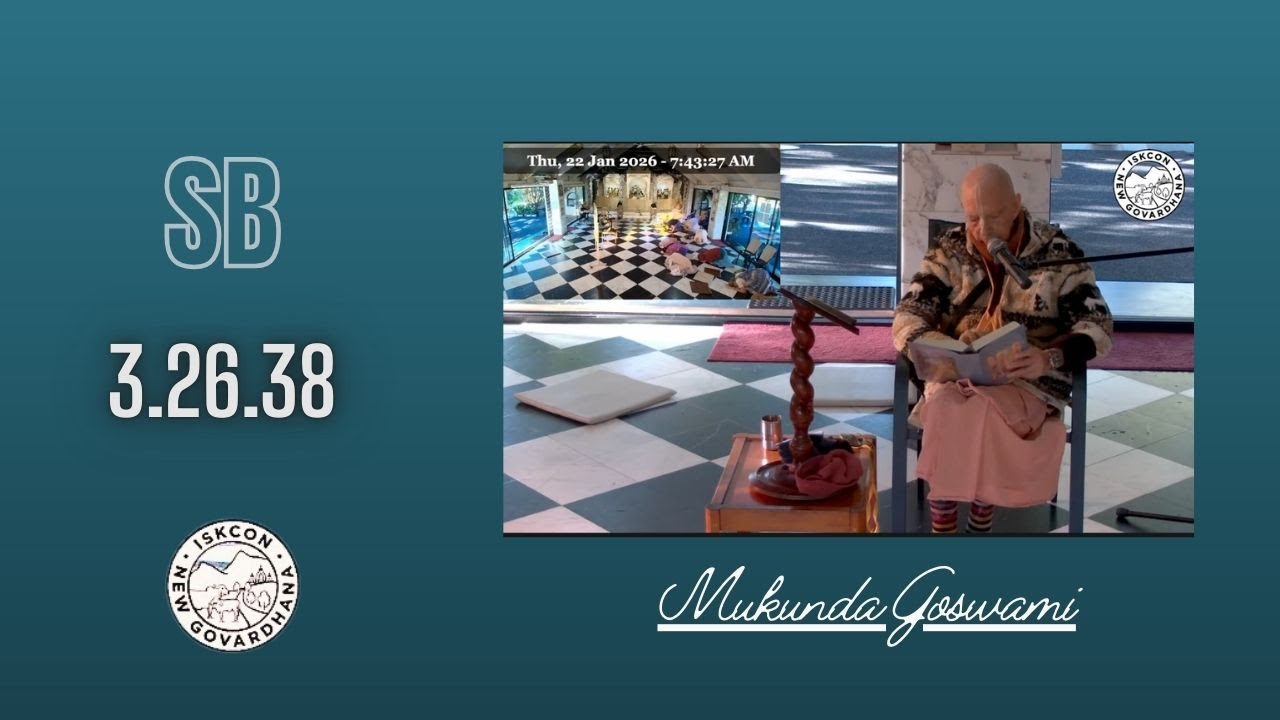
On 22 January 2026, Mukunda Goswami illuminated Srimad Bhagavatam 3.26.62–71, detailing how the presiding deities of the indriyas (senses) sequentially enter the Virat Purusha. The exposition clarifies that speech, smell, sight, hearing, touch, procreation, excretion, movement, circulation, hunger, mind (manas), intelligence (buddhi), and ego (ahankara) take their places, yet the cosmic form remains dormant.
The sequence emphasizes a striking metaphysical point: even when all functions and faculties are present, the cosmic being does not arise. Only when the Supersoul (Paramatma), described as the inner controller and the ground of consciousness, enters the Virat Purusha does life awaken. In this vision, senses, mind, and intelligence are necessary instruments, but they are not sufficient causes of life; consciousness is the indispensable principle that integrates and animates.
This teaching invites careful reflection on the relationship between matter and consciousness. Just as a complex system remains inert until power flows through it, the embodied macrocosm remains quiescent until the Paramatma infuses presence and purpose. The verses thereby frame a clear hierarchy: instruments (indriyas) are subordinate to awareness, and awareness derives from the Supersoul rather than from the instruments themselves.
Many practitioners recognize the experiential relevance of this insight. In moments of deep attention, the senses convey data, but meaning crystallizes only when awareness is steady and lucid. Meditation, ethical reflection, and disciplined living become practical methods to align the faculties with the inward source of consciousness, transforming scattered impulses into purposeful action.
Convergences across dharmic traditions reinforce this reading. Buddhist mindfulness reveals how perception requires stabilizing awareness; Jain emphasis on self-discipline and knowledge purifies the field in which experience becomes meaningful; Sikh remembrance of the Divine Name centers life in a conscious relationship with the Supreme. Together with the Bhagavata Purana’s portrayal of the Supersoul, these perspectives affirm a shared dharmic intuition: consciousness is primary, integrative, and ethically orienting.
Consequently, the verses offer a contemporary guide as much as a theological account. They suggest cultivating inward clarity so that speech, thought, and action serve wholesome ends. By recognizing the Supersoul as the enlivening principle, one sees the senses, mind, and intelligence not as sovereign rulers but as cooperative instrumentscapable of harmony, responsibility, and unity when guided by consciousness.
Srimad Bhagavatam 3.26.62–71 therefore stands as a precise philosophical statement with practical implications: the Virat Purusha arises only when the Supersoul enters, and likewise, authentic living begins when awareness illumines and integrates the manifold powers of human embodiment.
Inspired by this post on Dandavats.