Tag: indriyas

  • Krishna as Goswami: Powerful Symbolism of Cows, Senses, and Inner Mastery

    Krishna as Goswami: Powerful Symbolism of Cows, Senses, and Inner Mastery

    This article explains the deeper symbolism behind Krishna as Goswami, Gopala, Govinda, and Hrishikesha. It explores how the Sanskrit word go connects the cow, the senses, speech, light, and the earth within Hindu thought. The discussion shows that Krishna’s cowherd identity is also a profound teaching on mastering the indriyas without rejecting the body or…

  • Srimad Bhagavatam 3.26.47-49: Powerful Sankhya Wisdom on Senses and Earth

    Srimad Bhagavatam 3.26.47-49: Powerful Sankhya Wisdom on Senses and Earth

    Srimad Bhagavatam 3.26.47-49 offers a precise Sāṅkhya analysis of the senses, their objects, and the five gross elements. The passage explains hearing through sound, touch through air, sight through form, taste through water, and smell through earth. It also teaches that the effect carries the qualities of its cause, which is why earth is described…

  • Decoding Kamadeva’s Five Arrows: How the Senses Shape Desire, Dharma, and Creation

    Decoding Kamadeva’s Five Arrows: How the Senses Shape Desire, Dharma, and Creation

    Kamadeva’s five flower-tipped arrows and sugarcane bow form a precise allegory for how the senses animate desire and sustain the cosmic cycle of life. Read as psychology, the allegory maps stimulus, attention, valuation, and pursuit; read as theology, it integrates kāma into the puruṣārthas alongside dharma, artha, and mokṣa. The Madana-dahana narrative shows desire sublimated…

  • Panchamukhi Ganapati Explained: Five Faces, Five Elements, and Mastery of the Senses

    Panchamukhi Ganapati Explained: Five Faces, Five Elements, and Mastery of the Senses

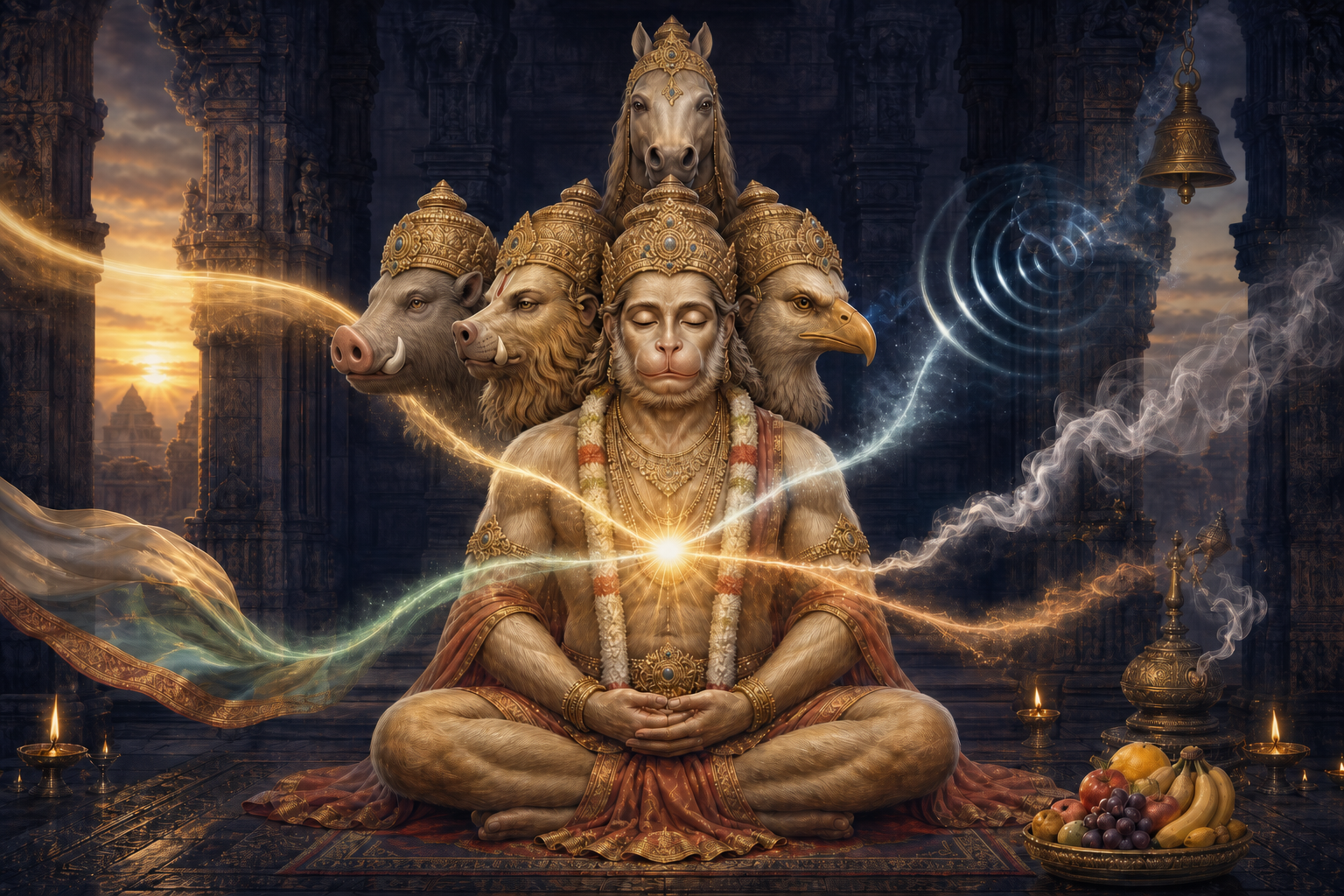
    Panchamukhi Ganapati symbolizes the integration of the five elements and the five senses, aligning personal practice with Vedic cosmology. Drawing on the Ganapati Atharvashirsha, this exploration shows how Ganesha is identified with Earth, Water, Fire, Air, and Ether. The five faces are read as guardians of perception, action, and awareness, mapped by many iconographers to…

  • Decoding Panchamukhi Ganapati: Five Faces that Harmonize Elements, Senses, and Self

    Decoding Panchamukhi Ganapati: Five Faces that Harmonize Elements, Senses, and Self

    This in-depth exploration decodes Panchamukhi Ganapati as a five-faced synthesis of the five senses and the five great elements. It clarifies the classical mapping of indriyas to pancha mahabhuta and shows how the image guides pratyahara and allied yogic practices. Readers encounter multiple scholarly interpretations, from pancha prana and Pancha Kosha Viveka to the fivefold…

  • Beyond the Senses’ Trap: Dharmic Science of Lasting Joy across Hindu, Buddhist, Jain, Sikh

    Beyond the Senses’ Trap: Dharmic Science of Lasting Joy across Hindu, Buddhist, Jain, Sikh

    Modern restlessness around pleasure and possession is precisely mapped in the shared wisdom of Hinduism, Buddhism, Jainism, and Sikhism. Each tradition explains how untrained senses agitate the mind and how disciplined attentionthrough pratyahara, mindfulness, aparigraha, Seva, and devotiontransforms agitation into equanimity. The piece integrates Hindu models of the indriyas, Gita psychology of desire, Buddhist dependent…

  • Freedom from the Senses: A Dharmic Pathway to Moksha, Mastery, and Inner Sovereignty

    Freedom from the Senses: A Dharmic Pathway to Moksha, Mastery, and Inner Sovereignty

    This essay explores the Hindu philosophical insight that freedom from the slavery of the senses constitutes liberation and shows how it converges with parallel teachings in Buddhism, Jainism, and Sikhism. It clarifies how indriyas, raga-dvesha, and samskaras generate compulsion, and how masterynot repressionunlocks moksha. Drawing from the Bhagavad Gita, the Upanishads, and Yoga philosophy, it…

  • Cosmic Harmony in Daily Puja: Aligning Five Elements and Senses for Transformative Worship

    Cosmic Harmony in Daily Puja: Aligning Five Elements and Senses for Transformative Worship

    Daily puja in the Hindu way of life is a precise, sense-centered discipline that aligns the five elements (Pancha Mahabhuta) with the five senses (Pancha Indriya). Drawing on the Bhagavad Gita 7.4 and allied traditions, it maps offerings such as gandha, pushpa, dhupa, deepa, and naivedya to smell, sight, sound, touch, and taste. Earth, water,…

  • Why Devotional Focus Suddenly Turns Sensualand Science-Backed Ways to Steady the Mind

    Why Devotional Focus Suddenly Turns Sensualand Science-Backed Ways to Steady the Mind

    Devotional focus can collapse into sensual distraction with surprising speed because material desire functions like a gravitational pull on attention. Classical frameworks from Hinduism, Buddhism, Jainism, and Sikhism explain this shift through gunas, kleshas, hindrances, and the five thieves, while neuroscience highlights cue-driven reward predictions and attentional capture. A practical, evidence-aligned toolkit helps steady the…

  • Ganesha’s Small Eyes, Vast Vision: Iconography, Mindfulness, and Dharmic Unity Lessons

    Ganesha’s Small Eyes, Vast Vision: Iconography, Mindfulness, and Dharmic Unity Lessons

    Ganesha’s small, intent eyes encode a powerful contemplative teaching: expansive wisdom arises from focused, compassionate attention. Drawing on Hindu iconography and Yoga philosophy, the symbol aligns with pratyahara, dharana, and dhyana, and is reinforced by the Bhagavad Gita’s guidance on nasikagra-drishti. Contemporary attention science complements this reading, linking steady gaze with reduced cognitive load and…

  • Karmendriyas and Tanmatras Explained: How Action Organs Align with the Five Elements

    Karmendriyas and Tanmatras Explained: How Action Organs Align with the Five Elements

    This article clarifies how the five karmendriyasspeech, hands, feet, procreation, and eliminationrelate to the tanmatras and the five elements in Hindu philosophy. It outlines the classical evolution from subtle tanmatras to pancha mahabhutas and shows how action organs are energized by rajas and prana. Readers gain a clear, text-sensitive view of commonly taught correspondencessuch as…

  • Virat Purusha Awakens: Srimad Bhagavatam 3.26 Reveals the Power of the Supersoul

    Virat Purusha Awakens: Srimad Bhagavatam 3.26 Reveals the Power of the Supersoul

    Srimad Bhagavatam 3.26.62–71 presents a clear philosophical insight: the senses, mind, and intelligence remain inert until the Supersoul (Paramatma) enters and animates the Virat Purusha. Mukunda Goswami’s exposition clarifies that all faculties are instruments requiring the integrative power of consciousness to become meaningful. Readers gain a practical framework for aligning speech, thought, and action through…

  • Beyond the Five Senses: Hinduism’s Profound Insight into Why Perception Misleads

    Beyond the Five Senses: Hinduism’s Profound Insight into Why Perception Misleads

    Human perception is inherently limited, a point Hinduism has articulated for centuries and modern science increasingly affirms. The five indriyas capture only a fraction of reality, making errors of judgment likely without disciplined methods of knowing. Hindu epistemology balances pratyaksha (perception), anumana (inference), and shabda (authoritative testimony) to refine understanding. Concepts like Maya and Avidya…

  • Discover the Proven Secret of Bliss in the Senses: Panchadasi’s Fifteenth Chapter, Vishayananda

    Discover the Proven Secret of Bliss in the Senses: Panchadasi’s Fifteenth Chapter, Vishayananda

    Panchadasi’s fifteenth chapter, Vishayananda, explains how everyday pleasures reflect the same ananda that shines as Brahman. By analyzing the role of the senses and the mind, it shows that pleasure arises when agitation pauses and awareness becomes momentarily still. This insight reframes ordinary enjoyment as a contemplative cue rather than an invitation to craving. The…

  • From Sthula to Sukshma: The Journey of Spiritual Practice

    From Sthula to Sukshma: The Journey of Spiritual Practice

    This blog post explores the journey from gross to subtle in Sanatana Dharma through meditation and japa. It delves into the importance of increasing sattva, the role of chakras in Raja Yoga, and the progressive nature of spiritual practices, emphasizing focus and one-pointedness to achieve spiritual realization.