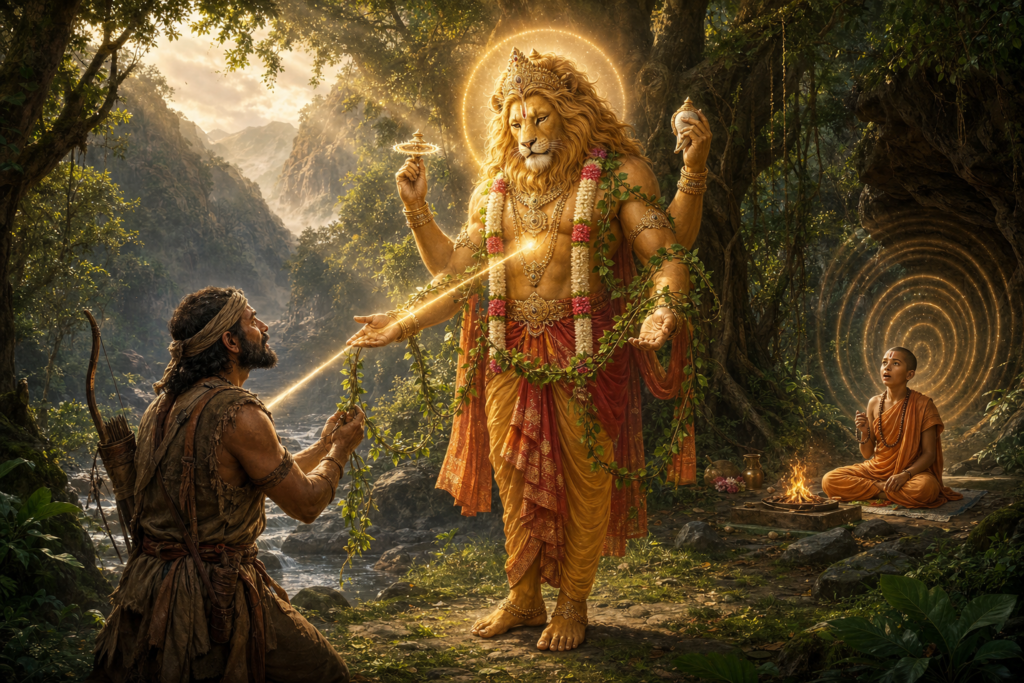
Across the Hindu scriptures, a striking thread of poetic justice links the Ramayana and the Mahabharata: the debated slaying of Vali by Rama and the later departure of Krishna through the arrow of Jara. Read together, these episodes illustrate a central teaching of Sanatana Dharmathat even divine incarnations model accountability within the moral architecture of dharma and karma, guiding society toward humility, responsibility, and compassion.
In the Ramayana’s Kishkindha Kanda, Rama eliminates Vali from concealment while assisting Sugriva. The episode prompts an enduring ethical inquiry: did the means align with dharma? Vali protests the manner of his death, while Rama articulates a rationale grounded in kshatra-dharma, sovereignty, and the protection of social order. The narrative preserves this tension rather than dissolving it, inviting careful reflection on righteous intent, just means, and the consequences that unfold within the law of karma.
The Mahabharata’s Mausala Parva later recounts Krishna’s earthly departure. A hunter named Jara, mistaking Krishna’s foot for a deer, releases an arrow that fulfills the destined close of Krishna’s avatara. Although the critical text of the Mahabharata identifies Jara simply as a hunter, later Purana-inspired and regional retellingsespecially within Vaishnava traditionsinterpret Jara as Vali reborn. This interpretive arc offers a deeply resonant symmetry: the one who once suffered a contested arrow now, in another birth, releases the fateful shaft that completes a cosmic cycle.
Within these traditions, the motif is not merely retribution but restoration. It frames karma as an educative principle through which even avatars illuminate ethical law by consenting to its pathways. Devotional commentators sometimes characterize this as “atonement,” while philosophical readings emphasize pedagogical reciprocitydemonstrating that dharma stabilizes the moral universe precisely because no actor, however exalted, exempts the world from cause and effect.
Interpreting Vali’s rebirth as Jara thus becomes a meditation on responsibility and compassion, not punishment. The Ramayana presents the complexity of statecraft and duty; the Mahabharata reveals the fragility of human perception and the gravity of unintended harm. Together they cultivate vivekadiscriminating wisdomabout intention, means, and outcome, reminding readers that the law of karma integrates justice with moral growth.
These themes resonate across dharmic traditions. Buddhism affirms karman and the ethical shaping of experience; Jainism explores karma’s subtle bondage and the liberating force of ahimsa; Sikh teachings on hukam and karam highlight accountability under divine order. Read in this wider dharmic frame, the linkage of Vali, Jara, Rama, and Krishna becomes a shared ethical parable: moral causality educates, harmonizes, and ultimately elevates.
From a literary perspective, the motif of rebirth provides narrative symmetry that bridges epics, sustaining cultural memory and spiritual contemplation. From a philosophical perspective, it underscores that dharma aims at restorationaligning beings, communities, and rulers to a just order. The idea that Rama’s arrow and Jara’s arrow are spiritually intertwined presents an elegant model of balance: power tempered by principle, action followed by reflection, destiny guided by discernment.
Scholarly caution remains essential. The identification of Jara with Vali is prominent in devotional and regional traditions and in certain Purana-oriented commentaries, yet it is not a universal reading of the Sanskrit critical editions. A balanced approach distinguishes between the textual core (Ramayana and Mahabharata) and the rich layer of reception history, allowing both to speak: the former for canonical narrative, the latter for living interpretation within Sanatana Dharma.
Ultimately, the “eternal cycle of justice” across these epics invites a unifying insight: moral law is not punitive machinery but compassionate guidance. By contemplating how Rama’s contested act and Krishna’s serene departure are woven through karma and reincarnation, readers gain a holistic appreciation of dharmaone that nurtures humility, ethical courage, and inter-traditional harmony among Hinduism, Buddhism, Jainism, and Sikhism.
Inspired by this post on Hindu Blog.