Lanka in the Ramayana is more than a metropolis of gold; it is a political-spiritual organism guarded by divinity and measured against dharma. At the city’s threshold stands Lankinialso remembered as Lankalakshmithe presiding guardian deity whose presence signals the city’s living fortune (śrī) and its ethical standing. In complement, the victory-bestowing aspect of Lakshmi, Vijayalakshmi, embodies the law that true triumph accompanies righteousness. Read together, Lankini and Vijayalakshmi illuminate how prosperity, protection, and victory are conditional upon moral orderan idea shared across dharmic traditions.
Classical narratives trace Lanka’s effulgence to an origin in divine craftsmanship: Viśvakarma fashions the golden citadel, which in early tradition is linked with Brahma and then with Kubera before being seized by Ravana. The city, famed as a treasury of wealth and architecture, thus becomes a ‘Brahma’s treasure’ not only in material terms but as a repository of cosmic order entrusted to just stewardship. Within this civilizational frame, a city’s fortune is personified, guarded, and morally contingenthence the figure of Lankini (Lankalakshmi) at Ravana’s gates.
Indic urban life long recognized presiding protectorsnagara-devatās, kṣetrapālas, and yakṣinīswho safeguard boundaries and remind rulers that sovereignty is sacral responsibility. In the Ramayana, Lankini distills this ethos: a guardian deity who not only patrols a perimeter but also personifies the city’s ethical credit. Her story becomes a constitutional principle in mythic formprosperity (Lakshmi) abides where dharma is upheld and withdraws where adharma prevails.
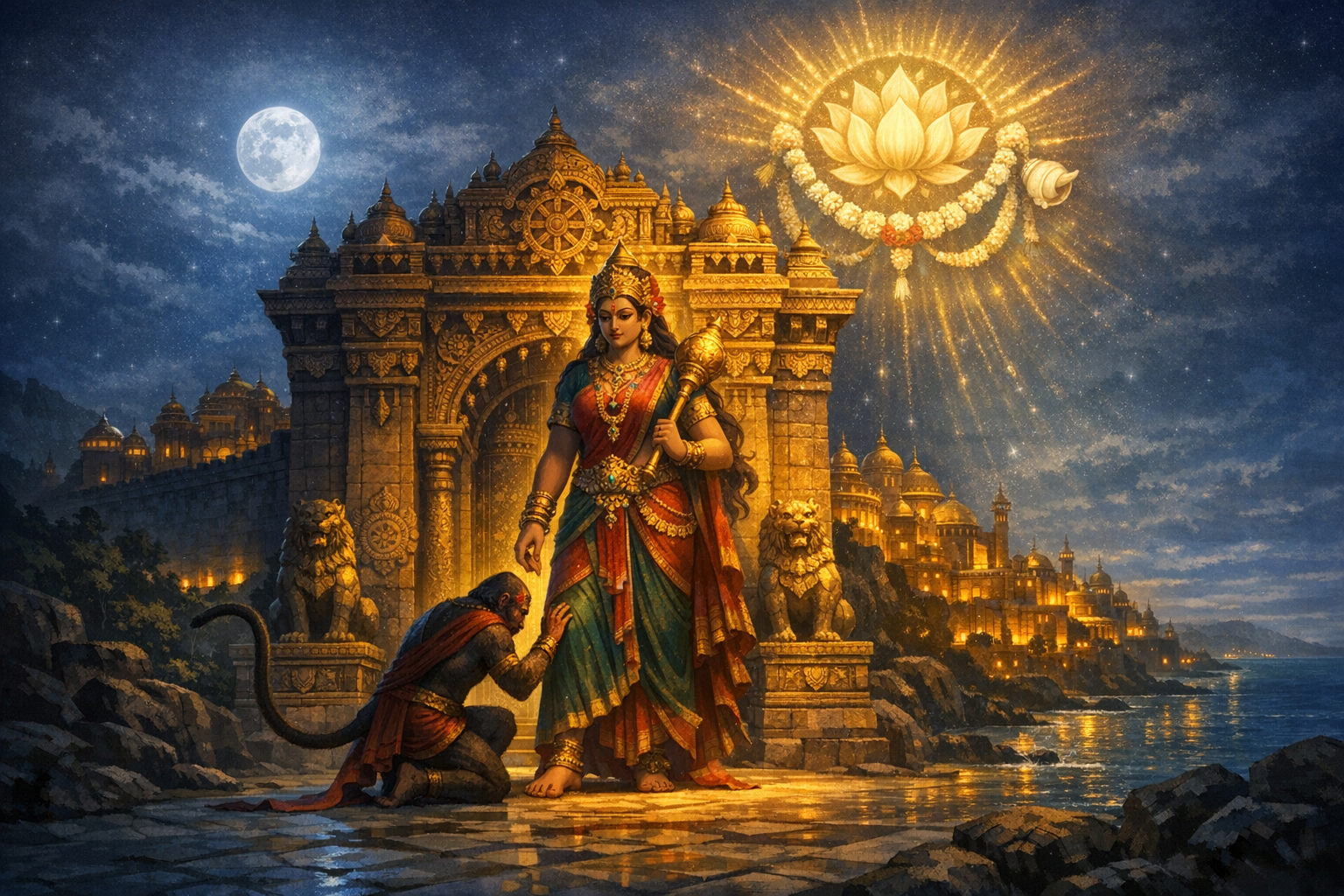
Valmiki’s Sundara Kāṇḍa preserves the dramatic encounter. As Hanuman, the envoy of Sri Rama, seeks ingress into Lanka under moonlit secrecy, Lankini challenges him at the main gate. The confrontation is brief: with a single measured blow, Hanuman subdues the guardian. Yet its resonance is immense, because what follows is not mere defeat but revelation.
Lankini recalls a boon from Brahma: the end of her guardianshipand the beginning of Lanka’s downfallwould be signaled when a vanara would strike her. Recognizing the dharmic mission embodied by Hanuman, she concedes passage and prophesies the near destruction of the rākṣasa power. In several recensions, she vanishes thereafter, as if the city’s fortune itself has withdrawn. The symbolism is precise: when adharma matures into tyranny, the protective merit guarding a polity dissolves by its own rule.
This is why many traditions gloss Lankini as Lankalakshmithe localized śrī of the city. Lakshmi in Sanskrit thought is not static but ‘cala’ (mobile); fortune is earned and kept by virtue. Lankini’s capitulation thus reads as the ethical ledger tipping against Ravana’s regime. What is lost at the gate is not merely a sentinel; it is Lanka’s claim to auspiciousness.
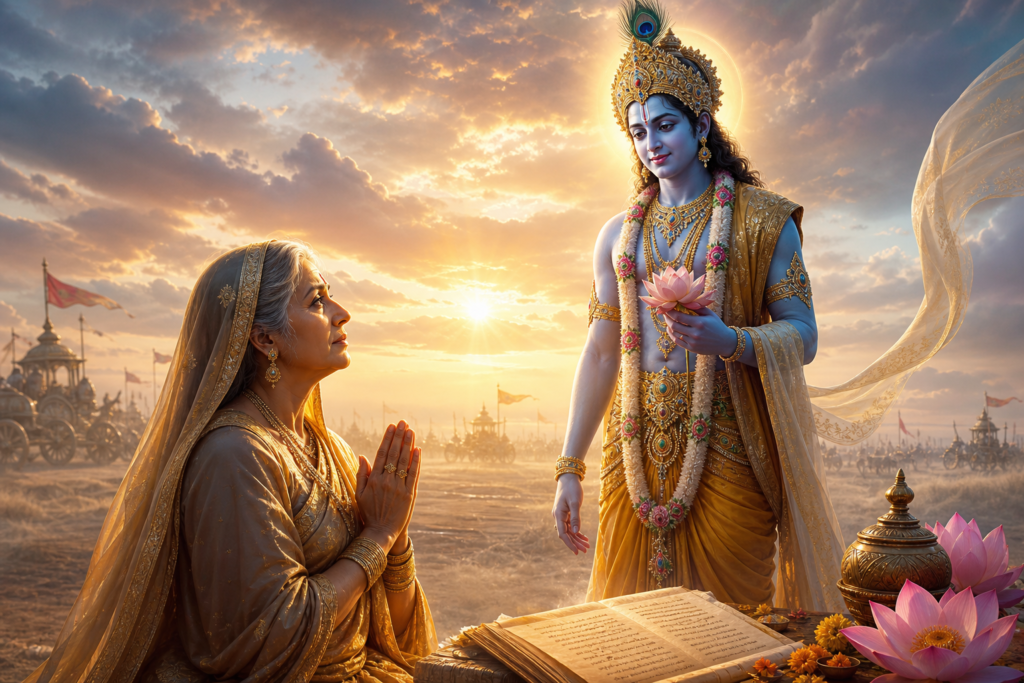
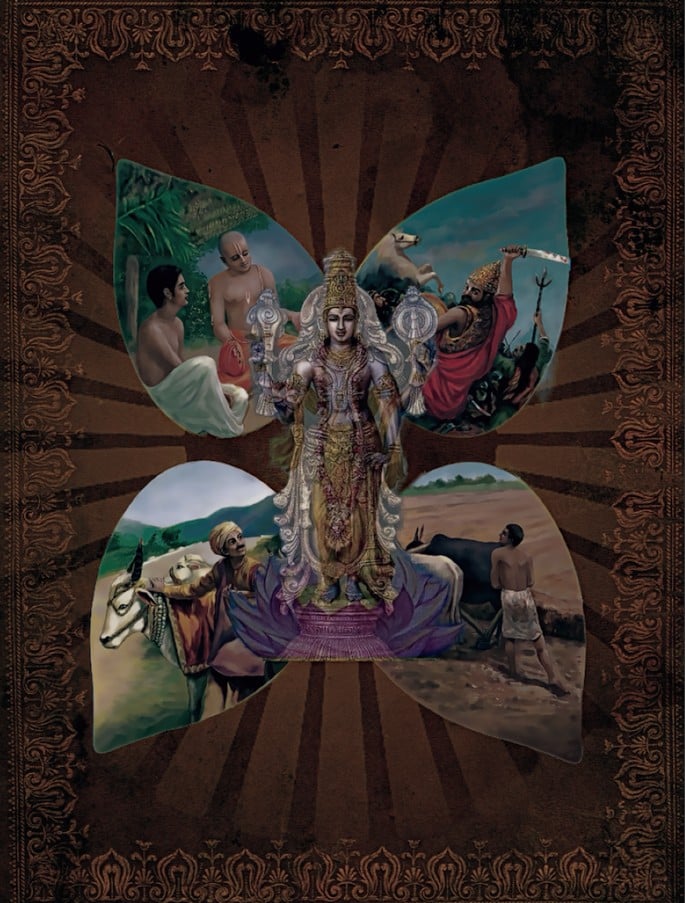
Vijayalakshmi, by contrast, articulates the positive pole: victory as grace aligned to righteousness. Counted among the Aṣṭalakṣmīs in Śrī-vidyā traditions, Vijayalakshmi grants vijayanot brute conquest but successful completion of a just undertaking. Read within the Ramayana’s arc, the same śrī that abandons adharma reappears as Vijayalakshmi with Maryada Purushottama Sri Rama, affirming that dharma and victory are inseparable.
Placing Lankini and Vijayalakshmi side by side yields a coherent political theology: the guardian (Lankini) indexes the state of a polity; the victor (Vijayalakshmi) confers outcome upon the just. In narrative terms, Hanuman’s passage is the hingeonce ethical protection no longer endorses Lanka, the tide irrevocably turns toward Rama’s dharma-yuddha and the restoration of order.
For many households that recite Sundara Kāṇḍa during Navaratri, this gate-scene remains emotionally immediate. The instant Lankini withdraws feels like a breathless threshold: a fortress built on fear begins to falter and a city’s conscience speaks. Devotees often sense in this moment that genuine protection is never merely martialit is moral.
The Ramayana’s framing of śrī resonates with broader Indic statecraft, where prosperity follows rajadharma. When rulers distort justicethrough abduction, cruelty, or deceitLakshmi departs. When rulers uphold truth, restraint, and compassion, Vijayalakshmi abides. The epic therefore reads as both sacred history and a constitutional mirror for governance.
Comparative dharmic perspectives reinforce this grammar of guardianship. Hindu, Buddhist, and Jain landscapes alike feature dvārapālas and yakṣa–yakṣiṇī pairs at city and temple thresholds, signaling that entry into sacred or civic space entails ethical accountability. In Buddhist settings, powerful protectors such as Vajrapāṇi uphold the Dharma; in Jain traditions, yakṣa–yakṣiṇīs (for example, Cakreśvarī and Ambikā) function as tutelary guardians. The shared motif is unmistakable: guardianship without righteousness is mere force; guardianship with dharma is protection.
Sikh thought, too, affirms a unity of spiritual and temporal responsibility through miri-piri, reminding communities that courage must be anchored in dharam (righteous conduct). Across these dharmic streams, victory is inseparable from ethical purposea resonance that harmonizes with Vijayalakshmi’s promise and with Hanuman’s role as a truthful envoy.
Iconographically, Lankini seldom appears as an independent cultic image; rather, her presence is inferred within the broader typology of guardiansyakṣiṇīs and dvārapālasat gateways and liminal spaces. Performance traditions such as Yakshagana and Koodiyattam occasionally stage the Lanka-entry episodes, making palpable the psychological weight of crossing from darkness to light, from terror to ethical confrontation.
The Sri Lankan cultural memory preserves a cognate insight through the veneration of Vibhishana as a guardian of the islanda reminder that, even within Lanka’s own horizons, protection ultimately sides with dharma. While distinct from Lankini, this devotion underscores the same axiom the Ramayana teaches at the city gate: guardianship is legitimized by righteousness.
Textually, Lankini’s episode appears in the Sundara Kāṇḍa (commonly sargas 3–5, depending on recension). She identifies herself as the appointed protector, recalls Brahma’s boon regarding a vanara’s blow, acknowledges Rama’s just cause, and yields. The narrative’s economy is striking: a single exchange relocates cosmic favor and forecasts the epic’s outcome.
Ethically, the lesson is precise and contemporary. A society’s ‘gatekeepers’its laws, institutions, and civic virtuesare spiritual technologies, not only administrative tools. When they are compromised, luck seems to fail; when they are upheld, even modest efforts achieve unlikely success. In Indic language, that difference is Lakshmi’s movementfrom Lankini departing to Vijayalakshmi arriving.
Ritually, the theme surfaces at Vijayadashami (Dussehra), when communities celebrate the victory of dharma and often invoke Lakshmi in her forms, including Vijayalakshmi. In stotra and vrata literature on the Aṣṭalakṣmīs, vijaya is praised as grace that crowns ethical endeavor, not as license for aggression. This accords with the Ramayana’s model of restraint, truthfulness, and compassionate strength.
Read as cultural heritage, the story of Lankini and Vijayalakshmi is not sectarian doctrine but a civilizational insight shared across Hinduism, Buddhism, Jainism, and Sikhism: prosperity, safety, and victory are functions of virtue. Whether one speaks of nagara-devatā, yakṣiṇī, kṣetrapāla, dharam yudh, or dvārapāla, the unity is clearguardianship is sacred because it protects the conditions under which all beings can flourish.
In this light, Hanuman’s fist is not a mere act of force. It is the ethical knock that awakens a city’s conscience, the signal by which a guardian deity fulfills her own vow, and the moment when śrī reorients toward dharma. Between Lankini’s withdrawal and Vijayalakshmi’s embrace lies the Ramayana’s enduring promise: where there is righteousness, there will be auspicious protection and true victory.
Inspired by this post on Hindu Blog.