Weaponry in the Dasam Granth Sahib occupies a unique intersection of history, martial discipline, and theology, where steel and spirit are deliberately fused. Within this scripture traditionally associated with Guru Gobind Singh, martial hymns sanctify shastra (weapons) as embodiments of Shakti, orienting armed practice toward the defense of dharma and the ethical restraint of power. Read as literature, history, and living guidance, these passages shape the Khalsa imagination while speaking more broadly to Dharmic understandings of righteous force, duty, and self-transformation.
Positioned alongside compositions such as Jaap Sahib, Akal Ustat, Chandi Charitar, Chandi di Vaar (Var Sri Bhagauti Ji Ki), Tav-Prasad Savaiye, Shastar Naam Mala, and the Hikayats, the Dasam Granth Sabah presents a capacious theology of sovereignty and responsibility. Written primarily in Braj, Punjabi, and Persianized registers, it employs a multilingual poetics to praise the Divine, narrate mythic combats, and catalog the instruments of war. In doing so, the text integrates the Sikh martial tradition (shastra-vidya) with a cosmology where weapons are not mere tools but vehicles for the protection of the weak and the preservation of justice.
The historical matrix of these compositions is decisive. After Guru Hargobind articulated Miri-Piri and militarized Sikh community life, Guru Gobind Singh consolidated that vision amid the conflicts with Mughal authority and the hill rajas. The founding of the Khalsa in 1699 publicly instituted a disciplined order of saint-soldiers. In this context, sanctifying weaponry was neither a celebration of violence nor a sectarian departure; it was a spiritualization of kshatra-dharma within a broader Indic framework of Dharma-Yuddha—war regulated by ethics, proportion, and last resort.
A recurring interpretive key is the term Bhagauti in Sikh liturgy and in Chandi di Vaar, where it is linked in many exegetical traditions to the Divine Sword as the empowered Shakti of the Timeless One. The opening of the daily Ardas—Pritham Bhagauti simar ke Guru Nanak lain dhiaye—preserves this theology in congregational memory. In the Dasam corpus, the sword is not idolized as an object; it is invoked as a transparent sign of disciplined courage, truth-protection, and collective responsibility under Akal Purakh.
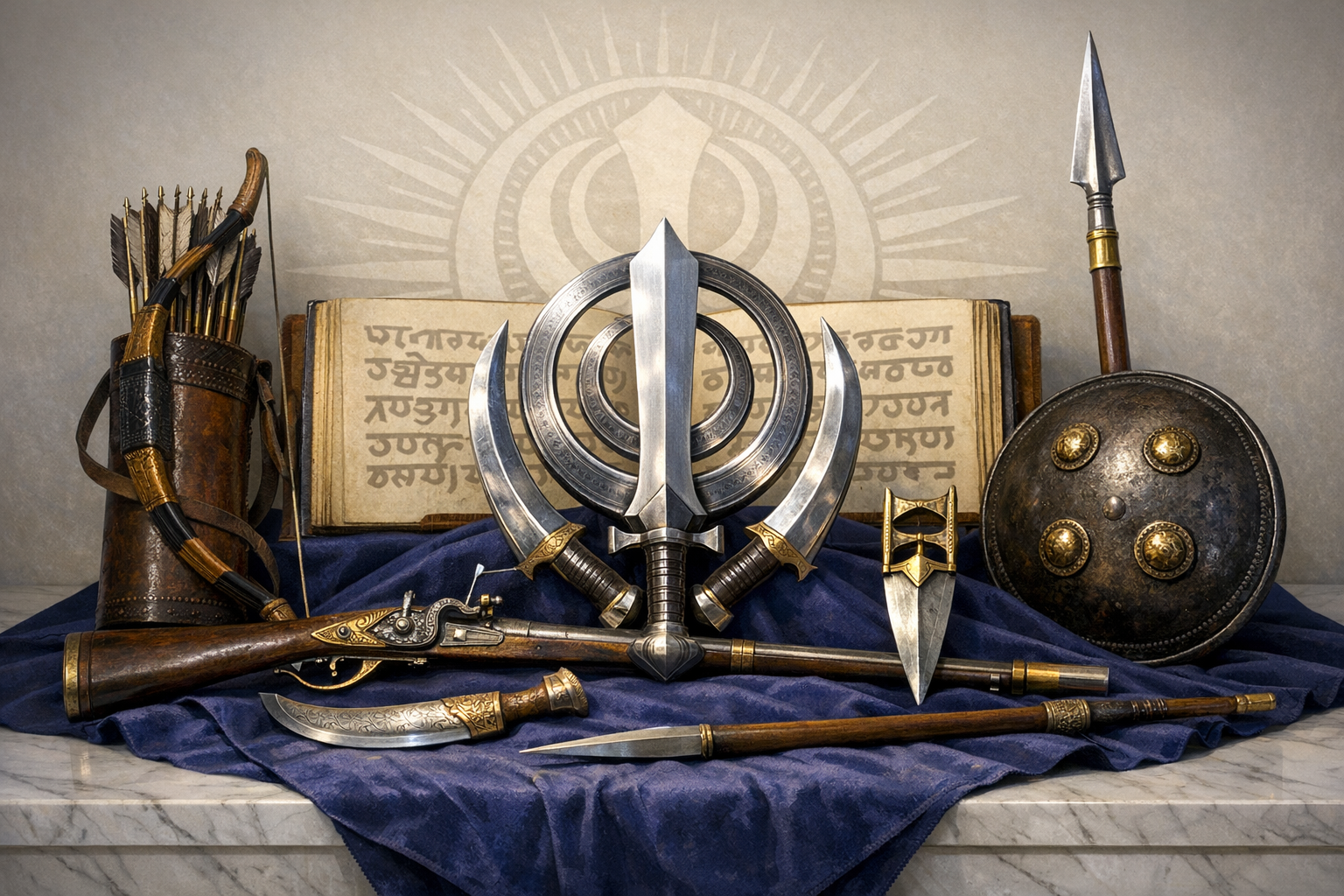
Shastar Naam Mala (literally, a “garland of weapon-names”) is central to the textual treatment of arms. Its cascading epithets weave a taxonomy that spans indigenous and transregional technologies, from ancient Indic arms to Perso-Islamicate innovations. The register is poetic yet precise, saturated with Sanskritic, Punjabi, and Persian-Urdu terms—tegh, kirpan, khanda, katar, barchha, kamān, tir, banduq, and top—each placed within rhythmic praise that elevates martial instruments into reminders of ethical alertness and spiritual grit.
While the Dasam Granth is not a manual of technique, its enumerations align with classical Dhanurveda typologies. Traditional categories include mukta (projectile weapons, released from the hand or a device), amukta (melee or hand-retained weapons), mukta-amukta (weapons that can be both thrown and wielded), and yantra-mukta (projectiles launched by mechanisms such as bows or cannons). Shastar Naam Mala’s inclusivity across these classes signals a theological hospitality toward evolving technologies, so long as their use remains yoked to dharma.
Swords receive especially rich treatment. The khanda, a double-edged straight blade, signifies forthrightness and decisive clarity, and forms the centerpiece of the Khanda emblem, framed by the circular chakkar and flanked by two kirpans. The talwar, a curved single-edged saber characteristic of the subcontinent, favors slashing arcs from horseback. The tegha, commonly a slightly heavier saber, offers reach and authority in cavalry charges. In the textual praise, each blade becomes an attribute of awakened conscience—cutting through adharma as a trained mind cleaves through confusion.
Smaller edged arms embody agility and vigilance. The kirpan, integral to Sikh identity, is the perpetual reminder that readiness is ultimately ethical, not merely tactical. The katar, a push-dagger with an H-shaped grip, permits compact thrusts at close quarters, translating decisiveness into economy of motion. Enumerations in Shastar Naam Mala keep such weapons in the orbit of virtue, where presence of mind and speed of response are sanctified only when undertaken to shield others and uphold truth.
Polearms align reach with discipline. The barchha (spear), neja (lance), and sang (a heavier thrusting implement) extend the warrior’s body and intent, whether on foot or from saddle. Their praise underscores a balance between distance and control—an image of proportionate force—befitting Dharma-Yuddha’s refusal of frenzy. In the cavalry milieu of late medieval and early modern India, such arms worked in concert with sabers to create flexible, ethical responses under command.
Blunt-force and chopping weapons manifest different martial logics. The tabar (battle-axe) punctures and breaks through armored defenses; the gurj or gada (mace) translates weight and timing into decisive shock. These arms recall pan-Indic memory—from Bhima’s gada to Rajput and Sikh battlefield practice—without glorifying brutality. The poetic frame reinscribes even crushing force within the moral architecture of proportion, restraint, and necessity.
Projectile disciplines—tir (arrows) and kamān (bows)—appear as arts of breath, timing, and one-pointedness. Composite and reflex bows enabled high draw weights; bodkin and broadhead arrowheads answered armor and formation problems differently. The metaphoric reading is immediate: the focused arrow resembles a disciplined intention; the bow is the poised mind that stores, releases, and then returns to equilibrium. In community memory, the Nihang tradition’s martial pageantry keeps these correspondences visible.
The chakkar (quoit), still emblematic in Nihang baana, embodies rotational dynamics and tactical unpredictability. Thrown along a flat plane, it combines range with speed, and its uninterrupted circle mirrors the chakkar in the Khanda emblem and, symbolically, the unbroken sovereignty of the Divine. Shastar Naam Mala’s embrace of both mythic and practical discs—from Sudarshan to the martial chakkar—places the weapon between cosmology and craft.
Firearms and artillery enter the Sikh martial lexicon through terms like banduq (musket), tufang (gun), and top (cannon). Their inclusion signals a principled engagement with technology. Rather than resisting innovation, the Dasam vision holds that tools acquire their moral valence from intention and restraint. Historically, matchlocks and later flintlocks altered skirmish and siege dynamics, just as swivel guns and field artillery reshaped mobile warfare on the subcontinental plains.
Defensive equipment appears in the repertoire with equal dignity. The dhal (shield) connotes not only protection but also tactical intelligence, while mail (zirah), helmets (khud), and gauntlets (dastana) register the body’s vulnerability and its disciplined safeguarding. The char-aina (four-plate cuirass) of Persianate origin joined the Indic kit, indexing the transregional exchange of military knowledge that the Dasam Granth acknowledges in its multilingual praise.
The equestrian world of Sikh warfare—saddlery, bits, and barding—infuses the text’s martial imagination with tempo and maneuver. Horses expand the spatial thinking of weapons; lances and sabers acquire new geometries from the saddle. Occasional evocations of gaj (elephant) also recall older Indic repertoires even as early modern tactics increasingly favored cavalry, muskets, and artillery combinations.
Symbolically, the Dasam Granth situates weapons within a shared Dharmic hermeneutic. The sword becomes viveka, the discerning intellect that cuts avidyā. The shield becomes karuna, compassion that absorbs injury so others need not suffer. The bow is dharana, the capacity to hold focused energy; the arrow is a vow. Such readings resonate across traditions—Hindu Ayudha Puja venerates tools of duty, the Buddhist vajra represents indestructible awareness, and Jain teachings speak of conquering inner enemies—showing a civilizational preference for mastery of self as the precondition for any just application of force.
Chandi Charitar and Chandi di Vaar adapt and reinterpret Devi Mahatmya motifs, transposing cosmic combats into ethical narratives for community life. The victory of Shakti in these hymns is not the triumph of a side but the triumph of order over chaos, courage over apathy, and justice over predation. In this light, the Dasam Granth transforms battlefield imagery into a pedagogy of responsibility, courage, and measured strength.
The poetics of the Dasam Granth—from alliteration to onomatopoeia—serves embodied learning. Recitation patterns mirror drill cadence; soundscapes evoke the snap of bowstrings or the arc of sabers. The blend of Braj and Punjabi, spiced with Persian-Urdu terminology, makes the vocabulary at once elevated and operational, allowing the scripture to function as a mnemonic for values and a lexicon for practice.
Ritually and socially, these hymns live in festivals and institutions. Hola Mohalla choreographs shastra-puja and demonstrations of gatka and shastra-vidya, reaffirming social ethics alongside skill. This aligns with wider Indic customs such as Navaratri’s Ayudha Puja, where tools and instruments are honored as extensions of righteous livelihood. The continuity demonstrates that martial symbolism in the Dasam Granth aims at community cohesion and ethical formation, not belligerence.
The ethical architecture is explicit: weapons exist to protect the weak, oppose tyranny, and restore balance—never to intimidate or dominate. In Sikh praxis, the kirpan is an article of faith enshrining vigilance and compassion. Read together with Dharma-Yuddha principles across Indic traditions, this yields a trans-sectarian ethic of minimal, proportionate, and restorative force under the sovereignty of truth.
Manuscript histories and debates about the Dasam corpus’s compilation are well known in Sikh studies. Early birs with variant orders and inclusions reflect the dynamism of transmission. Yet, across interpretive communities, compositions such as Shastar Naam Mala and Chandi di Vaar have palpably shaped Khalsa sensibility and institutional memory. The enduring consensus is functional and ethical: the hymns form a matrix for disciplined courage within the canopy of devotion.
Intertextually, the Dasam Granth converses with the vast Indic repertoire, from the Mahabharata’s discourses on rajadharma and war ethics to treatises associated with Dhanurveda. The resonance is not derivative imitation but principled convergence: arms and statecraft are legitimate only when animated by dharma and yoked to social protection. This convergence supports a wider Dharmic unity—Hindu, Buddhist, Jain, and Sikh—around the primacy of restraint, justice, and inner mastery.
Technically minded readers will find in the text cues to metallurgy, design, and tactics. South Asian wootz steel facilitated hard yet resilient sword edges; recurved bows stored energy efficiently; chakkar flight benefited from edge and mass distribution; early muskets changed formation depth, while artillery reconfigured mobility. The Dasam Granth’s inclusive praise treats such innovations as morally admissible only when subordinated to service and stewardship.
Contemporary relevance follows naturally. To communities today, the Dasam Granth encourages a synthesis of spiritual anchoring, physical discipline, and ethical clarity. It offers a framework for security that refuses securitization of the soul; it fosters courage that resists cruelty; it inspires unity without uniformity by honoring the diverse Dharmic grammars through which compassion and protection are practiced.
In sum, weaponry in the Dasam Granth Sahib is never an end in itself. It is a vehicle of remembrance and responsibility, illuminating how power must be trained by devotion, and how courage must be governed by conscience. In that disciplined convergence—blade and bhakti, readiness and restraint—Sikh tradition affirms an ideal shared across Dharmic horizons: strength in the service of truth, for the safeguarding of all.
Inspired by this post on SikhNet – News.