
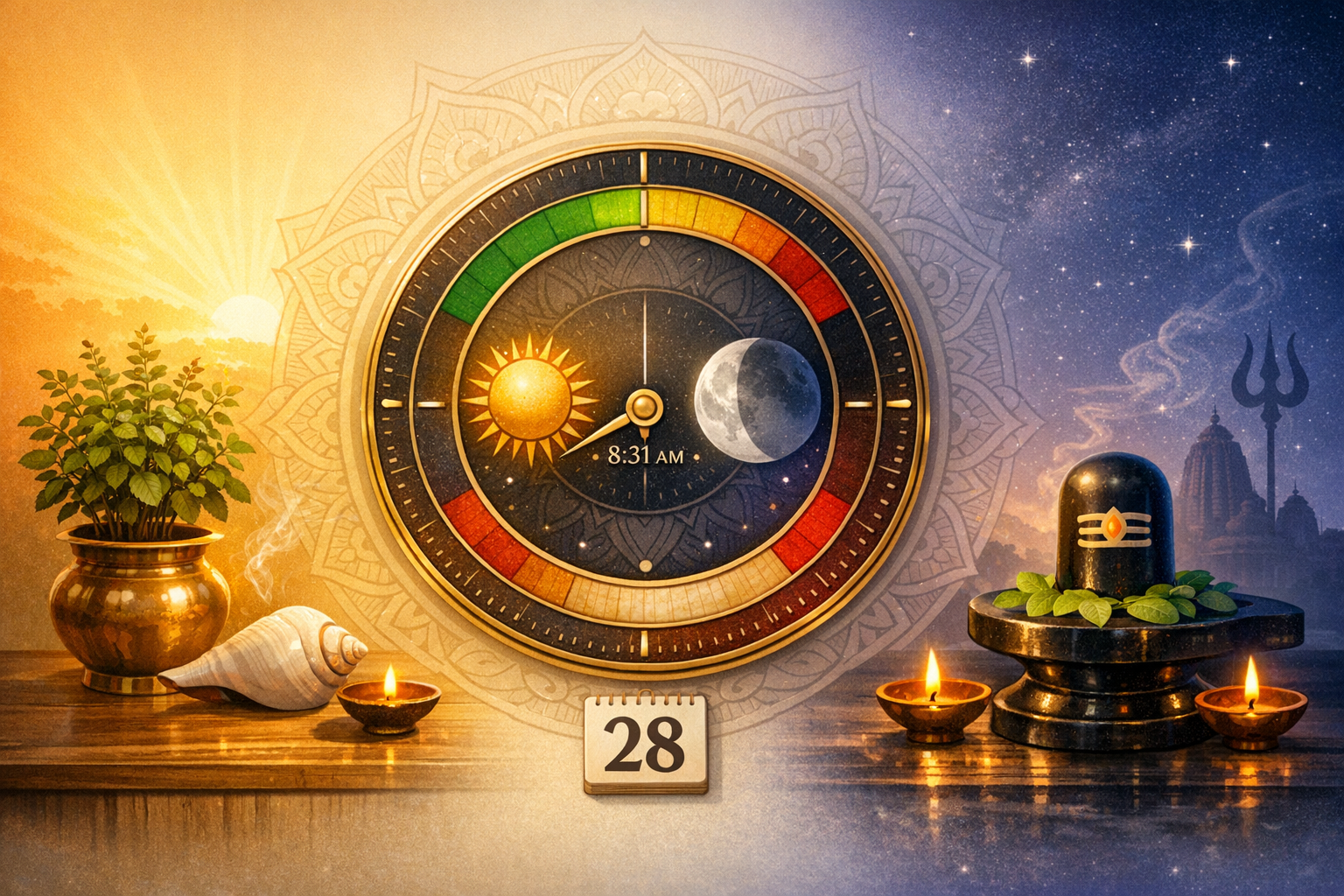
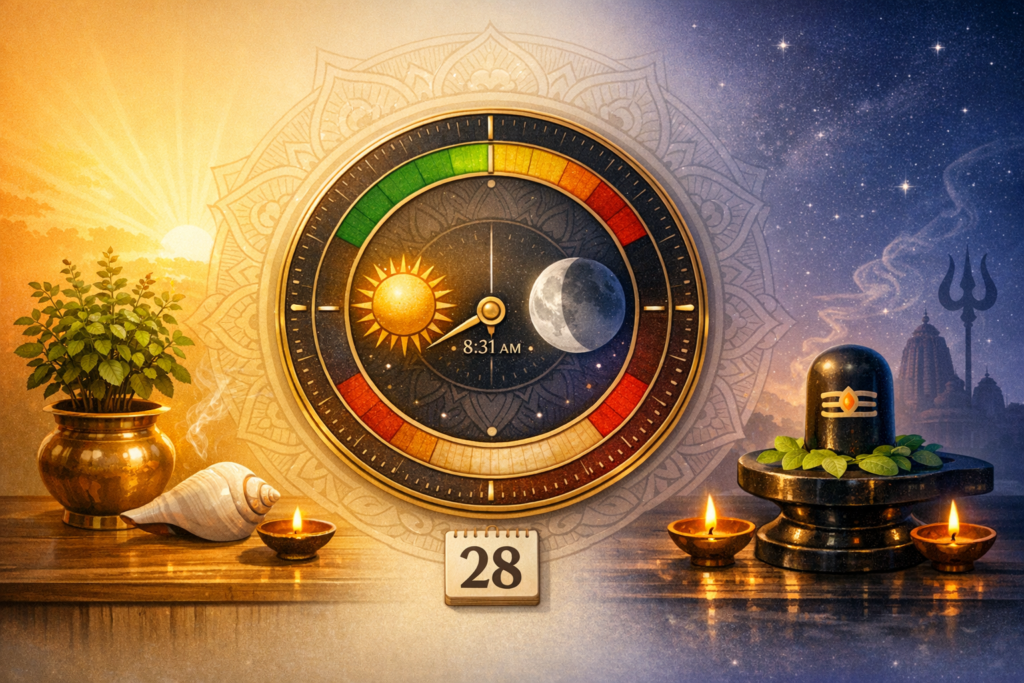
On Thursday, May 28, 2026, according to the Hindu Calendar (Panchang) followed in most regions, the day begins with Shukla Paksha Dwadashi tithi and transitions to Shukla Paksha Trayodashi tithi at 8:31 AM on May 28. Thus, Dwadashi prevails through the early morning, and Trayodashi governs the remainder of the day and evening. This tithi sequence structures the day’s auspicious windows (muhurat), frames Ekadashi parana considerations, and, because of the Trayodashi evening, aligns with the observance of Pradosh (Shukla Pradosham) in many locales.
A tithi is a lunar day, defined by every 12° increment in the angular separation (elongation) between the Moon and the Sun. Because the Moon’s apparent motion is not uniform, a tithi can be slightly shorter or longer than a civil day segment. The governing tithi for ritual purposes is determined at the specific time of the activity, and many observances additionally require the tithi to prevail during sunrise or during a designated ritual window, such as pradosha kāla near sunset.
Minor variations in tithi start and end times across Panchangs occur due to different computational canons (for example, drik-gaṇita using modern ephemerides versus traditional siddhāntic parameters), local sunrise times, and time zones. For practical observance, regional Panchangs and temple calendars typically standardize times for a city or region; diaspora communities should convert these to local time with care, especially where daylight saving time is in effect.
Significance of Shukla Paksha Dwadashi: In the Vaishnava tradition, Dwadashi morning often serves as the parana window for breaking the Ekadashi fast observed the previous day. When Dwadashi extends into the morning, as it does until 8:31 AM on May 28, parana is generally performed after sunrise and within the prescribed Dwadashi interval, unless the concluding phase of Ekadashi, known as Harivāsara, overlaps sunrise, in which case parana follows the end of Harivāsara. Local Panchang guidance should be followed to honor the correct parana period.
Ritual cadence on Dwadashi commonly includes Tulasi worship, recitation of Vishnu-sahasranāma, light dāna (charity), and simple sāttvika meals post-parana. Many households experience the Dwadashi morning parana as a moment of collective relief and gratitude, allowing the remainder of the day to be conducted with steadiness and mindfulness.
Significance of Shukla Paksha Trayodashi: If Trayodashi prevails during pradosha kāla (the twilight segment roughly 1.5 hours straddling sunset), the day is observed as Shukla Pradosh (Pradosham). Because Trayodashi begins at 8:31 AM on May 28, it will generally remain in force through the evening in most Indian regions, making this a likely Pradosh day. The hallmark observance emphasizes Shiva upāsanā, with worship focused during pradosha kāla; devotees often perform dīpa, bilva-patra offerings, and contemplation on humility and inner clarity.
Good Time (Auspicious Muhurats): Beyond the tithi, auspicious scheduling on May 28 can be refined using universal Panchang frameworks. Abhijit Muhurat is centered on the local true noon and spans a short interval symmetrically around it; it is frequently used for urgent or high-stakes undertakings when other strong muhurats are not readily available. Because true noon is location-specific, one should calculate it from the local sunrise-to-sunset midpoint to identify the Abhijit window accurately.
Rahu Kalam, Yamaganda, and Gulika are avoidance periods derived by dividing the daytime into eight equal parts from sunrise to sunset. For Thursday, Rahu Kalam falls in the sixth daytime segment (commonly approximated near early afternoon, e.g., around 1:30–3:00 PM for a 6:00 AM–6:00 PM day), Yamaganda in the first segment (early morning), and Gulika in the third segment (late morning). These intervals scale with local sunrise and sunset; practitioners should recompute them precisely for their location on May 28 to steer clear of inauspicious windows for initiatory tasks.
Choghadiya, widely used for day planning in western and northern India, classifies time into rotating qualities: Amrit, Shubh, and Labh are favorable; Char is generally acceptable; Rog, Kaal, and Udveg are to be avoided for beginnings. On a Thursday, the daytime Choghadiya cycle starts at sunrise and proceeds in its standard sequence; identifying Amrit–Shubh–Labh slots that also avoid Rahu Kalam and Gulika can refine the auspiciousness of the chosen window.
Nakshatra and Rashi: Nakshatra denotes the 13°20′ lunar mansions along the ecliptic; Rashi denotes the 12 zodiacal signs (30° each). The prevailing Nakshatra and the Moon’s Rashi change with the Moon’s longitude and can shift within the day. For May 28, 2026, determining the operative Nakshatra and Rashi for a specific city requires consulting a regional Panchang or an ephemeris-based calculator that reports the Moon’s ecliptic longitude and maps it to the corresponding Nakshatra and sign. Individuals typically choose worship times that harmonize the tithi with the Nakshatra active during the intended ritual.
Practical planning for May 28, 2026: Activities benefiting from the continuity and grace of Vishnu may be emphasized in the morning during Shukla Paksha Dwadashi, particularly after Ekadashi parana for those who observed the fast. Workplace meetings, study, or travel bookings can be aligned with Abhijit Muhurat or a favorable Choghadiya, ensuring that Rahu Kalam, Yamaganda, and Gulika are avoided. In the evening, those honoring Shukla Pradosh may focus on meditative Shiva worship during pradosha kāla, cultivating equanimity and restraint as the mind naturally turns inward at dusk.
Regional calendar notes: Differences between Amānta (month ending on Amavasya) and Purnimānta (month ending on Purnima) traditions affect month names but not the tithi mechanics for a given civil date. Additionally, local sunrise definitions (geographical latitude, horizon conditions) can slightly shift muhurat windows. When two tithis span a sunrise, most ritual rules privilege the tithi present at sunrise for the day’s designation, while some observances, such as Pradosh, require the relevant tithi to prevail during the specific worship window.
Time-zone and diaspora guidance: The 8:31 AM transition on May 28 is typically referenced for Indian Panchangs; outside India, the same astronomical moment converts to local time zones and may shift the civil date if far west or east. To preserve accuracy, diaspora communities are encouraged to use locally computed Panchangs or authoritative temple calendars that already account for the regional longitude and daylight saving adjustments.
Shared dharmic resonance: While the terminology here is rooted in the Hindu Panchang, the broader dharmic family—Buddhism, Jainism, and Sikhism—also honors lunar rhythms in distinct ways (for example, Uposatha in Buddhism, upavāsa and paryushan timing in Jainism, and historical usage of the Bikrami calendar in Sikh tradition). Across these paths, periodic fasting, ethical reflection, and evening contemplative practices cultivate mindfulness, compassion, and self-restraint, underscoring unity in the pursuit of dharma and inner clarity.
In sum, May 28, 2026 offers a well-contoured spiritual arc: Shukla Paksha Dwadashi through the early morning supports thoughtful Ekadashi parana and Vishnu-centered remembrance; from 8:31 AM onward, Shukla Paksha Trayodashi sets the stage for Shiva-focused Pradosh during pradosha kāla. Planned with attention to Abhijit Muhurat, favorable Choghadiya, and avoidance of Rahu Kalam, Yamaganda, and Gulika, the day’s Panchang can be used as a practical compass to align duties, worship, and well-being with the subtle cadence of the lunar cycle.
Inspired by this post on Hindu Blog.




Leave a Reply
You must be logged in to post a comment.