The question ‘Does God really exist?’ persists across ages, often surfacing most sharply in moments of suffering. Indic traditions approach this question with a distinctive framework: the world functions according to Yuga Dharma, the moral and spiritual tenor appropriate to a cosmic age. In the fourth Yuga (Kali Yuga), ethical confusion, social strain, and inner restlessness intensify; yet this very climate is said to make simple, sincere practice especially potent. Rather than dismissing suffering, the dharmic lens interprets it as a signal to inquire, realign, and act with compassion.
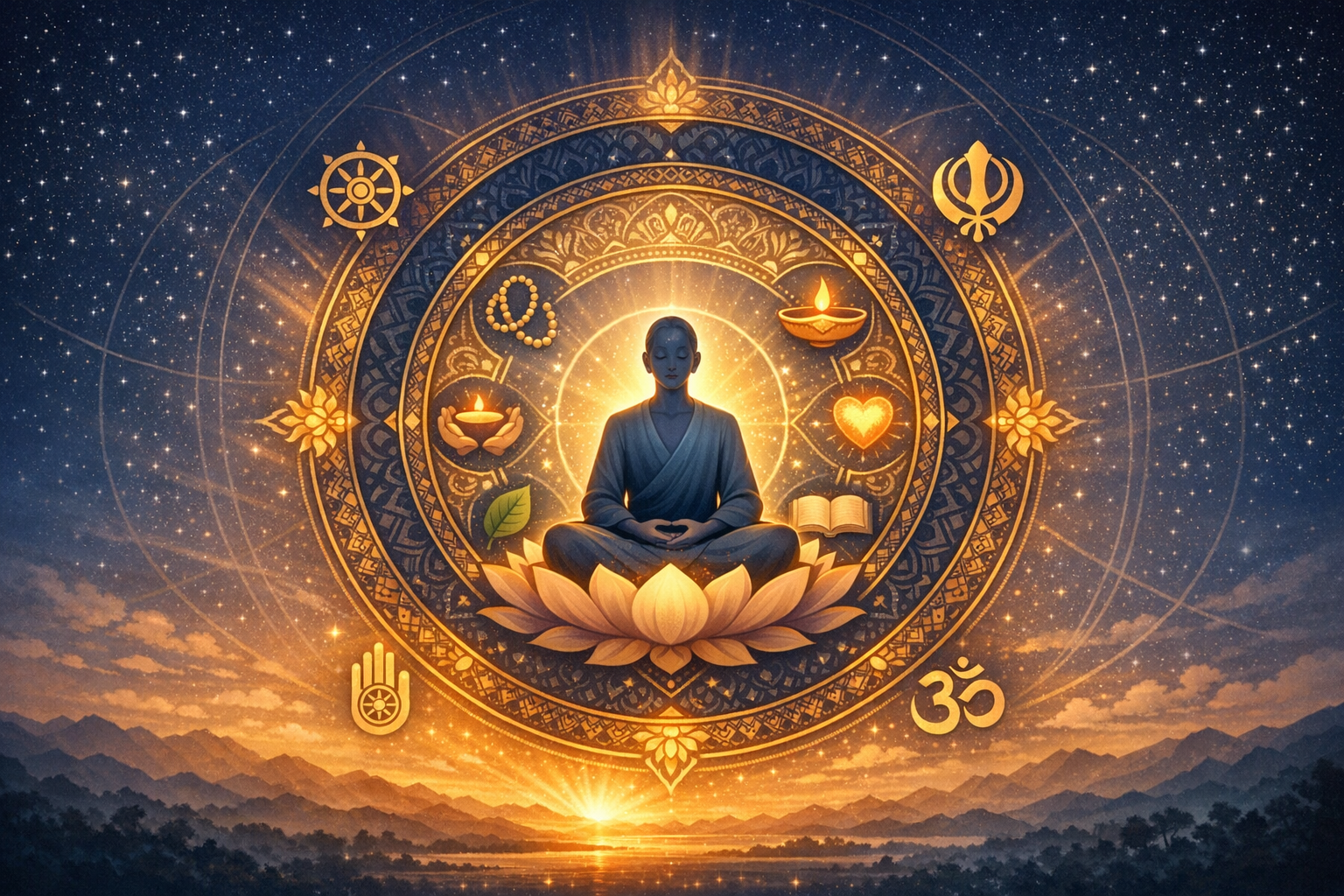
Yuga Dharma, classically described in Hindu Puranic and Itihasic literature, outlines four erasSatya, Treta, Dvapara, and Kalieach with distinct spiritual conditions and recommended disciplines. In Kali Yuga, textual sources emphasize readily accessible means: remembrance of the Divine Name (nama-japa), devotion (bhakti), ethical restraint (yama-niyama), and service (seva). Comparable emphases appear across dharmic paths: Sikh simran and seva, Buddhist mindfulness and mettā, and Jain ahiṃsā and aparigraha. The shared intuition is clear: when outer complexity rises, inner simplicity and ethical steadiness yield transformative results.
At the heart of the existential puzzle lies suffering. In Indic thought, suffering is not divine punishment but a lawful consequence within samsara under the moral dynamics of karma and rebirth. Rather than positing a single theodicy, these traditions frame suffering as a motivator for self-knowledge and compassionate action. Under Yuga Dharma, the practical question becomes: what method most reliably reduces suffering and cultivates wisdom in the present age?
Any reasoned exploration begins with epistemology. Classical Indian philosophy examines pramāṇavalid means of knowingsuch as pratyakṣa (direct perception), anumāna (inference), and śabda (reliable testimony, including scripture and the testimony of realized sages). Across traditions, disciplined practice yields refined forms of experiencesometimes termed yogic or contemplative perceptionwhereby moral clarity and insight are directly tasted rather than theorized. This interplay of experience, reason, and testimony shapes how the Divine, or ultimate reality, is approached.
Within Hindu philosophy, Vedānta articulates Brahman as ultimate reality, understood as both immanent and transcendent. Advaita Vedānta emphasizes nonduality and the identity of ātman with Brahman (echoed in the mahāvākya tat tvam asi), while Viśiṣṭādvaita and Dvaita uphold enduring distinctions between the individual self and Īśvara (God), thereby foregrounding devotion as a path to liberation. The Bhagavad Gita integrates these strands, presenting Īśvara as the ground of moral order and the inner guide of beings, while also affirming experiential yoga as a verifiable method.
Naiyāyikas (Nyāya philosophers) construct rigorous inferences for Īśvara as an intelligent cause, drawing on order, lawfulness, and the intelligibility of the cosmos. Vaiseṣika atomism pairs with Nyāya logic to argue that the coordination of causes, regularities, and teleological features are best explained by a superintending consciousness. Other schools nuance this picture: Sāṅkhya is non-theistic in its classical form, positing Puruṣa and Prakṛti without a creator, while Yoga recommends īśvara-praṇidhāna (devotion to a special puruṣa) as a practical aid to still the mind and attain samādhi.
Buddhism reframes the inquiry: rather than asserting or denying a creator God, it foregrounds dukkha (suffering), its origin, cessation, and the path. Dependent origination (pratītyasamutpāda) explains phenomena through interdependent causes without requiring an omnipotent deity. Devas appear in Buddhist narratives, yet none is ultimate; liberation culminates in nirvāṇa, the extinguishing of afflictions and the direct realization of the unconditioned. Thus, the pragmatic question is not metaphysical allegiance but whether a path verifiably reduces suffering and ignorance.
Jainism offers another rigorous perspective. The universe is beginningless, composed of jīva (conscious beings) and ajīva (non-conscious substances), bound by karmic particles in precise moral causality. There is no creator God; instead, perfected beings (Jinas, Tīrthaṅkaras) embody omniscience and liberation, serving as exemplars. Anekāntavāda, the doctrine of many-sidedness, cautions against absolutism and provides a philosophical basis for inter-traditional respect, suggesting that ultimate truth surpasses any single verbal formulation.
Sikh thought proclaims Ik Onkara single, formless, timeless Reality (Akal) that infuses all existence. God is simultaneously transcendent and immanent, beyond attributes (nirguṇa) yet apprehensible through Name (saguṇa) in devotion. Alignment with hukam (the divine order) unfolds through simran (remembrance) and seva (selfless service), cultivating humility, equality, and moral courage. In this view, the question of God’s existence interweaves with the quality of one’s life in truth, justice, and love for all beings.
Across these dharmic traditions, a striking convergence appears: moral transformation precedes and deepens metaphysical insight. Whether one speaks of Brahman, Īśvara, Ik Onkar, or the unconditioned, the lived disciplines of compassion, truthfulness, self-restraint, and contemplative steadiness open a reliable avenue to freedom from suffering. Unity in spiritual diversity is not a slogan but a methodological consensus: many valid paths, one shared human aspiration.
Contemporary scientific reflection enriches, but does not settle, the question. Cosmology reveals lawful emergence, astonishing fine-tuning in constants, and mathematical elegance. While such features suggest deeper intelligibility, they do not compel a single metaphysical conclusion. Consciousness research likewise highlights a persistent explanatory gapthe hard problemwhich contemplative traditions address through first-person disciplines rather than exclusively third-person analysis.
Moral experience further complicates reductionist accounts. The call of conscience, the reality of meaning, and the universality of ethical intuitions resonate with the dharmic concept of Dharma as objective moral order. This does not prove God in a deductive sense, but it supports the rationality of spiritual life: to live as if reality is intelligible, goodness is real, and wisdom is attainable.
Given Yuga Dharma and the conditions of Kali Yuga, practical synthesis matters. Time-tested disciplines include: bhakti (devotion), nama-japa (Divine Name remembrance), dhyāna (meditation), svādhyāya (study of scriptures such as the Upanishads and Bhagavad Gita), ahiṃsā (non-violence), dana (generosity), and seva (service). Complementary practices across traditionsSikh simran and langar, Buddhist mindfulness and mettā, Jain pratikraman and aparigrahademonstrate that inner clarity and outer compassion reinforce one another.
A simple daily framework aligns with this age: begin with remembrance (simran or japa), cultivate attention through meditation, study a few verses from a revered text, practice one concrete act of service, and close the day with honest self-reflection. Such a regimen is modest yet cumulative, producing measurable shifts in equanimity, ethical responsiveness, and clarity of purpose.
Doubt should not be pathologized; it is an intelligent companion when guided by sincere inquiry. Classical traditions call for viveka (discernment), parīkṣā (critical examination), and satsanga (good company) to refine understanding. In this spirit, dialogue among Hindu, Buddhist, Jain, and Sikh practitioners becomes a shared laboratory of the sacred, where diverse insights illuminate one human quest.
What then of the original question? In Indic philosophy, ‘Does God exist?’ is not answered once and for all by argument alone. Rather, reason prepares the ground, ethical living purifies intention, contemplative practice yields experience, and reliable testimony helps integrate that experience responsibly. Under Yuga Dharma, this integrative path is held to be especially suited to the present age.
In conclusion, the claim that the world functions under Yuga Dharma, and that humanity is presently in the fourth Yuga, situates suffering within a broader moral and spiritual ecology. Whether one speaks of Brahman and Īśvara, the unconditioned nirvāṇa, the perfected wisdom of the Jinas, or Ik Onkar, the shared imperative is clear: cultivate compassion, deepen insight, and serve the whole. In that unified commitmentVasudhaiva Kutumbakam, the world as one familythe question of God evolves from abstraction into a life lived in truth.
Inspired by this post on Hindu Pad.