-
Shaurya Vrata: Timeless Vow of ValorScriptural Roots, Warrior Codes, and Living Ethics

Śaurya Vrata (शौर्य व्रत) unites scriptural vrata discipline with the historical ethics of kṣātra-dharma, defining valor as compassionate, restrained, and service-oriented strength. This comprehensive guide clarifies its roots in the Puranas and the Mahabharata, explains how ritual components like sankalpa, niyamas, japa-dhyāna, and śāstra/āyudha-pūjā cohere, and shows how communities align observances with Navaratri, Vijayadashami, Skanda…
-
Guru Gobind Singh’s Charaina at Bhangani: Forging the Sacred Saint‑Soldier Ideal

The charaina associated with Guru Gobind Singh at the Battle of Bhangani embodies a rare convergence of metallurgy, martial science, and Sikh spiritual ethics. This analysis explains the armor’s four‑plate design, its performance against period threats, and how artisans balanced protection with agility for cavalry and mixed infantry tactics. It situates the charaina within the…
-
Historic 327th Baisakhi: Khalsa Spirit and Dharmic Unity Ignite Gatherings Worldwide

The historic 327th Baisakhi united Sikh communities across India and the global diaspora in a powerful commemoration of Khalsa Sirjana Diwas. Centered on Amrit Sanchar, kirtan, Ardas, and the Hukamnama, observances highlighted discipline, equality, and the living legacy of Guru Gobind Singh’s 1699 institution of the Khalsa. Processions (Nagar Kirtan) and Gatka demonstrations intertwined martial…
-
Baba Deep Singh Ji: Scholar‑Warrior who safeguarded the Guru’s Word and Amritsar’s sanctity

Baba Deep Singh Ji (1682–1757) embodies the Sikh Sant‑Sipahi ideal, uniting rigorous scholarship with principled courage. This comprehensive account situates his formation at Anandpur Sahib and Damdama Sahib, his role in scribing and standardizing Gurbani manuscripts, and his leadership within the Dal Khalsa and the Shaheedan Misl. It presents the 1757 defense of Amritsar with…
-
Baba Deep Singh Ji: Scholar‑Soldier of the Khalsa and Guardian of the Golden Temple

Baba Deep Singh Ji embodied the Sikh sant‑sipahi ideal by uniting deep scholarship with principled courage, ensuring the protection of sacred spaces and the continuity of learning. Set against the turbulence of eighteenth‑century Punjab, his work at Damdama Sahib safeguarded scriptural integrity while his leadership helped restore access to Harmandir Sahib after its desecration in…
-
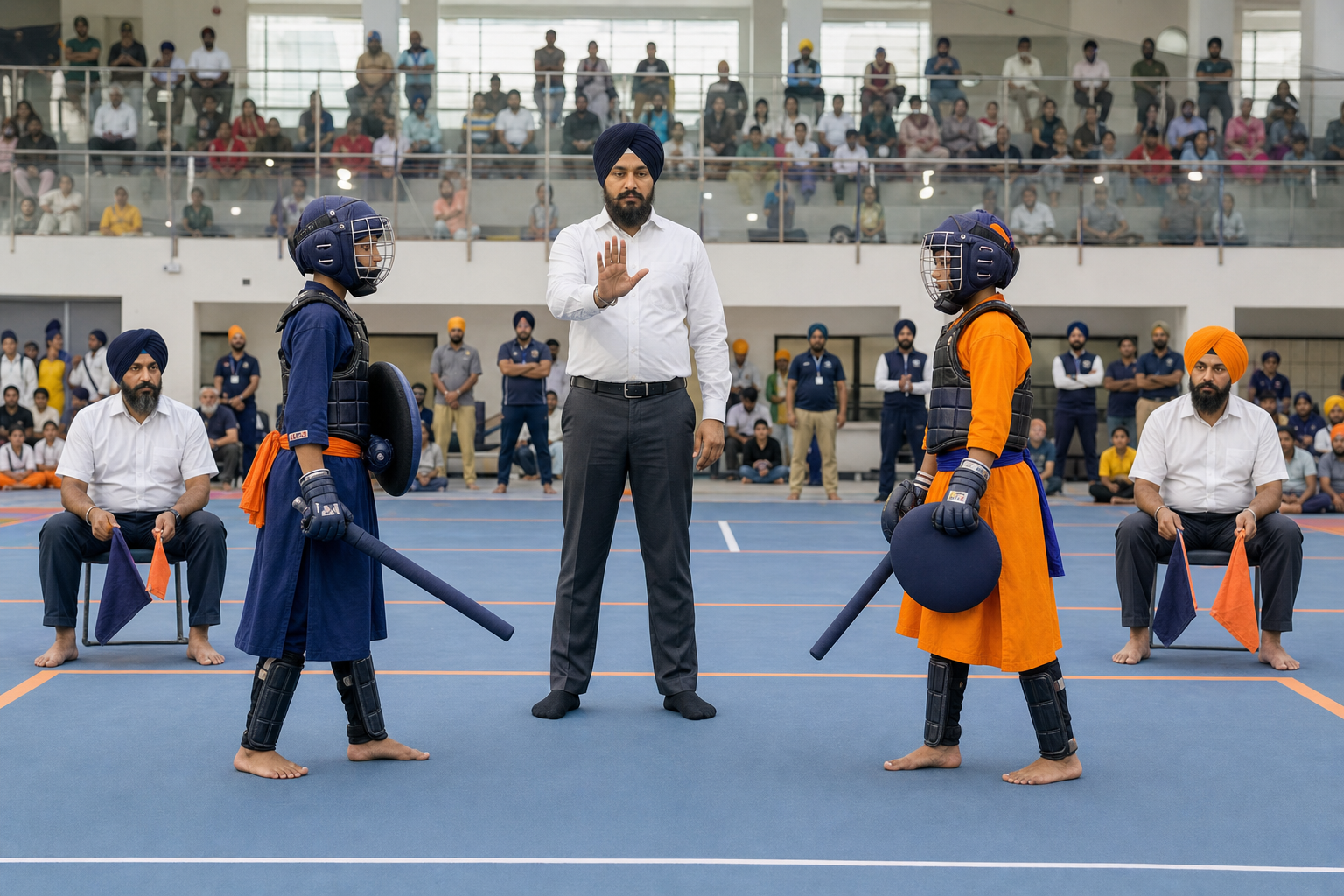
12th State Gatka Championship for Girls: Precision, Courage, and Dharmic Unity on Display

The 12th State Gatka Championship for Girls showcased a disciplined, safety-first competition rooted in the Sikh martial tradition, highlighting precision, timing, and ethical strength. Organized with standardized rules and protective equipment, it balanced point-sparring duels with judged demonstrations that rewarded control, coordination, and cultural literacy. Athletes benefited from periodized training, sports medicine awareness, and psychology-informed…
-
Vaisakhi Through Sikh Art: An Invitation to the VillaA Powerful Blueprint for Unity

This exhibition blueprint frames Vaisakhi as an academic and community-centered journey through Sikh art within an intimate villa setting. It traces the Khalsa’s founding at Anandpur Sahib, highlights Gurmukhi calligraphy and manuscript traditions, and situates paintings, textiles, and martial regalia within rigorous historical context. Preventive conservation, ethical display practices, and bilingual interpretation ensure scholarly integrity…
-
Forged in Faith: Weaponry in the Dasam Granth SahibHistory, Shastra-Vidya, and Symbolic Power

Weaponry in the Dasam Granth Sahib is presented as a disciplined convergence of steel and spirit, where shastra-vidya is sanctified by ethics and devotion. Set in the historical crucible of the Khalsa’s formation, these hymns catalog armsfrom khanda and kirpan to chakkar, banduq, and topwhile binding their use to Dharma-Yuddha principles. The text’s poetic multilingualism…
-
Baisakhi (Vaisakhi) 2026 on April 14: Sikh New Year, Harvest Joy, and Mesha Sankranti

Baisakhi (Vaisakhi) 2026 falls on April 14 in India, uniting Sikh New Year observances, Khalsa remembrance, and Punjab’s harvest celebrations with the pan-Indian solar milestone of Mesha Sankranti. The date aligns with 1 Vaisakh in the Solar Nanakshahi framework while also intersecting with regional new-year festivals like Puthandu, Vishu, Rongali Bihu, and Maha Vishuva Sankranti.…
-
‘Nari Samarthyachi Navi Pahat’ Jalgaon: Actionable Self‑Defence and Dharmic Heritage for Women

On 7 March in Jalgaon, Maharashtra, the Ranragini wing of the Hindu Janajagruti Samiti will host “Nari Samarthyachi Navi Pahat,” a women’s empowerment programme focused on self-defence awareness and cultural heritage. The initiative emphasises prevention, de-escalation, and proportionate response, supported by practical movement drills and verbal boundary-setting. Participants benefit from legal literacy on the right…
-
Honoring Sikh Women: Trailblazing Courage, Seva, and Scholarship for International Women’s Week

International Women’s Week highlights the enduring leadership of Sikh women in seva, scholarship, and public life. Grounded in Gurbani’s affirmation of equality“ਸੋ ਕਿਉ ਮੰਦਾ ਆਖੀਐ ਜਿਤੁ ਜੰਮੇ ਰਾਜਾਨ॥”their contributions span the langar tradition of Mata Khivi, the martial resolve of Mai Bhago, and the statecraft of Rani Sada Kaur. From heritage stewardship to humanitarian response,…
-
Gulsatrān in Sikh Shastar Vidya: The Archer’s Thumb Ring Shaping Courage and Unity

Gulsatrān (Archer’s Thumb Ring) holds a vital place in Sikh Shastar Vidya, where technique and ethics meet. This overview explains how the ring’s protection of the thumb enables a consistent, powerful release while reinforcing discipline and restraint. It traces cross-cultural origins from Persianate zihgir to Mughal-era craftsmanship and Panjab’s martial context. Readers gain practical insights…
-
Empowering Safety: Kranti Petkar Calls for Self‑Defence Training for Young Women in Pune

At Dance Festival 2025 in Pune, Ms. Kranti Petkar of the Ranragini wing emphasized that self‑defence is essential to women’s empowerment. The focus extended beyond techniques to include situational awareness, assertive communication, and de‑escalation. Framed through shared dharmic values, the message aligned personal safety with a unifying ethos across Hinduism, Buddhism, Jainism, and Sikhism. Traditional…
-
NGAI unveils nationwide initiative to empower Gatka officials, elevate safety and fair play
The National Gatka Association of India has launched a nationwide initiative to strengthen Gatka officiating through standardized training, tiered certifications, and harmonized rulebooks. The program prioritizes athlete safety, fair play, and transparent decision-making to build trust among participants and spectators. Inclusive pathways will encourage women, youth, and regional practitioners to join, supported by multilingual resources…
-
Bengaluru to Host a Thrilling Three-Day Gatka Showcase from Nov 7, Celebrating Dharmic Unity

Bengaluru will host a three-day Gatka showcase from November 7, presenting a rigorous and culturally rich program led by experienced Gatkabaz. The event highlights Gatka’s roots in Sikh martial heritage while resonating with shared dharmic values of discipline, compassion, and social responsibility. A progressively structured schedule helps audiences appreciate how advanced forms build from foundational…
-
Martial Arts in Sanatana Dharma: A Comprehensive Guide

Sanatana Dharma is a term used to describe the ancient Indian tradition that encompasses Hinduism, Jainism, Buddhism, and Sikhism. These religions share many fundamental principles and values, including the importance of physical and mental discipline, self-defense, and protection of one’s community. Martial arts have played a significant role in the culture and history of Sanatana…