
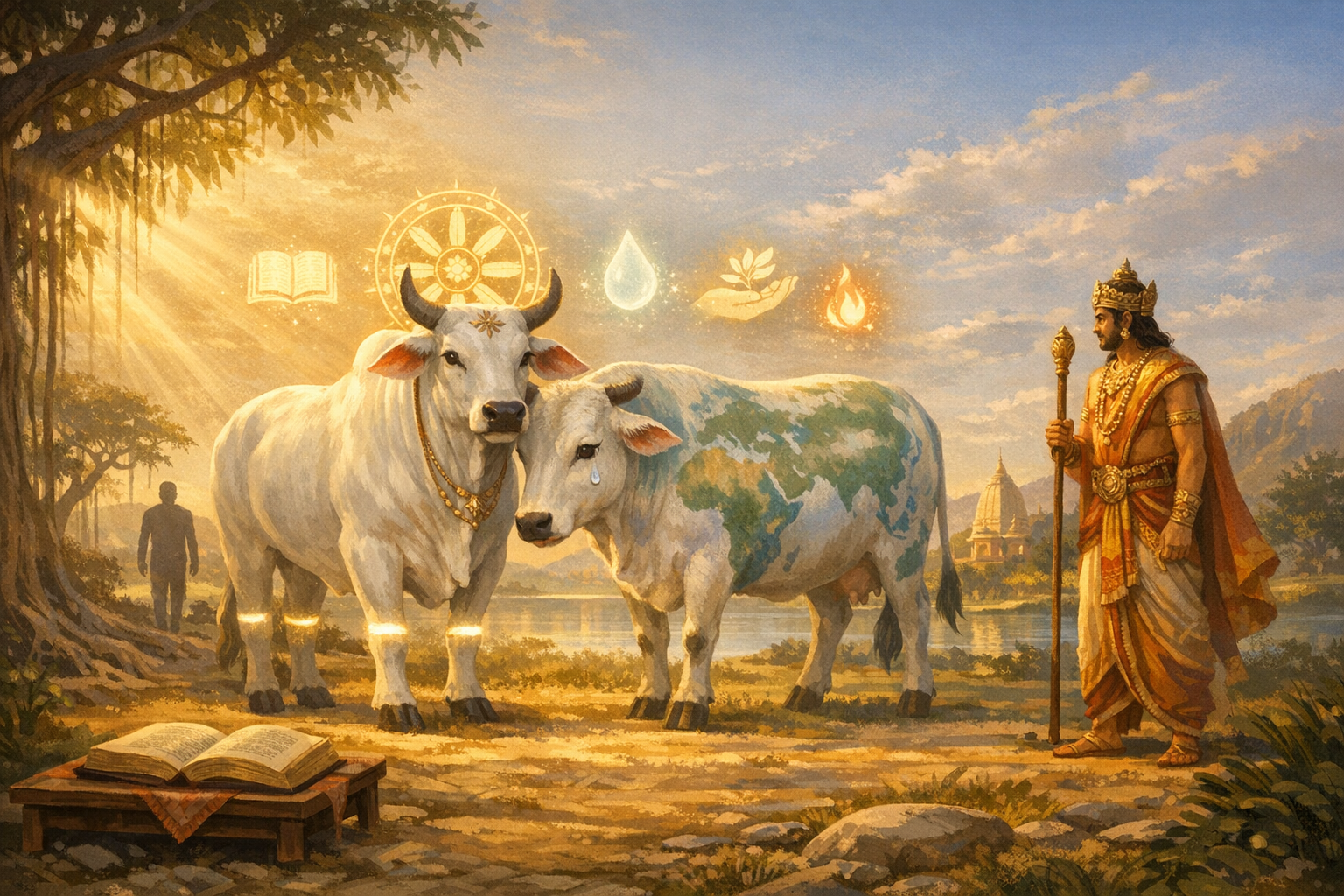

SB 1.16.5 resides within a pivotal narrative arc of the Bhāgavata Purāṇa (Srimad-Bhagavatam), where the transition into Kali‑yuga is rendered visible through a moral tableau: Dharma personified as a bull and Bhūmi (Mother Earth) personified as a cow. Frequently illuminated in SB classes by HDG A. C. Bhaktivedanta Swami Prabhupada (Srila Prabhupada), this section frames the ethical crisis of a new age and the responsibility of just governance through the figure of Mahārāja Parīkṣit. The episode is not mere allegory; it encodes a theory of social health, environmental stewardship, and intergenerational duty consistent with a broad Indic understanding of dharma.
Situated early in the chapter’s development, the verse functions as a hinge that turns the narrative from historical recollection to normative critique. The text’s atmosphere is charged with vigilance: a righteous king tours his realm to directly assess conditions on the ground, revealing a hermeneutic of leadership grounded in pratyakṣa (seeing for oneself) rather than abstraction. This diagnostic posture sets the stage for a face‑to‑face encounter with the very symptoms of Kali—quarrel and hypocrisy—now embodied in an assailant who strikes at Dharma and Earth.
Within the classical exegesis, the Dharma‑bull’s four legs denote satya (truthfulness), śauca (cleanliness), dayā (mercy), and tapas (austerity). The Bhāgavata’s distinctive claim is that in Kali‑yuga only satya initially persists, with the other supports weakened. Srila Prabhupada’s discussions repeatedly draw out the practical correlates of this decline: the erosion of truth manifests in public discourse; uncleanliness appears as environmental and personal negligence; cruelty emerges in institutionalized violence (notably against animals); and the dimming of austerity is discerned in unregulated consumption and addiction. These are not abstractions but measurable social pathologies.
In Srila Prabhupada’s teachings, the cow as Bhūmi symbolizes ecological integrity, food security, and a culture of care; the bull as Dharma symbolizes the rule of law and moral capital that keeps a society coherent. When Kali strikes the bull and the cow, the text is spotlighting systemic failures: moral disarray and ecological damage move together. Parīkṣit’s intervention models rāja‑dharma—swift, proportionate, and values‑based statecraft rooted in daṇḍa‑nīti (just enforcement) to protect the vulnerable and to re‑anchor the polity in shared ethical norms.
Read comparatively across dharmic traditions, the four legs of dharma map naturally onto shared civilizational commitments. Buddhism’s pañca‑śīla prioritize non‑violence, truth, and sobriety; Jainism’s ahiṃsā, satya, asteya, brahmacarya, and aparigraha sharpen an ethic of restraint and accountability; Sikh teachings—kīrat karo (honest work), vand chhako (sharing), and nām japo (remembrance)—anchor social duty and inner discipline; classical Hindu yamas/niyamas articulate a parallel grammar of self‑regulation. In this light, SB 1.16.5 is not sectarian; it is a unifying, dharmic diagnostic that multiple Indic traditions can recognize and reinforce in concert.
Hermeneutically, the personifications of Dharma and Bhūmi are more than poetic devices. They operationalize a systems model: when satya, śauca, dayā, and tapas are strong, social trust, public health, compassion economies, and sustainable consumption co‑rise; as they weaken, corruption, pollution, cruelty, and excess become statistically visible. Srila Prabhupada’s commentarial emphasis—truthful governance, sanctity of life, sobriety, and cleanliness—can be read as policy levers for re‑inflating the legs of dharma in civic space.
Ecologically, the weeping Earth‑cow is a warning against extractive paradigms. The verse’s symbolism anticipates a contemporary sustainability lexicon: planetary boundaries, soil fertility, biodiversity loss, and food ethics. Protection of cows in the Purāṇic frame signals a wider duty of stewardship toward the sources of nutrition and the cycles that maintain life. In this sense, SB 1.16.5 sits comfortably alongside Jain ecological ethics, Buddhist compassion for sentient beings, and Sikh environmental reverence, reinforcing a shared dharmic mandate for care of the living world.
Philologically, the key terms carry layered meaning: “dharma” denotes that which sustains, not merely denominational religion; “Kali” marks a historical‑moral condition of entropy and contention; “Bhūmi” is simultaneously physical earth and moral ecology. Purāṇic hermeneutics thus blend ontology (what is), axiology (what matters), and praxeology (what to do) into one narrative fabric. The verse’s power lies in how it compresses these registers into a single, memorable scene.
Historically, the setting in Naimiṣāraṇya—Sūta Gosvāmī instructing sages—signals continuity between oral transmission and community deliberation. The narrative exemplifies how classical India processed crises: through public counsel, ethical evaluation, and exemplary leadership rather than fatalistic resignation. Srila Prabhupada’s modern pedagogy, delivered in SB classes around the world, reactivates this dialogic method for contemporary audiences.
As praxis, the four‑leg model scales down to the individual and scales up to institutions. At the personal level: satya (transparent speech), śauca (sanitation and digital hygiene), dayā (plant‑forward diets, animal welfare), and tapas (moderation, mindful consumption) create resilient households. At the institutional level: truthfulness becomes open data and audit integrity; cleanliness becomes air/water standards; mercy becomes welfare protections; austerity becomes anti‑corruption, responsible finance, and demand‑side efficiency. These translations keep the Purāṇa’s intent alive in policy and practice.
Governance is central to the chapter’s logic. Parīkṣit’s willingness to confront Kali dramatizes the state’s duty to constrain vice without persecuting people. Srila Prabhupada regularly highlighted this balance: a society prospers when leadership curbs practices that degrade the four legs of dharma, while expanding education, compassion, and pathways for ethical uplift. This is congruent with Kautilya’s daṇḍa‑nīti and with Sikh notions of mīrī‑pīrī (temporal and spiritual responsibility in harmony).
From a literary perspective, the scene’s affect is carefully composed. The battered bull evokes pathos (karuṇa‑rasa); the king’s resolve introduces vīra‑rasa (heroism). The resulting ethical imagination—sorrow transformed into courageous protection—supplies a template for civic action: feel the harm; then organize to heal it. Across Indic traditions, this is a shared rhythm of compassion followed by service (seva).
Contemporary readers regularly recognize these motifs in daily news cycles: rising misinformation eroding satya, public health crises challenging śauca, industrial violence dulling dayā, and compulsive consumption overwhelming tapas. SB 1.16.5 thus reads as a live dashboard rather than an archaic relic, inviting communities—Hindu, Buddhist, Jain, and Sikh alike—to co‑create solutions consistent with their overlapping vows and values.
Crucially, the Bhāgavata’s approach affirms plural spiritual pathways while insisting on shared civic ethics. Srila Prabhupada’s teachings strongly encourage bhakti as a transformative discipline; yet the text’s ethical spine—truthfulness, cleanliness, mercy, austerity—can be cultivated through diverse sādhanā: Hindu japa and vrata, Buddhist mindfulness and śīla, Jain anuvratas and tapas, Sikh simran and seva. Unity in spiritual diversity is not a compromise; it is the dharmic method for stabilizing society while honoring different temperaments and callings.
In sum, SB 1.16.5 offers a compact, rigorous model of moral ecology: Dharma (law and virtue) and Bhūmi (earth and life) rise and fall together. Srila Prabhupada’s SB classes bring this model into sharp contemporary focus, connecting scriptural insight with practical reforms—from personal vows to public policy. Strengthening satya, śauca, dayā, and tapas is the shared dharmic project of the age, and it is one that Hinduism, Buddhism, Jainism, and Sikhism can advance collaboratively, each contributing its strengths toward a stable, compassionate, and sustainable common life.
Inspired by this post on Dandavats.










Leave a Reply
You must be logged in to post a comment.