
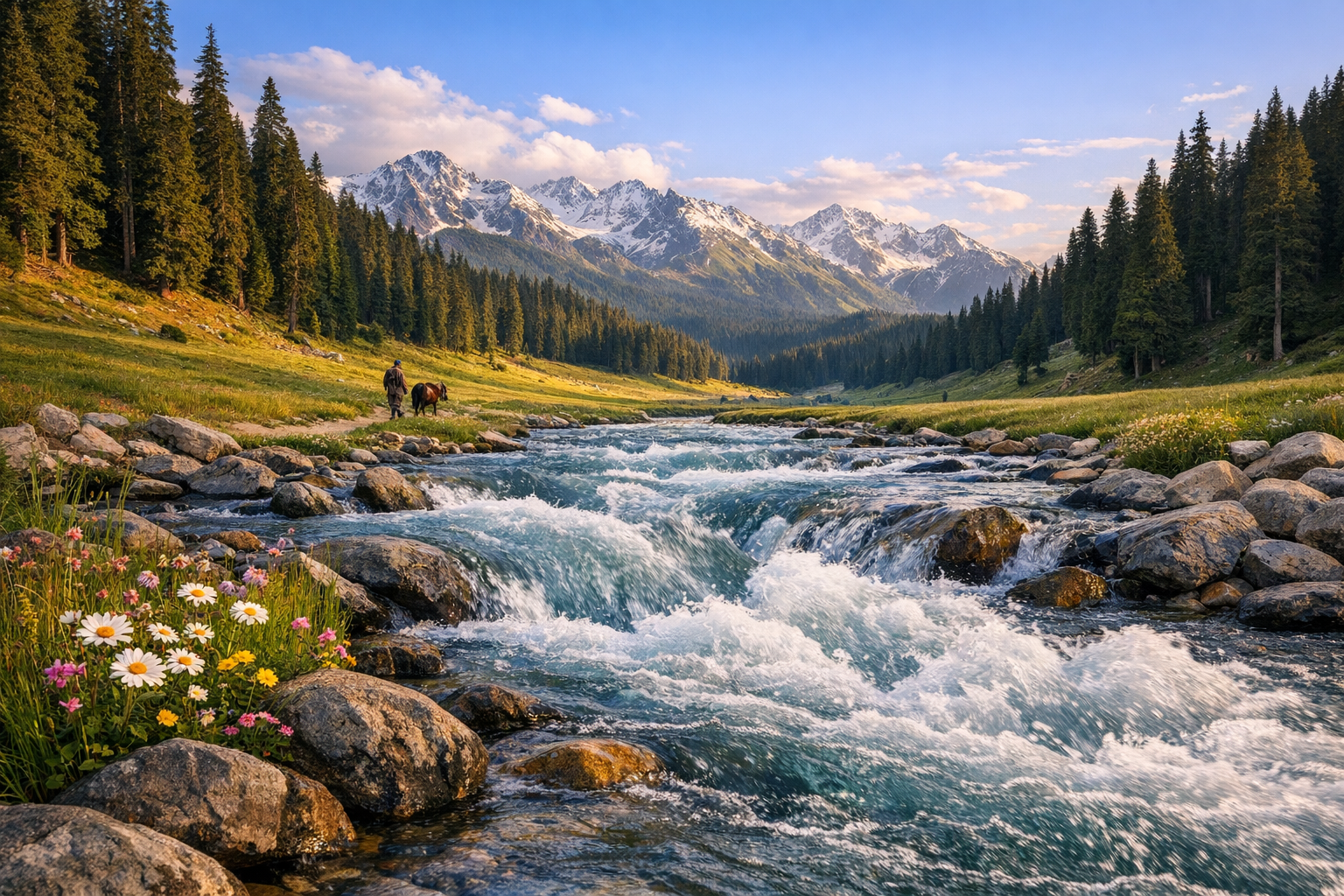
Doodhpathri, often translated as the “Valley of Milk,” is a high-altitude meadow in the Budgam region of Kashmir that rewards careful, unhurried travel. Framed by the Pir Panjal range and threaded by a clear, fast stream, the landscape combines ecological richness with quietude that many visitors find restorative. As a less-crowded counterpart to better-known destinations, it offers a study in Himalayan meadow systems, seasonal hydrology, and living pastoral cultures, while remaining accessible as a day trip or slow two-day pause from Srinagar.
The name Doodhpathri is commonly linked to the milky appearance of the river’s froth as it tumbles over gravel and mineral-laced beds. This etymology captures the sensory experience of the place: a valley floor of emerald meadows where whitewater threads through pastures, bordered by dark conifer silhouettes. Local narratives, languages, and pastoral rhythms all converge here, shaping a landscape that is as cultural as it is geographic.
Geographically, Doodhpathri occupies a broad, bowl-like depression typical of glacially influenced Himalayan terrain. The surrounding ridgelines intercept moisture-laden winds, encouraging orographic precipitation that sustains perennial grasses and wildflowers in the temperate months. The central streamknown locally for its striking clarity and frothacts as the valley’s organizing spine, with side gullies and seepage zones feeding a mosaic of wet and dry meadow patches.
Hydrologically, the river displays textbook headwater behavior: cold, oxygen-rich flows, gravel-cobble substrates, and variable discharge across seasons. During snowmelt and post-monsoon periods, increased turbulence and suspended micro-bubbles can give the water a pale, milky sheen. Such high-energy channels carve shallow banks and create riffle-pool sequences ideal for observing riparian dynamics without the need for long ascents.
The meadow’s ecology reflects a temperate Himalayan assemblage. Around the periphery, conifer stands typical of the Pir Panjalpine, fir, and cedarshelter understories of shrubs and spring ephemerals. Late spring through mid-summer often brings flushes of wildflowers and pollinators, while open swards support traditional grazing by Gujjar and Bakarwal pastoralists. Birdlife includes montane species adapted to mixed grassland and forest edges, offering rewarding, low-impact observation for patient visitors.
Seasonality defines the visitor experience. Heavy winter snow can limit access; in contrast, late spring to early autumn tends to provide comfortable daytime temperatures, long light windows, and stable footing for meadow walks. Afternoon showers can develop quickly; carrying a light shell, sun protection at altitude, and layered clothing improves comfort and safety. Shoulders seasons yield quieter trails, but early snow or lingering wet patches may influence route choices.
Access typically involves a scenic drive from Srinagar toward Budgam, continuing to the upland roadheads that lead into the valley. Travel times vary with weather, road work, and seasonal closures. Local shared cabs, hired vehicles, or organized day tours are common. On arrival, expect basic facilities; it is prudent to carry water, snacks, and a small kit for sudden weather shifts. Mobile connectivity can be intermittent, encouraging a more immersive, device-light visit.
The core experiences in Doodhpathri are deliberately simple and slow. Meadow-side walking allows granular observation of grasses, soils, and micro-habitats, while the riverbank offers restful vantage points for soundscapes and photography. Short, undulating trails reach low ridgelines with panoramic views. Many visitors choose to sit in mindful silence near the water, a practice that dovetails with the valley’s calm. Where available, pony rides offered by locals provide an alternative mode of exploration; travelers can make informed choices aligned with personal comfort and animal welfare considerations.
Engagement with local communities strengthens the sense of place. Basic interactionexchanging greetings, accepting a cup of kahwa when offered, or learning a few phraseshelps sustain community-led tourism. Observing pastoral activity from a respectful distance, yielding right-of-way on narrow tracks, and seeking permission before photographing people or livestock fosters trust and reciprocity.
The valley’s ambience resonates with contemplative traditions across Hinduism, Buddhism, Jainism, and Sikhism, all of which value quiet attention, compassion for living beings, and reverence for nature. In this shared spirit, Doodhpathri can be approached as a living classroom: a setting for reflection on interdependence between land, water, flora, fauna, and human communities. Such a perspective naturally encourages unity-in-diversity, where varied spiritual paths find common ground in stewardship and gratitude.
Responsible travel practices are essential to keep the meadow resilient. Principles include packing out all waste, minimizing single-use plastics, staying on established paths to protect fragile turf and soils, and using refillable bottles. Choosing locally owned services distributes economic benefits more equitably and incentivizes conservation. Quiet hours, low-volume music, and small group sizes preserve the area’s soundscape for wildlife and fellow visitors.
Risk management at altitude is straightforward with preparation. Weather can change rapidly; a waterproof layer, warm mid-layer, and sturdy footwear are advisable. River edges can be slipperymaintaining safe standoff distances reduces fall risk. In shoulder seasons, early dusk and fog occasionally impair visibility, making a headlamp and conservative turnaround times prudent. As always, informing a contact of plans and expected return enhances safety.
Itinerary design can be adapted to time and interest. Many travelers prefer a single unhurried day that includes a meadow walk, riverside pause, and a short ridge viewpoint. Those with additional time can pair Doodhpathri with other Budgam uplands or schedule an overnight in the Srinagar area to balance field time with cultural exploration. Photographers may favor dawn and late afternoon light for contrast-rich meadow textures and river movement.
For visual documentation, Doodhpathri rewards wide-angle lenses for meadowscapes and mid-range primes for river studies and pastoral portraits (with permission). A circular polarizer can cut glare on water and saturate skies. On clear nights, low light pollution enhances stargazing; a compact tripod and fast lens enable short-exposure astrophotography without intensive hiking.
Ultimately, Doodhpathri is best understood as a layered landscape: a Himalayan meadow shaped by water and weather, animated by seasonal pastoral life, and open to quiet, contemplative travel. Approached with curiosity and care, it becomes more than a scenic detourit offers a grounded lesson in ecology, culture, and the shared dharmic ethic of living gently with the land.
Inspired by this post on SikhNet – News.
