

Translating the Infinite invites a precise and devotional kind of listening. In a wide-ranging conversation, Ek Ong Kaar Kaur Khalsa—known for contemporary English renderings of Sikh prayer and Gurbani—articulates a disciplined yet compassionate approach to carrying meaning across languages, traditions, and lived experience. The discussion situates translation as seva, an offering that honours the sonic power, semantic depth, and spiritual authority of the Guru Granth Sahib while making its teachings accessible to a global community. Framed by intellectual rigor and bhakti, the dialogue underscores how a careful hermeneutic can illuminate Sikhism’s core insights and nourish unity among the dharmic traditions of Hinduism, Buddhism, Jainism, and Sikhism.
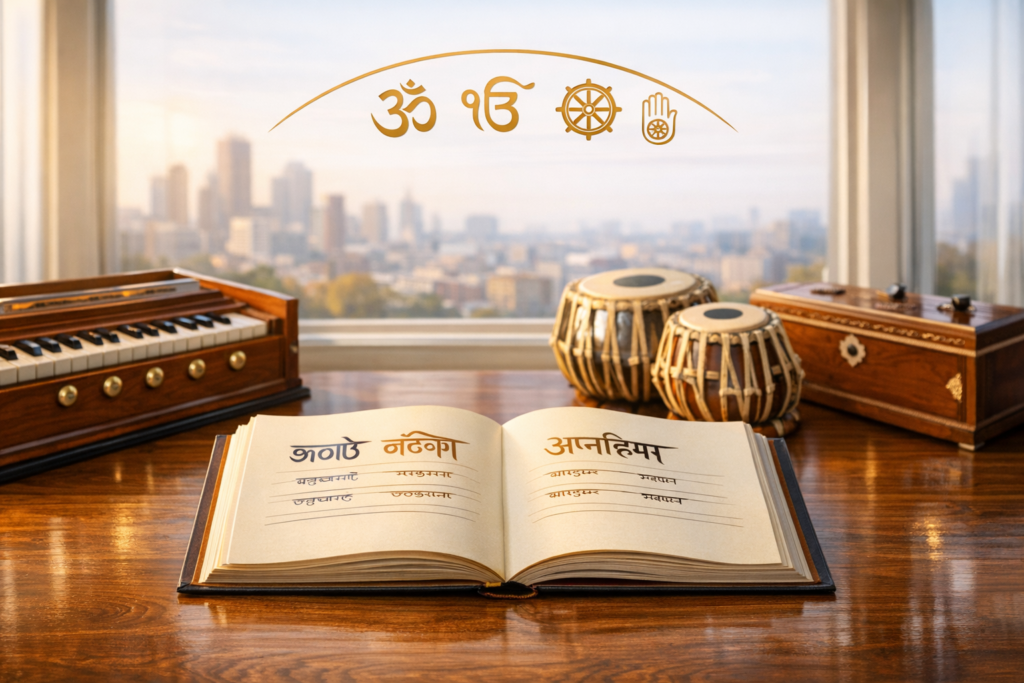
At the heart of the exchange is the recognition that Gurbani is not merely text but revealed Sound—Shabad—carried in Gurmukhi script, performed in raga, and embodied through daily practice. Any Gurbani translation that aims for accuracy must therefore attend simultaneously to meaning (artha), aesthetic experience (rasa), and spiritual function (sadhana). The conversation emphasizes that a translator’s first commitment is fidelity to the Guru’s voice as preserved in the Guru Granth Sahib, followed by a transparent explanation of interpretive choices that allows readers to distinguish literal sense from devotional or pedagogical paraphrase.
Why translate at all? The dialogue notes three converging needs: first, the Sikh and wider Indic diaspora’s desire to study Guru Granth Sahib with scholarly clarity; second, a global readership seeking reliable pathways into Sikh philosophy; and third, the ethical imperative to prevent oversimplification when sacred vocabulary (Naam, Shabad, Hukam, Seva, Simran) lacks precise English equivalents. Well-executed Gurbani translation becomes a bridge—supporting congregational learning, personal contemplation, and interfaith dialogue grounded in mutual respect.
The foundational affirmation Ik Oṅkār anchors the conversation. Rather than treating it as a slogan, the discussion situates Ik Oṅkār as an ontological statement: all existence expresses a single, ineffable Reality that is simultaneously immanent and transcendent. This affirmation resonates with Indic philosophies that prize unity-in-diversity—echoes can be heard in the Upanishadic intuition of oneness, in the Buddhist emphasis on interdependence rightly understood, and in the Jain articulation of anekāntavāda (the many-sidedness of truth). The dialogue is careful to avoid flattening differences; instead, it highlights a shared civilizational grammar that can enrich each tradition’s distinct practice and insight.
Methodologically, the conversation contrasts literal (formal) equivalence with sense-for-sense (dynamic) equivalence, and then adds a third dimension: contemplative equivalence. Formal equivalence preserves lexeme and syntax; dynamic equivalence protects idiom and flow; contemplative equivalence safeguards the text’s soteriological function—whether the translation still guides the seeker toward Naam, Nirbhau, Nirvair, and living in Hukam. Far from being competing camps, these approaches are treated as complementary lenses that a responsible translator cycles through in iterative drafts.
A rigorous linguistic map undergirds this practice. The Guru Granth Sahib carries layers of Punjabi (especially Sant Bhasha registers), Braj, Sanskrit, Persian, and Arabic vocabulary; it houses regionally inflected idiom and technical terms whose connotations cannot be compressed into single English words. The dialogue describes a philological workflow that logs etymologies, attested usages, and cross-grantha echoes, so that decisions about a word such as Gurprasad or Saibhang rest on documented usage rather than intuition alone. This philology remains subservient to the primary reality that Gurbani is sung revelation organized by raga.
Poetic and musical architecture are not ornament—they are meaning. Each shabad is placed within a raga that shapes emotional color, contemplative pacing, and theological contour. Chhand (meter), internal rhyme, and sonic clusters act as vehicles for remembrance. The conversation argues that translations should mark the raga context and, where feasible, offer performance notes that help readers feel how raag-ras supports insight. When possible, retaining key Gurmukhi terms alongside English renderings preserves untranslatable resonance without sacrificing readability.
From principle to practice, the dialogue outlines a reproducible translation pipeline. First, establish a critical base text from a reliable saroop. Second, consult respected teekas and grammars to surface classical interpretations and grammatical constraints. Third, draft a formally equivalent translation. Fourth, iteratively refine with dynamic equivalence for idiomatic clarity. Fifth, add a contemplative layer that respects liturgical function. Sixth, test the draft in sangats and study circles to gauge comprehensibility and devotional integrity. Seventh, document choices in concise notes so readers can track where meaning is stable and where legitimate variance exists.
A focused example illustrates how this plays out with the Mool Mantra: Ik Oṅkār, Satnam, Karta Purakh, Nirbhau, Nirvair, Akaal Moorat, Ajuni, Saibhang, Gurprasad. The dialogue shows why translators differ. Karta Purakh can be rendered as “the Creative Being” to retain theological depth, while others prefer “the Creator” for concision. Akaal Moorat as “Timeless Form” retains paradox—Form that is beyond time—without importing foreign metaphysics. Ajuni (“not subject to birth”) and Saibhang (“self-existent,” “self-illumined”) mark attributes that resist material categories. Gurprasad retains its devotional density best as “by the Guru’s Grace,” with the note that “Guru” in Sikh theology points above all to the Shabad-Guru as revealed in the Guru Granth Sahib.
Untranslatables require principled restraint. The conversation recommends leaving Naam, Shabad, and Hukam in transliteration with a concise gloss on first occurrence, then trusting readers to learn by immersion. Over-defining can domesticate mystery; under-defining can obscure guidance. The translator’s art is to signal depth without prematurely closing interpretive doors that the tradition has intentionally left open.
Hermeneutically, the conversation privileges a “hermeneutic of trust” anchored in the Guru’s authority, balanced by scholarly scrutiny to avoid anachronism. The aim is neither to project modern categories onto Gurbani nor to fossilize living wisdom. Instead, it seeks what the Indic knowledge systems have long practiced: a disciplined reading (svādhyāya) aligned with transformative practice (sādhana) and ethical action (seva). In this cadence, accuracy is not only a lexical virtue; it is a moral commitment.
Intertradition dialogue benefits when this discipline is shared across the dharmic family. The conversation points to fruitful resonances: Sikh emphasis on fearless compassion aligns with the Buddhist cultivation of karuṇā; Sikh insistence on truthful living (Sach) resonates with Jain ahiṁsā and anekāntavāda; Sikh remembrance of the One through Naam shares a horizon with Hindu bhakti’s devotion to the Divine Name. Without erasing distinctive revelations or practices, such comparisons help communities recognize a common civilizational ethic: oneness of reality, dignity of all beings, and the indispensability of self-discipline.
Guardrails are equally important. The dialogue cautions against sectarian triumphalism and the temptation to read Gurbani as confirmatory proof for non-dharmic ideological projects. It also resists missionary exclusivism of any sort—Sikh, Hindu, Buddhist, or Jain—that would flatten the plural, many-voiced conversations that have always characterized Indic spirituality. Translation here becomes a craft of hospitality: welcoming readers into Sikh wisdom while modeling respect for the valid paths that others responsibly walk.
Digital philology can assist without usurping discernment. The conversation sketches a practical toolkit: version-controlled repositories for translation drafts; TEI-XML or comparable markup to preserve lineation, raga metadata, and chhand structure; corpus queries to compare usage across the Guru Granth Sahib; and open glossaries of key terms with consensus-driven definitions. These tools increase transparency, enable peer review, and preserve the performative features that standard prose sometimes neglects.
Pedagogically, the most effective translations prove themselves in lived settings: sangats that sing, study, contemplate, and serve together. The conversation describes how small reading groups—diverse in age and background—surface practical feedback about readability, theological clarity, and devotional traction. This classroom-in-the-sangat ensures that translations remain accountable to both scholarship and sadhana, avoiding the extremes of esoteric academicism on one side and oversimplified paraphrase on the other.
Ethically, attribution and lineage matter. The dialogue recommends clear acknowledgment of prior translators and commentators, so readers understand how contemporary work continues a lineage of seva rather than claiming novelty for its own sake. When differences arise, the preferred posture is to present alternatives with reasons, inviting readers into discernment rather than foreclosing it.
The conversation also addresses voice. English has its own rhythms; imposing English idiom onto Gurbani can obscure Sikh theological emphases, yet avoiding fluency can estrange readers. The proposed solution is a “hospitable English”—clean, dignified, and spare—that carries the cadence of the original without archaism or unnecessary neologism. Where poetry is essential to sense, translators aim for luminous compression rather than prolix explanation.
Over time, a well-curated translation ecosystem can support unity among dharmic traditions by modeling principled plurality. Sikh, Hindu, Buddhist, and Jain readers can witness how respectful philology, contemplative practice, and ethical service converge to deepen understanding. Not every term will carry over seamlessly, and not every interpretive choice will win consensus; still, the disciplined pursuit of truth in community builds trust and invites cooperation around shared values such as compassion, self-restraint, and truthful living.
Ultimately, the conversation returns to Ik Oṅkār as lived orientation. Translation succeeds when readers sense the presence named Satnam, feel courage awaken in Nirbhau and reconciliation in Nirvair, intuit the liberating vastness of Akaal Moorat, and are drawn to rely on Gurprasad. In this measure, accuracy is not only correct wording; it is faithfulness to the liberating work the words perform when sung, remembered, and embodied.
Translating the Infinite, as presented here, is both science and art—philology disciplined by devotion, devotion guided by scholarship. Ek Ong Kaar Kaur Khalsa’s reflections trace a path that other translators across the dharmic spectrum can follow: document decisions, honour music and meter, retain sacred terms with judicious glosses, test in community, and keep the door open to multiple, responsible readings. The fruit of such work is not merely a readable text but an invitation into practice—simran that softens the heart, seva that steadies the hand, and insight that binds communities together in shared purpose.
In that spirit, translation becomes a living bridge. It carries voices across centuries and geographies, allows seeker and scholar to converse, and helps diverse traditions recognize their kinship without surrendering their uniqueness. When undertaken with humility, precision, and love, it does more than render words into English; it renders the reader more able to hear, to serve, and to live in truth.
Inspired by this post on SikhNet – News.








Leave a Reply
You must be logged in to post a comment.