

On 23 June 2026, ISKCON London hosted a Srimad Bhagavatam class that exemplified how an ancient scripture can illuminate contemporary life. Set within a devotional learning environment shaped by the Hare Krishna tradition, the session invited participants to engage not only intellectually with the Bhagavata Purana but also experientially through attentive listening, reflection, and community dialogue. The atmosphere combined disciplined study with an ethos of humility and service, allowing the text’s insights on devotion (bhakti), character formation, and social harmony to become immediately relatable.
Srimad Bhagavatam, traditionally regarded as a mahapurana, presents a comprehensive theology and spirituality of devotion to Krishna as the Supreme Person. Attributed to Veda Vyasa, its twelve books (cantos), approximately 335 chapters, and around 18,000 verses culminate in a vision of Sanatana Dharma that is at once devotional, ethical, and philosophical. The text moves from cosmology and metaphysics to exemplary narratives and lived practice, offering a coherent pathway from inquiry to realization. Its central proposition is clear: enduring well-being emerges from loving service to the Divine that refines the heart and elevates conduct.
The class situated the Bhagavatam within the Gaudiya Vaishnavism lineage, where parampara (disciplic succession) serves as the methodological backbone of interpretation. Within this framework, śabda (reliable testimony transmitted through realized teachers) complements reason and experience, creating a rigorous yet compassionate hermeneutic. Srila A.C. Bhaktivedanta Swami Prabhupada’s translation and purports provide a widely followed expository bridge in ISKCON, connecting the original Sanskrit to accessible, ethically charged guidance for modern practitioners. The study thus proceeds with a dual fidelity: to the source text and to the learner’s transformative journey.
Pedagogically, ISKCON Bhagavatam classes follow a deliberate sequence: Sanskrit verse recitation, word-by-word meaning, translation, and unpacking of philosophical purports in dialogue with time-tested commentaries. Discussion then turns to lived application—how virtues such as compassion, truthfulness, self-restraint, and gratitude can be cultivated through daily sadhana and responsible citizenship. This structure ensures that exegetical rigor is never severed from ethical outcomes, embodying the Bhagavatam’s insistence that knowledge attains meaning only when it reforms conduct and deepens devotion.
Doctrinally, the session highlighted bhakti-yoga as a precise discipline of consciousness cultivation. Far from mere sentiment, bhakti in the Bhagavatam functions as a systematic process that integrates thought, word, and deed. Sadhana-bhakti employs practices that gradually clarify intention, regulate the senses, and align aspirations with dharma. Participants encountered the text not simply as literature but as a living map for internal reorganization—redirecting attention from fragmented pursuits to an integrated life of purpose anchored in the Divine.
In this light, the traditional nine processes of devotion—sravanam (hearing), kirtanam (chanting), smaranam (remembering), pada-sevanam (service), arcanam (worship), vandanam (offering prayers), dasyam (servitude), sakhyam (friendship), and atma-nivedanam (self-surrender)—were framed as mutually reinforcing modalities. Each practice refines cognition and emotion in distinct ways while converging on the same end: love expressed as service. The cumulative effect is a character education that is contemplative, embodied, and socially constructive.
A recurring theme was ethical transformation. The Bhagavatam describes how sustained devotion recalibrates dispositions (gunas), enabling steadiness amidst fluctuation and generosity amidst scarcity. Attendees reflected on practical scenarios: communicating with integrity in professional settings, practicing restraint on digital platforms, and exchanging status-driven consumption for service-driven living. The class underscored that devotion is verified not by display but by the quiet reliability of duty, empathy, and responsibility.
The cognitive and affective benefits of mantra recitation and contemplative study were also addressed in a measured, evidence-aware tone. While the class did not prioritize scientific validation, it acknowledged converging observations: regular chanting and focused hearing can stabilize attention, soften reactivity, and foster a more prosocial orientation. Such outcomes, while not the ultimate aim of bhakti, demonstrate how spiritual disciplines can support mental clarity and communal well-being.
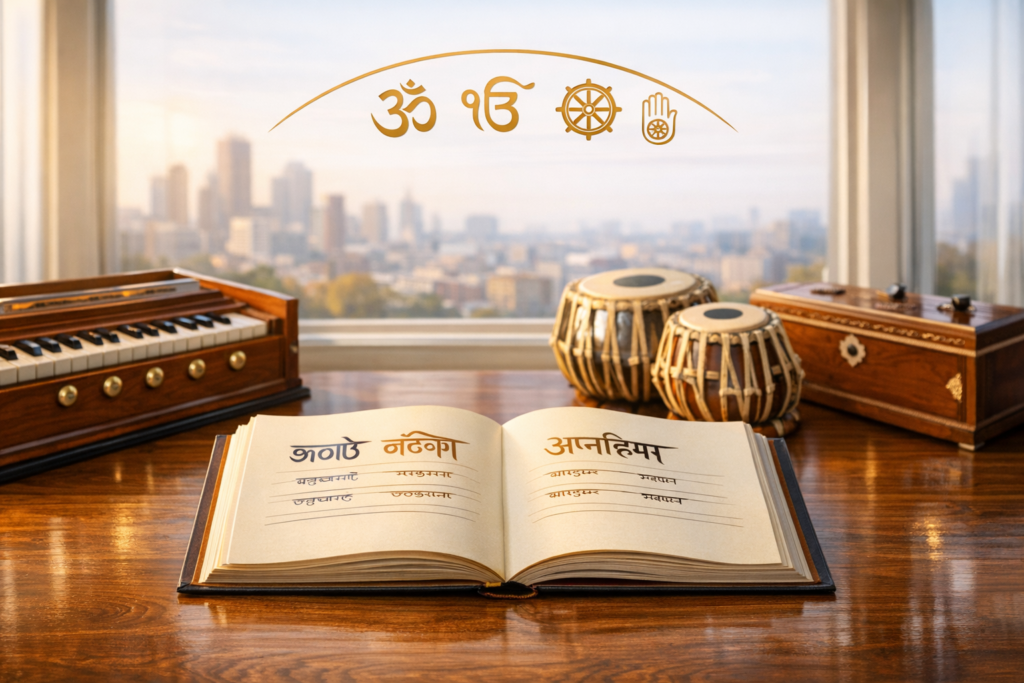
Consistent with the blog’s commitment to dharmic unity, the class drew resonances across Hinduism, Buddhism, Jainism, and Sikhism without collapsing their distinctive paths. The Bhagavatam’s emphasis on compassion and self-mastery converses naturally with Buddhist karuna and mindfulness; its honoring of plurality aligns with Jain anekantavada; its valorization of kirtan, seva, and remembrance of the Divine harmonizes with Sikh practice. The shared ground is evident: disciplined inner work, ethical living, and reverence for the Sacred in all beings—an approach that nurtures unity in spiritual diversity.
In a cosmopolitan setting like London, such classes become vital sites of cultural continuity and inclusive dialogue. Participants often include long-time practitioners, new seekers, and interfaith neighbors, all encountering the Bhagavatam’s vision of a world held together by devotion and responsibility. The result is not a recruitment drive but a public pedagogy of respect: many paths, one human family, and a commitment to coexistence grounded in principled conduct.
Attendees frequently describe an affective arc across the session: curiosity at the outset, contemplative focus during verse and purport, and grounded optimism by the close. The tone is neither triumphalist nor insular; it is sober, invitational, and service-oriented. Questions raised—about suffering, duty, freedom, and meaning—are treated with care, connecting textual insights to the pressures of modern work, family life, and civic engagement.
Practical integration received explicit attention. Students were encouraged to sustain a daily rhythm of hearing (sravanam), reflective remembrance (smaranam), and courageous kindness in ordinary interactions. Small, consistent steps—mindful speech, honest work, gratitude practices, and community seva—were presented as the surest confirmations of learning. In this pedagogy, progress is measured less by intensity than by continuity and by the steadiness with which one’s life becomes nourishing to others.
The class also reaffirmed a core Bhagavatam intuition: knowledge is complete only when it heals. By aligning thought with devotion, emotion with compassion, and action with service, individuals become instruments of social concord rather than competition. This is where the text’s ancient authority meets contemporary urgency—inviting a civilization of gentleness, courage, and accountability.
Situated within the lineage of Srila Prabhupada’s teachings, the ISKCON London class provided clarifying structure and devotional warmth, yet it remained accessible to those from other dharmic paths. The guiding principle was not exclusivity but depth: any sincere seeker can draw nourishment from the Bhagavatam’s well of Vedic wisdom while honoring the sanctity of their own tradition.
In summary, the 23 June 2026 Srimad Bhagavatam class at ISKCON London modeled how scriptural study, when rooted in parampara and expressed through lived ethics, catalyzes both inner renewal and social harmony. It demonstrated that devotion is a disciplined art of living; that unity across Hindu, Buddhist, Jain, and Sikh traditions is strengthened by shared virtues; and that the Bhagavatam’s living wisdom becomes most persuasive when it quietly improves the way people think, feel, speak, and serve.
Inspired by this post on Dandavats.










Leave a Reply
You must be logged in to post a comment.