
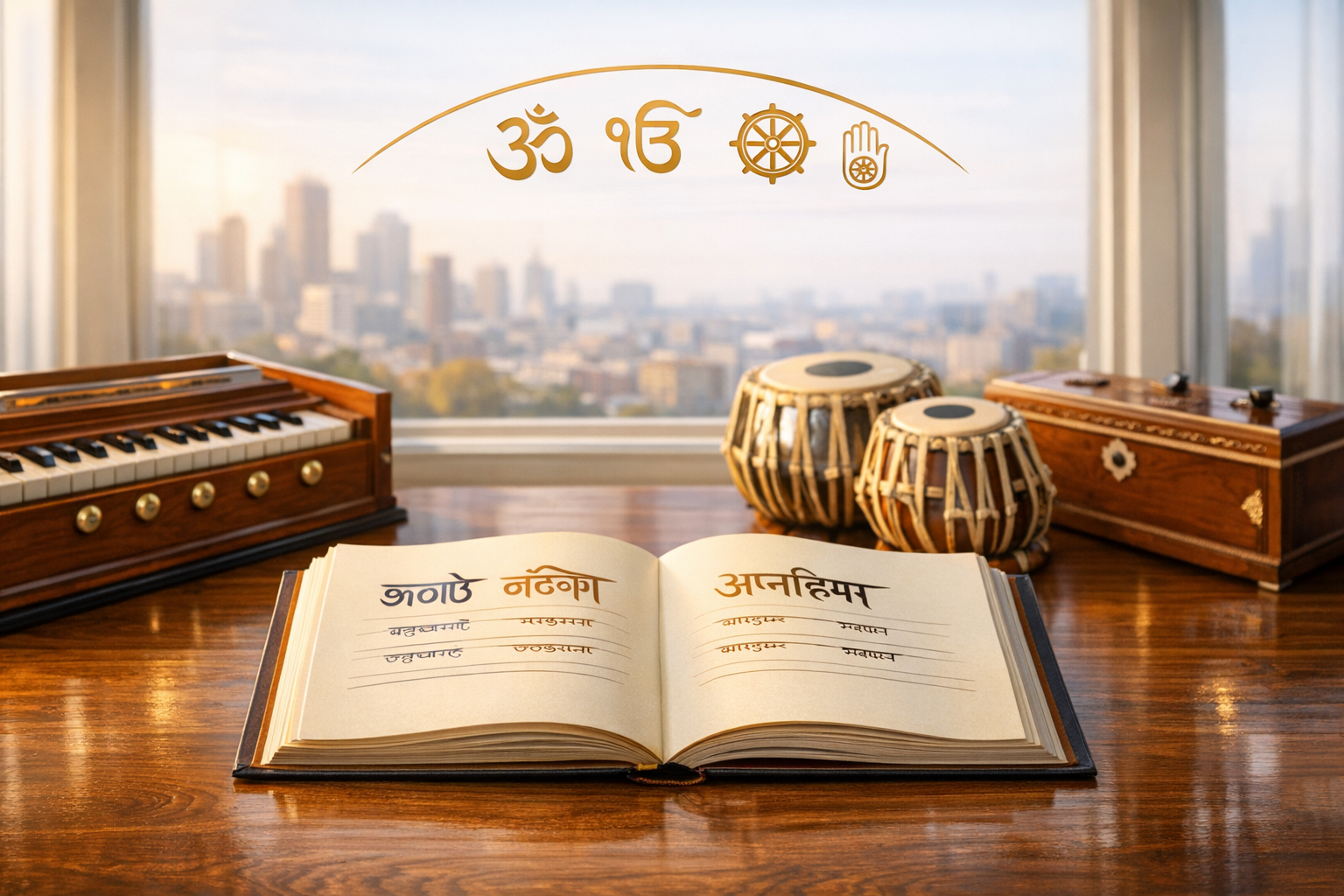
Prabh Ke Geet is released in the USA, signaling an important moment for the Indian diaspora and for those invested in the preservation of devotional literature, music, and shared dharmic heritage. The title itself carries an inclusive resonance: Prabh evokes the Divine across Sanskrit, Hindi, and Punjabi usage, while Geet emphasizes the living, sung tradition of devotion. In bringing such a work to a North American context, the release draws together the intellectual, aesthetic, and spiritual strands that have long connected Hinduism, Sikhism, Jainism, and Buddhism in a common pursuit of the sacred through song.
The phrase Prabh Ke Geet naturally situates the book within the Bhakti Tradition, where poetic utterance and musical performance are interwoven as a path to inner transformation. In Hinduism, bhajans, kirtans, and stotras nourish community life and personal sadhana; in Sikhism, shabad kirtan unfolds within a formal raga grammar and congregational singing; in Jainism, stavans carry ethical guidance and contemplative clarity; in Buddhism, gathas and chants frame mindfulness and compassion. The title’s semantic breadth invites readers and listeners from each of these traditions to recognize a familiar devotional vocabulary while respecting doctrinal differences.
As a devotional form, song is both text and performance. This duality is technical as well as experiential. Sikh shabads are historically organized by raag and taal, reflecting the classical foundations of Hindustani music; the Guru Granth Sahib includes compositions anchored in defined melodic frameworks. Across bhajans and stotras, prosodic structures such as doha, chaupai, and shloka serve as rhythmic containers that make memorization and recitation natural within community settings. Such formal features enable Prabh Ke Geet to resonate not only aesthetically but pedagogically: meters, cadences, and refrains help learners internalize meaning through repetition and melody.
Understanding the craft of devotional song in a diaspora setting benefits from a technical lens. Melodic organization (raag), rhythmic cycles (taal), and improvisational arcs that balance sthayi (refrain) and antara (verse) shape congregational participation. Tablas articulate theka patterns across cycles such as teentaal or keherwa; harmonium supports the melodic contour; tanpura or shruti maintains a sonic ground. Even when ensembles are minimal, the grammar of call-and-response, antiphony, and unison singing facilitates inclusive engagement, allowing multigenerational audiences to join seamlessly.
Devotional poetics have their own internal architecture. Chhanda determines metrical cadence; alankara (figurative embellishment) organizes imagery; and anubhava (felt realization) gives language its transformative force. In Sikh and Hindu compositions alike, names and attributes of the Divine function as semantic anchors repeated across lines to cultivate dhyana. Jain stavans similarly align linguistic restraint with ethical clarity, while Buddhist chant prioritizes precise articulation to support attentive presence. Prabh Ke Geet is thus well positioned to highlight how a shared devotion to the sacred can manifest through different but complementary literary and musical technologies.
Transliteration and translation are crucial for accessibility in the USA. Gurmukhi and Devanagari provide scriptural fidelity; Roman transliteration broadens reach. Employing standards such as ISO 15919 or the IAST system helps preserve phonetic accuracy for terms like Prabh, dharma, shabda, and prema. Clear transliteration reduces ambiguity in pronunciation, strengthens learning outcomes for youth and adult learners, and improves search discoverability in digital environments where users might query in English but seek content rooted in Sanskrit, Hindi, or Punjabi vocabulary.
Editorial choices can further advance readability without diluting authenticity. Parallel texts—original script on one side, transliteration and translation on the other—allow readers at different proficiency levels to progress together. Glossaries for key terms such as bhakti, shabad, ananda, karuna, and shraddha prevent conceptual drift. Brief endnotes clarifying historical references or raga indications can guide curious readers deeper into the musicological and philosophical context while keeping the main flow uncluttered.
The performance ecology around a book like Prabh Ke Geet in the USA invites temples, gurdwaras, community centers, and university groups to collaborate. Mixed gatherings that include bhajans, shabads, stavans, and Buddhist chants naturally embody Unity in spiritual diversity, allowing communities to listen across traditions while honoring specific liturgical norms. In practice, facilitators can curate sequences that alternate between contemplative and participatory pieces, balancing linguistic variety (Sanskrit, Hindi, Punjabi, and English) so that newcomers and tradition-bearers both feel at home.
For the Indian Diaspora in US contexts, devotional song often doubles as cultural pedagogy. Children encounter language through refrain and rhyme; elders carry memory through familiar melodies; working professionals find rest in shared rhythm and silence. Experiences of this kind are widely recalled in diaspora families: evening aarti or kirtan, weekend satsangs, or festival gatherings become emotional anchors that transmit values. A work titled Prabh Ke Geet participates in this transmission by foregrounding devotion-as-practice rather than devotion-as-ideology.
Digital integrations can significantly extend impact. Audio renditions aligned with the book’s pieces, QR codes linking to recordings, and brief tutorials on raga and taal provide multi-sensory learning pathways. Consistent metadata, clear attributions, and accessible file formats enable archiving and future-proofing, while careful curation ensures that the dignity of sacred performance is preserved online as thoughtfully as it is in person.
From an archival perspective, devotional anthologies serve as cultural time capsules. Library deposits, community archives, and oral-history addenda help capture not only the text and melody but also the stories around their use—who sang them, when, and in which communal settings. Such documentation safeguards intangible heritage, supports scholarship in musicology, literature, and religious studies, and helps future generations trace the lineages that shaped their practice.
Pluralism frames the ethical core of a project like Prabh Ke Geet. The devotional impulse in Sanatana Dharma, Sikhism, Jainism, and Buddhism shares a commitment to sincerity, humility, and compassion, even as metaphysical vocabularies differ. A dharmic approach recognizes many valid pathways to the Real and resists reducing practice to a single sanctioned form. In that spirit, devotional song becomes a meeting ground: diverse liturgical lineages sing to, about, and with the Divine in ways that cultivate reverence without requiring sameness.
For event designers and community organizers, inclusive practices are straightforward and effective. Alternating language registers across items, offering transliteration for congregational responses, and signaling moments of silence or reflection help all participants orient themselves. Brief introductions to each piece—its origin, meter, and mood—create a gentle learning arc. When participants sense both competence and welcome in the curation, devotional space naturally deepens.
The US release of Prabh Ke Geet also has research implications. Comparative studies in prosody, performance, and translation gain a living laboratory as communities sing, interpret, and adapt. References to classical treatises such as the Natyashastra and the Sangeet Ratnakar can be made operational for learners, not in a purely academic way, but by showing how principles like rasa, laya, and swara animate real congregational experience. Scholarly rigor and community wisdom thus reinforce one another.
From a linguistic and hermeneutic standpoint, the word Prabh offers a bridge vocabulary. It appears in Sikh Gurbani with profound devotional intimacy and in Hindu Sanskritic usage as an honorific pointing to the Supreme. In Hindi, it retains the same devotional horizon, inviting a reader from multiple traditions into a shared semantic field. This cross-linguistic elasticity allows Prabh Ke Geet to serve as a hospitable text for mixed congregations and study groups.
Educationally, communities can use the book to scaffold curricula that integrate language learning with music practice and ethical reflection. Short weekly circles might focus on one composition at a time, unpacking vocabulary, practicing melody and rhythm, and discussing the piece’s moral insights in everyday life. The approach turns culture class into a lived craft—musical, literary, and contemplative.
Ultimately, Prabh Ke Geet in the USA exemplifies how devotional literature and music can nurture unity without erasing difference. By respecting distinct lineages and inviting shared participation, it echoes the civilizational ideal of Vasudhaiva Kutumbakam while remaining grounded in specific textual and musical disciplines. In emphasizing song as a disciplined path of remembrance and love, the work strengthens communal bonds, sustains intergenerational learning, and offers a resilient, pluralistic model for spiritual life in the modern world.
Inspired by this post on SikhNet – News.







Leave a Reply
You must be logged in to post a comment.