
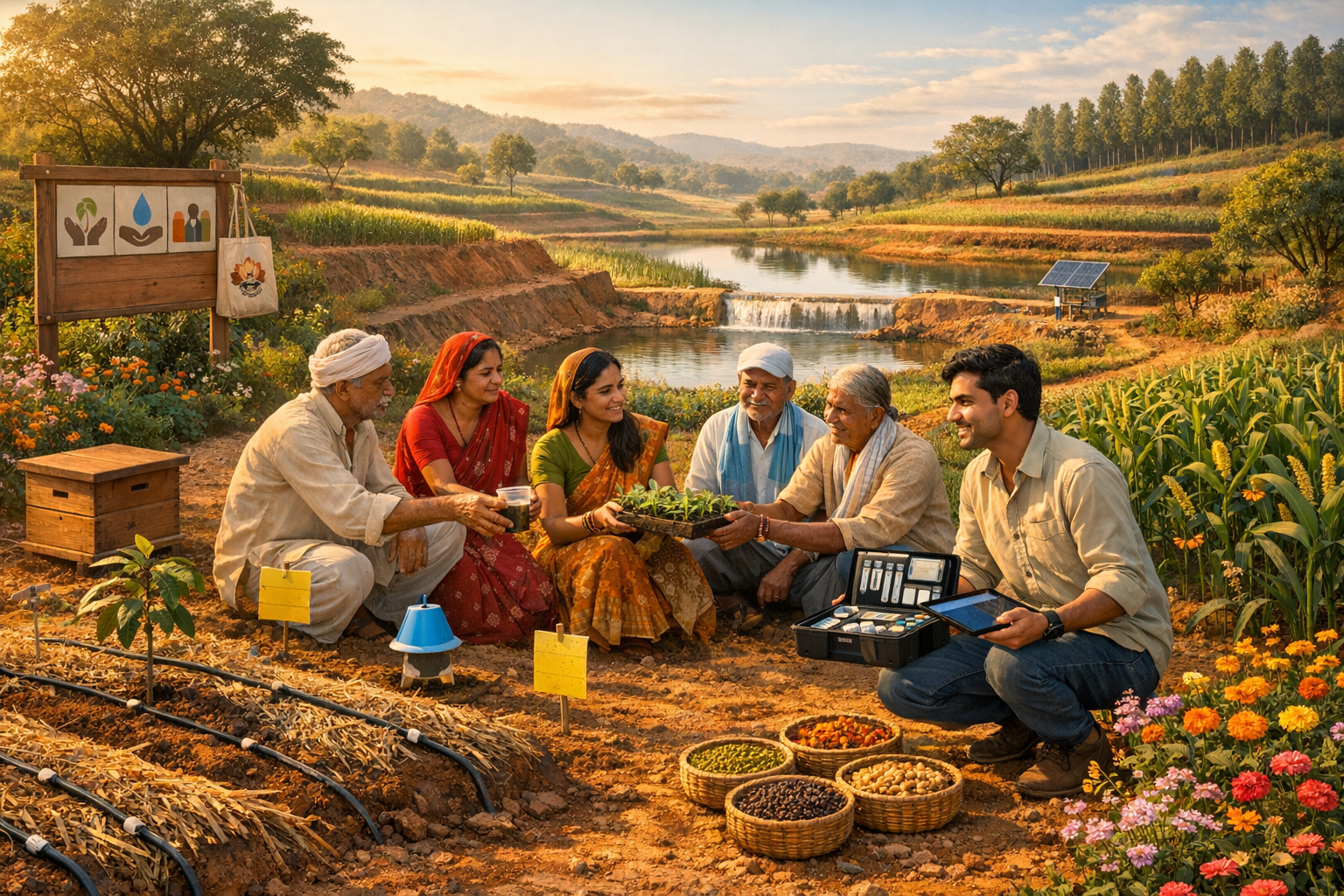
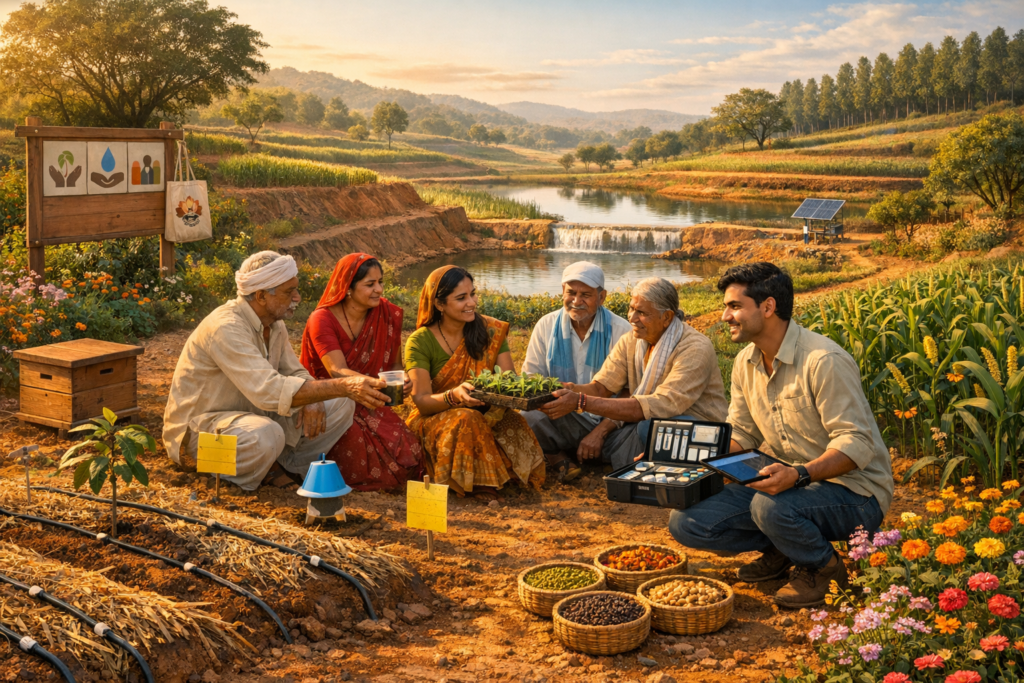
Farmer Outreach Program — Cultivating Hope — frames a pragmatic, evidence-informed pathway to climate-resilient agriculture and cohesive rural development. Grounded in shared dharmic ethics such as ahimsa, seva, sarbat da bhala, and aparigraha, the approach strengthens soil health, water security, and dignified livelihoods while honoring the cultural plurality of Hindu, Buddhist, Jain, and Sikh communities. The result is a synthesis of sustainable agriculture practices with values-based community engagement that elevates productivity, equity, and ecological stewardship together.
Rural smallholders face converging pressures: erratic monsoons and rising temperatures, episodic droughts and floods, fragmented landholdings, soil organic matter loss, pest resurgence, volatile markets, and indebtedness. In such settings, narrowly technical interventions seldom endure without social capital, inclusive institutions, and locally credible knowledge systems. Cultivating Hope addresses this by combining agroecological methods, water management, enterprise support, and participatory extension within a single, farmer-centered design.
In public discourse, initiatives associated with Govardhan Ecovillage (GEV) are often cited as emblematic of holistic outreach. The analysis here abstracts generalizable lessons from such experiential models and aligns them with established agronomic science and community-development practice. The aim is to articulate a replicable blueprint that other landscapes can adapt without being bound to any single organization or locale.
The program architecture rests on four mutually reinforcing pillars: agroecology and soil health; water resilience through watershed and on-farm measures; diversified cropping and climate-smart practices; and market, finance, and social-inclusion mechanisms that stabilize incomes. Each pillar is advanced through participatory planning, iterative learning, and context-specific adaptation, ensuring that solutions are both technically sound and locally owned.
Agroecology and soil health begin with restoring living soils. Practices emphasize residue retention, diversified rotations, intercropping, cover crops, and composting to rebuild soil organic carbon, aggregate stability, and water-holding capacity. Integrated Nutrient Management (INM) combines site-specific soil testing with balanced macro- and micro-nutrients, biofertilizers (e.g., nitrogen-fixing and phosphate-solubilizing microbes), and on-farm organics. The agronomic logic is clear: healthier soils reduce input dependence, buffer climatic stress, and improve yield stability across seasons.
Traditional bio-inputs are approached with scientific prudence. Where practitioners employ preparations such as panchagavya, the program encourages batch standardization, pathogen-screening, and side-by-side field demonstrations against validated biologicals (e.g., Trichoderma, Pseudomonas fluorescens). This safeguards farmer trust, aligns with regulatory guidance, and preserves the spirit of indigenous knowledge within an evidence-based agronomic framework.
Integrated Pest Management (IPM) reduces reliance on broad-spectrum chemicals by emphasizing field sanitation, crop diversity, botanical pesticides (such as neem-based formulations), pheromone and sticky traps, biological controls (NPV, Bacillus thuringiensis), and economic threshold-based decisions. By harnessing beneficial insects and ecological interactions, IPM lowers costs, curbs resistance, and protects both human and environmental health.
Water resilience integrates green and grey infrastructure across the watershed continuum. Community-led planning prioritizes contour bunding, vegetative barriers, check dams, recharge pits, farm ponds, and desiltation of tanks to slow, spread, and store monsoon flows. On-farm measures—mulching, raised beds, micro-irrigation (drip and sprinkler), and precise irrigation scheduling—translate watershed gains into crop-level water-use efficiency and improved root-zone moisture conditions.
Local institutions steward these assets through clear norms on maintenance, water allocation, and drought-time sharing. Transparent record-keeping, seasonal water budgeting, and equitable distribution are embedded into gram sabha processes, aligning hydrological realities with social legitimacy. Over time, rising infiltration and moderated runoff typically manifest as more reliable baseflows and improved water table behavior.
Diversified cropping systems enhance ecological and market resilience simultaneously. Millets, pulses, and oilseeds complement staples to distribute risk, fix atmospheric nitrogen, and expand dietary diversity. Intercropping and relay planting improve light interception and suppress weeds, while agroforestry (e.g., fruit and timber species integrated with field crops) adds long-duration assets, microclimate buffering, and carbon sequestration. Fodder components strengthen mixed crop–livestock systems, closing nutrient loops.
Seed system strengthening is prioritized through community seed banks, participatory varietal selection, and timely access to stress-tolerant cultivars adapted to local soils and seasons. By shortening the distance between farmer preference and seed availability, outreach reduces the lag with which innovations reach fields and elevates farmer agency in varietal choice—an often overlooked lever for resilience.
Post-harvest and market linkage support address losses and price discovery. Primary processing, grading, moisture control, and safe storage reduce quality deterioration. Collective marketing via Farmer Producer Organizations (FPOs) and cooperatives improves bargaining power, while diversified channels—local buyers, institutional procurement, and digital marketplaces—moderate volatility. When feasible, value addition (e.g., simple cleaning, milling, pickling, or dehydration) captures margins locally.
Risk management blends financial inclusion with public program convergence. Self-Help Groups and producer collectives improve credit access and savings discipline. Weather advisories and crop-contingency planning reduce exposure to shocks, while alignment with social protection and agricultural schemes can smooth liquidity across lean periods. Insurance literacy is built carefully so that products are understood, affordable, and context-appropriate.
Social inclusion is treated as a design variable, not an afterthought. Women’s leadership in SHGs and FPOs is actively fostered; youth are engaged as agri-entrepreneurs, service providers, and digital extension facilitators. Marginalized households receive tailored entry points that match risk appetite and resource constraints, ensuring that benefits distribute fairly and community cohesion strengthens over time.
Extension follows a “learn-by-doing” pedagogy. Farmer Field Schools, demonstration plots, and peer-led field days allow side-by-side comparisons of practices and transparent cost–benefit observation. Local language advisories, seasonal crop calendars, and short-format videos or IVRS calls meet farmers where they are. Digital tools complement—not replace—trusted, in-person relationships and uphold data privacy and informed consent.
Behavioral design accelerates adoption. Cost-sharing for durable assets, phased rollouts, and recognition for lead innovators create credible signals. Simple record books track input costs, labor, yields, and net margins, enabling farmers to evaluate profitability rather than yield alone. Over successive seasons, evidence from their own fields becomes the most persuasive extension message.
Monitoring and evaluation anchor accountability and learning. Baselines and seasonal follow-ups track agronomic and socioeconomic indicators: soil organic carbon and basic soil health metrics; water-use efficiency and pre-/post-monsoon groundwater levels; input intensity; yield stability; net income; dietary diversity; women’s participation in decision-making; and migration patterns. Data loops back into planning so that interventions iterate responsively.
Environmental co-benefits are integral. Increased ground cover and mixed canopies support pollinators and natural enemies, while improved infiltration reduces erosive runoff and sedimentation. Over time, healthier soils, diversified landscapes, and moderated microclimates often translate into fewer pest outbreaks, more stable production, and measurable ecosystem services that benefit entire villages.
Nutrition and public health synergies are pursued through kitchen gardens, school gardens, safe water practices, and sanitation awareness that complement agricultural gains. When families diversify diets alongside cropping patterns, resilience expresses itself not only in incomes but in child growth, women’s health, and overall community well-being.
Dharmic principles provide a unifying ethical compass. Ahimsa encourages low-toxicity inputs and humane livestock care; seva inspires mutual aid and volunteerism; karuṇā and daya cultivate empathy in water sharing and risk pooling; and sarbat da bhala frames decisions around collective welfare. These shared values—across Hinduism, Buddhism, Jainism, and Sikhism—strengthen trust, reduce conflict, and align productivity with responsibility.
Field experiences frequently illustrate how small, well-sequenced changes cascade into broader transformation. In a semi-arid hamlet, for instance, shifting from flood irrigation to drip on a vegetable plot, adding organic mulches, and introducing a short-duration pulse intercrop together reduced visible moisture stress and stabilized income across two contrasting monsoons. Such stepwise gains, validated by village peers, often unlock confidence to diversify further.
Institutional alignment is critical. Panchayats, water-user groups, SHGs, and FPOs coordinate seasonal work plans, asset maintenance, and market calendars. Clear role definitions, transparent fund flows, and grievance processes foster accountability. Public agencies, academic institutions, and civil society partners complement village leadership with technical depth and policy convergence.
Scaling is pursued through training-of-trainers, open-source agronomic protocols, and locally adapted crop–water–soil toolkits. Cost-effectiveness is enhanced by prioritizing low-regret measures (mulching, contouring, seed choices) and phasing capital-heavy investments after quick wins. The program’s modular structure allows districts to adopt components that best fit agro-climatic conditions and community priorities.
Risk management acknowledges potential pitfalls: under-maintained water structures, over-enthusiastic input promotion, elite capture in collectives, or digital exclusion. Safeguards include maintenance endowments, third-party quality checks, inclusive governance bylaws, and analog fallbacks for advisories. Continuous feedback and course correction prevent small issues from compounding into systemic setbacks.
Data ethics remain non-negotiable. Consent, minimal data collection, secure storage, and farmer control over sharing uphold dignity and trust. When analytics inform advisories, explainability is prioritized so that recommendations are intelligible and contestable by farmers and local experts alike.
Looking ahead, climate adaptation will hinge on stress-tolerant varieties, heat- and drought-smart agronomy, decentralized water storage, and landscape-scale tree cover. Youth-led services—soil testing, drone-enabled scouting, nursery raising, micro-irrigation installation, and repair—can create green livelihoods within villages, ensuring that resilience is both a public good and a private opportunity.
Cultivating Hope, understood as both ethos and method, translates dharmic stewardship into everyday practice—one contour bund, one seed choice, and one fair price at a time. By uniting sustainable agriculture with inclusive community processes, the Farmer Outreach Program offers a credible route to climate resilience, ecological regeneration, and shared prosperity across rural India and beyond.
Inspired by this post on Dandavats.










Leave a Reply
You must be logged in to post a comment.