

Srimad Bhagavatam 2.2.27 stands at a pivotal juncture in the second canto’s exploration of yogic concentration, guiding the practitioner from disciplined technique toward steady absorption in the indwelling Supreme, the Paramatma. Within the living tradition of study and practice, settings such as ISKCON Silicon Valley’s Bhakti Yoga Society (ISV BYS) and reflections associated with HG Vijaya Prabhu draw attention to how this verse consolidates the chapter’s instructions on posture, breath, sense-withdrawal, and one-pointed remembrance into an integrated path that is elevating, practical, and deeply devotional.
Context clarifies its force. Canto Two presents instruction delivered by Śukadeva Gosvāmī to King Parīkṣit on the eve of the king’s final days. Chapter One turns the mind outward to the virāṭ-rūpa as a preparatory aid, while Chapter Two turns inward, instructing the transition from gross contemplation to subtle meditation on the Lord within the heart. Verse 2.2.27, positioned toward the close of this inward turn, encapsulates the culmination: unwavering internal focus upon the Supreme Person who pervades and yet transcends the field of the mind.
Read with the chapter as a whole, the verse functions as a synthesis. The progression is deliberate: pratyāhāra (withdrawal of the senses), dhāraṇā (fixing the mind), and dhyāna (continuous flow of attention) mature into smaraṇa (steadfast remembrance). The emphasis is less on displayable techniques and more on a stable orientation—an inner alignment in which the life-airs, senses, and attention cease their scattered movement and become harmonized in devotion to the Paramatma residing within the lotus of the heart.
This inner orientation is framed in classical terms of yogic physiology without losing devotional center. Traditional commentaries speak of directing the prāṇa-vāyus—prāṇa, apāna, udāna, samāna, and vyāna—through measured breath (prāṇāyāma) so the mind becomes serviceable to contemplation rather than captive to distraction. The Bhagavata’s contribution is not a mere rehearsal of technique but the clear assertion that technique realizes its telos only when yoked to bhakti-yoga.
Anatomically, the text’s heart-centered focus corresponds to anāhata as the contemplative locus, while the tradition often notes sūtra-like guidance on directing attention along the suṣumṇā-nāḍī. Such mappings are aids, not ends. They facilitate the transition from intermittent attention to unbroken dhyāna, where the “object” is not impersonal vacancy but the personal, immanent-transcendent Paramatma who witnesses and sanctions every movement of consciousness.
Srimad Bhagavatam 2.2.27 thereby warns against mistaking austerity for attainment. Mechanical breath counts, rigid postures, or solitary retreat can subdue agitation, but Bhagavata disclosure insists that realization ripens through loving, personal orientation—bhakti. In this frame, prāṇāyāma, pratyāhāra, and dhyāna become supportive limbs, while bhakti-yoga supplies the meaning, direction, and experiential sweetness (rasa) that stabilize practice across life’s changing conditions.
When situated in living communities of study such as ISV BYS, the verse’s pedagogy becomes vividly contemporary. Practitioners often note that mantra-japa—particularly the Hare Krishna mahā-mantra—binds breath, attention, and devotion in a single act. The mind’s restlessness, normally fueled by sense-contact, progressively yields to a gentler, brighter center of gravity rooted in remembrance. What begins as effortful focus grows into a felt companionship with the indwelling Lord.
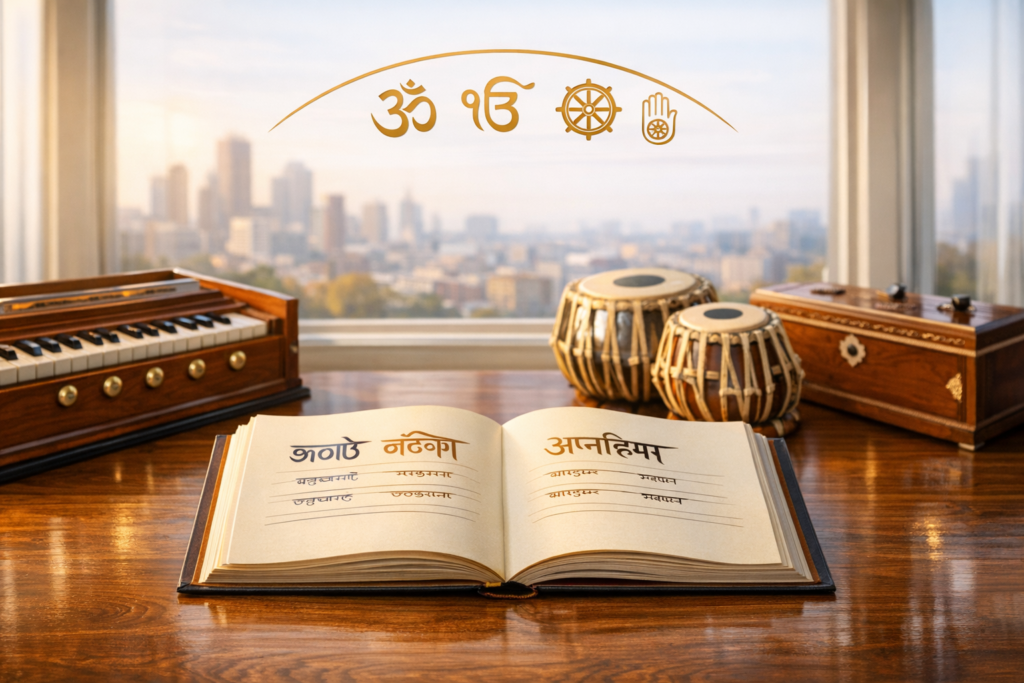
The chapter’s interiorization aligns with a broader dhārmic consensus that spans Hinduism, Buddhism, Jainism, and Sikhism. Buddhism’s samatha–vipassanā tandem matures attention and insight; Jain dhyāna and pratikraman refine conscience through ahiṁsā and aparigraha; Sikh nām-simran and kīrtan sustain remembrance through sacred sound. Each tradition prizes ethical restraint, disciplined attention, and ongoing remembrance. Srimad Bhagavatam 2.2.27 contributes a distinctively theistic articulation of this shared interior path, situating the culmination in living relationship to Paramatma.
That convergence suggests a practical, unifying ethic for modern seekers. Across traditions, three strata recur: ethical steadiness (yamas/niyamas or their equivalents), regulated breath and body to quiet agitation, and ongoing remembrance through sound, image, or meaning. The Bhagavata’s genius is to assert that remembrance is not only a cognitive fixation but a responsive encounter—hearing (śravaṇam), chanting (kīrtanam), and remembering (smaraṇam) form a living artery between person and Person.
Contemporary readers frequently report concrete changes when practice follows this arc. Breath synchronized with recitation reduces cognitive load and anxiety; a one-to-two inhalation–exhalation rhythm often enhances vagal tone and supports sustained attention. As japa deepens, the felt sense of effort can give way to easeful absorption, where the mantra seems to “move” the breath and the mind rather than the reverse. The Bhagavata’s counsel becomes emotionally resonant here: peace is not invented but uncovered when attention is anchored in the indweller.
Ethical groundwork is indispensable. Ahimsa curbs impulsive harm, satya trains transparent speech, asteya checks acquisition, brahmacarya refines energy, and aparigraha instills contentment—parallel to Sikh seva and Jain vows. Such commitments unburden attention, making dhyāna less a struggle against inner turbulence and more a natural settling. Srimad Bhagavatam 2.2.27 sits precisely at this threshold where ethics, attention, and devotion converge.
Technically, the verse presumes maturation from dhāraṇā to dhyāna—a shift from repeated refocusing to an unbroken stream. Two errors are common. First, perfectionism, which mistakes unbroken attention for a prerequisite rather than an outcome, breeds discouragement. Second, spiritual bypassing, which uses technique to avoid honest emotion, silently reintroduces restlessness. The Bhagavata’s affective realism remedies both by rooting the work of attention in relationship, gratitude, and service.
Breath training is most helpful when subordinated to meaning. In many households, practitioners begin with five to ten minutes of gentle prāṇāyāma, then proceed to japa while seated comfortably with the spine erect, eyes soft or closed, attention placed in the heart region. When agitation arises, briefly returning to the breath, then to the mantra, preserves continuity. Such cyclic refinement realizes the intent of 2.2.27: technique becoming translucent to devotion.
At deeper stages, remembrance flowers into intimacy. The heart-lotus imagery becomes less metaphorical and more phenomenological; many report a subtle warmth or spaciousness that coincides with spontaneous gratitude. Theologically, the Bhagavata interprets this change not as self-hypnosis but as correspondence—attention discovering the already-present Paramatma whose grace draws the mind into steadiness.
Sound plays a central role across dharmic practice. In the Bhagavata stream, the Hare Krishna mahā-mantra supplies semantic depth and affective sweetness; in Sikh tradition, shabad-guru and kīrtan form a living scripture of sound; in Buddhist practice, paritta and nembutsu establish rhythmic recollection; in Jain devotion, navkār-mantra shapes reverent attention. Srimad Bhagavatam 2.2.27 resonates with this pan-dharmic acoustics of remembrance: sacred sound stabilizes sacred sight.
Community sustains the trajectory. Satsanga creates accountability without coercion, models steady practice, and offers corrective warmth when technique eclipses relationship. In circles such as ISV BYS, youth and professionals alike report that collective study of Bhagavata Purana, guided chanting, and regular seva convert solitary aspiration into shared momentum—an indispensable social technology for a distracted age.
From a philosophical standpoint, the verse reframes “concentration” as a sacred form of seeing. The mind does not manufacture divinity; concentration removes interference so that cognition may comport with reality. This aligns with Vedic philosophy at large: knowledge is remembrance, not invention; liberation is recognition, not flight. The personalism of the Bhagavata safeguards this recognition from dissolving into abstraction.
In interfaith and intradharmic dialogue, the verse offers common ground. It values ethical formation, disciplined attention, contemplative interiority, and loving service—all elements shared by Hinduism, Buddhism, Jainism, and Sikhism, albeit with distinct theological contours. Instead of competing techniques, the shared grammar of attention invites mutual respect and fruitful learning.
Psychologically, the trajectory outlined here dovetails with evidence on attention training and emotional regulation. Steady exhalation lengthens parasympathetic windows, mantra recitation occupies sub-vocal channels that would otherwise host rumination, and affect-laden remembrance recalibrates threat perception. Theologically, these mechanisms are signposts, not sources; the source is the indwelling Lord whose grace makes steadiness sustainable.
Common impediments often dissolve with gentle adjustments. Shorter sittings done daily outpace occasional marathons. Linking practice to ordinary transitions—after waking, before meals, or prior to sleep—helps continuity. Allowing emotion to surface without judgment prevents spiritual bypassing. Above all, remembering that the goal is relationship, not performance, fulfills the heart of 2.2.27.
In sum, Srimad Bhagavatam 2.2.27 compresses a vast pedagogy into a single movement: collect the senses, harmonize the breath, settle attention, and remember the Paramatma with devotion. The fruit is not only cognitive clarity but a tender steadfastness—courage without hardness, gentleness without passivity—that travels well across the seasons of a human life.
Read in harmony with allied dharmic traditions, the verse advances unity without erasing difference. It honors the many doors—japa, kīrtan, dhyāna, simran, pratikraman—while inviting a shared destination: a heart at rest in Reality. In that spirit, the Bhagavata’s ancient counsel becomes a contemporary bridge, guiding practice that is at once technically sound, emotionally humane, and spiritually unifying.
Approached this way, the teaching linked with HG Vijaya Prabhu and nurtured in communities like ISV BYS is neither an esoteric relic nor a private consolation. It is a method with measure, a theology with tenderness, and a way of life with room for all who value ethical steadiness, luminous attention, and love of the indwelling Lord.
Inspired by this post on Dandavats.










Leave a Reply
You must be logged in to post a comment.