
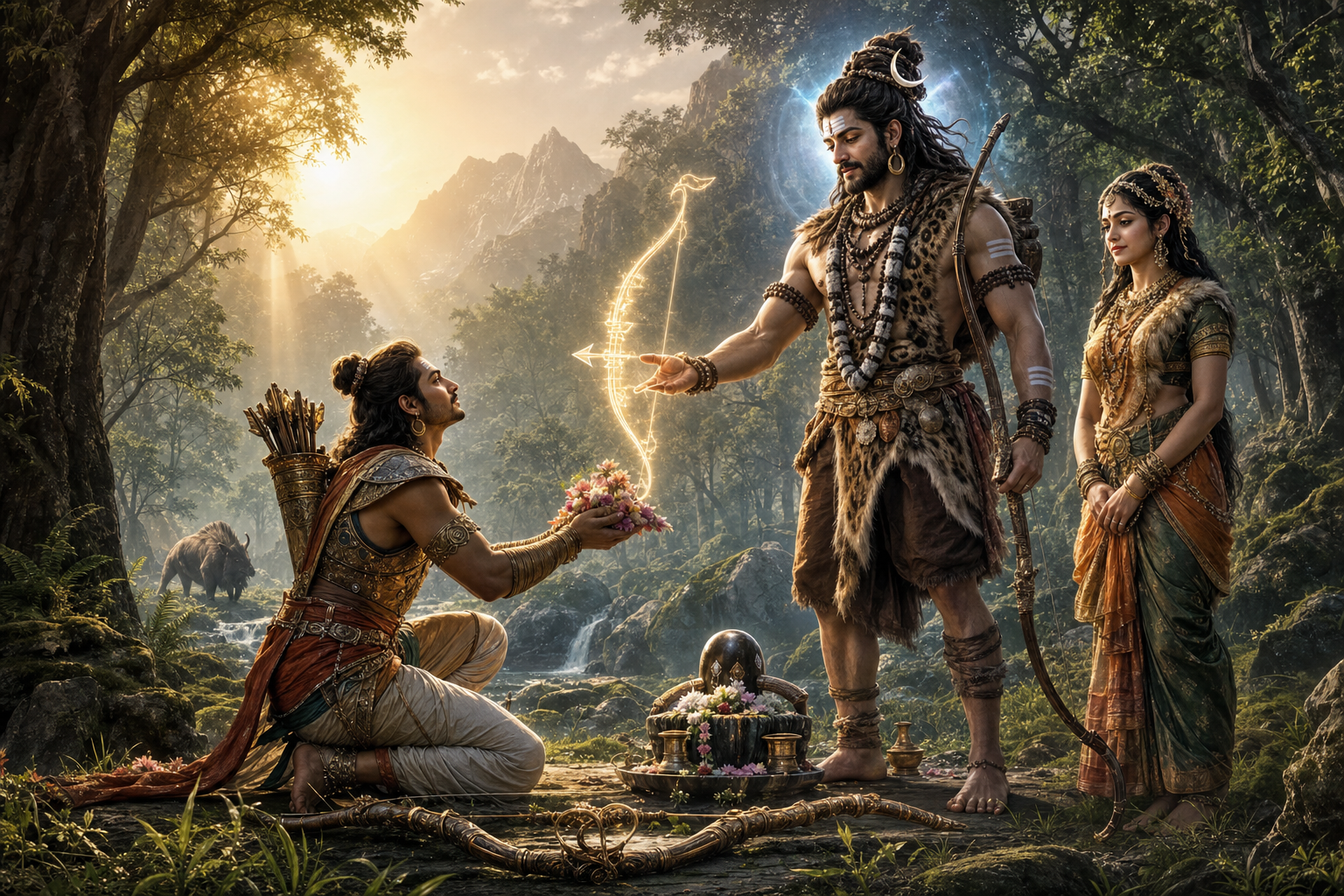
Arjuna Anugrahamurti is one of the most powerful forms of Lord Shiva in the sacred imagination of Hindu tradition. Known also as Kiratarjunamurti and Pashupatamurti, this manifestation remembers the moment in the Mahabharata when Shiva tested Arjuna, fought him in the form of a Kirata hunter, and finally blessed him with the formidable Pashupatastra. The episode is not merely a heroic tale; it is a theological teaching on grace, discipline, humility, spiritual readiness, and the difficult purification required before divine power can be responsibly received.
The story belongs to the wider Mahabharata world, especially the period of the Pandavas’ exile, when the coming Kurukshetra War had already begun to cast its shadow over the future. Arjuna, guided by the need to prepare for a conflict of enormous moral and historical consequence, undertakes severe tapas to obtain celestial weapons. His quest is not driven by ordinary ambition alone. It is linked to dharma, responsibility, and the painful burden of action in a world where adharma has become organized, powerful, and relentless.
In this context, Shiva appears not as a distant deity who distributes blessings casually, but as the divine examiner who measures the seeker from within. Arjuna’s devotion is real, his skill is extraordinary, and his courage is unquestionable. Yet the story insists that even these qualities are not enough. The seeker must be stripped of pride, tested in crisis, and made capable of holding power without being consumed by it. This is the central meaning of Arjuna Anugrahamurti: Shiva’s grace arrives through trial, not as an escape from trial.
The word Anugraha means grace, favor, or blessing, but in Shaiva thought it is never a shallow kindness. Shiva’s grace can appear as comfort, protection, knowledge, destruction of ignorance, or a direct confrontation with ego. In the Arjuna episode, grace takes the form of combat. Shiva does not first appear with obvious majesty. He arrives disguised as a Kirata, a forest hunter, accompanied by Parvati in a corresponding form. The divine is concealed within the unfamiliar, and Arjuna must respond without knowing that the one before him is Mahadeva himself.
The immediate cause of the encounter is the attack of a wild boar, often understood in the tradition as a demonic force sent to disturb Arjuna’s penance. Arjuna shoots the boar, but the Kirata also claims to have struck it. A dispute follows over who truly killed the animal. On the surface, this is a quarrel over a hunt. At a deeper level, it is a confrontation between human achievement and divine agency. Arjuna must discover that even the most precise arrow, the sharpest perception, and the strongest will remain limited before the hidden working of Shiva.
The quarrel turns into combat, and the battle becomes the heart of the iconographic and spiritual meaning of Kiratarjunamurti. Arjuna, the supreme archer among men, uses his weapons against the mysterious hunter, but nothing succeeds. His arrows fail, his strength is exhausted, and his confidence is shaken. The warrior who had defeated kings and protected dharma must confront an opponent beyond all categories. This defeat is not humiliation in the ordinary sense; it is instruction. Shiva defeats Arjuna in order to make him worthy of victory.
This is why the form is spiritually moving even for readers far removed from the battlefield of the Mahabharata. Human life often teaches through resistance. One may prepare sincerely, act with discipline, and still encounter a force that cannot be controlled by skill alone. The Arjuna Anugrahamurti episode gives sacred language to that experience. It shows that an obstacle may sometimes be a disguised form of grace, and that the collapse of self-certainty can become the beginning of deeper insight.
Arjuna’s recognition of Shiva comes after his external strength has been spent. In many retellings, he makes a linga of clay or offers worship with flowers, only to discover that the flowers placed in devotion have appeared upon the Kirata. The meaning is unmistakable: the hunter whom he opposed is the very Lord whom he worshipped. The divine was not absent during the conflict. The divine was present as the conflict itself, shaping the warrior’s consciousness through resistance, bewilderment, and eventual surrender.
At this point, the narrative turns from battle to revelation. Shiva reveals his true form and grants Arjuna the Pashupatastra, one of the most powerful weapons in the sacred literature of Hinduism. The weapon is not treated as a mere instrument of destruction. It is a force connected to Shiva’s cosmic authority, and therefore it requires ethical restraint, spiritual discipline, and exact knowledge of use. Arjuna receives not only power but responsibility. In this sense, the story is a profound meditation on the moral burden of capability.
The Pashupatastra has a special place in the religious and literary memory of the Mahabharata. It represents more than military advantage. It symbolizes mastery over the violent energies that exist both in the world and within the self. The one who receives it must know when not to use it. This restraint is central to dharma. Power becomes sacred only when governed by discernment, humility, and alignment with a larger moral order.
Arjuna Anugrahamurti therefore places Shiva before the devotee as both the terrible tester and the compassionate giver. These two aspects are not contradictory. In Shaiva theology, Shiva destroys in order to liberate, conceals in order to reveal, and challenges in order to elevate. His compassion is not sentimental softness. It is the fierce compassion that removes weakness, pride, illusion, and unpreparedness. The blessing comes after the seeker has been made inwardly capable of receiving it.
The episode also reveals Arjuna’s own greatness in a refined way. His greatness does not lie only in archery, lineage, or battlefield success. It lies in his capacity to recognize truth once his pride has been broken. He does not cling to resentment after defeat. He bows. He understands. He receives instruction. This movement from resistance to surrender is one of the most important spiritual arcs in the Mahabharata, and it prepares the reader for Arjuna’s later crisis and instruction in the Bhagavad Gita.
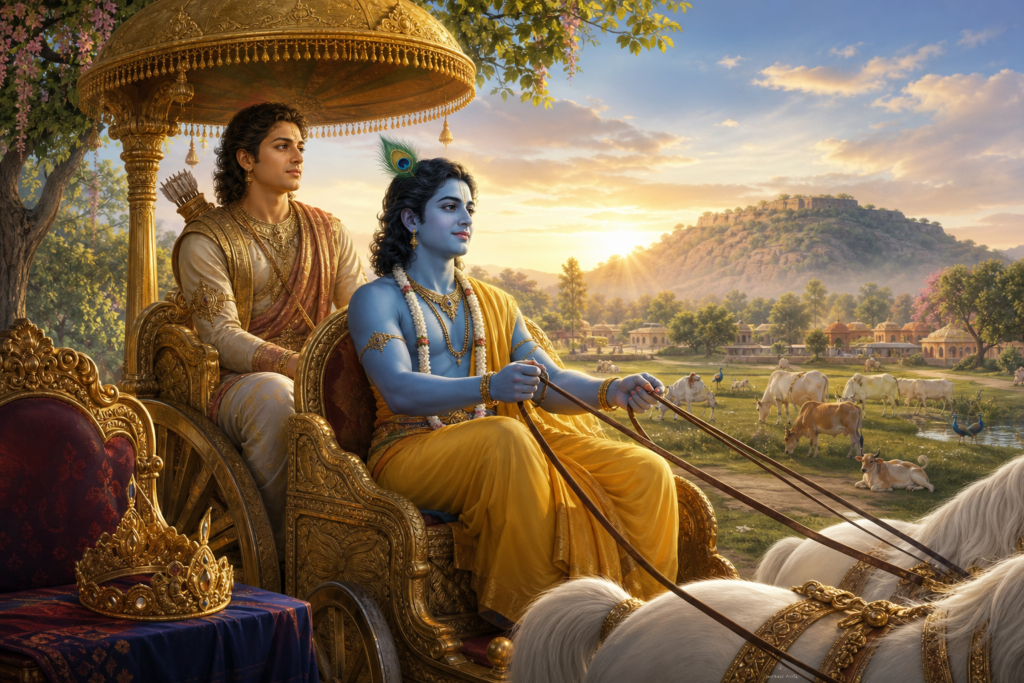
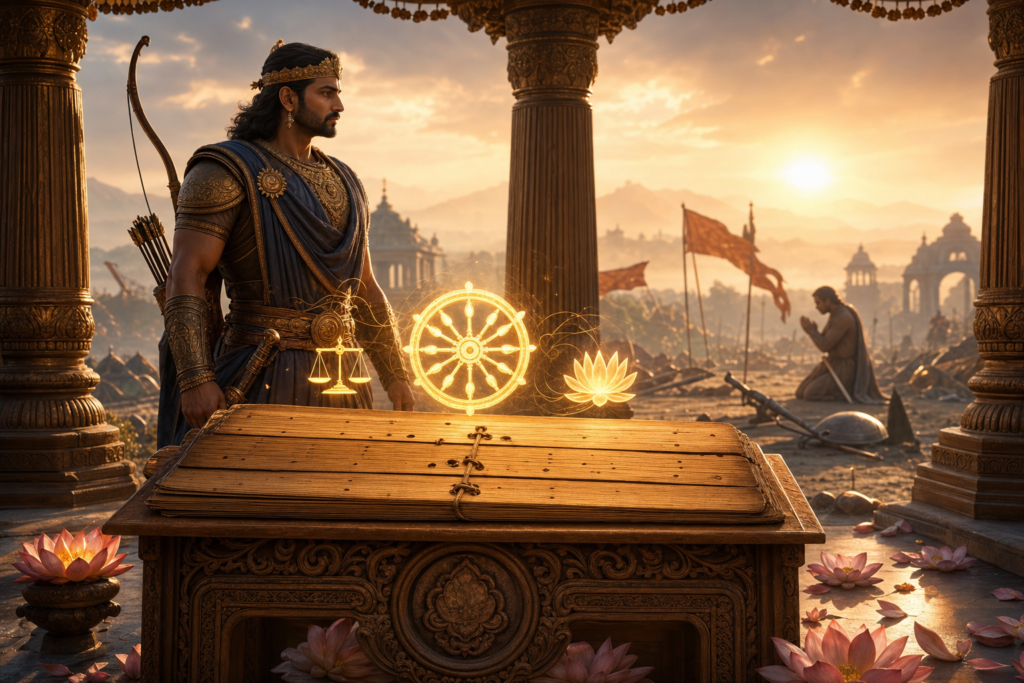
The connection with the Bhagavad Gita is especially meaningful. In both episodes, Arjuna stands at the threshold of war, uncertainty, and moral responsibility. In the forest, Shiva tests his strength and humility. On the battlefield, Krishna teaches him the nature of action, self, duty, and surrender. These two moments do not compete; they complement each other. They show the unity of dharmic wisdom, where different divine forms guide the same seeker toward courage, clarity, and spiritual maturity.
For this reason, Arjuna Anugrahamurti is not only a Shaiva theme but a broader dharmic teaching. It honors Shiva while remaining fully rooted in the Mahabharata’s integrated sacred universe. The episode does not divide devotion into sectarian compartments. Instead, it shows how Shiva, Krishna, Arjuna, Parvati, tapas, dharma, and divine weapons all belong to a shared spiritual grammar. Such narratives help sustain unity among Hindu traditions and also invite respectful reflection across the wider family of dharmic paths, including Hinduism, Buddhism, Jainism, and Sikhism, where discipline, humility, restraint, and inner conquest remain central ethical values.
The form of Kiratarjunamurti also has a rich iconographic life in Indian art and temple culture. Sculptures often show Shiva as a hunter, sometimes with bow in hand, accompanied by Parvati, while Arjuna stands in reverence or combat readiness. The visual language captures the paradox of the episode: the Lord of Kailasa appears in the wild forest; the ascetic god enters the world of warriors; the bestower of grace first appears as an adversary. The image is therefore not decorative alone. It is a compact theological statement carved in stone.
In South Indian temple art, this theme is especially significant because it allows sculptors to express movement, tension, humility, and revelation in a single sacred composition. Arjuna’s body may carry the discipline of the warrior, while Shiva’s hunter form carries relaxed, overwhelming authority. The contrast teaches visually what the text teaches narratively: human excellence is real, but divine power exceeds it. The warrior must be refined by encounter with the transcendent.
The name Pashupatamurti links the episode to Shiva as Pashupati, the Lord of beings. The Pashupatastra, in this light, is not simply a weapon given by a god to a warrior. It is a sign that all force in the universe belongs ultimately to the Supreme Lord and must be used in harmony with cosmic order. The destructive capacity of the weapon is restrained by the compassionate intelligence of the one who grants it. This is why Arjuna must first be tested. Without self-mastery, divine weapons would become instruments of disorder.
The forest setting also deserves attention. In the Mahabharata, the forest is not merely a place of exile. It is a spiritual laboratory. Kings lose their kingdoms there, warriors learn austerity there, sages teach there, and hidden truths emerge there. Arjuna’s encounter with Shiva in the forest reflects a recurring pattern in Indian sacred literature: when worldly structures fall away, the deeper structure of dharma becomes visible. The wilderness strips the seeker of public identity and exposes the inner person.
Arjuna enters this space as a warrior seeking power, but he emerges as a devotee who has been corrected by grace. The transformation is subtle but decisive. He does not abandon his kshatra dharma; he becomes more fit for it. The story does not glorify violence for its own sake. It teaches that force, when unavoidable, must be governed by tapas, devotion, restraint, and divine sanction. This distinction is essential for understanding the Mahabharata’s treatment of war in Hinduism.
The battle with Shiva also offers a psychological reading. Arjuna’s opponent is external in the story, but the struggle also mirrors the confrontation with ego. The Kirata disrupts Arjuna’s certainty, challenges his claim, and exposes the limit of his control. In spiritual practice, such moments are familiar. A person may feel devoted yet still be attached to recognition, correctness, or superiority. The divine test reveals these attachments not to condemn the seeker, but to free him from them.
This is where the episode becomes emotionally resonant. Many people understand the feeling of working hard, praying sincerely, and still being forced into difficulty. The lesson of Arjuna Anugrahamurti is not that every hardship should be romanticized. Rather, it is that the dharmic imagination can find meaning in struggle when it leads to humility, clarity, and deeper alignment with truth. Shiva’s grace is not always recognized at the moment it arrives. Sometimes it is understood only after resistance has done its work.
Bharavi’s classical Sanskrit poem Kiratarjuniya later gave this episode a celebrated literary form. The poem is known for its density, verbal artistry, and philosophical grandeur. Its enduring reputation shows how deeply the encounter between Shiva and Arjuna captured the Indian intellectual and aesthetic mind. The theme could speak simultaneously to poets, warriors, philosophers, devotees, and temple artists because it joined action and contemplation in one dramatic event.
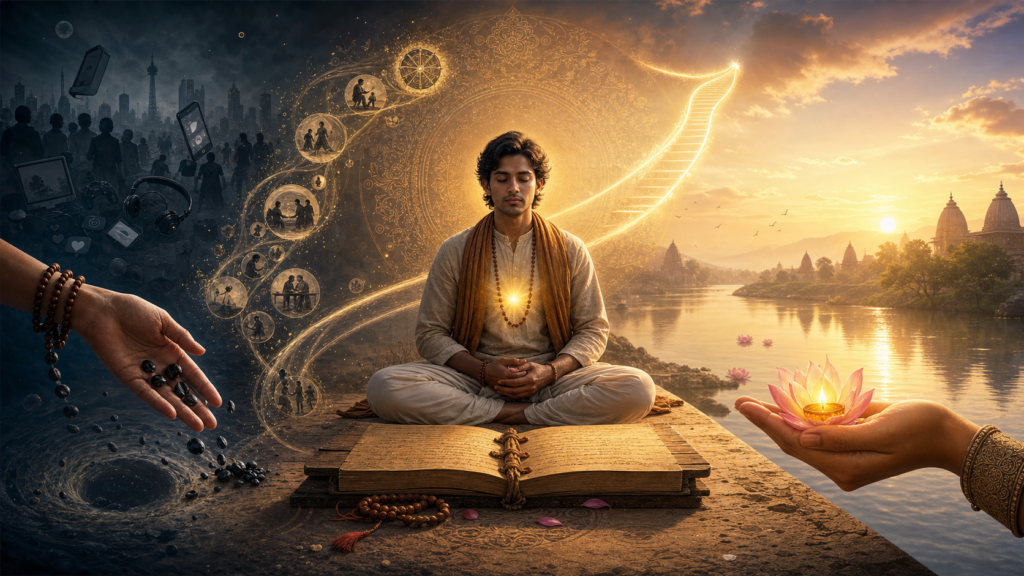
From a theological perspective, the story also clarifies the relationship between tapas and anugraha. Tapas prepares the vessel, but grace fills it. Arjuna’s austerity is necessary, yet it does not mechanically compel Shiva to give the Pashupatastra. Divine grace remains free. It is not purchased by effort, but effort makes the seeker receptive. This balance prevents both passivity and arrogance. The devotee must strive fully, while still knowing that the final blessing is not a possession to be seized.
The presence of Parvati in many versions and depictions adds another dimension. Shiva’s test is not isolated from Shakti. The divine couple’s appearance in forest forms indicates that grace is complete, dynamic, and relational. The masculine language of combat is balanced by the compassionate witness of the Goddess. The blessing given to Arjuna is therefore not merely martial; it is sustained by the fullness of divine consciousness and energy.
Arjuna Anugrahamurti also warns against judging the divine by appearance. Shiva comes as a hunter, outside royal and ritual expectation. Arjuna initially sees an opponent, not the Lord. This motif is common in sacred traditions: truth may appear in forms that disturb social assumptions. The seeker must develop humility not only before obvious sanctity but also before the unexpected. Dharma often requires the capacity to recognize wisdom beyond familiar symbols.
This does not mean that all claims are equal or that discernment should be abandoned. On the contrary, Arjuna’s story strengthens discernment by showing its limits. The human mind must test, act, and reason, but it must also remain open to correction. The meeting with Shiva teaches that intellectual and martial excellence become spiritually complete only when joined with reverence. Knowledge without humility becomes brittle; strength without surrender becomes dangerous.
The form is especially relevant in modern discussions of leadership and responsibility. Societies often celebrate skill, confidence, and the acquisition of power, but the Mahabharata asks a harder question: who is worthy of power? Arjuna is worthy because he can be corrected. He can endure defeat without losing his dedication to truth. He can receive a terrible weapon and still remain under the discipline of dharma. This is a timeless standard for ethical authority.
In devotional terms, the episode deepens the meaning of worship. Worship is not only the offering of flowers, mantras, and ritual gestures, though these remain sacred and meaningful. Worship also includes the willingness to be transformed. Arjuna’s flowers reaching Shiva in hidden form suggest that sincere devotion is never wasted, even when the devotee is confused. The divine receives what is offered with sincerity, even before the devotee fully understands the path.
Arjuna Anugrahamurti therefore stands as a profound synthesis of bhakti, tapas, jnana, and karma. Bhakti appears in Arjuna’s worship of Shiva. Tapas appears in his austerity. Jnana dawns when he recognizes the Kirata as Mahadeva. Karma continues as he returns to his duty with greater preparedness. The form shows that dharmic life is not fragmented. Devotion, discipline, knowledge, and action support one another when directed toward truth.
The story also preserves a crucial lesson about compassion. Shiva’s compassion does not remove Arjuna’s struggle; it gives the struggle meaning and direction. The Lord does not weaken the warrior by protecting him from difficulty. He strengthens him by entering the difficulty with him, opposing him, defeating him, revealing himself, and blessing him. This is why the form is called Anugrahamurti. The grace is fierce, but it is grace nonetheless.
For students of Hindu scriptures, Arjuna Anugrahamurti offers a disciplined way to read mythological narrative. The episode should not be reduced to fantasy, nor should it be flattened into a simple moral tale. It operates at several levels at once: historical imagination within the epic, theology of Shiva, ethics of power, psychology of ego, aesthetics of temple iconography, and spiritual instruction for the seeker. Its richness lies precisely in this layered structure.
The continuing power of Kiratarjunamurti comes from the fact that it refuses easy spirituality. It does not promise that devotion will make life smooth. It teaches that true devotion may intensify the test because the divine intends to make the seeker capable of a greater responsibility. Arjuna does not receive the Pashupatastra because he avoids conflict. He receives it because he passes through conflict, learns humility, and stands ready to serve dharma.
In the end, Arjuna Anugrahamurti is Shiva’s revelation as the Lord who tests in order to bless. The form brings together the forest and the battlefield, the hunter and the god, the warrior and the devotee, the weapon and the restraint that must govern it. Its message remains enduring: divine grace is not always gentle in appearance, but when received with humility, it transforms strength into service, struggle into wisdom, and human effort into an instrument of dharma.
Inspired by this post on Hindu Blog.




Leave a Reply
You must be logged in to post a comment.