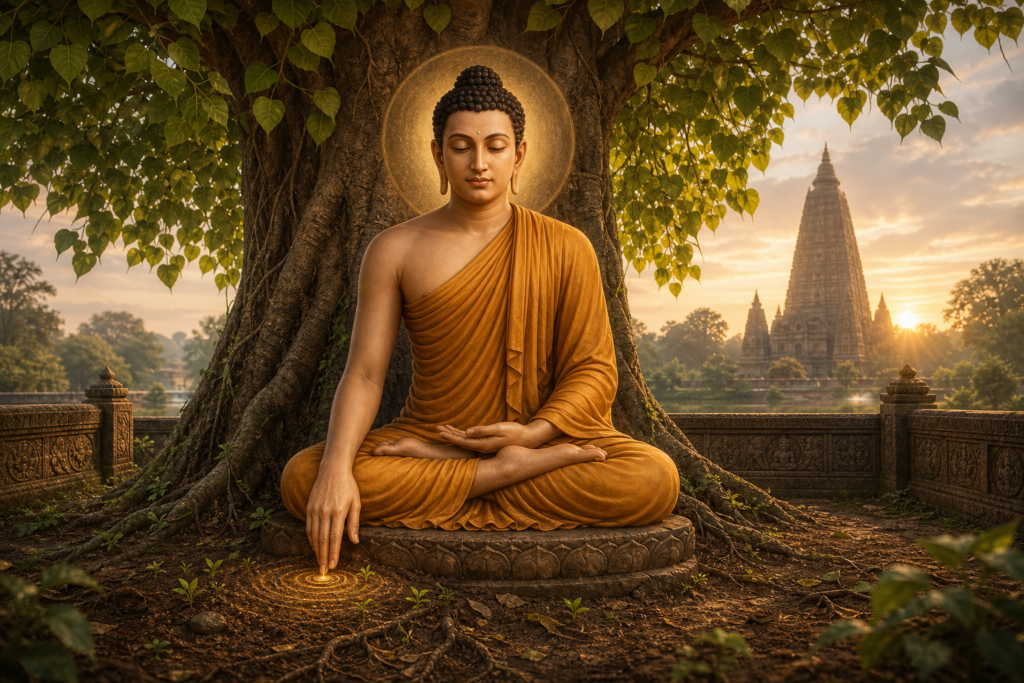
In a world of incessant notifications, news cycles, and social pressure, many experience a constant hum of restlessness that overwhelms attention and peace of mind. This condition may be described as the tyranny of the mindan inner narrative that never stops and a stream of thoughts that seldom settles. Ancient insights offer a grounded response to this modern mental chaos, inviting a deliberate shift from identification with thought to clear awareness.
The Silent Revolution: How Ancient Wisdom Conquers Modern Mental Chaos becomes palpable in the teachings associated with Rishi Ashtavakra. The central insight is concise and transformative: one is not the mind. This view, articulated in the Advaita tradition and resonant with the Upanishads, distinguishes between the changing movements of thought and the changeless witness, the sakshi. Such discernment reframes mental activity as an object of awareness rather than the essence of identity.
Why this matters today is straightforward. Over-identification with mental fluctuations (vrittis) sustains cycles of overthinking, anxiety, and rumination. Recognizing the mind as an instrument rather than a master softens reactivity and creates space for clarity. This shift is not a rejection of the mind but an alignment with vivekadiscriminative understanding that situates mental events within a broader field of awareness.
Classical frameworks such as the Pancha Kosha describe multiple layers of experience: annamaya (physical), pranamaya (energy), manomaya (mental), vijnanamaya (intellect), and anandamaya (bliss). The insight ‘you are not the mind’ situates the Self beyond the manomaya kosha, without denying the practical value of thought and analysis. The result is balance: the mind remains a vital tool, yet no longer defines identity.
This discernment aligns with a broader dharmic conversation. In buddhism, reflections on anatma emphasize non-clinging to mental phenomena; Jain practices of samayik cultivate equanimity and ethical awareness; Sikh simran or remembrance refines attention and softens egoic fixation; Yoga integrates pratyahara and dhyana to steady the field of consciousness. While doctrinal nuances differ, these traditions converge in practical wisdom: freedom grows as identification with mental turbulence recedes.
Practical step one: steady attention through breath awareness. Simple cycles of slow, natural breathing anchor wandering attention and calm physiological arousal. This approach parallels anapanasati in Buddhist practice, aligns with samayik in Jainism, finds resonance with Sikh simran, and is foundational to pranayama in Yoga. The aim is not to suppress thought, but to let thought arise and pass without compulsion.
Practical step two: cultivate pratyahara in daily life. Setting clear boundaries with devices, batching notifications, and choosing mindful intervals introduces restful gaps in the cognitive stream. In such quiet, dhyana becomes accessiblea sustained, easeful attention that loosens the knot of overthinking and restores clarity.
Practical step three: apply inquiry (vichara). When an anxious thought appears, one may ask: to whom does this thought arise? The question redirects awareness from the content of thought to the presence that knows it. Across the dharmic spectrum, comparable methods invite careful observation and ethical introspectionwhether in vipassana-type noting, pratikraman’s reflective honesty, or Naam-centered remembrance.
Common misunderstandings deserve clarification. This teaching is not nihilism, escapism, or indifference. Disidentification from mental turbulence allows steadier discernment, and with it more coherent action in accord with dharma. As attachment loosens, compassion and responsibility become more reliable, not less, because choices are no longer driven by agitation.
Many readers will recognize familiar situations: the late-night scroll that amplifies anxiety, the morning rush that fragments attention, the meeting where inner commentary drowns out listening. In each case, shifting from identification with thought to witness awareness interrupts the cycle. The mind continues to think; awareness quietly holds and clarifies.
A simple 3–3–3 reset can help. First, take three unforced breaths and feel the body settle. Second, name three points of contact (feet on the floor, hands on the desk, air on the face). Third, ask three orienting questions: what is present now, what truly matters now, and what is the kindest next step. This brief protocol restores composure and purpose without struggle.
Contemporary research in attention training suggests that meta-awareness reduces rumination and reactivity. In parallel, contemplative traditions describe the same outcome in different language: when awareness becomes more stable than thought, mental patterns loosen. The shared conclusion is practical and testableclarity grows through consistent practice, not through force.
Ethical integration is essential. Non-identification with thought encourages humility and care in speech and action. Across Hindu, Buddhist, Jain, and Sikh traditions, the fruit of practice is measured not merely in quietude but in lived virtueahimsa, truthful conduct, generosity, and service. Inner stillness and outer responsibility are mutually reinforcing.
In this sense, Ashtavakra’s guidance enacts a quiet, accessible revolution. By recognizing that one is not the mind, it becomes possible to meet the digital age with steadiness, to relate to anxiety without being defined by it, and to participate in society with clarity. The unity of dharmic wisdom offers multiple doorways, yet a common promise: a mind at ease, a heart attuned to compassion, and awareness free to see things as they are.
Inspired by this post on Hindu Blog.