Bhujanga Lalita Tandava stands within the vigorous tandava tradition of Shiva’s dance, presenting a rare synthesis of force and fluidity. As a theological and aesthetic motif, it maps the paradoxes of creation and dissolution, wrath and compassion, and motion and stillness into a single, intelligible grammar of movement. The very name frames its hermeneutics: “Bhujanga” (serpent) evokes the coiled, sinuous intelligence of life-force, while “Lalita” (grace) points to the soft, harmonizing cadence that tempers power with beauty.
In Shaiva philosophy and classical dance lineages, tandava denotes dynamism, whereas lasya accents delicacy. Bhujanga Lalita Tandava occupies a liminal space where dynamism does not discard tenderness but sublimes it. The posture and flow are interpreted as a kinetic allegory for the cosmic principle that holds opposites in tension without collapsean insight resonant across dharmic philosophies that consider reality as a living continuum rather than a static binary.
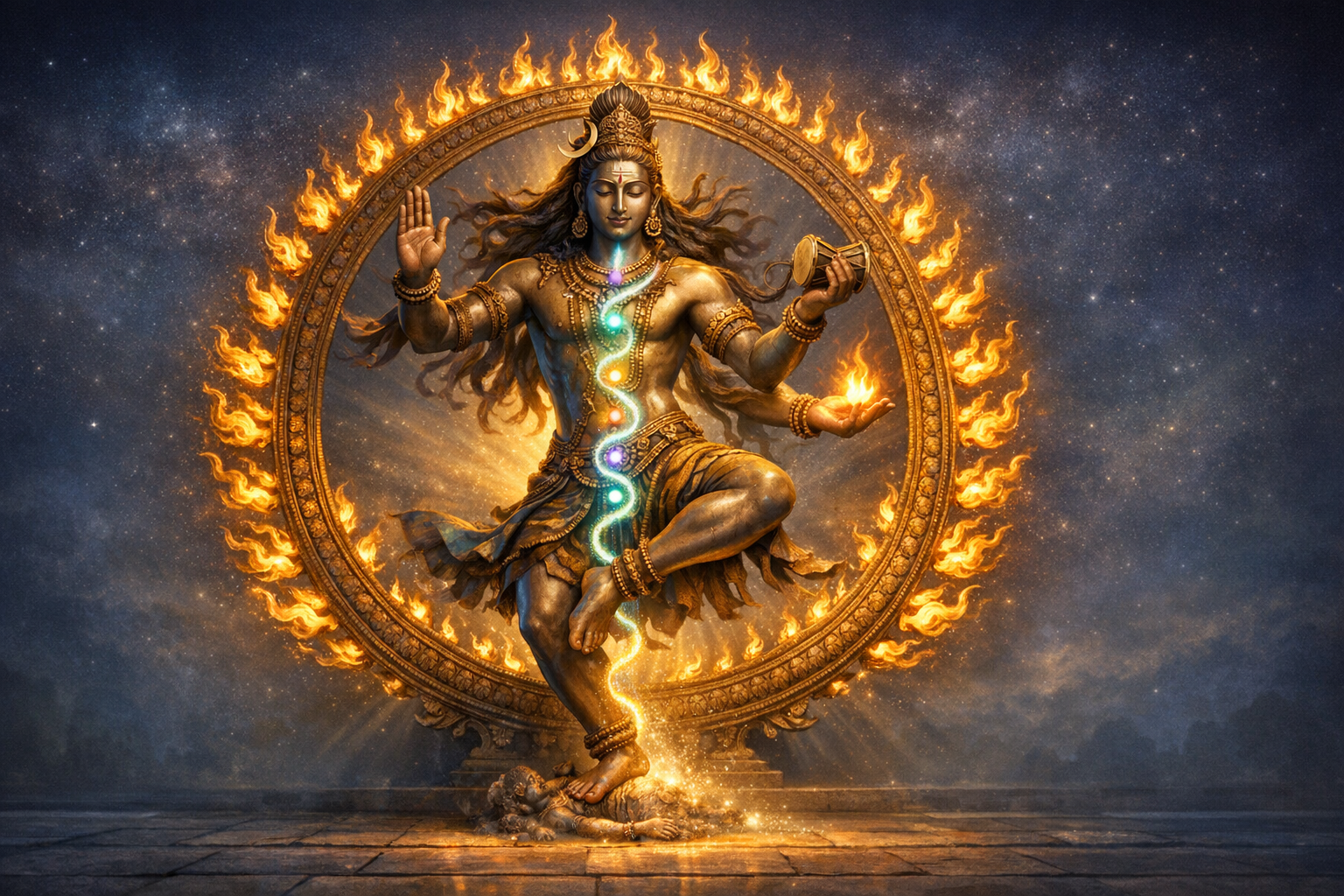
Iconographically, Shiva as Nataraja offers the canonical template. The circle of fire (prabha-mandala) suggests the boundless field of becoming; the ḍamaru signals primal pulsation; the raised hand assures fearlessness; the fire in the opposite hand connotes transformative dissolution. At the foot lies Apasmara, the dwarf that symbolizes avidyā (ignorance). In many readings, Bhujanga Lalita integrates into this tableau as the serpentine modulation through spine and torsoan embodied refutation of rigidity, and thus of ignorance.
Traditional arts discourse often reads Bhujanga Lalita as a specific tandem of karana-inspired transitions whose signature is wave-like continuity. The line of movement originates at the pelvic center, traverses the axial spine, arcs through the chest and shoulders, and resolves in the wrists and fingertips. The result is an unbroken, serpentine ribbon of force that appears to “breathe,” balancing the emphatic stamp of tandava with the tensile softness of lalita.
The philosophical stakes of this dance remain profound. Avidyā, personified as Apasmara, is not annihilated by aggression but subdued by higher awarenessthe very awareness that coordinates rhythm, breath, and intention. In Shaiva frameworks, this is aligned with the five cosmic acts (pañcakṛtya): creation, maintenance, dissolution, concealment, and grace. Bhujanga Lalita functions as a ritual semiotic where grace (anugraha) does not negate force; it refines it.
Inter-dharmic resonances deepen this reading. Buddhism identifies avidyā as the first link in dependent origination, the root mistaking of reality. Jainism locates delusion in mohaniya karma, which clouds discernment. Sikh teachings point to haumai (egoic self-absorption) as a source of suffering and separation from the Divine. In all, ignorance yields to awakened vision, ethical clarity, and compassionate action. Bhujanga Lalita, as an emblem, converges with this shared soteriological arcvictory over ignorance through insight rather than suppression through mere force.
Yogic cartography offers a complementary lens. The serpentine contour naturally recalls kundalini imagery, with the subtle current rising within the suṣumṇā nāḍī through chakras. Practitioners often map the undulation of Bhujanga Lalita to a refined spinal wave coordinated with breath, producing an inner quietude even amidst strong outward articulation. This is not a medical prescription but an experiential template: steady inhalation lengthens the axial line; exhalation releases excess effort; awareness rests at the heart center where vigor and gentleness meet.
Ritually, many temple traditions celebrate Nataraja as the mover of all movements while remaining the unmoved witness. Devotees frequently report that the serpentine grace instills an immediate sense of interior spaciousness, mirroring the Chidambaram emphasis on ākāśa (space) as a sacred principle. The dance thus serves as contemplative instruction: widen attention, refine breath, and let discernment displace reactivity.
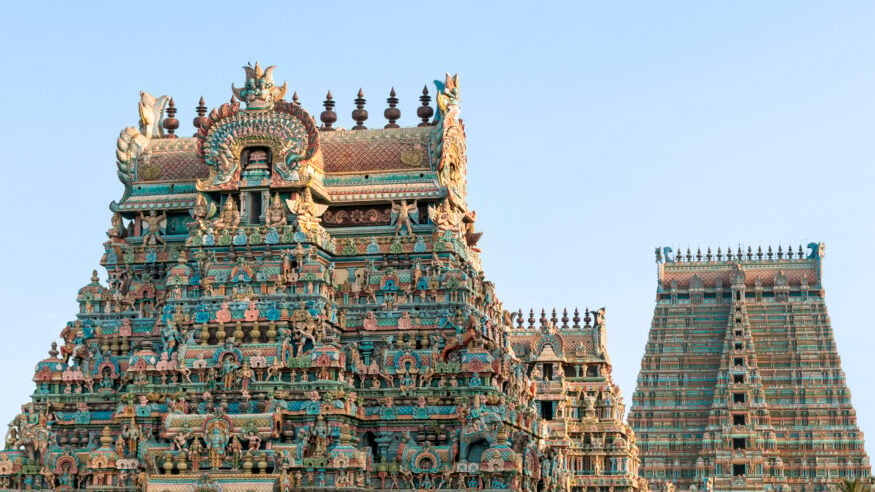
Within the history of Indian aesthetics, the Natyashastra’s karana vocabulary informs how scholars and performers discuss such movements. South Indian temple sculpture preserves many of these dance grammars in stone panels, enabling careful comparative study of gesture, stance, and transition. Contemporary exponents have explored these sources to reconstruct fluid sequences that embody both theological symbolism and refined technique without claiming exact one-to-one replication across eras.
Technically, Bhujanga Lalita may be studied through three lensesalignment, continuity, and modulation. Alignment stabilizes the pelvis and lengthens the lumbar curve without collapse. Continuity threads motion so that power originates centrally and disperses outward in a smooth wave. Modulation calibrates amplitude and speed, ensuring that force does not break the line. This triad allows the dancer to communicate strength without stiffness and beauty without slacknessthe very paradox the dance seeks to resolve.
For contemplative practice, simple protocols can anchor the symbolism in lived experience. Quiet standing with soft gaze, three to five cycles of nadi-śodhana (alternate-nostril breathing), and a brief mantra-japa such as Om Namah Shivaya can prime attention. A slow, mindful spinal undulation practiced within one’s range reminds the body of the serpent’s lesson: clarity emerges when effort becomes intelligent and continuous rather than fragmented and forceful.
Comparative symbolism across dharmic traditions further illuminates the serpent motif. In Hindu narratives, Ananta-Śeṣa embodies infinite support; in Buddhist lore, Mucalinda shelters the meditating Buddha; in Jain tradition, Pārśvanātha’s canopy evokes serene vigilance. Across these streams, the serpentoften misunderstoodbecomes a sign of awakened energy rightly harnessed: protective, poised, and uncoiled from fear.
As a cultural artifact, Bhujanga Lalita Tandava belongs equally to spiritual insight and civilizational heritage. It encodes metaphysics in movement, ethics in rhythm, and psychology in breath. The vigor of tandava need not oppose the tenderness of lalita; their union becomes a pedagogy of wholeness, suggesting that societies flourish when strength is braided with empathy and tradition with inquiry.
In everyday life, the dance offers pragmatic counsel. Ignorance appears now as rigid certainty, now as diffuse confusion. A serpentine approachresponsive, centered, and continuously adjustinghelps untie both knots. Coordination of breath and attention interrupts habitual reactivity; a bias toward grace tempers righteous heat; clarity replaces conquest as the preferred means of overcoming inner and outer discord.
Seen through the wider dharmic lens, Bhujanga Lalita’s victory over avidyā is not tribal but universal. It invites shared commitmentsnon-harm, truthful seeing, disciplined practice, and compassionate servicethat Buddhists, Jains, Sikhs, and Hindus recognize as pathways to freedom. Unity here arises not by erasing differences but by honoring a common telos: the awakening of wisdom that dissolves ignorance at its root.
Ultimately, Bhujanga Lalita Tandava presents a luminous thesis: grace is the highest strength. When the spine of attention undulates without break, when breath and intention conjoin, and when knowledge refines power, Apasmara falls away. What remains is Nataraja’s assurancefearlessness within the wheel of changeand a living invitation to dance wisely in a world that is always already in motion.
Inspired by this post on Hindu Blog.