Across Hindu symbolism, the khatvanga endures as one of the most arresting emblems of Shakta and Shaiva-tantric worship. Most closely linked to fierce goddessesChamunda, Kali and other tantric manifestations of the Divine Mother (Shakti)this skull-staff announces a theology of fearlessness, radical compassion, and transformative wisdom expressed in cremation-ground imagery. Read as both a weapon and a vow, the khatvanga frames the goddess’s Dance of Transcendence: death is not denied or despised; it is integrated and overcome.
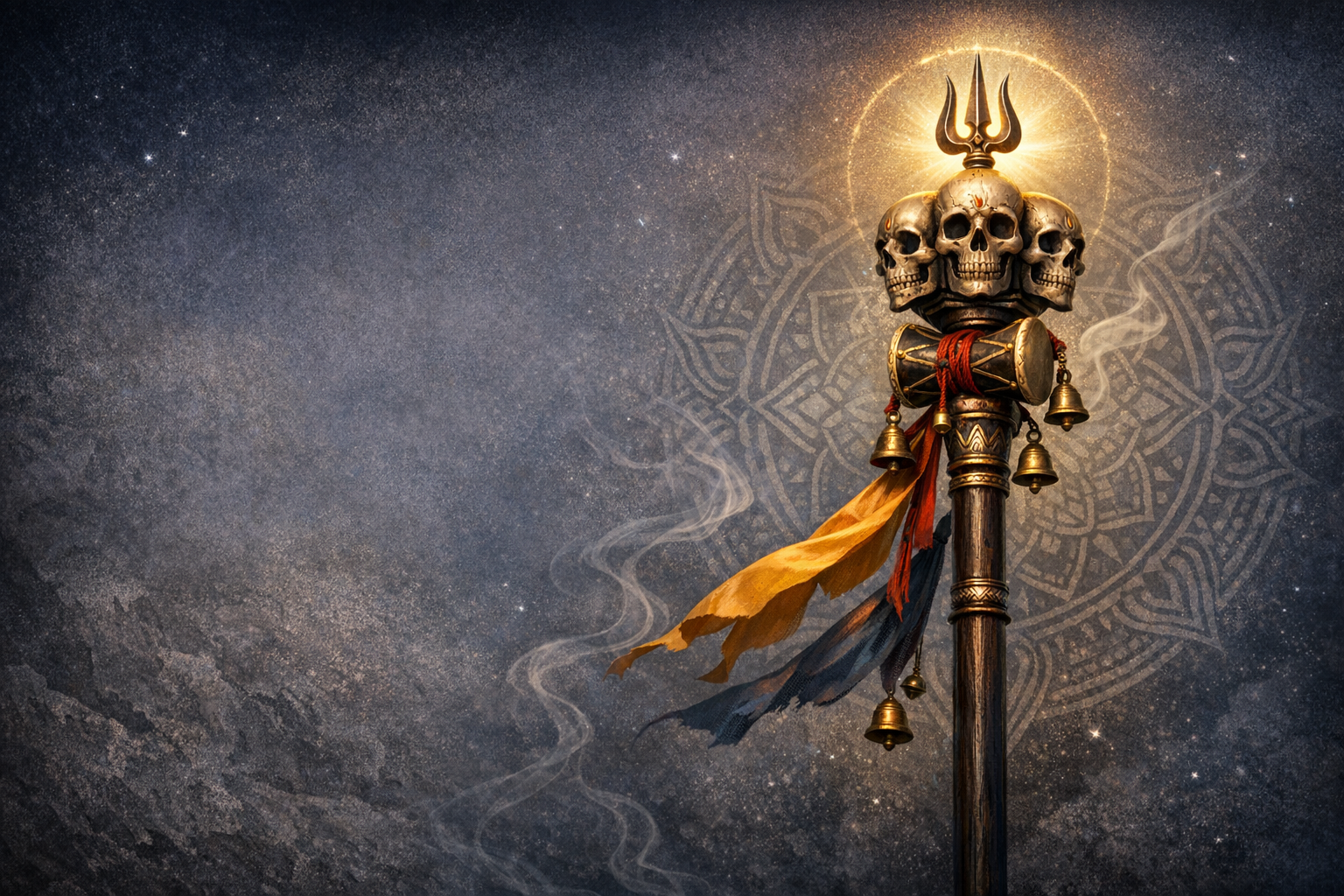
At the level of form, the khatvanga is classically envisioned as a human skull (kapala) mounted on a length of bone (often described as a femur), sometimes expanded into a triple-skull finial or capped by a trident. Ritual variants add a damaru (hourglass drum), a fluttering banner, and garlands of bells or severed heads, visually connecting the staff with Bhairava and the goddess’s cremation-ground retinue. While ascetic lineages historically used human bone, most temple and monastic representations are wood or metal, preserving the symbol’s meaning without transgressing ethical norms.
Iconographic treatises in the Agamic and Tantric streams, together with Puranic narratives that sacralize the śmaśāna (cremation ground), provide the conceptual grammar for the khatvanga. Kapālika and Kaula traditions, as well as late-medieval Shakta milieus in the Pāla–Sena sphere of eastern India, normalized charnel-ground implements as vehicles for spiritual transmutation. The recurring motif is consistent: what appears impure or terrifying is precisely what, in tantric hermeneutics, is harnessed and sanctified.
Chamunda epitomizes this logic. Emaciated, garlanded with skulls, accompanied by jackals, and seated upon a corpse or the panchamundi asana, she often holds the khatvanga to signal dominion over decay and dread. In her hands, the skull-staff is not morbid spectacle; it is an assurance that time, death, and fear themselves become guardians once their energies are absorbed into dharma.
Kali, too, appears with the skull-bowl (kapala) and, in several tantric ateliers, with the khatvanga. More widely known for the sword (khadga) and the severed head that cuts through avidya (ignorance), she nonetheless shares the khatvanga’s message: the relentless cycles of becoming and unbecoming can be witnessed, danced upon, and transformed by Shakti.
Symbolically, the first stratum of the khatvanga is memento morianitya (impermanence) as a contemplative discipline. The skull mirrors the end to which clinging leads, while the staff declares steadiness through that realization. For devotees reading Hindu symbols in temple halls or palm-leaf manuscripts, this is a visual sermon: freedom grows where denial ends.
A triadic finial of three heads (fresh, decaying, and bare skull) is sometimes shown. In Shakta exegesis this triad maps to iccha, jnana, and kriya shaktis (will, knowledge, action) mastered by the goddess; alternatively, to the trigunas (sattva, rajas, tamas) stabilized in her presence; or to the three timespast, present, futureheld effortlessly in awakened awareness. In Vajrayana hermeneutics, the same triad is read as the three kayas (nirmanakaya, sambhogakaya, dharmakaya), illustrating how a single cultural symbol travels across dharmic families with luminous coherence.
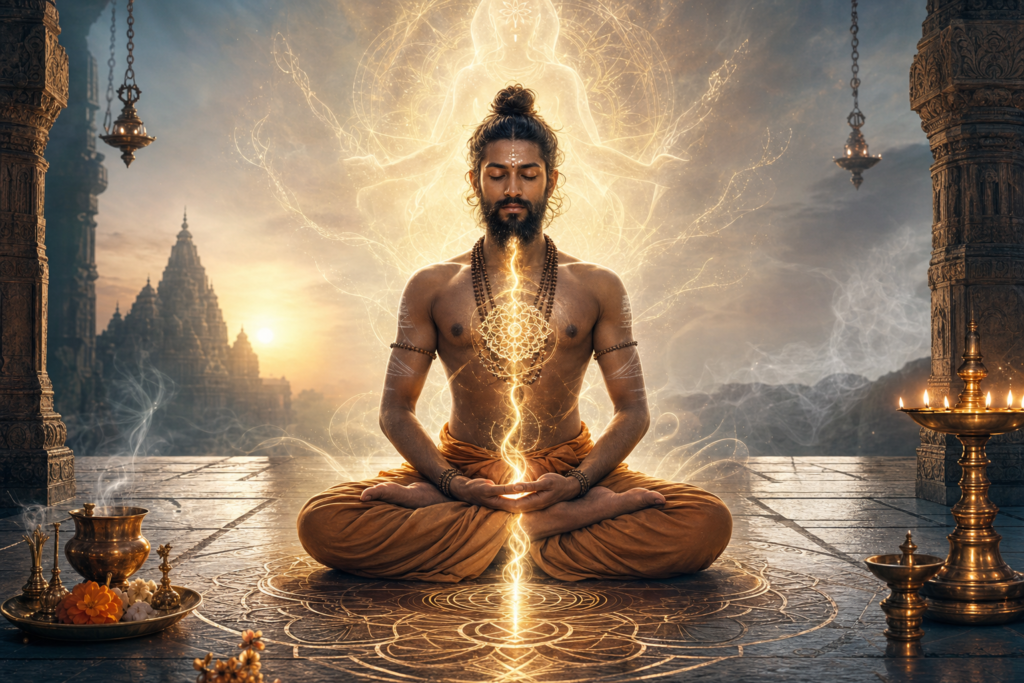
A yogic anatomy reading deepens the picture. The upright staff is readily interpreted as the sushumna nadi, the axial channel through which kundalini ascends. The skull at the summit signifies the opening of sahasrara and the dawning of non-dual awareness; the damaru evokes spandacosmic vibrationwhile the fluttering banner recalls pranic movement. In this light, the khatvanga stands beside Shiva Nataraja’s damaru and fire as part of a shared iconographic language of liberation.
Ritually, the khatvanga functions as a consecrated implement in select tantric pujas and in raudra dhyana (wrathful contemplations) designed to metabolize fear and aversion. Closely allied is the panchamundi asana symbolisman intentional seating over five skulls signifying mastery over five elemental and psycho-ethical limitations. Where law, ethics, or common-sense decorum preclude literal materials, lineage communities retain the full contemplative intent through purely symbolic media.
Across traditions, Vajrayana Buddhism depicts dakinis such as Vajrayogini and masters like Padmasambhava with a khatvanga slung over the left shoulder, signifying inseparable union of skillful means and wisdom. The ornamental tri-skull, trident finial, damaru, and banner are near-identical to Shakta prototypes, underscoring long-standing philosophical conversation and shared sacred geography across the Indic world.
Unity of purpose emerges even when external forms differ. Jain contemplative focus on non-violence and disentanglement from attachment, and Sikh emphasis on fearlessness (Nirbhau), truthful living, and cutting through ego (haumai) converge with the khatvanga’s interior teaching: look directly at impermanence, stand upright in dharma, and transmute reactive fear into compassionate courage. Such resonances exemplify the civilizational idea of Vasudhaiva Kutumbakam lived across Hindu, Buddhist, Jain, and Sikh paths.
From an art-historical perspective, skull-staffs and related kapala motifs proliferate in late-medieval stone and bronze from eastern India and Nepal, and transmit robustly into Tibetan ateliers. Figures of Chamunda, Bhairava, and attendant yoginis in the Pāla–Sena idiom frequently integrate the staff, while later Shilpa traditions codify its proportions and emblems for temple sculpture and ritual metalwork.
In contemporary practice, the khatvanga remains a powerful teaching imagefound in temples, museums, and textual illustrationsas a guide to reading Hindu symbols beyond surface reaction. Educators, priests, and practitioners commonly frame it as an ethical invitation: to honor the body as sacred, to regard death with sobriety rather than sensationalism, and to cultivate the steadiness that the staff proclaims. In this sense it is less an object and more a pedagogy.
For many devotees encountering Chamunda or Kali for the first time, the skull-staff can evoke unease. With study, darshana, and quiet reflection, that unease often ripens into clarity: the symbol is addressing a universal human questionhow to live well in full view of mortality. The answer it proposes is neither despair nor denial, but fearless intimacy with truth.
Thus the khatvanga, in the hands of the Divine Mother, is both sceptre and sutra. It gathers cremation-ground, cosmos, and consciousness into one vertical line and invites participation in the Dance of Transcendence, where time is witnessed, fear is transformed, and compassion becomes the natural strength of a liberated heart.
Inspired by this post on Hindu Blog.