
The Question of Preservation
The preservation of the Veda stands among the most refined achievements of Indian Knowledge Systems. Across centuries, the Vedic tradition did not depend on writing alone, nor did it entrust sacred knowledge to memory in an informal sense. It developed a disciplined oral architecture in which sound, measure, structure, meaning, ritual action, and time-reckoning were each protected through a corresponding Vedāṅga.
Śikṣā safeguards the exact articulation of Vedic sound. Chandas preserves the measured arrangement through which Vedic śabda moves. Nirukta sustains access to meaning. Kalpa orders ritual action. Jyotiṣa anchors action in time. Yet one question remains central: if sound is preserved and meaning is explained, what preserves the inner structure of the śabda itself?
The answer given by the tradition is Vyākaraṇa. It is not merely grammar in the modern schoolroom sense. It is the discipline that protects the form, derivation, validity, and internal order of śabda. Without this structural layer, pronunciation may survive while understanding becomes unstable, or meaning may remain broadly remembered while the actual constitution of valid words becomes uncertain.
This is why Vyākaraṇa occupies such an important position in the Vedāṅga system. It preserves the conditions under which Vedic language remains intelligible, transmissible, and open to disciplined inquiry. It enables śabda-pramāṇa to remain more than inherited sound; it allows it to remain a structured vehicle of knowledge.
The Meaning of Vyākaraṇa
The word Vyākaraṇa itself reveals the nature of the discipline. Traditional derivation explains it as वि + आङ् + √कृ + ल्युट् → व्याकरणम् (vi + āṅ + √kṛ + lyuṭ → vyākaraṇam). The prefix वि (vi) carries the sense of analysis or differentiation. आङ् (āṅ) suggests explicit manifestation. The verbal root √कृ (√kṛ) conveys bringing into being or making. Together, the word points to a śāstra that analyses śabda and makes its constitution explicit.
The traditional nirvacana expresses this with precision:
व्याक्रियन्ते व्युत्पाद्यन्ते विशोध्यन्ते साधुशब्दाः अनेनेति व्याकरणम्।
vyākriyante vyutpādyante viśodhyante sādhuśabdāḥ aneneti vyākaraṇam.
(That by which valid śabdas are analysed, derived, and validated is Vyākaraṇa.)
The expression is significant because it does not speak of words in a loose or casual way. It speaks of sādhuśabdas, valid śabdas. Vyākaraṇa is therefore concerned with legitimacy, derivation, and order. It asks how a śabda is formed, what makes it valid, and how its structure can be understood within a system rather than through isolated usage.
A Brāhmaṇa passage deepens this understanding by describing speech as initially avyākṛta, undifferentiated and unarticulated:
वाग्वै पराची अव्याकृतावदत् ।
ते देवा इन्द्रमब्रुवन्निमां नो वाचं व्याकुर्विति ।
तामिन्द्रो मध्यतोऽवक्रम्य व्याकरोत् ।
तस्मादियं वागुद्यते ॥
vāgvai parācī avyākṛtāvadat |
te devā indram abruvann imāṃ no vācaṃ vyākurv iti |
tām indro madhyato’vakramya vyākarot |
tasmād iyaṃ vāg udyate ||
Here speech is not created from disorder; rather, its inner order is brought into manifestation. What is avyākṛta becomes vyākṛta. It becomes articulated, distinguishable, and available for understanding. This passage offers a powerful philosophical image of Vyākaraṇa: it does not impose order from outside but reveals the order already present within speech.
The same insight appears in another traditional statement:
वाग्नो विवृणुयादात्मानम् इत्यध्येयं व्याकरणम्।
vāg no vivṛṇuyād ātmānam ity adhyeyaṃ vyākaraṇam.
(Vyākaraṇa is to be studied because it enables speech to unfold its own nature.)
This view gives Vyākaraṇa an intellectual dignity that extends beyond technical grammar. It becomes a disciplined way of allowing speech to disclose its own structure. In this sense, grammar is not dry classification. It is a mode of reverent analysis, a way of listening carefully enough that śabda reveals its own architecture.
Why Vyākaraṇa Is Called the Mukham of the Veda
The Pāṇinīya Śikṣā identifies Vyākaraṇa as the mukham of the Veda-Puruṣa:
मुखं व्याकरणं स्मृतम्
mukham vyākaraṇaṃ smṛtam
(Vyākaraṇa is remembered as the mukha of the Veda-Puruṣa.)
The Sanskrit word mukha has a broader range than the English word “mouth.” It can mean the face, the front, the point of manifestation, or the means by which something becomes apprehensible. In the imagery of the Veda-Puruṣa, Vyākaraṇa is the mukha because it makes the structure of śabda visible to disciplined understanding.
This designation is not accidental. The face is the point through which identity becomes recognizable. Speech becomes intelligible through ordered articulation. In the same way, the Veda becomes structurally available through Vyākaraṇa. The discipline allows the constitution of words, forms, stems, suffixes, roots, and syntactic relations to be seen with clarity.
For anyone approaching Sanskrit, this insight is often experienced in a concrete way. A Vedic or classical expression may first appear as a dense sequence of sounds. Once its derivation, compounds, suffixes, and grammatical relations are understood, the expression opens. What seemed opaque begins to disclose order. That movement from opacity to intelligibility is precisely the work of Vyākaraṇa.
The World Before Pāṇini
Pāṇini did not create grammatical inquiry out of nothing. By the time the Aṣṭādhyāyī was composed, the analysis of śabda already belonged to a rich and living intellectual tradition. The sophistication of the Aṣṭādhyāyī, its reliance on the Māheśvara Sūtras, Dhātupāṭha, and Gaṇapāṭha, and its integration with the Vedāṅgas indicate a long prior history of reflection.
The roots of this tradition are visible in the Vedic corpus itself. Vedic and Brāhmaṇa literature preserves concern with dhātu, nāma, ākhyāta, vibhakti, pratyaya, and vyākaraṇa. These terms show that inquiry into the formation and meaning of śabda was already active before the Aṣṭādhyāyī attained its classical form.
The grammatical tradition also remembers earlier authorities such as Āpiśali, Kāśakṛtsna, Śākaṭāyana, Gārgya, and others. Their independent works are no longer available in full, yet their memory within the tradition is important. It indicates that Pāṇini inherited an already mature field of inquiry and gave it an extraordinary śāstric architecture.
The Aṣṭādhyāyī is therefore both culmination and foundation. It culminates older reflections on śabda and becomes the foundation for the later Vyākaraṇa tradition. Pāṇini’s genius lies not merely in preserving earlier material, but in organizing it into a system of astonishing precision, economy, and generative power.
The Engineering of the Aṣṭādhyāyī
The Aṣṭādhyāyī is often described as a text of nearly four thousand sūtras. That description is accurate but incomplete. Its true achievement lies in the way those sūtras interact as an integrated system. The text is brief because its architecture is dense, not because its subject is simple.
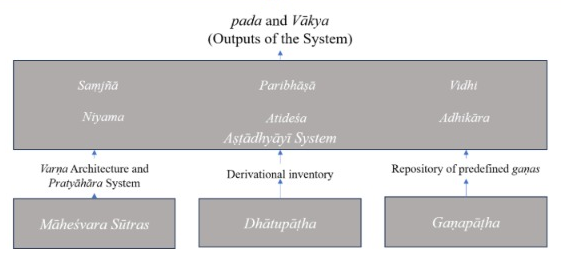
Several foundational components make this system possible. The Māheśvara Sūtras provide the varṇa-architecture used to construct pratyāhāras. The Dhātupāṭha supplies the inventory of dhātus. The Gaṇapāṭha supplies predefined collections of śabdas and roots that can be invoked by concise designations. Together, these resources allow the Aṣṭādhyāyī to operate with extraordinary compression.
The Māheśvara Sūtras
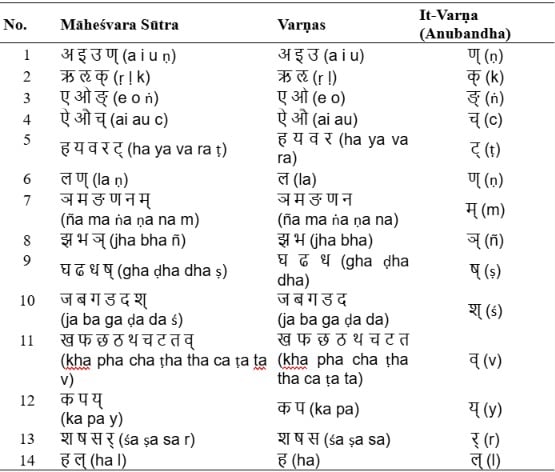
The Māheśvara Sūtras occupy a central place in the Pāṇinian system. They consist of fourteen sūtras that arrange varṇas in a carefully structured sequence. Each sūtra ends with an it-varṇa, also called an anubandha. These markers are not included in the varṇa groups themselves; they function as boundary indicators for forming pratyāhāras.
A pratyāhāra is a compact designation for a group of varṇas. It is formed by taking the initial varṇa of the desired range and combining it with the marker that closes that range. The resulting expression denotes all varṇas from the starting point up to, but not including, the marker. This allows Pāṇini to refer to large and precisely defined phonetic groups through very short expressions.
For example, the first two Māheśvara Sūtras are a i u ṇ (अ इ उ ण्) and ṛ ḷ k (ऋ ऌ क्). Here, ṇ (ण्) and k (क्) function as it-varṇas. The pratyāhāra aṇ (अण्) begins with a (अ) and extends to the marker ṇ (ण्), thereby denoting a, i, u (अ, इ, उ). Similarly, ik (इक्) begins with i (इ) and extends to k (क्), denoting i, u, ṛ, ḷ (इ, उ, ऋ, ऌ).
This is not merely a mnemonic device. It is an indexing framework. By selecting different starting varṇas and ending markers, the system generates many pratyāhāras from one ordered sequence. Without this device, the Aṣṭādhyāyī would need to repeatedly list phonetic classes in full. The Māheśvara arrangement therefore functions as a compression mechanism that supports the brevity and accuracy of the entire śāstra.
The Dhātupāṭha
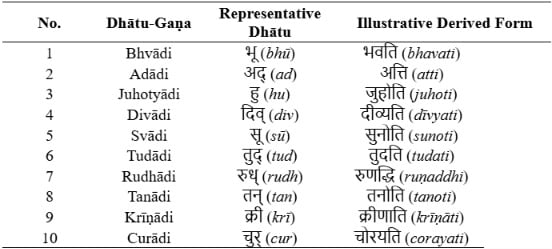
The Dhātupāṭha is the traditional collection of dhātus presupposed by the Aṣṭādhyāyī. A dhātu is not merely a “verb root” in a narrow modern sense. It is a foundational derivational element from which verbal forms and many nominal expressions may arise.
For example, from the dhātu भू (bhū) arise forms such as भवति (bhavati), भावः (bhāvaḥ), भूतम् (bhūtam), and many related expressions. The Dhātupāṭha therefore functions as an inventory of generative elements, allowing the system to account for families of śabdas rather than isolated words.
The Dhātupāṭha organizes dhātus into ten traditional gaṇas. These groupings are not arbitrary lists. They classify dhātus according to patterns of operation within the derivational system. Because of this classification, a rule can apply efficiently to a whole class rather than being repeated for each individual root.
The Gaṇapāṭha
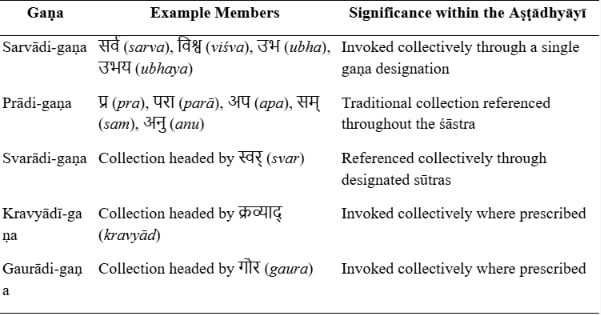
The Gaṇapāṭha is another important repository in the Pāṇinian system. While the Dhātupāṭha supplies dhātus, the Gaṇapāṭha supplies predefined collections of śabdas or roots that the Aṣṭādhyāyī can invoke collectively. This gives the system another layer of economy.
For example, the Sarvādi-gaṇa contains śabdas such as sarva, viśva, ubha, and ubhaya. Instead of listing these members repeatedly wherever a grammatical rule applies, the Aṣṭādhyāyī can invoke the gaṇa through a single designation. A compact reference thus carries an entire predefined set.
The Gaṇapāṭha works in a manner analogous to pratyāhāras. A pratyāhāra gives a compact name to a group of varṇas; a gaṇa gives a compact name to a group of śabdas or roots. Both mechanisms reveal the same architectural intelligence: Pāṇini’s system achieves brevity through carefully designed reference structures.
The Internal Architecture of the System
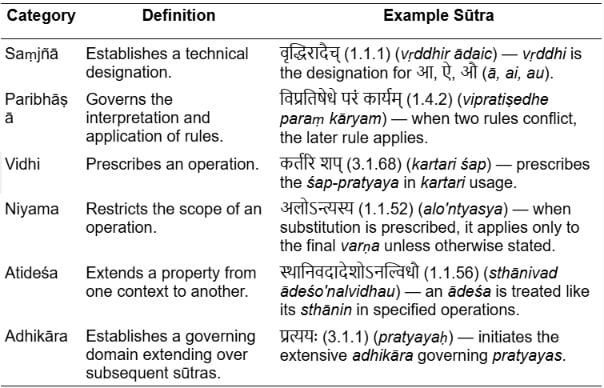
The real sophistication of the Aṣṭādhyāyī lies in its internal operations. Technical designations, carried conditions, restrictions, interpretive principles, domain markers, and extensions all interact across the text. A single sūtra may depend on definitions established elsewhere, conditions carried forward through anuvṛtti, or limitations introduced by later rules.
Traditional scholarship identifies several structural categories within this system. Saṃjñās establish technical definitions. Paribhāṣās guide interpretation. Vidhis prescribe operations. Niyamas restrict application. Atideśas extend properties across contexts. Adhikāras establish domains of applicability. Together, these categories allow the Aṣṭādhyāyī to remain concise while retaining immense analytical range.
This interconnectedness is what makes the Aṣṭādhyāyī a system rather than a mere compilation. A condition stated once may govern a long sequence of rules. A technical term may influence operations distributed across the text. A restriction in one place may determine the scope of another rule. The result is a compact but highly coordinated intellectual architecture.
Modern readers often find this difficult at first because they expect a grammar to proceed in linear explanation. The Aṣṭādhyāyī works differently. It functions more like a tightly structured generative system, where small rules interact according to precise conditions. This is one reason it continues to attract interest not only from Sanskrit scholars but also from those interested in logic, linguistic structure, formal systems, and knowledge representation.
Vyākaraṇa as a Living Knowledge-Preservation System
Vyākaraṇa should therefore be understood as more than the study of forms. It is a knowledge-preservation system. It protects the structural integrity of śabda by showing how valid words are constituted, derived, distinguished, and regulated. It allows transmission to remain faithful not only at the level of sound but also at the level of linguistic order.
This function becomes especially important in an oral tradition. When knowledge is transmitted from teacher to student across generations, precision must be distributed across multiple safeguards. Śikṣā protects pronunciation, Chandas protects measure, Nirukta protects meaning, and Vyākaraṇa protects structure. Each Vedāṅga strengthens the others, and none can fully replace the rest.
Sound may remain intact while grammatical structure becomes obscure. Meaning may be remembered while derivation is forgotten. A word may be pronounced correctly while its relation to a dhātu, suffix, or syntactic function is no longer understood. Vyākaraṇa prevents such fragmentation by preserving the intelligible form of śabda.
This is also where the tradition offers a broader lesson for Dharmic knowledge systems. Hindu, Buddhist, Jain, and Sikh traditions have all valued disciplined transmission, careful interpretation, and reverence for sacred or philosophical language. While their textual canons and doctrinal frameworks differ, they share a deep respect for the responsibility of preserving meaning without severing it from form. Vyākaraṇa belongs to this larger civilizational concern for faithful transmission.
Vyākaraṇa Within the Vedāṅga Architecture
The Vedāṅgas are distinguishable but not separable. Each protects a specific dimension of Vedic transmission, yet the preservation of the Veda as śabda-pramāṇa depends on their coordinated operation. This is the central insight of the oral architecture of the Vedāṅgas.
Śikṣā ensures that sound is transmitted accurately. Chandas preserves the measured structure through which Vedic sound is arranged. Vyākaraṇa protects the internal integrity of śabda. Nirukta maintains access to meaning. Kalpa links knowledge to ordered ritual practice. Jyotiṣa relates action to time. Together, these disciplines protect the Veda as a living body of transmitted knowledge.
Within this architecture, Vyākaraṇa occupies a vital middle position. It stands between sound and meaning, not as a compromise but as a structural bridge. It shows how sound becomes meaningful śabda through ordered formation. It also shows how meaning is stabilized by valid linguistic structure.
This explains why Vyākaraṇa is remembered as the mukham of the Veda-Puruṣa. The mukha is the point of expression and intelligibility. Through Vyākaraṇa, the Vedic word becomes available for analysis, understanding, and transmission. It gives the tradition a way to preserve not only what is heard, but how what is heard is formed.
Conclusion: The Integrity of Śabda
The preservation of the Veda required far more than memorization. It required an integrated architecture of disciplines capable of safeguarding sound, measure, structure, meaning, action, and time. Vyākaraṇa performs one of the most subtle tasks within this architecture: it preserves the structural order of śabda itself.
If Śikṣā preserves the sound of the Veda and Nirukta preserves access to meaning, Vyākaraṇa preserves the integrity of the linguistic form through which meaning is conveyed. It protects the derivational and grammatical principles that make valid śabdas intelligible across generations.
The enduring achievement of Pāṇini’s Aṣṭādhyāyī lies in giving this function an extraordinary śāstric form. Through the Māheśvara Sūtras, Dhātupāṭha, Gaṇapāṭha, saṃjñās, paribhāṣās, vidhis, niyamas, atideśas, and adhikāras, it creates a disciplined framework for understanding the architecture of Sanskrit śabda.
Vyākaraṇa therefore remains indispensable to the study of Vedic Knowledge, Sanskrit, and the wider intellectual heritage of Sanatana Dharma. It teaches that preservation is not merely the act of keeping something unchanged; it is the disciplined protection of the conditions that allow knowledge to remain intelligible. In that sense, Vyākaraṇa is rightly remembered as the powerful mukham of the Veda.
References
Garikapati Pavan Kumar. Indian Knowledge Systems as Epistemic Architectures: Transmission, Validation, and Ontology. Zenodo, 2025. https://doi.org/10.5281/zenodo.17970871
Garikapati, Pavan Kumar. The Oral Architecture of the Vedāṅgas: Preserving the Eternal Veda. Indica Today, November 27, 2025.
Telugu Akademi. Pāṇinīya Aṣṭādhyāyī: Kāśikāvṛtti Sahitam (Prathama, Dvitīya Bhāgamulu). Translated into Telugu by Prof. Ravva Sri Hari. Vols. I–II. Hyderabad: Telugu Akademi, Reprint 2017.
Inspired by this post on Indica Today.
