
Aksharabhyasam at Koothanur Saraswathi Temple occupies a special place in the religious and educational culture of Tamil Nadu. Also known as Vidyarambham, the rite marks the formal beginning of a child’s journey into letters, language, memory, discipline, and sacred learning. In Hindu tradition, education is not treated merely as the acquisition of information; it is understood as a refinement of the mind, speech, conduct, and inner awareness. For this reason, the first encounter with writing is placed under the blessing of Goddess Saraswathi, the deity associated with knowledge, eloquence, music, learning, and purity of expression.
The term Vidyarambham comes from two Sanskrit words: Vidya, meaning knowledge, and arambham, meaning beginning. Aksharabhyasam similarly refers to the disciplined practice or initiation into akshara, the letter or syllable. This vocabulary itself reveals the philosophical depth of the ceremony. A letter is not only a mark on a surface; in Indian knowledge traditions, sound, speech, script, and meaning are connected to memory, recitation, grammar, sacred study, and the transmission of wisdom across generations.
Koothanur Maha Saraswathi Temple, situated in Koothanur in the Tiruvarur district of Tamil Nadu, is among the most significant places associated with this ceremony. The temple is dedicated to Mata Saraswathi, also reverently called Vidya Devi and Vidya Saraswathi. Temples where Saraswathi is the principal deity are comparatively rare in India, and Koothanur is especially valued because it is widely regarded as the only individual temple in Tamil Nadu with Saraswathi as the main deity. This makes the shrine an important spiritual destination for families, students, teachers, artists, and seekers of learning.
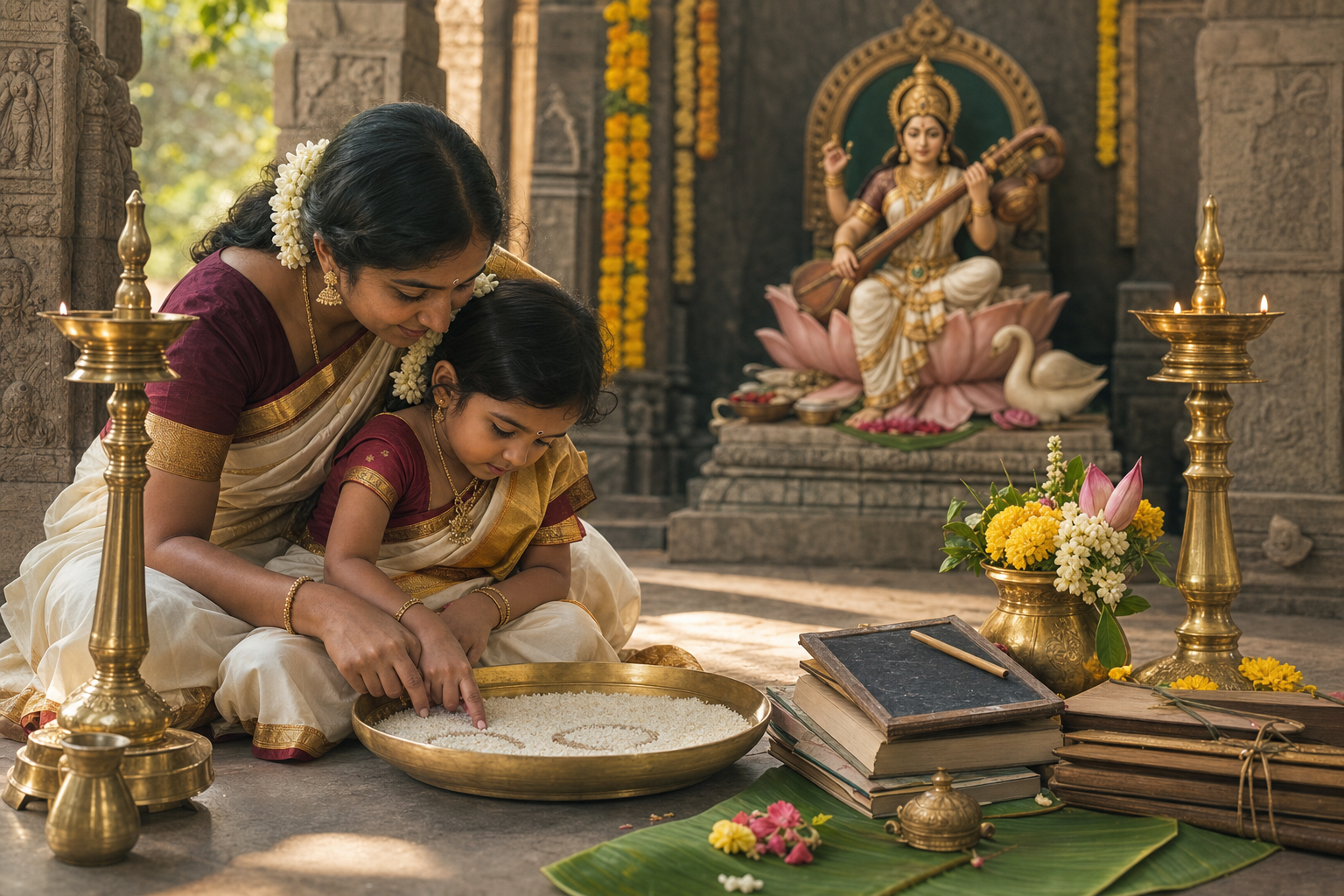
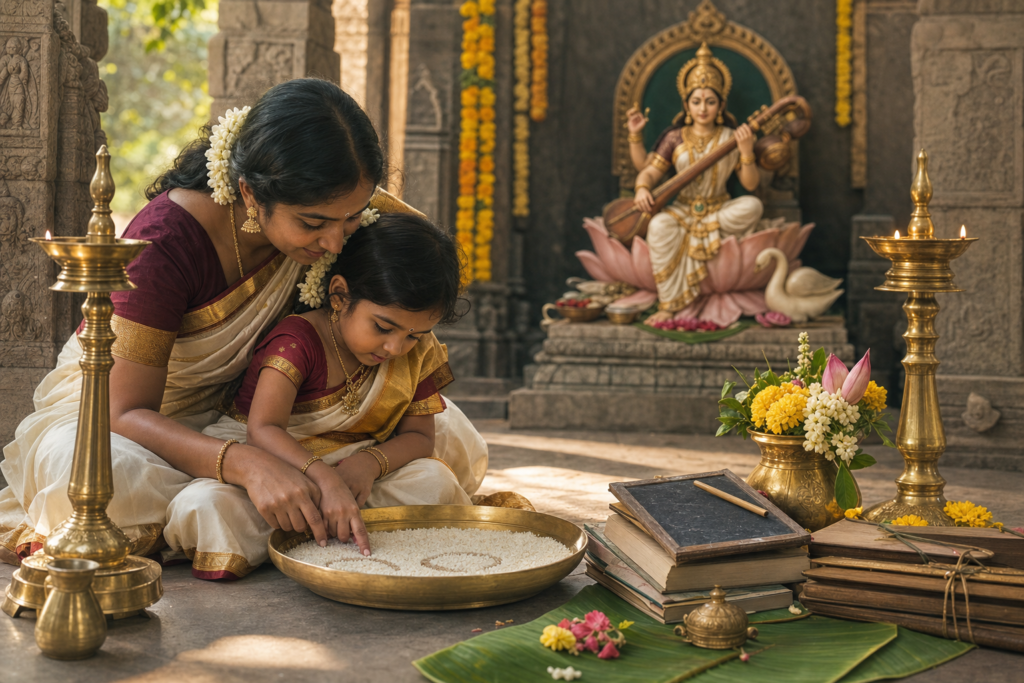
The emotional power of the ceremony is easy to understand. A child who is just entering formal education sits before the deity, often surrounded by parents, elders, and priests. Grains of rice or wheat may be spread on a plate or banana leaf, and the child’s hand is gently guided to trace sacred syllables, mantras, or the first letters of the mother tongue. The gesture is simple, but its meaning is profound. It suggests that learning begins with humility, guidance, discipline, and reverence for those who transmit knowledge.
Traditionally, the father, mother, guru, priest, or another respected elder may guide the child’s finger. In many South Indian practices, the Panchaksharam or Ashtaksharam mantra may be written first, followed by the alphabets of the child’s native language. The use of rice or grain is symbolically meaningful. Grain represents nourishment, continuity, fertility, and abundance. When letters are written upon grain, the act links intellectual growth with the wider rhythm of life, family, agriculture, food, and social prosperity.
Vidyarambham is often associated with Vijayadashami, the concluding day of Navaratri. In Tamil Nadu and Kerala, the final days of Navaratri are closely connected with Saraswathi Puja, Ayudha Puja, and the resumption of learning and work. Books, musical instruments, tools, and implements are placed for worship, acknowledging that human skill depends upon both effort and grace. On Vijayadashami, they are taken up again with renewed commitment. The beginning of education on this day reflects the belief that knowledge should be pursued with sacred intent and ethical discipline.
At Koothanur Saraswathi Temple, Vijayadashami is one of the most important festivals. Families bring young children for Aksharabhyasam, and students visit before examinations, school admissions, or major academic transitions. The practice reflects a living relationship between temple culture and education. For many families, the visit is not an act of superstition but an expression of gratitude and aspiration. It recognizes that learning requires memory, attention, confidence, patience, and blessings from teachers, parents, and the divine principle of wisdom.
The temple’s association with Tamil literary culture strengthens its significance. Koothanur is connected with the celebrated Tamil poet Ottakoothar, and local tradition explains the name of the village through this literary memory: Koothan and oor, meaning the village of Koothan. Another tradition holds that King Rajaraja Chola II honored the poet and that the village came to be associated with him. Whether approached through history, legend, or devotional memory, Koothanur stands at the meeting point of poetry, kingship, language, and sacred learning.
This literary connection is important because Saraswathi is not merely the goddess of school education. She is associated with refined speech, poetry, music, grammar, reasoning, creativity, and the clarity needed for higher inquiry. In the Indian tradition, knowledge includes both practical competence and inner cultivation. The same reverence that protects a child’s first alphabet also honors the poet’s composition, the musician’s discipline, the scholar’s study, and the seeker’s contemplation.
The ritual also reveals the central role of the guru-shishya tradition. A child does not begin learning in isolation. The hand is guided. The letter is shown. The sound is pronounced. The first step is taken through relationship. This emphasizes a major principle in Hindu education: knowledge is not merely consumed; it is received, practiced, internalized, and ethically used. The family, teacher, and temple together form a cultural environment in which learning becomes a sacred responsibility.
In many households, Aksharabhyasam is remembered for years because it becomes the symbolic doorway into formal education. Parents may recall the child’s hesitation, the priest’s chanting, the feel of rice beneath the fingers, and the quiet seriousness of the moment. Such memories matter because they bind education to affection. They teach the child, even before intellectual understanding matures, that books, letters, teachers, and learning deserve respect.
The ceremony should also be understood as one among the broader samskaras, the life-cycle rites that mark important transitions in Hindu tradition. Samskaras are not only ritual acts; they are cultural frameworks for shaping responsibility and awareness. Aksharabhyasam marks the transition from early childhood into disciplined learning. It gently introduces the child to the idea that speech should be truthful, memory should be cultivated, and knowledge should be used for personal growth as well as the welfare of society.
Koothanur’s importance also lies in its accessibility as a living temple rather than a distant historical monument. It continues to serve families who seek blessings for education, examinations, admission to schools, and the development of intellectual ability. Students and devotees often approach Saraswathi with prayers for concentration, memory, clarity of thought, and freedom from confusion. In devotional language, those who struggle with forgetfulness or dullness may worship the goddess for improvement. In academic terms, the ritual gives emotional structure to the anxiety surrounding learning and performance.
The prayers recited at the temple are commonly rendered in Tamil, which reinforces the intimate relationship between regional language and sacred practice. This is especially meaningful in the context of Vidyarambham, since the child’s first letters are often written in the native language. The rite therefore affirms both Sanskritic sacred vocabulary and Tamil linguistic identity. It demonstrates how Hindu traditions often preserve unity through diversity, allowing local language, family practice, temple custom, and pan-Indian devotional ideas to coexist harmoniously.
This point is significant for the broader dharmic understanding of knowledge. Hindu, Buddhist, Jain, and Sikh traditions all preserve deep respect for learning, teachers, recitation, disciplined memory, and ethical conduct. Though their practices and theological frameworks differ, they share the conviction that knowledge should refine the person rather than inflate the ego. A ceremony such as Aksharabhyasam can therefore be appreciated not only as a Hindu ritual but also as part of a wider dharmic culture that honors wisdom, humility, and disciplined learning.
Saraswathi herself is often represented with the veena, book, rosary, and swan or lotus imagery. These symbols point toward music, learning, contemplation, discrimination, and purity. The veena suggests harmony and cultivated skill. The book points to study and scriptural wisdom. The rosary indicates concentration and spiritual discipline. The swan is traditionally associated with discernment, the ability to separate the essential from the non-essential. In the context of education, these symbols remain deeply relevant: true learning requires harmony, attention, memory, ethical judgment, and refinement of speech.
Aksharabhyasam also challenges a narrow modern understanding of education as competition alone. Examinations, admissions, and career ambitions are real concerns, but the ritual places them within a larger moral horizon. It reminds families that learning is not only for status or livelihood; it is also for clarity, responsibility, creativity, and service. When students bow before Saraswathi, they are symbolically reminded that knowledge must be approached with gratitude rather than arrogance.
For parents, the ceremony can be a moment of reflection. The child’s first written letters are also a reminder of parental duty. Education requires encouragement, routine, patience, and the creation of a home atmosphere where curiosity is protected. The temple ritual may last only a short time, but its value extends into daily life: reading with the child, respecting teachers, speaking truthfully, honoring books, and cultivating discipline without harshness.
For teachers, Vidyarambham affirms the sacredness of instruction. A teacher does more than transfer facts. The teacher shapes attention, language, confidence, and character. This is why the ceremony traditionally includes reverence for the guru and the offering of respect. In many practices associated with Vijayadashami, gurudakshina may be offered in a simple form, such as betel leaf, areca nut, cloth, or a token of gratitude. The material value may be small, but the cultural meaning is substantial.
Koothanur Saraswathi Temple also carries architectural and devotional importance as a Dravidian temple in the Tamil sacred landscape. Tamil Nadu’s temple culture has long integrated ritual, music, poetry, education, sculpture, and public memory. A shrine dedicated principally to Saraswathi therefore becomes a natural center for the celebration of learning. The temple’s identity is strengthened by its association with ancient poets, Saraswathi Puja, and Vijayadashami, making it a focal point for both devotion and cultural continuity.
The practical performance of Aksharabhyasam may vary by family, region, and temple custom. Some families emphasize mantras; others emphasize the first letters of Tamil, Telugu, Malayalam, Kannada, Sanskrit, Hindi, or another language. Some perform the rite on Vijayadashami, while others may choose another auspicious day according to family tradition or local guidance. Such variation should not be viewed as inconsistency. It reflects the flexible and regional character of Hindu practice, where a shared spiritual intention can take many local forms.
The central intention remains constant: the child is introduced to knowledge with reverence. This intention is what gives Aksharabhyasam its enduring strength. The ceremony does not guarantee academic success by itself, nor does it replace study, discipline, teaching, or effort. Rather, it sanctifies the beginning. It places the child’s learning journey within a network of blessings, responsibilities, and cultural memory.
In contemporary life, where education is often associated with pressure, comparison, and anxiety, Koothanur’s Aksharabhyasam offers a gentler and deeper view. It encourages families to see learning as a sacred unfolding rather than a race. It invites students to approach books with respect, speech with care, and examinations with steadiness. It also reminds communities that schools and temples, when properly understood, need not stand in opposition; both can help cultivate disciplined, thoughtful, and ethical human beings.
The devotional phrase “JAI SRI AKSHARAVIDYA MATI NAMO NAMAHA” captures the spirit of this tradition. It honors the sacred intelligence behind letters and learning. In the setting of Koothanur Saraswathi Temple, such devotion becomes more than a chant. It becomes a cultural philosophy: knowledge begins with humility, grows through practice, and reaches fulfillment when it serves wisdom, creativity, and dharma.
Aksharabhyasam at Koothanur Saraswathi Temple is therefore not simply a childhood ritual. It is a condensed expression of Hindu educational philosophy, Tamil literary heritage, family devotion, and the wider dharmic respect for knowledge. The child’s first traced letter becomes a bridge between home and school, temple and society, language and meaning, memory and aspiration. In that small movement of a guided finger over grain, an entire civilization’s reverence for learning becomes visible.
Inspired by this post on Hindu Pad.








Leave a Reply
You must be logged in to post a comment.