
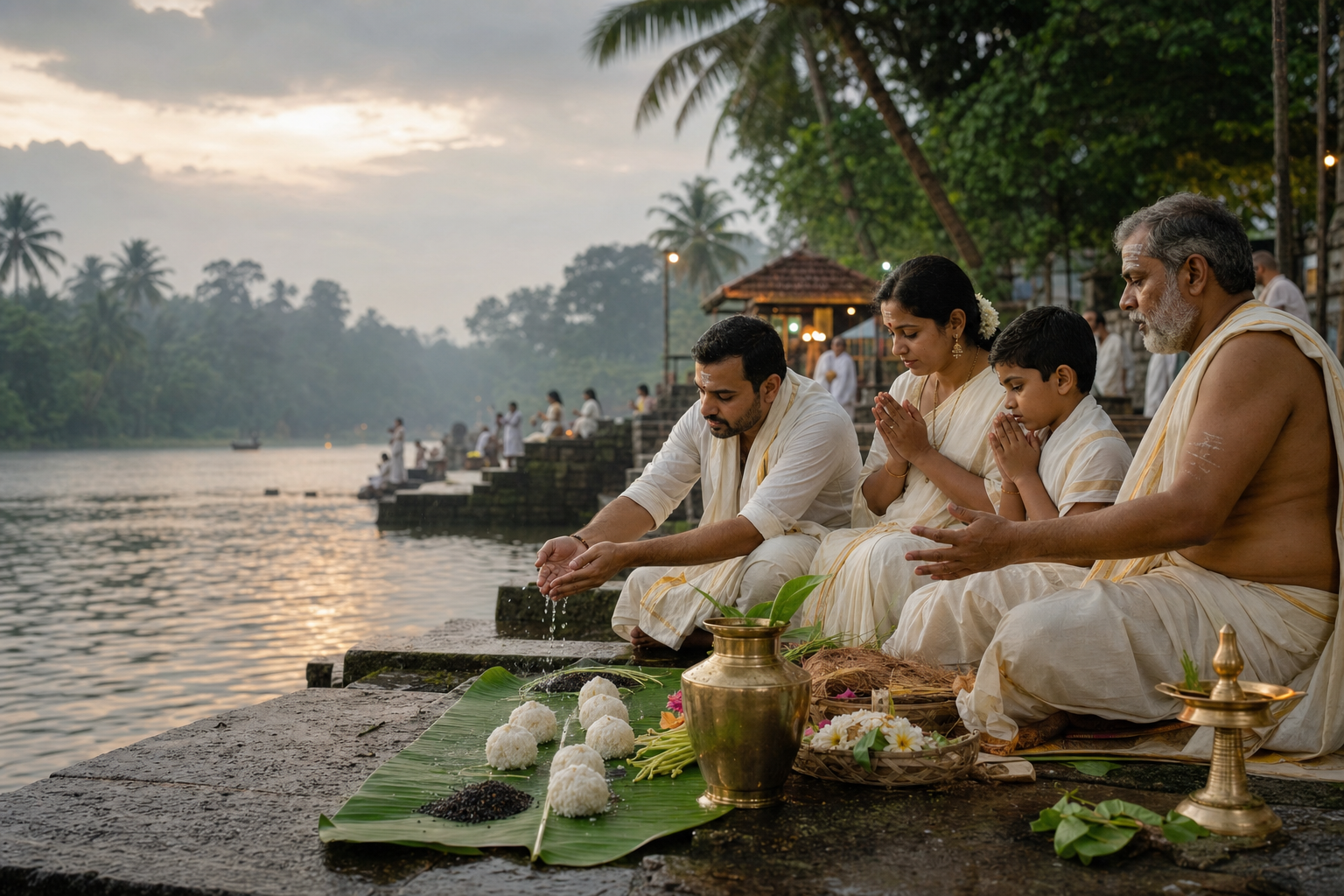
Karkidaka Vavu Bali 2026, also written as Karkadika Vavu Bali or Karkidaka Vavubali, falls on August 12, 2026, according to the Kerala observance referenced for this festival. It is observed on the Amavasya, or new moon day, in the Malayalam month of Karkidakam, a period that usually falls between July and August. In Kerala’s sacred calendar, this day is set apart for remembering departed ancestors through bali and tharpanam, two ritual forms centered on gratitude, lineage, humility, and continuity.
The ritual is among the most emotionally significant ancestral observances in Kerala. It is not simply a calendrical event or a temple custom; it is a disciplined act of remembrance. Families gather at rivers, seashores, temple tanks, and traditional bali ghats to offer prayers for forefathers, parents, elders, and departed members of the family lineage. The central idea is that life is not isolated. Every individual stands within a stream of inherited care, sacrifice, language, culture, land, memory, and dharma.
The term Vavu refers to Amavasya, the new moon day. Bali, in this context, means a sacred offering. It should not be confused with the modern English idea of sacrifice. Karkidaka Vavu Bali is therefore best understood as a ritual offering performed on the new moon of Karkidakam for the peace and spiritual welfare of departed ancestors. The ritual is also known as Bali Tharpanam, a term that highlights the offering of water, sesame, rice, and prayer with reverence.
In the broader dharmic world, Karkidaka Vavu Bali belongs to a larger civilizational pattern of ancestor remembrance. Similar observances are found across Hindu traditions under names such as Pitru Tharpanam, Shraddha, Mahalaya, and Pitru Paksha. Tamil communities observe a closely related ancestral rite as Aadi Amavasi or Aadi Amavasya. Regional panchang calculations and local temple calendars may differ in naming, timing, and ritual detail, but the emotional and spiritual foundation remains strikingly similar: the living pause to honor those who came before.
Kerala gives Karkidaka Vavu Bali a distinctive cultural setting. The month of Karkidakam is traditionally associated with monsoon rains, agricultural uncertainty, physical vulnerability, scriptural recitation, and inward reflection. It is also widely known as Ramayana Masam, a period in which many households recite the Ramayana and turn toward discipline, simplicity, and devotion. Within this atmosphere, Vavu Bali becomes more than an isolated rite. It becomes part of a seasonal grammar of cleansing, remembrance, and renewal.
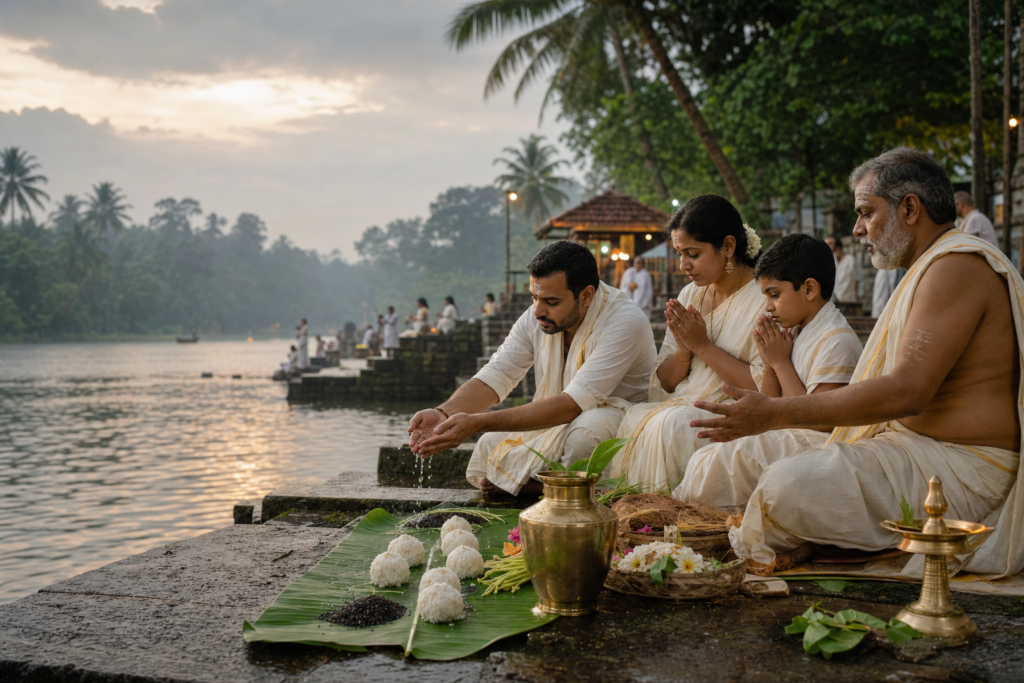
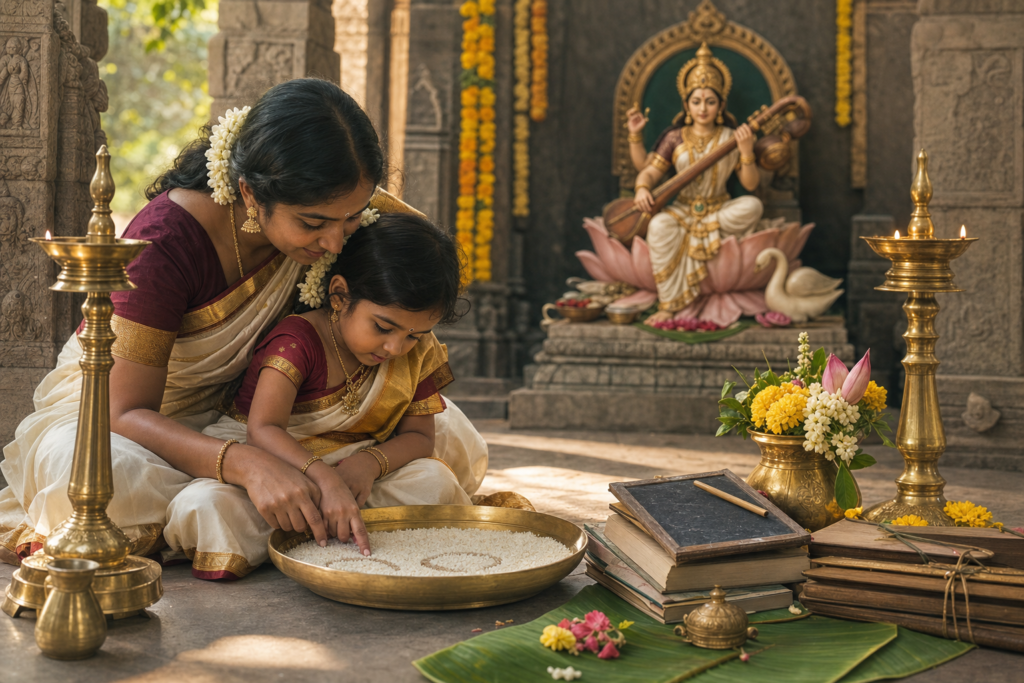
The ritual normally begins early in the morning. Devotees often bathe before the ceremony, wear simple clothing, and approach the ritual site with a sober mind. Priests or knowledgeable elders guide the procedure, especially where the exact mantras, sankalpa, and order of offerings must be followed. The materials commonly include cooked rice or rice balls, black sesame seeds, darbha grass, water, flowers, banana leaves, and sometimes coconut. These natural materials reflect the ritual’s older ecological character: the offering is simple, biodegradable, and deeply connected to earth and water.
At the heart of the observance is the idea of Pitru Rina, the debt owed to ancestors. In dharmic thought, human life is shaped by several kinds of obligation: to the divine, to sages and knowledge traditions, to society, to nature, and to one’s parents and ancestors. Pitru Rina does not imply a burden in a narrow sense. It expresses a mature recognition that every person receives life before exercising personal freedom. Body, language, memory, family customs, inherited values, and even unresolved responsibilities arrive through lineage.
Karkidaka Vavu Bali gives this recognition a visible form. The act of offering water and rice is modest, yet it carries profound symbolic meaning. Water represents continuity, purification, and the flow between worlds. Rice represents nourishment and the duty to feed. Sesame seeds are associated with ancestral rites and purification. Darbha grass is used in many Vedic and ritual contexts as a marker of sanctity and discipline. Together, these offerings turn memory into action.
The ritual also has a psychological dimension that deserves serious attention. Modern life often hides death, grief, and remembrance behind private silence. Karkidaka Vavu Bali brings grief into a structured, communal, and sacred setting. It allows families to remember the departed without reducing memory to sadness alone. The rite acknowledges loss, but it also affirms gratitude. It teaches that mourning can become responsibility, and remembrance can become ethical continuity.
Many devotees believe that performing Karkidaka Vavu Bali supports the peaceful onward journey of departed souls and brings blessings, prosperity, and spiritual stability to the family. From an academic perspective, such beliefs show how ritual links metaphysical hope with social order. The rite does not operate only as theology. It sustains family memory, reinforces respect for elders, and reminds younger generations that ancestry is not an abstract concept. It is lived through names, stories, rituals, duties, and inherited values.
Important sites for Karkidaka Vavu Bali in Kerala include riverbanks, beaches, and temple-associated water bodies. Papanasam Beach at Varkala is especially well known, as its very name is associated with the removal of sins. Other traditional locations include the banks of sacred rivers, local ghats, and temple precincts where priests conduct bali rituals for large numbers of devotees. In many places, administrative arrangements are made to manage crowds, provide access to ritual materials, maintain safety near water, and regulate the flow of devotees.
The popularity of the observance shows that ancestral rituals remain meaningful even in a mobile and urbanized society. Families living outside Kerala, including those in other Indian cities and abroad, often search for local temples, community centers, riverbanks, or priest-led arrangements to perform the rite. When physical access to a traditional ghat is not possible, many consult family elders or priests for an appropriate simplified observance. This adaptability has helped Karkidaka Vavu Bali retain continuity across geography.
The relationship between Karkidaka Vavu Bali and Aadi Amavasai is especially important for understanding dharmic unity. Kerala’s Karkidakam and Tamil Nadu’s Aadi are both solar calendar months falling in the July-August season. In both traditions, the Amavasya of this period becomes a sacred day for honoring ancestors. The ritual vocabulary may differ, the local temples may differ, and the liturgical traditions may differ, yet the underlying principle is shared: gratitude to the departed is a living duty.
This shared pattern also speaks to the broader unity of dharmic traditions. Hindu, Buddhist, Jain, and Sikh civilizational worlds have each preserved powerful ideas of lineage, remembrance, gratitude, ethical inheritance, and reverence for teachers and elders. Karkidaka Vavu Bali belongs specifically to Hindu ritual practice in Kerala, but its moral intuition is widely intelligible: human beings are not self-created. They are shaped by those who nurtured, protected, taught, and sacrificed before them.
Academically, the ritual may be studied through several lenses: religious anthropology, cultural memory, family ethics, ecology, regional calendar systems, and ritual symbolism. It connects cosmic time, marked by Amavasya, with family time, marked by lineage. It connects natural elements, such as water and rice, with metaphysical beliefs about the departed. It also connects public sacred spaces with intimate family grief. Few rituals combine these dimensions with such clarity and restraint.
Karkidaka Vavu Bali also reflects Kerala’s strong relationship with water. Rivers, backwaters, ponds, temple tanks, and the Arabian Sea have shaped the region’s religious imagination and cultural geography. Performing bali near water is not incidental. Water is the medium through which offerings are released, prayers are carried, and memory is ritually externalized. The devotee stands at the edge of land and water, symbolically standing between the visible and invisible worlds.
The ritual’s simplicity is one of its most powerful features. It does not require spectacle. Its materials are humble. Its gestures are repetitive and focused. Its mood is solemn rather than festive. In an age often shaped by display, speed, and distraction, Karkidaka Vavu Bali preserves a different discipline: to stand quietly, remember accurately, offer sincerely, and leave with a renewed sense of duty.
For many families, the observance carries deeply personal memories. A person may remember a parent who carried the household through hardship, a grandparent who preserved stories and customs, or an elder whose discipline shaped the family’s moral world. The ritual gives these memories a sacred container. It prevents remembrance from becoming vague nostalgia by placing it within dharma, gratitude, and responsibility.
The day also invites reflection on generational continuity. In many households, children watch elders perform the ritual before they fully understand its meaning. Over time, the gestures become familiar: the early bath, the quiet journey to the ghat, the banana leaf, the rice, the sesame, the priest’s instructions, the folded hands, and the final release of offerings into water. Such experiences transmit culture not through lecture but through embodied memory.
Care is necessary while discussing the purpose of the ritual. Karkidaka Vavu Bali should not be reduced to fear of misfortune or mechanical obligation. Traditional belief does speak of blessings, prosperity, and the welfare of ancestors, but the deeper message is ethical. The rite asks the living to remember that gratitude must be practiced, not merely felt. It asks families to keep lineage connected to virtue rather than pride. It asks individuals to see inherited life as a responsibility.
The observance is also connected to the dharmic understanding of death as transition rather than annihilation. Different schools of Hindu philosophy explain the journey of the jiva, karma, rebirth, and liberation in distinct ways. Ritual practice does not always require every participant to hold the same philosophical interpretation. The shared act of tharpanam allows families to participate in a common grammar of reverence while leaving space for devotional, philosophical, and regional diversity.
This diversity is one reason the ritual continues to remain inclusive within Kerala’s Hindu society. Different communities may follow different family customs, priestly lineages, mantras, and local procedures. Some may perform the rite at famous pilgrimage points; others may do so at a nearby river or temple tank. Some may emphasize scriptural precision; others may emphasize sincere remembrance under the guidance of elders. The living tradition accommodates these variations without losing its central purpose.
Karkidaka Vavu Bali 2026 is also significant because Amavasya itself carries ritual weight in the Hindu calendar. The new moon is traditionally associated with introspection, ancestral rites, and spiritual quietness. Unlike full moon festivals that often carry a visibly celebratory character, Amavasya observances tend to be inward-looking. The absence of the visible moon becomes symbolically appropriate for remembering those who are no longer visible yet remain deeply present in family consciousness.
Those planning to observe Karkidaka Vavu Bali in 2026 should confirm the exact local timing with a trusted Kerala panchang, temple authority, or family priest. Tithi observance depends on traditional calendrical rules, including the presence of Amavasya at relevant times. Since regional calendars may sometimes list related observances on nearby civil dates, local confirmation is especially useful for families outside Kerala or outside India.
Practical preparation usually includes identifying a proper ritual location, arranging necessary materials, and consulting a priest if the family tradition requires specific mantras or sankalpa. Devotees are generally expected to approach the rite with physical cleanliness, mental seriousness, and respect for the ritual environment. Since many sites become crowded, especially well-known beaches and river ghats, early arrival and attention to safety are important.
Environmental responsibility is also central to the spirit of the observance. Traditional offerings are natural and biodegradable, but modern crowding can create waste when plastic packets, synthetic materials, and disposable items are introduced. A dharmic approach to Karkidaka Vavu Bali should preserve the purity of water bodies and ritual spaces. Reverence for ancestors cannot be separated from reverence for the land and waters that sustained them.
The ritual’s relevance in contemporary life lies precisely in this combination of memory, ecology, family ethics, and spiritual discipline. Many modern people experience rootlessness, fragmented families, and weakened intergenerational bonds. Karkidaka Vavu Bali offers a corrective. It restores attention to origin, duty, and gratitude. It suggests that progress need not require forgetfulness, and that modern life becomes more balanced when it remains connected to ancestral wisdom.
In Kerala’s cultural landscape, Karkidaka Vavu Bali is therefore not only a ritual for the departed. It is also a ritual for the living. It teaches the living how to remember, how to grieve, how to give thanks, and how to stand within a lineage without arrogance. Its quiet power lies in the fact that a small offering of rice, sesame, and water can carry the emotional weight of generations.
As August 12, 2026 approaches, Karkidaka Vavu Bali will again draw families to sacred waters across Kerala and in Malayali communities elsewhere. The day will renew an old civilizational truth: ancestors are honored not only by words, but by disciplined remembrance and righteous living. In that sense, Karkidaka Vavu Bali remains one of Kerala’s most profound expressions of Hindu tradition, cultural continuity, and dharmic gratitude.
Inspired by this post on Hindu Pad.





Leave a Reply
You must be logged in to post a comment.