
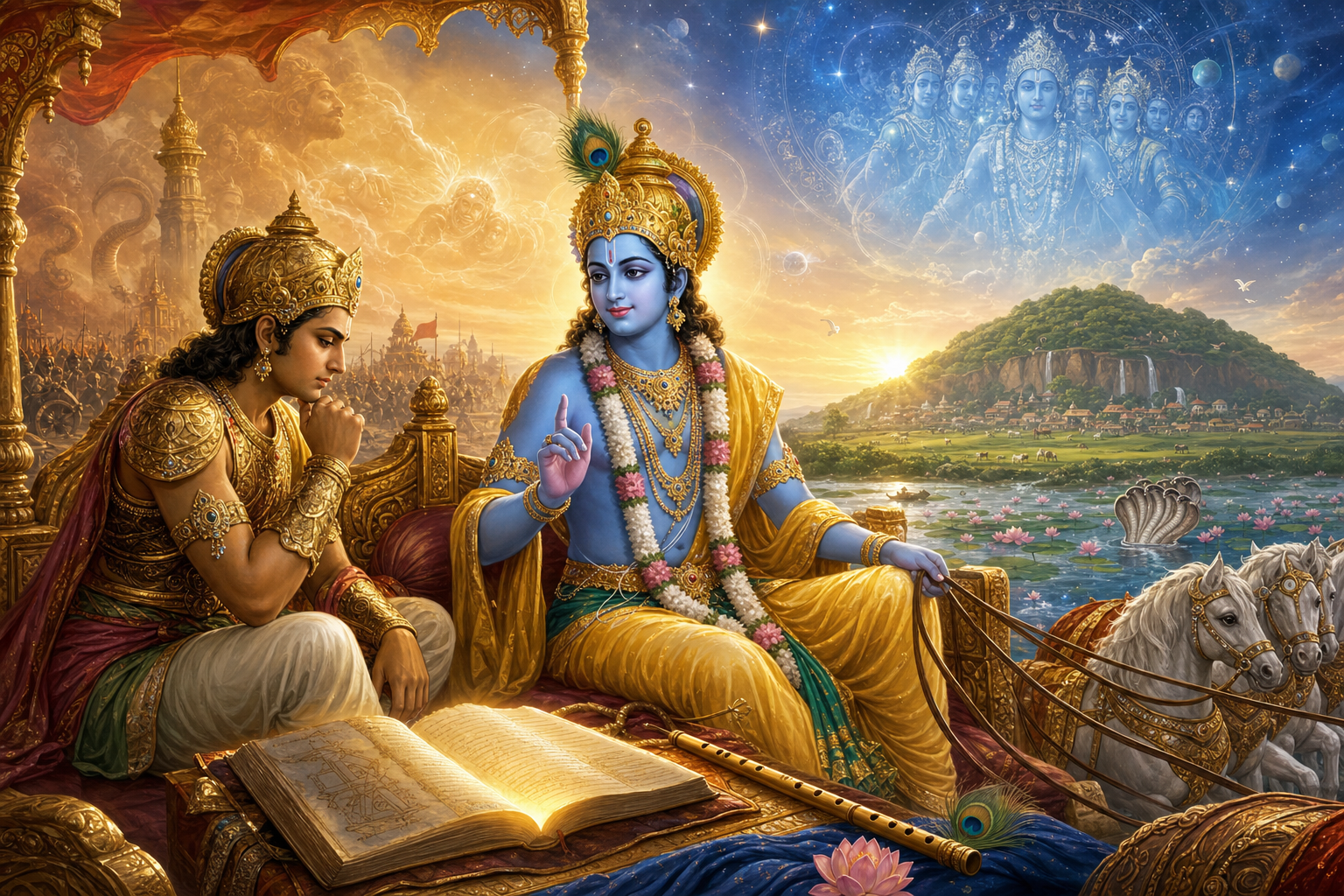
Reading the stories of Bhagavan Sri Krishna has long been understood within Hindu tradition as a source of renewal for those scorched by the heat of samsara. Samsara, the cycle of worldly struggle, attachment, anxiety, duty, desire, loss, and rebirth, is not merely a metaphysical idea. It is also an existential condition that can be felt in ordinary life whenever the mind becomes restless, the heart becomes burdened, and moral clarity becomes difficult to preserve.
The narratives of Sri Krishna offer a spiritual response to this condition. They do not present escape as indifference to the world, nor do they reduce spirituality to sentiment. Instead, they teach a disciplined way of living in the world with dharma, devotion, discernment, courage, compassion, and selfless action. This is why the stories of Krishna continue to nourish seekers, householders, scholars, artists, and devotees across generations.
In the Mahabharata, Krishna appears not only as a divine figure but also as counselor, diplomat, friend, strategist, charioteer, protector, and teacher. His presence reveals that dharma is not an abstract rule applied mechanically to every situation. Dharma requires attention to context, responsibility, intention, consequence, and the welfare of the larger order. This makes Krishna’s role especially significant in a world where ethical choices are often complex rather than simple.
The Bhagavad Gita, set on the battlefield of Kurukshetra, is the most concentrated philosophical expression of this teaching. Arjuna’s crisis is not merely fear of war; it is a breakdown of moral confidence. He sees teachers, elders, relatives, and friends on both sides and becomes overwhelmed by grief, doubt, and confusion. Krishna does not dismiss that anguish. He transforms it into a doorway for spiritual insight.
This transformation is one of the enduring reasons the Bhagavad Gita remains relevant. Human beings continue to face moments when duty conflicts with emotion, when attachment clouds judgment, and when action appears painful even when it is necessary. Krishna’s teaching addresses this universal condition by showing how clarity emerges when action is aligned with dharma rather than ego, fear, anger, or personal gain.
Karma Yoga is central to this vision. Krishna teaches that action cannot be abandoned by those living in the world, but action can be purified. The bondage of action arises when the individual clings to possession, pride, reward, or control. The freedom of action arises when work is offered with discipline, steadiness, and dedication to a higher purpose. This teaching gives practical psychological strength to those who feel exhausted by responsibility.
Bhakti, or devotion, deepens this discipline by adding love, surrender, and intimacy with the divine. The stories of Krishna’s childhood in Gokula and Vrindavan are not merely charming episodes of divine play. They reveal the tenderness of the relationship between the human heart and the divine presence. Yashoda’s affection, the devotion of the gopas and gopis, and the sweetness of the flute all point toward a theology in which divine reality is not distant, cold, or impersonal, but profoundly accessible.
At the same time, Krishna’s life cannot be reduced to sweetness alone. The same Krishna who steals butter as a child also subdues Kaliya, protects the people of Vraja by lifting Govardhan, guides the Pandavas through political crisis, and speaks the highest wisdom of the Gita. The fullness of Krishna’s character prevents a narrow reading of spirituality. Spiritual life includes love, beauty, play, duty, courage, knowledge, and the willingness to confront adharma.
The Govardhan episode is especially instructive. Krishna redirects the people from ritual habit toward a more conscious reverence for the natural order that sustains them. Govardhan becomes a symbol of ecological gratitude, community protection, and divine shelter. In a technical theological sense, the episode shows how bhakti can integrate ritual, nature, ethics, and social cohesion without separating worship from everyday life.
The Kaliya episode similarly reveals the movement from poison to purification. The serpent’s venom contaminates the waters, endangering the community. Krishna’s dance upon Kaliya is not merely a display of divine power; it is an image of cosmic order overcoming toxicity. Read inwardly, the story speaks to the poisons of anger, envy, arrogance, and fear that disturb the waters of the mind. Read socially, it affirms the need to restore balance wherever life is threatened.
Krishna’s friendship with Arjuna is another important dimension of the tradition. The divine does not remain aloof from human struggle. Krishna becomes Arjuna’s charioteer, placing himself in a position of service while simultaneously revealing the highest truth. This paradox is central to Hindu spiritual insight: the Supreme can be both transcendent and intimate, both cosmic and personal, both teacher and companion.
The Vishvarupa Darshana of the Bhagavad Gita expands this intimacy into cosmic vision. Arjuna beholds Krishna as the universal form, containing time, beings, worlds, creation, preservation, and dissolution. Philosophically, this vision shows that the divine is not one object within the universe but the ground, order, and destiny of the universe itself. Emotionally, it teaches humility, because the individual self is invited to act responsibly without imagining itself to be the ultimate controller.
For those scorched by samsara, this teaching offers a profound reorientation. Suffering intensifies when the mind believes it must control every outcome. Krishna does not encourage passivity, but he does challenge the illusion of absolute ownership. The seeker is asked to act with skill, devotion, and moral steadiness while surrendering the fruits of action to the divine order. This is a disciplined freedom, not fatalism.
The stories of Krishna also support unity among dharmic traditions by emphasizing inner transformation, ethical conduct, compassion, and liberation from ignorance. Hindu, Buddhist, Jain, and Sikh traditions differ in theology, metaphysics, ritual, and scriptural authority, yet they share a civilizational concern with overcoming ego, cultivating restraint, honoring truth, and moving beyond the narrow self. Krishna’s teachings can therefore be read in a spirit of dharmic harmony rather than sectarian competition.
Within Hinduism itself, Krishna is approached through many sampradayas and devotional moods. For some, he is the Supreme Personality of Godhead. For others, he is an avatara of Vishnu, a divine teacher, the beloved of Radha, the ruler of Dwaraka, or the charioteer of Arjuna. This plurality does not weaken the tradition. It demonstrates the richness of Hindu spirituality, where different temperaments encounter the sacred through knowledge, devotion, service, meditation, ritual, music, poetry, and ethical action.
From a literary perspective, Krishna’s stories endure because they operate on multiple levels at once. A child can receive delight from the butter thief of Vrindavan. A devotee can receive rasa from the music of the flute. A philosopher can contemplate the relation between atman, prakriti, and Purusha. A leader can study Krishna’s diplomacy in the Udyoga Parva. A person in grief can find refuge in the assurance that no sincere spiritual effort is ever wasted.
This layered quality is one reason Krishna literature has shaped Indian art, music, dance, temple culture, poetry, and ethical imagination for centuries. Bharatanatyam, Odissi, Kathak, kirtan, bhajans, miniature painting, Sanskrit commentary, vernacular poetry, and temple festivals have all drawn from Krishna’s life and teachings. The result is not simply religious memory but a living cultural ecosystem.
The emotional power of these stories lies in their ability to meet the human condition honestly. People experience fatigue, longing, moral uncertainty, family conflict, social duty, ambition, failure, and loss. Krishna’s narratives do not deny these realities. They illuminate them. They show that grief can become inquiry, duty can become worship, love can become liberation, and daily life can become a field of sadhana.
The heat of samsara is therefore cooled not by withdrawal from meaning but by deeper participation in truth. Krishna teaches that the world becomes binding when approached through ego and liberating when approached through dharma. The same action that exhausts the self can purify the self when performed with devotion, discernment, and surrender. This is one of the most practical contributions of Krishna’s wisdom to spiritual psychology.
In contemporary life, where distraction, anxiety, competition, and fragmentation often dominate the mind, Krishna’s stories remain deeply therapeutic. They invite reflection before reaction, duty before self-indulgence, inner steadiness before emotional collapse, and devotion before despair. Their purpose is not escapist comfort but moral and spiritual regeneration.
Reading about Bhagavan Sri Krishna thus becomes more than the study of sacred narrative. It becomes a disciplined encounter with dharma, bhakti, karma yoga, jnana, and inner transformation. For those burned by the pressures of worldly existence, these stories offer shade, clarity, and renewal. They remind the seeker that even in the midst of conflict and uncertainty, divine wisdom can restore life, direction, and peace.
Inspired by this post on Hindu Blog.





Leave a Reply
You must be logged in to post a comment.