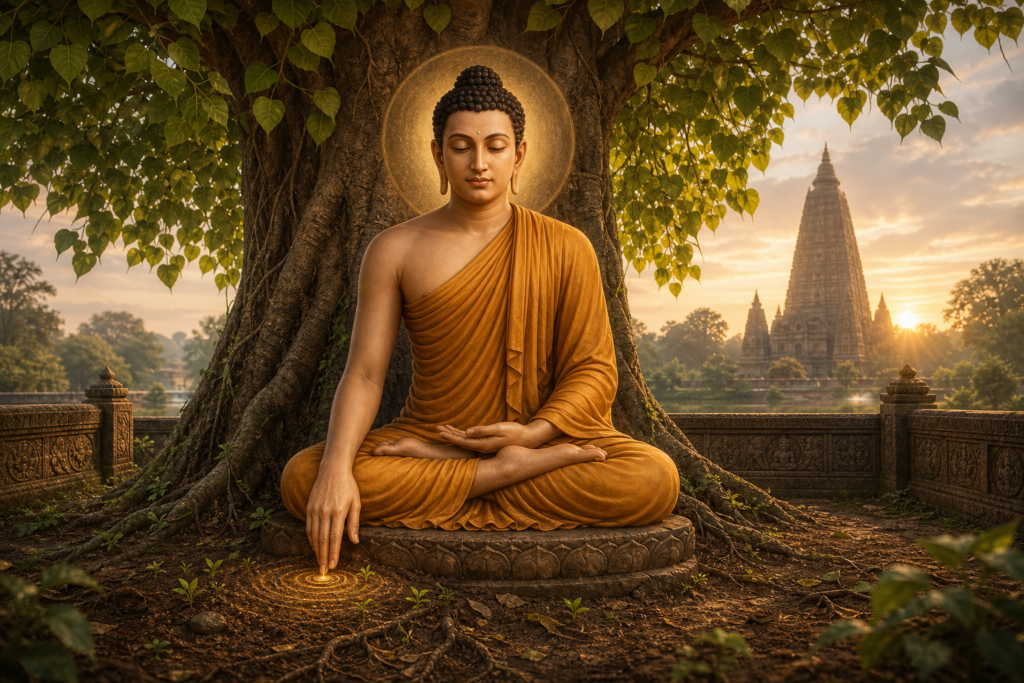
Utpatti Ekadashi, also known as Utpanna Ekadashi, is revered as the origin point of the Ekadashi vrata in many traditions. The narrative is preserved in the Bhavishyottara Purana, where Arjuna asks Sri Krishna to explain the spiritual importance of observing Ekadashi. The dialogue frames Ekadashi as a disciplined practice that purifies the mind, steadies conduct, and aligns the practitioner with dharma.
According to the Bhavishyottara Purana, the story begins when a formidable asura named Mura sought to disrupt cosmic order. During a period of divine rest, Sri Vishnu reclined in a Himalayan cave (often associated with the sacred region of Badarikashrama). As Mura advanced to attack, a radiant feminine shakti emerged from Vishnu’s own energy. This manifestation, later known as Ekadashi Devi, confronted and defeated Mura. Upon awakening and witnessing the victory, Sri Vishnu conferred a boon: those who observe the Ekadashi vrata with sincerity would be freed from accumulated demerits and progress toward spiritual liberation. Thus, the day of Ekadashi was sanctified and entrusted to humanity as a path of devotion and self-mastery.
Utpatti (Utpanna) Ekadashi is traditionally observed on the Krishna Paksha Ekadashi of the Margashirsha month, though regional calendars may differ. Many consider it among the earliest Ekadashis in the annual cycle, symbolically marking the beginning of the vrata’s spiritual momentum for the year. In practice, it invites remembrance of the Ekadashi Devi’s origin and the protective grace of Vishnu.
Core observances include fasting (upavasa) in forms suited to health and tradition, japa of Vishnu mantras, recitation of sacred texts such as Vishnu Sahasranama, and attentive listening to the Utpatti Ekadashi Vrat Katha. Devotees typically break the fast (parana) on Dwadashi at a time aligned with their local panchang. While the vrata promises merit, the discipline is meant to cultivate sattvaclarity, compassion, and restraintrather than encourage rigidity; those with health conditions are advised to adapt the fast wisely.
Spiritually, the narrative of Mura and Ekadashi Devi offers a clear metaphor: the asura reflects inner tendencies such as inertia, anger, and heedlessness, while Ekadashi embodies awakened discernment born of the Divine. By restraining the senses and refining intention, practitioners develop inner strength to overcome such obstacles. The vrata thus becomes a living sadhana that harmonizes devotion to Sri Krishna and reverence for Vishnu with practical ethics in daily life.
The values at the heart of Utpatti Ekadashiself-discipline, mindfulness, compassion, and serviceresonate across the broader dharmic family. In Hinduism, Buddhism, Jainism, and Sikhism, traditions of reflective observance, ethical restraint, and remembrance of the Divine support inner purification and social harmony. While modes of fasting and emphasis differ among these paths, the shared quest for self-mastery and upliftment underscores a unifying spiritual ethos.
In lived experience, families often gather on Utpatti Ekadashi to chant together, share the Katha, and cultivate a calm, reflective ambience. Many find that even a thoughtfully adapted fast, combined with prayer and charity, yields renewed focus, emotional balance, and a sense of connection to a lineage of seekers. As the story is retold, it imparts to younger generations a model of courage (as personified by Ekadashi Devi), devotion (to Sri Krishna and Vishnu), and commitment to dharma in community life.
Utpatti Ekadashi thus stands not only as a revered vrata with deep scriptural roots in the Bhavishyottara Purana, but also as a contemporary practice that strengthens unity, nurtures inner transformation, and affirms the shared wisdom of dharmic traditions. Observed with sincerity and understanding, it becomes a bridge between ancient insight and modern wellbeing.
Inspired by this post on Hindu Pad.