Babruvahana Katha, a compelling episode within the Mahabharata, explores the delicate balance between dharma, familial bonds, and kingship. Babruvahana, son of Arjuna and Chitrangada, princess of Manipur, was raised in Manipur in accordance with a promise Arjuna made to Chitrangada’s father. Remembered as a wise and just ruler, Babruvahana embodies the virtues of responsibility and humility that resonate across dharmic traditions.
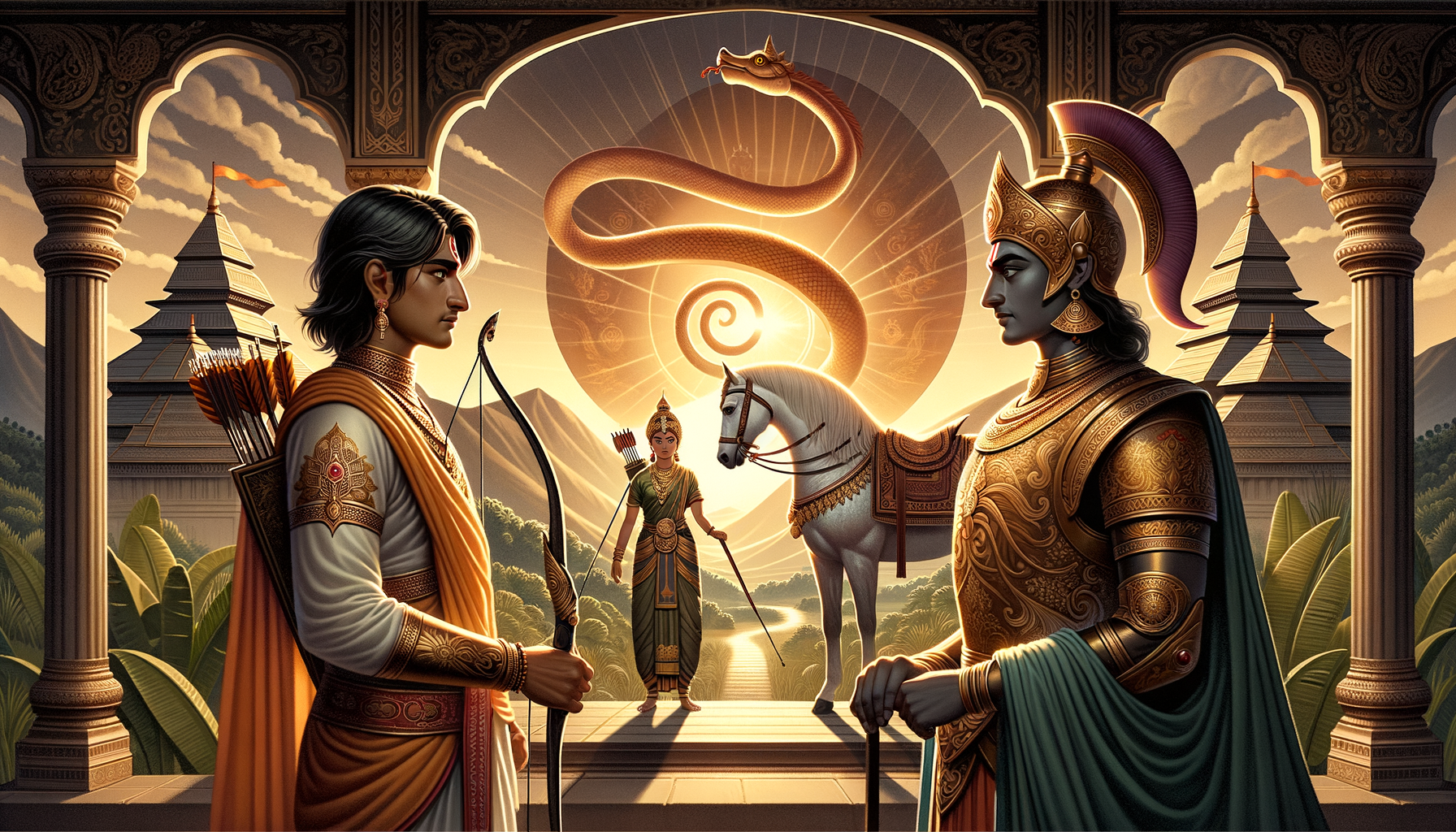
The story unfolds during the Ashvamedha Yajna conducted after the Kurukshetra War, when Arjuna is tasked with guarding the sacrificial horse. As the horse wanders into Manipur, political protocol and Kshatra-dharma require the reigning king either to accept the sovereignty of Yudhishthira or to engage in honorable combat. This sets the stage for a fateful encounter between Arjuna and Babruvahana that tests both duty and affection.
Several recensions describe an emotionally charged exchange in which lineage and obligation come to the fore. In prominent tellings, Ulupi, the Naga princess and another wife of Arjuna, counsels Babruvahana to face Arjuna in battle. A long-standing spiritual blemish attached to Arjuna for slaying revered elders in the war, it is said, could be lifted only if he were defeated by his own son. Thus, the confrontation is framed not as hostility but as a sacramental act of dharmic completion.
The battle itself is portrayed with controlled intensity. Babruvahana, trained in statecraft and martial wisdom, meets Arjuna in single combat. Accounts commonly note that he employs divine weaponryoften identified as the Nagastrato bring Arjuna down. In this way, the question “How did Babruvahana kill Arjuna?” is answered: he fulfills Kshatriya duty during the Ashvamedha Yajna, defeats Arjuna in fair combat, and strikes him with celestial force as tradition demanded.
What follows transforms defeat into redemption. Ulupi procures a life-restoring Naga gemvariously described as the Naga-mani or a Sanjivani-like boonand revives Arjuna. The spiritual burden is lifted, and reconciliation unfolds among father, son, and queens. Arjuna embraces Babruvahana, acknowledges his valor and righteousness, and the sacrificial horse proceeds, symbolizing the restoration of moral order.
As a narrative of ethical discernment, the Story of Babruvahana underscores humility amid power, duty tempered by compassion, and the healing of generational bonds. Its values speak across dharmic traditions: adherence to dharma (Hindu thought), compassion and non-harm as guiding ideals (Buddhist and Jain perspectives in lived ethics), and honor coupled with seva (Sikh inspiration). The episode thereby affirms unity in ethical vision while honoring diversity in practicea shared civilizational inheritance.
Textual traditions differ in detail. Some versions stress the Nagastra; others highlight Ulupi’s spiritual agency or name alternative divine weapons. Yet core motifs remain stable: the testing of Kshatra-dharma, the paradox of love and duty, the temporary fall of a great hero, and the grace of restoration. These constants anchor the tale within the broader Ashvamedhika Parva and enrich regional retellings, especially in Manipur where the narrative deepens cultural memory and pan-Indian connections.
For many readers, this episode mirrors lived experience: moments when principle challenges personal attachment, and reconciliation requires courage as much as victory. In this sense, Babruvahana’s triumph and Arjuna’s revival model a dharmic path that prizes accountability, forgiveness, and unityvirtues essential to cohesive communities across traditions.
In summary, “How Babruvahana killed Arjuna” can be understood with clarity and nuance: during the Ashvamedha Yajna, Babruvahana, following dharma and guided by Ulupi, defeats Arjuna in honorable combat, often through the Nagastra; Ulupi then restores Arjuna’s life with a Naga boon, transforming a tragic moment into an act of purification and reconciliation. This Babruvahana Katha stands as a timeless lesson in duty, dignity, and compassionate resolution.
Inspired by this post on Hindu Pad.