
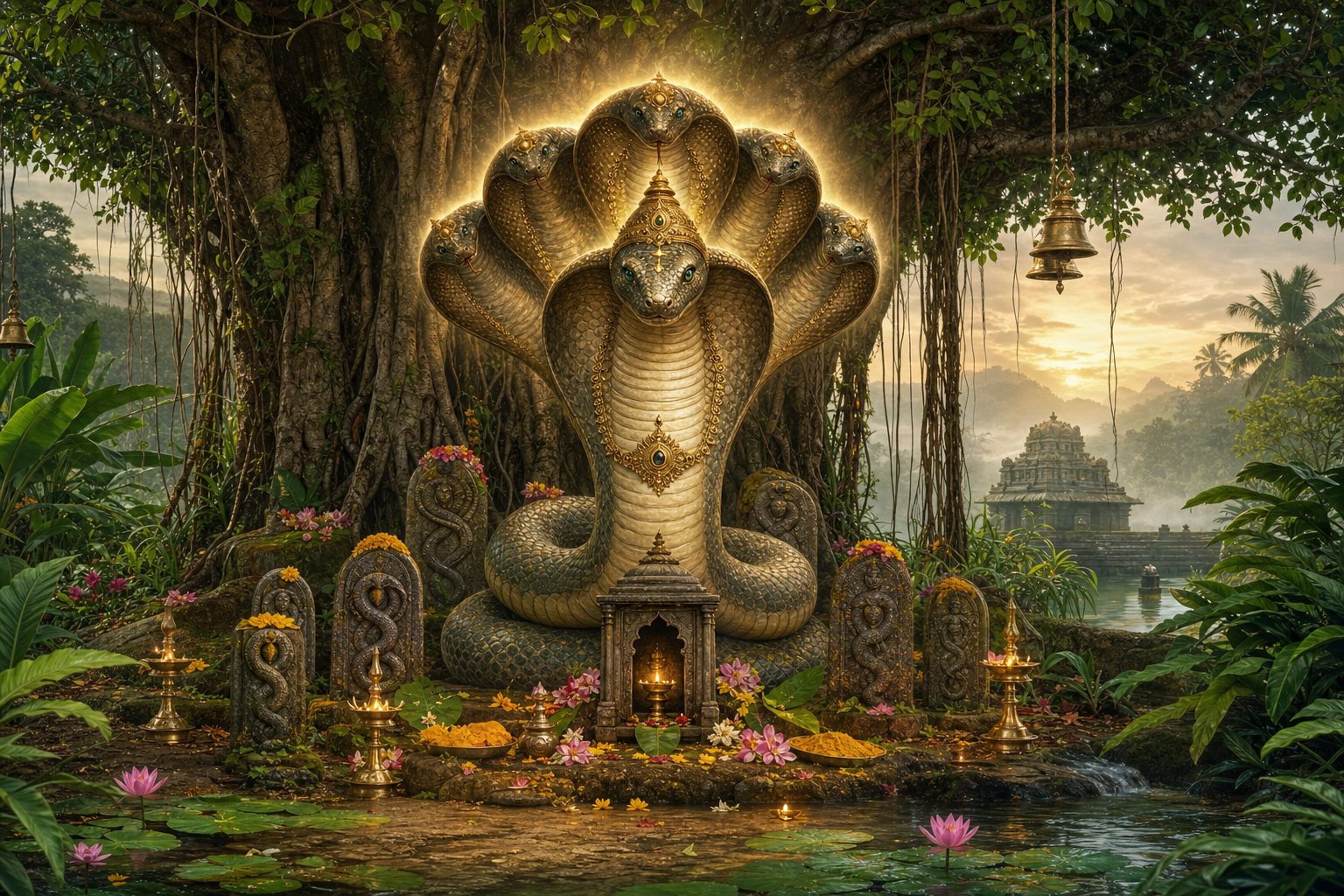
Nagaraja, literally understood as the “King of Serpents,” occupies a distinctive and deeply layered place in Hindu tradition. The term does not refer only to one isolated deity, but to a sacred category of serpent kings associated with the Nagas, a class of divine or semi-divine beings found in Hindu scriptures, temple worship, folklore, ritual practice, and regional devotional life. In South India, especially in Kerala, Tamil Nadu, and coastal Karnataka, Nagaraja is revered with unusual intimacy as a guardian of land, lineage, fertility, rainfall, ancestral continuity, and spiritual power.
To understand Nagaraja in Hinduism, it is necessary to move beyond the modern tendency to reduce serpent worship to fear, superstition, or nature symbolism alone. The serpent in Hindu thought is a profound religious symbol. It can represent danger, but also protection; hidden poison, but also healing power; the earth’s subterranean mysteries, but also cosmic infinity. This layered symbolism explains why the Naga is not treated merely as an animal form, but as a sacred presence woven into cosmology, ecology, ritual, and metaphysics.
The Sanskrit word “Naga” can refer to a serpent, especially a cobra, but in the religious imagination of India it also points to a powerful class of beings connected with waters, fertility, treasure, underworld realms, and esoteric knowledge. “Raja” means king. Nagaraja, therefore, signifies a sovereign serpent being, a ruler among Nagas. In different texts and regions, this title may be associated with Ananta or Shesha, Vasuki, Takshaka, Karkotaka, and other serpent kings. Rather than a contradiction, this plurality reflects the wider Hindu pattern in which divine reality may be encountered through many names, forms, and regional traditions.
Among the most important serpent kings is Ananta, also known as Shesha or Adishesha. In Vaishnava traditions, Lord Vishnu reclines upon Ananta in the cosmic ocean, while the thousand-hooded serpent shelters and supports him. The image is not merely decorative. It communicates a theological idea: beneath creation, preservation, and dissolution lies an endless substratum. The name Ananta means “endless,” and Shesha can mean “that which remains.” In this form, the serpent king becomes a symbol of cosmic continuity, the mysterious remainder that survives cycles of creation and dissolution.
Vasuki is another celebrated Nagaraja. In the Samudra Manthan episode, Vasuki serves as the churning rope when devas and asuras churn the ocean of milk in search of amrita, the nectar of immortality. This story carries a sophisticated symbolic structure. The serpent becomes the force through which opposing powers interact, tension is generated, poison emerges, and divine treasures arise. Vasuki’s presence around Lord Shiva’s neck also expresses mastery over fear, poison, time, and death. What terrifies ordinary consciousness becomes an ornament of the awakened divine.
Takshaka, known from the Mahabharata, represents another dimension of Naga tradition. His role in the story of King Parikshit and the snake sacrifice of Janamejaya shows the complexity of Naga-human relations in epic literature. The episode is not a simplistic tale of humans against serpents. It raises questions of vengeance, ritual excess, restraint, and reconciliation. The sage Astika’s intervention to stop the exterminating sacrifice is especially significant, because it affirms a dharmic principle: even when conflict arises, total destruction of a people, lineage, or species violates cosmic balance.
This concern for balance is central to the meaning of Nagaraja. In Hindu thought, the serpent is often associated with thresholds: between land and water, life and death, surface and depth, fear and wisdom, instinct and awakening. Serpents move close to the earth and disappear into hidden spaces, making them natural symbols of subterranean forces. For agrarian communities, this symbolism became connected with soil fertility, monsoon rhythms, water sources, and the unseen life beneath cultivated land.
In Kerala, Nagaraja worship is especially visible through sarpa kavu, sacred serpent groves traditionally preserved near homes, temples, and ancestral lands. These groves are not only ritual spaces but also ecological sanctuaries. They protect vegetation, moisture, small life forms, and biodiversity. The worship of Nagaraja in such settings reveals a practical environmental ethic embedded in Hindu culture: reverence for the sacred can become a social mechanism for conserving land and restraining destructive use of nature.
Kerala’s Mannarasala Sree Nagaraja Temple is among the best-known centers of serpent worship. Devotees visit the temple seeking blessings for fertility, family welfare, relief from ancestral afflictions, and protection from misfortune. The large number of serpent images installed in and around the temple reflects the devotional intensity surrounding Naga worship. The ritual atmosphere also shows how Nagaraja is experienced not as an abstract theological idea alone, but as a living guardian whose presence is felt through vows, offerings, memory, and inherited family traditions.
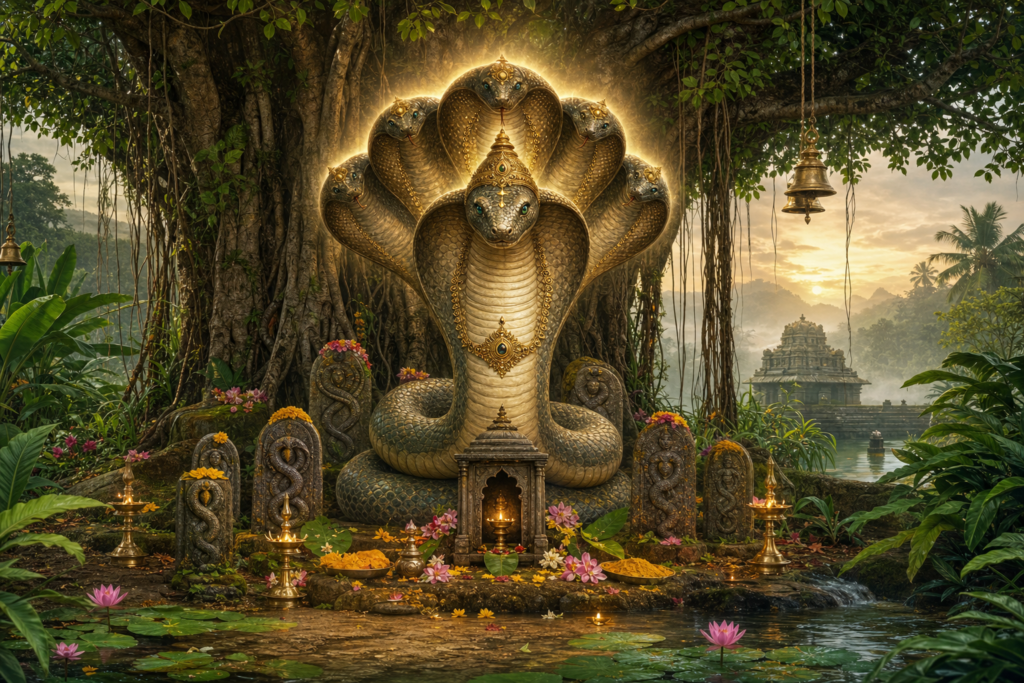
In Tamil Nadu, serpent stones are commonly found beneath sacred trees, near temple precincts, and in village shrines. These images often show intertwined serpents or hooded Nagas, sometimes connected with Shiva, Vishnu, Devi, or Subrahmanya traditions. The worship may include offerings of turmeric, milk, flowers, lamps, and circumambulation. While ritual forms vary by community, the underlying themes remain consistent: protection of lineage, fertility, removal of obstacles, reverence for the earth, and continuity between household devotion and temple culture.
Coastal Karnataka preserves another rich stream of Naga devotion through practices associated with Nagaradhane, Nagamandala, and rituals connected to Subrahmanya. Kukke Subramanya temple is especially important, where Lord Subrahmanya is worshipped in association with serpent power and relief from sarpa dosha. Rituals such as Sarpa Samskara and Ashlesha Bali are performed by many devotees within the traditional framework of karma, ancestral obligation, and spiritual correction. These practices should be understood within their own ritual logic rather than judged through superficial categories.
The connection between Nagaraja and Lord Subrahmanya is particularly meaningful in South India. Subrahmanya, also known as Kartikeya, Muruga, or Skanda, is a deity of wisdom, valor, youth, and divine command. His association with serpents does not reduce him to a serpent deity; rather, it shows how serpent symbolism enters wider Shaiva, Shakta, and regional devotional frameworks. In many communities, the Naga is honored as a guardian force under the protection or presence of Subrahmanya.
Nagaraja worship is also closely linked with festivals such as Nag Panchami and Nagula Chavithi. On these observances, devotees honor Nagas through prayer, offerings, fasting, and acts of restraint. The rituals often express gratitude toward serpents and seek protection from snake-related harm, but they also carry deeper meanings. They remind human beings that the world is shared with other forms of life, and that dharma requires humility before powers that cannot be fully controlled.
From a scriptural perspective, Nagas appear across the Mahabharata, Puranas, and regional narratives. They live in realms such as Patala, guard treasures, inhabit waters, and interact with sages, kings, devas, and humans. Their depiction is rarely one-dimensional. Some Nagas are wise and protective; others are fierce or dangerous; still others become participants in moral and cosmic drama. This complexity is important because Hindu sacred literature often resists simplistic moral binaries. Power must be understood, respected, disciplined, and integrated.
Iconographically, Nagaraja is often represented as a serpent with expanded hoods, a human figure crowned by serpent hoods, or a divine being sheltered by a multi-hooded cobra. The expanded hood suggests sovereignty, protection, and awakened force. In temple art, the serpent canopy over Vishnu, Shiva, or the Jina in Jain tradition expresses sheltering wisdom and spiritual authority. The same visual grammar appears across dharmic traditions, demonstrating how serpent symbolism became a shared sacred language in the Indian civilizational world.
The serpent’s association with water is one of the oldest and most important layers of Naga symbolism. Rivers, ponds, wells, springs, and underground water channels are frequently connected with Naga presence. In agrarian life, water is fertility, food, continuity, and survival. A deity who governs or protects water naturally becomes linked with prosperity and family welfare. In this sense, Nagaraja worship expresses a theological ecology in which nature is not inert matter but a living field of sacred relationships.
Fertility is another major theme. Many devotees approach Nagaraja for blessings related to childbirth, marital harmony, and the continuation of family lines. This does not make the tradition merely transactional. In Hindu ritual life, fertility is not only biological reproduction; it is also continuity of dharma, memory, inheritance, and responsibility. A child is not seen only as a private desire, but as part of a larger chain of ancestors, descendants, and sacred obligations.
Nagaraja also has a philosophical dimension through the idea of latent energy. In yogic language, the coiled serpent is often associated with Kundalini, the subtle spiritual power said to rest at the base of the spine until awakened through disciplined practice. This should not be carelessly collapsed into temple-based Naga worship, because the two belong to different ritual and philosophical contexts. Yet the symbolic resonance is clear: the serpent represents concentrated power, hidden potential, and the movement from dormancy to illumination.
In Shaiva traditions, the serpent around Shiva’s neck conveys mastery over fear, ego, death, and time. In Vaishnava traditions, Ananta supports Vishnu as the cosmic foundation. In Shakta traditions, serpent power can be linked with the dynamic force of Devi and the subtle body. In folk and village traditions, Nagaraja protects land, families, and ecological boundaries. These diverse expressions do not cancel one another. They show how Hinduism allows symbols to operate at multiple levels without forcing them into a single rigid interpretation.
This plurality is one reason Nagaraja remains such a powerful figure in Hinduism. He belongs simultaneously to scripture, temple, household, village, forest, and philosophical imagination. A devotee may approach him for practical blessings, a scholar may study him as part of Naga mythology, an environmental thinker may see in him a model of sacred ecology, and a practitioner of yoga may recognize the serpent as a symbol of inner transformation. Each approach reveals something real, provided it remains respectful of the tradition’s own vocabulary.
Nagaraja worship also offers a corrective to the assumption that Hindu religious life is centered only on grand temples and major pan-Indian deities. Much of Hindu civilization has been sustained through local shrines, sacred trees, family vows, village guardians, seasonal rituals, and inherited practices. The Naga shrine beneath a tree may appear modest, but it can carry centuries of memory. Such places preserve a lived Hinduism that is intimate, ecological, and intergenerational.
At the same time, Nagaraja is not outside the larger Sanskritic and scriptural world. His presence in the Mahabharata, Puranic mythology, Vaishnava imagery, Shaiva symbolism, and temple ritual shows continuous interaction between local devotion and classical theology. This is one of the strengths of Hindu tradition: it can absorb regional forms without erasing their uniqueness, while also connecting them to wider philosophical and sacred narratives.
The ethical message of Nagaraja worship is especially relevant in the modern world. Human beings often relate to nature through extraction, fear, or domination. The serpent challenges that attitude. It cannot be domesticated in the ordinary sense. It demands distance, alertness, and respect. By sacralizing the serpent, Hindu culture teaches that not everything powerful must be conquered. Some forms of power must be honored, given space, and approached with discipline.
The tradition also invites reflection on coexistence. Snakes can be dangerous, yet they play an important ecological role by controlling pests and maintaining balance in agricultural landscapes. The religious reverence for Nagas therefore carries a practical wisdom: fear should not become hatred, and caution should not become destruction. This insight aligns with the broader dharmic principle that life is interconnected and that human welfare cannot be separated from the wellbeing of the natural world.
Nagaraja’s significance extends beyond Hinduism into the broader dharmic cultural sphere. Buddhist traditions know the protective Naga Mucalinda, who shelters the Buddha during meditation. Jain art also includes serpent-canopied imagery, especially in relation to Parshvanatha, the twenty-third Tirthankara. These shared motifs do not erase doctrinal differences among Hinduism, Buddhism, and Jainism. Instead, they reveal a civilizational pattern in which the serpent becomes a symbol of protection, spiritual authority, and awakened stillness across multiple dharmic paths.
Such shared symbolism supports a wider understanding of dharmic unity. The traditions of Hinduism, Buddhism, Jainism, and Sikhism differ in theology, practice, and historical development, yet they have long interacted through shared ethical concerns, sacred geography, philosophical inquiry, and reverence for disciplined spiritual life. Nagaraja, when studied with care, becomes one example of how dharmic traditions can preserve distinct identities while still participating in a broader cultural and spiritual conversation.
Modern readers may also find an emotional connection in Nagaraja worship because it speaks to anxieties that remain deeply human: the desire for protection, the longing for children, fear of hidden dangers, the need to heal inherited burdens, and the wish to live in harmony with forces larger than oneself. These concerns are not primitive. They are enduring. Ritual gives them form, language, discipline, and community support.
For many families, a Naga shrine is not merely a religious installation. It is a place where grandparents prayed, where vows were remembered, where land was treated as sacred, and where continuity was felt across generations. This emotional dimension helps explain why Nagaraja devotion remains resilient even in urbanized and modernized settings. People may move away from ancestral homes, but the memory of the serpent grove, the temple visit, or the annual observance continues to shape cultural identity.
Academically, it is important to avoid two errors. The first is to dismiss Nagaraja worship as superstition without understanding its scriptural, ecological, and social depth. The second is to romanticize it without recognizing that ritual traditions have specific rules, contexts, and responsibilities. A balanced interpretation sees Nagaraja devotion as a sophisticated religious phenomenon that integrates mythology, local ecology, family life, temple worship, and philosophical symbolism.
Nagaraja’s enduring importance lies in this integration. He is the serpent king of hidden waters and cosmic foundations, the guardian of fertility and lineage, the symbol of awakened energy, the protector of sacred groves, and the reminder that dharma includes right relationship with the unseen. His worship is not a marginal curiosity within Hinduism. It is a window into how Hindu tradition understands power: not merely as force, but as something sacred, dangerous, protective, and transformative when approached with reverence.
Therefore, the answer to “Who is Nagaraja in Hinduism?” cannot be limited to a single sentence. Nagaraja is a divine serpent king, but he is also a theological symbol, ecological guardian, ritual presence, and cultural memory. He links the cosmic ocean to the household shrine, the forest grove to the temple, the ancient epic to living devotion, and fear to wisdom. In that layered meaning, Nagaraja continues to occupy a powerful and compassionate place in Hindu spirituality and dharmic heritage.
Inspired by this post on Hindu Blog.





Leave a Reply
You must be logged in to post a comment.