
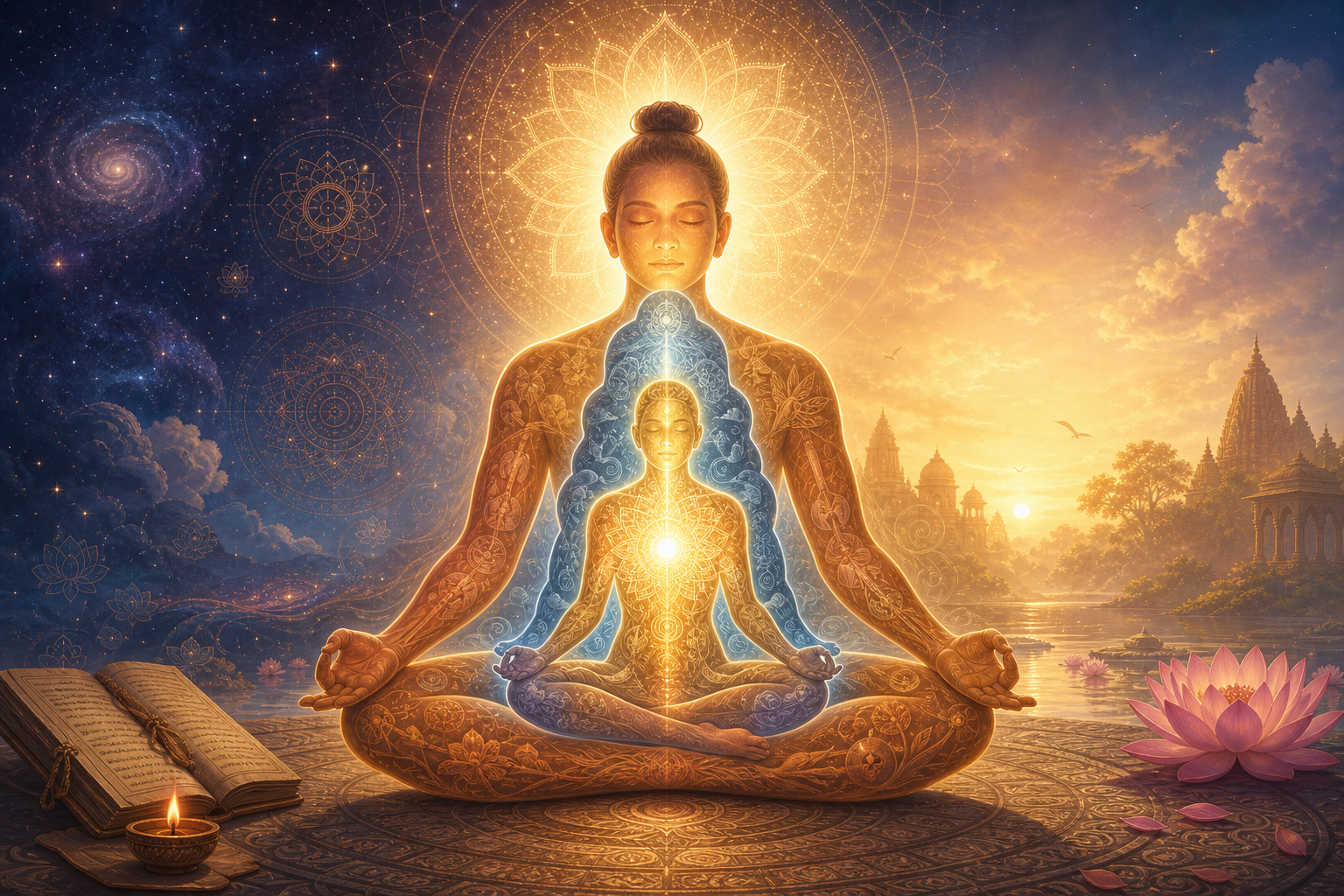
In Hindu philosophy, the word Atma or Atman points to one of the deepest questions a human being can ask: what is the true self? The Atmopanishad, also known as the Atma Upanishad and traditionally associated with the Atharva Veda, presents a compact but profound teaching on this question. It describes three ways in which the self may be understood: Bahyatma, the outer self; Antaratma, the inner self; and Paramatma, the supreme Self. This threefold classification offers a careful movement from the visible body, through the subtle interior life of mind and experience, toward the highest spiritual reality.
The teaching is not merely theoretical. It speaks to the everyday human condition, where identity is often built around the body, social roles, memories, emotions, achievements, injuries, and fears. The Upanishadic approach does not dismiss these layers as meaningless. Instead, it places them in a larger order. The body has its place, the inner psychological life has its place, and yet neither is the final truth of the person. The search for Atma is therefore a disciplined inquiry into what remains constant beneath changing experiences.
The first kind is Bahyatma, the outer Atman. This refers to the physical body, called Deha or Sharira in Sanskrit. It is the visible and tangible aspect of human existence: the limbs, organs, skin, bones, senses, and biological structure through which one acts in the world. It is the body that is seen by others, named by society, nourished by food, affected by climate, shaped by age, and eventually subject to decay. In this sense, Bahyatma is the outermost layer of embodiment.
Calling the body Bahyatma does not mean that Hinduism treats the body as worthless. The body is honored as an instrument of Dharma, Sadhana, seva, learning, worship, and self-discipline. Through the body, one performs puja, studies sacred texts, serves family and community, practices Yoga, and participates in the wider rhythm of life. Yet the Upanishadic insight is that the body is not the ultimate self. It is changing from childhood to youth, from youth to maturity, and from maturity to old age. What changes cannot be the permanent foundation of identity.
This distinction is important because much human suffering begins with total identification with Bahyatma. Beauty, strength, illness, aging, caste markers, gendered expectations, and social appearance can become the basis of self-worth. The Upanishadic view offers a liberating correction: the body deserves care, respect, and purity, but it is not the whole person. A body-centered identity remains fragile because it depends on conditions that are never fully under human control.
The second kind is Antaratma, the inner Atman. This refers to the inner field of experience, including mind, emotion, memory, intention, thought, desire, doubt, pleasure, pain, and moral awareness. If Bahyatma is the visible body, Antaratma is the subtle interior world through which one interprets life. It is the space where love is felt, fear arises, judgment forms, attachment grows, and spiritual longing begins. It is inward, subtle, and closer to one’s lived sense of self than the physical body alone.
In many Vedantic discussions, this inner layer is connected with the subtle body, or Sukshma Sharira, though the terminology may vary across texts and traditions. It includes the faculties that allow perception, reflection, imagination, and decision. The Antaratma is therefore more refined than Bahyatma, but it too is marked by movement and change. Thoughts arise and vanish. Emotions intensify and fade. Desires shift. Certainties become doubts, and doubts become insight. The inner self, as ordinarily experienced, is not yet the unchanging Self.
This is where Hindu spiritual practice becomes deeply practical. Meditation, japa, svadhyaya, ethical discipline, breath awareness, and devotion help a person observe the inner movements of Antaratma without being ruled by them. The mind can be trained; emotions can be purified; attention can be steadied. A person who watches anger arise has already discovered a point of awareness deeper than anger. A person who notices fear has found something that is not identical with fear. This simple observation is one of the great gateways into Atma Vichara, the inquiry into the self.
The Antaratma also has moral significance. It is within this inner field that Dharma is recognized as more than an external rule. Conscience, discrimination, compassion, restraint, and reverence all operate inwardly before they become outward conduct. When the Bhagavad Gita speaks of self-mastery, steadiness, and the disciplined mind, it addresses this inner world. When the Upanishads speak of turning inward, they do not recommend withdrawal from responsibility; they recommend clarity about the source from which action should arise.
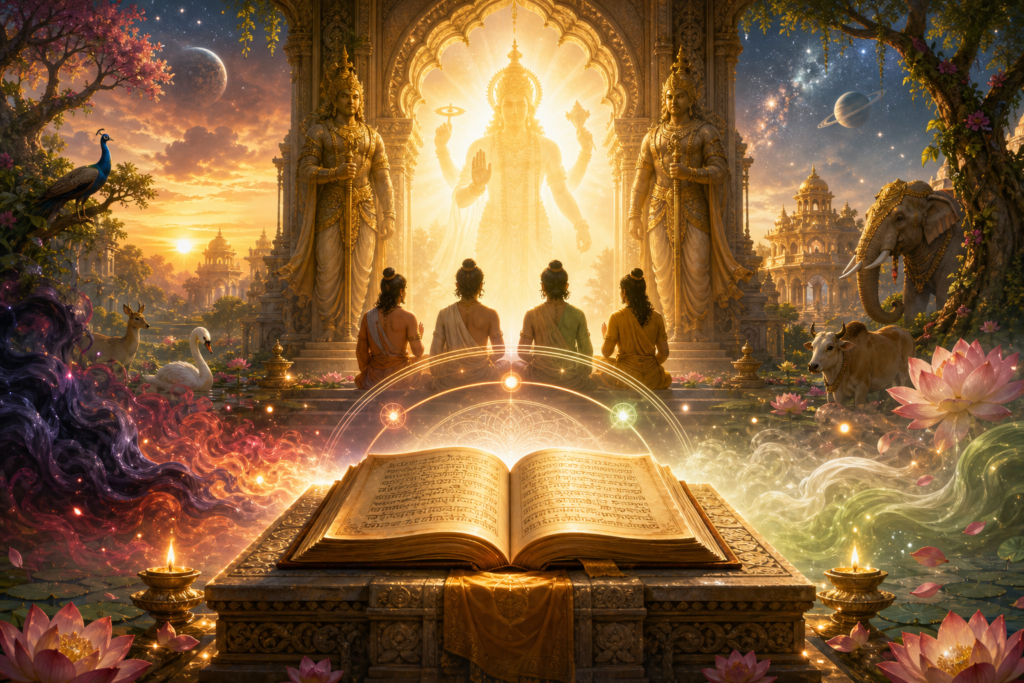
The third kind is Paramatma, the supreme Self. Paramatma is not merely another layer of personality. It is the highest principle, the pure consciousness that is beyond the body and beyond the shifting mind. In Vedantic language, Paramatma is associated with the deepest reality of the self and its relation to Brahman, the absolute reality. It is not born with the body, does not age with the body, and is not destroyed when bodily life ends. It is the spiritual ground that gives meaning to the search for liberation, or Moksha.
The movement from Bahyatma to Antaratma to Paramatma is therefore a movement from gross to subtle, and from subtle to transcendental. The body is observed. The mind is observed. Even the changing sense of “I” can be observed. The question then arises: who is the witness of all these changes? The Upanishadic answer points toward Atman as consciousness itself, not as an object among objects. Paramatma is the highest recognition of this truth, where the seeker no longer mistakes temporary forms for the final self.
Different Hindu traditions explain the relationship between Atman and Paramatma in distinct ways. Advaita Vedanta emphasizes the non-duality of Atman and Brahman, teaching that the deepest self is not separate from ultimate reality. Vishishtadvaita affirms a qualified non-dual relationship in which the individual self is real and inseparably dependent on the Supreme. Dvaita Vedanta emphasizes an eternal distinction between the individual self and the Supreme Being. These differences are philosophically significant, yet they share a common reverence for the spiritual seriousness of self-knowledge, devotion, and liberation.
This plurality of interpretation reflects the wider strength of Sanatana Dharma. Hinduism does not reduce spiritual life to one narrow intellectual formula. It allows room for jnana, bhakti, karma, yoga, ritual, meditation, temple worship, philosophical inquiry, and guru-shishya parampara. The teaching of the three kinds of Atma can therefore be read through many sampradayas while still preserving its central insight: human identity is layered, and wisdom requires distinguishing the temporary from the eternal.
The teaching also harmonizes naturally with the broader Dharmic emphasis on disciplined self-understanding. Jainism’s careful analysis of jiva and karma, Buddhism’s rigorous inquiry into attachment and misidentification, and Sikhism’s emphasis on inner remembrance and union with the Divine all encourage the human being to look beyond ego-centered living. The terms and metaphysical conclusions differ across traditions, but the ethical and contemplative seriousness is shared. In that sense, the study of Atma can become a bridge for respectful dialogue among Dharmic paths rather than a source of division.
At a personal and social level, this teaching has enduring relevance. Modern life often trains people to identify with the most unstable layers of existence: appearance, productivity, status, ideology, anxiety, and public approval. The Upanishadic framework gives a more spacious view. The body is cared for, but not worshipped as the final self. The mind is refined, but not mistaken for pure consciousness. The supreme Self is contemplated as the deepest ground of dignity, freedom, and inner peace.
This has practical consequences for ethics. If a person sees others only as bodies, difference becomes exaggerated. If a person sees others only through personality, conflict becomes permanent. But if the presence of Atma is honored, dignity becomes more than a social convention. It becomes a spiritual fact. Such a view supports compassion, restraint, humility, and unity across communities. It also discourages the arrogance that comes from reducing human beings to labels, appearances, or temporary opinions.
The threefold teaching of the Atmopanishad can also be compared with the Pancha Kosha model found in the Taittiriya Upanishad, where the human being is examined through five sheaths: Annamaya, Pranamaya, Manomaya, Vijnanamaya, and Anandamaya. Both frameworks guide the seeker inward. Both insist that the visible person is not the complete person. Both lead toward a reality that is subtler than thought and deeper than ordinary self-image. Such internal consistency across Upanishadic literature shows the sophistication of Hindu philosophical anthropology.
Bahyatma, Antaratma, and Paramatma should therefore not be treated as three separate souls in a crude numerical sense. They are better understood as three standpoints or levels through which the self is approached. The outer body is the embodied standpoint. The inner self is the psychological and subtle standpoint. The supreme Self is the spiritual and ultimate standpoint. Confusion begins when the lower is mistaken for the whole. Wisdom begins when each level is understood in its proper place.
The language of Atma also challenges purely materialist assumptions about human life. A person is not merely a biological mechanism, though biology is real. A person is not merely a bundle of thoughts, though thought is powerful. A person is not merely a social identity, though society shapes experience. The Upanishadic view asks for a more complete account of being human, one that includes matter, mind, consciousness, ethics, and transcendence.
For spiritual practice, the teaching may be summarized as a method of discernment. One may begin by observing the body: its needs, limitations, habits, and impermanence. One may then observe the mind: its desires, fears, judgments, and memories. Finally, one may inquire into the witness of both. This inquiry does not have to be dramatic. It can begin quietly in daily life, whenever a person pauses before reacting, watches a thought without becoming it, or remembers that the deepest self is not diminished by temporary difficulty.
The Atmopanishad’s teaching remains powerful because it is concise yet expansive. It gives a map of the human being that is at once philosophical, psychological, and spiritual. Bahyatma reminds one to respect the body without becoming imprisoned by bodily identity. Antaratma reminds one to refine the inner life without mistaking mental activity for the highest truth. Paramatma reminds one that the aim of Hindu spirituality is not merely adjustment to the world, but realization of the deepest reality.
In this way, the three kinds of Atma offer a profound framework for self-realization. They help explain why Hindu scriptures place such emphasis on discipline, inquiry, devotion, and inner purity. The journey begins with the obvious fact of embodiment, deepens through self-observation, and culminates in the recognition of the supreme Self. For seekers across generations, this remains one of the most enduring gifts of the Upanishadic vision: the reminder that the true self is not exhausted by the body, not confined to the mind, and not separate from the sacred depth of existence.
Inspired by this post on Hindu Blog.


Leave a Reply
You must be logged in to post a comment.