
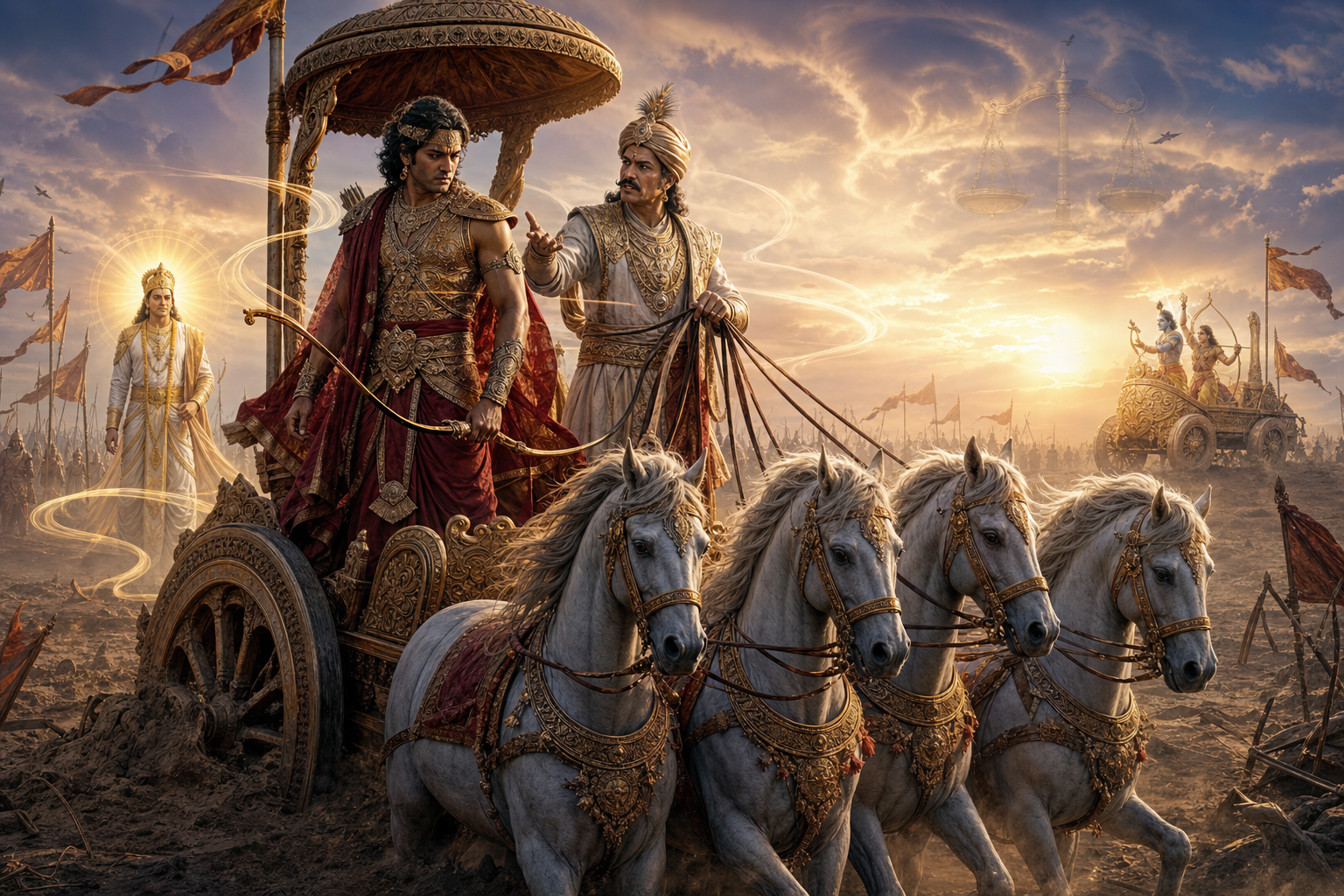
In the Mahabharata, battles are rarely decided by weapons alone. They are shaped by vows, obligations, friendships, wounds of pride, old curses, and the subtle force of speech. The encounter between Yudhishthira, Shalya, and Karna belongs to this deeper layer of the epic. It is often remembered as a hidden psychological battle: Yudhishthira, the son of Dharma, persuaded Shalya, king of Madra, to become an inward obstacle to Karna at the very moment when Karna needed absolute confidence.
Shalya was not a minor figure dragged into the Kurukshetra War by accident. He was the ruler of Madra and the maternal uncle of Nakula and Sahadeva, since he was the brother of Madri, the second wife of Pandu. By family affection, lineage, and natural sympathy, he belonged close to the Pandavas. Yet the Mahabharata repeatedly teaches that blood relations do not automatically settle dharma. Human beings act within tangled networks of honour, hospitality, pride, debt, and political obligation.
The turning point came when Shalya marched with a large army to support the Pandavas. Duryodhana, aware of his importance, arranged magnificent hospitality for him on the road. Shalya accepted the hospitality, believing it had been arranged by Yudhishthira. Pleased by the generosity, he promised to grant a boon to the host. Only afterward did he learn that the host was Duryodhana. Bound by the ethics of promise and royal honour, Shalya could not simply withdraw his word. Thus, a king who intended to aid the Pandavas became committed to the Kaurava side.
This episode is important because it is not a simple case of betrayal. Shalya did not abandon the Pandavas out of hatred. He was trapped by the moral weight of a promise. The Mahabharata’s genius lies precisely here: it refuses to flatten characters into easy categories. Shalya’s conduct shows how dharma can become difficult when two obligations collide: affection toward kin and fidelity to a given word.
When Shalya later met Yudhishthira, the eldest Pandava did not rage against him. Instead, he understood the predicament and worked within it. Yudhishthira accepted that Shalya would have to fight for Duryodhana, but he made a strategic request. If Karna ever chose Shalya as his charioteer, Shalya should weaken Karna’s spirit by speaking words that would diminish his confidence and remind him of Arjuna’s superiority. Shalya agreed.
This agreement is sometimes described as a secret pact, but it must be read carefully. It was not a crude conspiracy in the modern sense. It was a moral and psychological maneuver inside a war already governed by complicated vows and prior wrongs. Yudhishthira did not ask Shalya to sabotage the chariot mechanically or strike Karna unfairly. He asked him to use speech as a weapon. In the world of the Mahabharata, speech is not ornamental; it is a force capable of sustaining courage or breaking it.
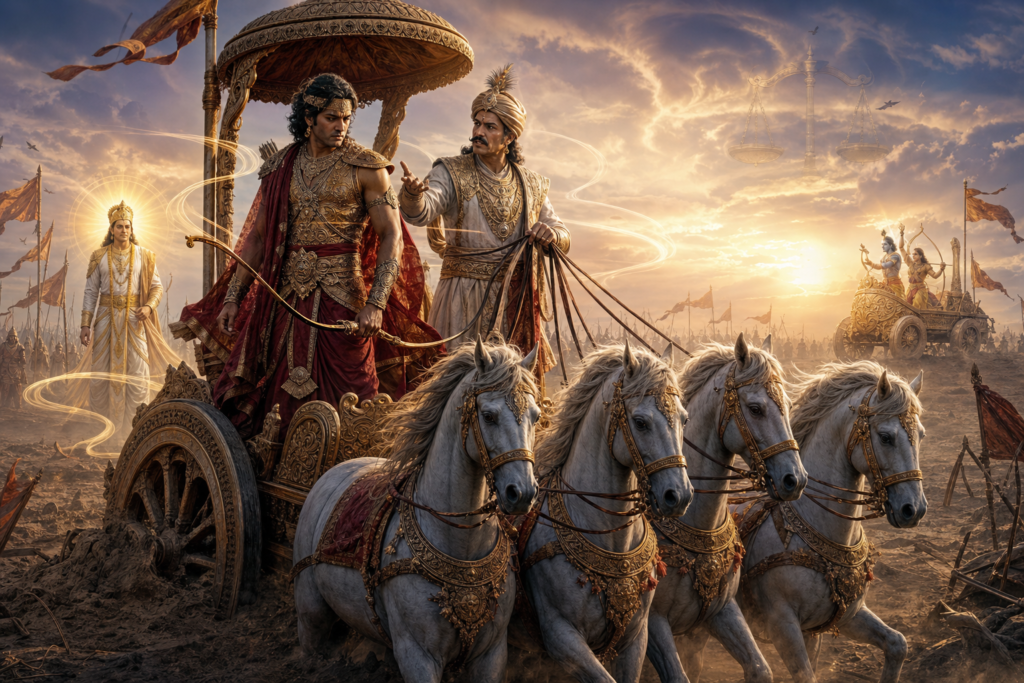
The role of the charioteer in ancient Indian warfare explains why this request mattered so much. A charioteer, or sarathi, was not merely a driver. He controlled the horses, judged terrain, positioned the warrior, guarded timing, watched the movement of enemy weapons, and advised the fighter in moments of danger. Krishna’s role as Arjuna’s charioteer in the Bhagavad Gita gives the most elevated example of this function. The sarathi could become counselor, strategist, witness, and moral anchor.
For Karna, the choice of Shalya as charioteer carried irony. Karna needed a charioteer equal in skill and composure to Krishna. Duryodhana believed Shalya’s royal stature and command over horses could help Karna match Arjuna’s advantage. Yet Yudhishthira had already prepared the inner battlefield. The chariot would move forward, but its emotional center would be unstable.
Karna’s tragedy was already heavy before Shalya entered the final scene. Born to Kunti before her marriage, raised by Adhiratha and Radha, denied full social recognition, and bound by deep gratitude to Duryodhana, Karna lived under the ache of legitimacy. His loyalty to Duryodhana was sincere, even when Duryodhana’s cause was ethically damaged. This makes Karna one of the most emotionally complex figures in the Mahabharata. Admiration for his generosity and courage can coexist with criticism of his choices, especially his participation in the humiliation of Draupadi and his support for Duryodhana’s injustice.
Shalya understood Karna’s vulnerability. During Karna’s final day as commander, Shalya repeatedly spoke in ways that pricked his pride. He praised Arjuna, compared Karna unfavourably with him, questioned Karna’s boasts, and reminded him that confidence without restraint becomes arrogance. These words were not random insults. They targeted the exact place where Karna was most exposed: his need to prove himself against Arjuna.
The psychological dimension of this episode is striking. A warrior may possess weapons, training, and heroic will, but war also demands steadiness of mind. Karna entered the final duel burdened by curses, fatigue, rivalry, and destiny. Shalya’s words intensified that burden. The Mahabharata shows that morale is not a modern military concept alone; it was recognized in epic literature as a decisive factor in combat.
Yudhishthira’s involvement also complicates common assumptions about his character. He is often remembered primarily for truthfulness, restraint, and commitment to dharma. Yet the epic does not present him as naive. He could recognize strategy when the survival of the Pandavas and the restoration of justice required it. His request to Shalya reveals a ruler who understood that dharma-yuddha was not sentimental passivity. It demanded judgment, timing, and the ability to counter adharma without becoming consumed by cruelty.
At the same time, this action raises a genuine ethical question. Was it righteous to ask Shalya to undermine Karna from within his own chariot? The Mahabharata does not hand over a simplistic answer. It places the question before the reader. The war had begun after repeated failures of peace, after deceit in the dice game, after the public humiliation of Draupadi, after exile, and after Duryodhana refused even a minimal settlement. Within that context, Yudhishthira’s strategy appears not as personal malice, but as part of a larger effort to defeat a destructive political order.
Karna’s fall, however, cannot be attributed only to Shalya. The epic gives multiple causes. Parashurama’s curse deprived Karna of the full use of divine knowledge at the crucial hour. The curse of the Brahmana, whose cow Karna had mistakenly killed, returned through the sinking of his chariot wheel. Indra had obtained Karna’s kavacha and kundala, weakening his natural protection. Karna had already used the Vasavi Shakti against Ghatotkacha, leaving him without that one irresistible weapon against Arjuna. Shalya’s demoralizing speech was therefore one strand in a larger web of destiny and consequence.
This is why the phrase “sealed Karna’s fate” should be understood with nuance. Shalya did not single-handedly destroy Karna. Rather, he worsened the pressure already surrounding Karna’s final battle. He became the voice of doubt inside the chariot at the moment when Karna needed clarity. In epic terms, Shalya was not the cause of destiny, but an instrument through which accumulated karma ripened.
The contrast between Krishna and Shalya is one of the most powerful literary designs in the Karna Parva. Krishna strengthens Arjuna’s discernment, protects his attention, and reminds him of the moral stakes. Shalya, by contrast, drains Karna’s confidence and provokes his anger. One charioteer stabilizes the warrior; the other unsettles him. The battlefield becomes a study in guidance: the right guide can transform fear into duty, while a hostile guide can turn pride into confusion.
For readers of Hindu scriptures and Indian epics, this episode also illuminates the importance of counsel. A person’s inner battle is often shaped by the voices allowed close to the mind. Arjuna had Krishna, whose counsel led from despair to clarity. Karna had Shalya, whose counsel sharpened insecurity. The Mahabharata thereby teaches that companionship is not neutral. Association can elevate judgment or corrode it.
Shalya’s own character remains tragic. He was neither wholly villainous nor fully heroic. He loved the sons of Madri, but he fought for Duryodhana. He honoured his promise, but that promise placed him on the side opposing justice. He served as Karna’s charioteer, but inwardly favoured the Pandavas. Such divided loyalties make him one of the epic’s most politically realistic figures. In public life, people often stand where circumstance, debt, or obligation places them, even when the heart leans elsewhere.
The episode also reveals Duryodhana’s limitations as a strategist. He was clever enough to secure Shalya through hospitality, but not wise enough to command his heart. He could obtain external allegiance, but he could not generate inner loyalty. This distinction matters deeply in the Mahabharata. Power acquired by manipulation remains brittle. Dharma requires not only victory in arrangement, but integrity in relationship.
Karna, too, misunderstood the emotional cost of his alliance. His gratitude to Duryodhana was noble in one sense, because he did not abandon the friend who had raised him to kingship. Yet loyalty becomes dangerous when it binds a great soul to an unrighteous cause. The Mahabharata does not deny Karna’s greatness; it mourns the misdirection of that greatness. His generosity, courage, and endurance are real, but so are the consequences of standing with Duryodhana against dharma.
Yudhishthira’s strategy toward Shalya must therefore be interpreted within the epic’s wider moral architecture. It was not a celebration of deception for its own sake. It was a response to a conflict where direct appeals had failed, where adharma had used gambling, insult, exile, and political stubbornness to avoid justice. The Pandavas were not fighting merely for territory; they were fighting to restore a moral order that had been repeatedly violated.
For contemporary readers, the story carries a practical lesson about leadership. Yudhishthira did not waste energy condemning Shalya for a situation that could no longer be reversed. He converted a disadvantage into a strategic opening. This is a mature form of political intelligence. It recognizes reality as it stands, then acts within the available field. Dharma in action is not abstract idealism; it is principled judgment under pressure.
The story also warns against overconfidence. Karna repeatedly declared that he would defeat Arjuna, but his confidence often depended on comparison, resentment, and the need to prove social worth. Shalya’s words found power because they touched existing wounds. A mind free from insecurity is harder to disturb. In this sense, Karna’s final battle was not only against Arjuna; it was also against the unresolved pain he had carried all his life.
There is an emotional reason this episode continues to hold attention. Many readers recognize the pain of being misunderstood, underestimated, or judged by birth rather than merit. Karna embodies that wound powerfully. Yet the epic asks readers to go further. Sympathy for suffering cannot erase responsibility for action. Karna’s hurt explains much, but it does not absolve every choice. This balance is one of the Mahabharata’s enduring strengths.
Similarly, respect for Shalya’s adherence to his promise does not erase the ambiguity of his conduct. He fulfilled one duty while weakening another. He honoured hospitality while remaining emotionally aligned with those he was bound to oppose. The Mahabharata presents such moral tension not to confuse the reader, but to educate judgment. Dharma is often discerned not in clean conditions, but amid competing obligations.
The final duel between Arjuna and Karna is therefore more than a clash of archers. It is the convergence of divine counsel, human pride, political loyalty, maternal secrecy, curses, vows, and psychological endurance. Krishna stands beside Arjuna as clarity. Shalya stands beside Karna as contradiction. Yudhishthira’s earlier request ensures that this contradiction will speak at the decisive hour.
When Karna’s chariot wheel sinks and his memory of the Brahmastra fails, the epic reaches one of its most debated moments. Karna appeals to the rules of warfare, while Krishna reminds Arjuna of the many moments when Karna and the Kauravas had ignored dharma: Draupadi’s humiliation, Abhimanyu’s killing, and the long chain of injustice that made the war inevitable. The scene is not comfortable, and it is not meant to be. It shows that adharma, once unleashed, damages the moral clarity of the entire world around it.
In that sense, Shalya’s role is part of a larger meditation on consequence. The Mahabharata does not present war as glorious entertainment. Even necessary war carries sorrow. Even righteous victory is shadowed by loss. Karna’s fall is not merely the defeat of an enemy; it is the collapse of a gifted warrior whose life had been shaped by secrecy, humiliation, generosity, anger, and misplaced loyalty.
The unity of dharmic traditions is strengthened by reading such episodes with seriousness rather than sectarian simplification. Hindu, Buddhist, Jain, and Sikh traditions all preserve, in different ways, deep reflections on conduct, self-mastery, truth, compassion, and the consequences of action. The Shalya-Karna episode invites reflection on speech, intention, loyalty, and moral responsibility. It is not a call to hatred; it is a call to discernment.
The most important lesson may be that dharma requires both inner clarity and wise association. Arjuna survived despair because he received guidance that lifted him toward duty. Karna entered his greatest test with a charioteer who deepened his agitation. Yudhishthira recognized this difference before the battle unfolded and acted accordingly. His strategy was subtle, uncomfortable, and effective.
Thus, the secret pact between Yudhishthira and Shalya was not merely a tactical footnote in the Kurukshetra War. It was a profound example of psychological strategy in the Mahabharata. It showed that a chariot is not guided by reins alone, that a warrior is not protected by armour alone, and that victory is not produced by strength alone. In the epic world, the spoken word, the state of the mind, and the moral direction of one’s loyalty can decide the fate of kings.
Inspired by this post on Hindu Blog.


Leave a Reply
You must be logged in to post a comment.