
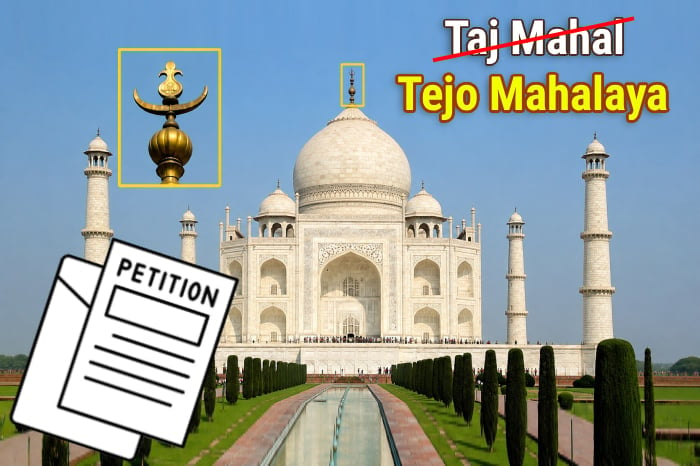
The renewed legal debate over the Taj Mahal has placed one of India’s most studied monuments back at the centre of public, historical, and constitutional scrutiny. A petition before the Allahabad High Court at Prayagraj seeks a survey of the Taj Mahal, asking the court to examine claims that the monument was originally a Shiva temple known as ‘Tejomahalaya’. The petition reportedly cites 109 archaeological and historical features that the petitioners describe as evidence of Hindu origins. At this stage, however, these points remain legal claims placed before the court, not judicial findings.
The matter is significant because it combines several sensitive questions: the evidentiary standards of archaeology, the authority of the Archaeological Survey of India, the management of protected monuments, the religious rights claimed under Article 25 of the Constitution, and the public memory attached to medieval Indian history. The High Court has directed the Centre and the ASI to file counter-affidavits, meaning the case has not yet reached a final conclusion. The court is asking the responsible institutions to place their formal positions on record before the legal issues are examined further.
The petition has been filed on behalf of the deity Lord Sri Agreshwar Mahadev Nagnatheswar Virajman through a legal representative described as the deity’s next friend, along with devotees. In Indian temple litigation, a deity can be treated as a juristic person, and a next friend may approach a court on its behalf when a claim is framed around the deity’s rights or the management of a sacred site. The petitioners have sought a declaration that the Taj Mahal is a Hindu temple, and they have also requested permission for darshan and prayers inside the premises.
The immediate procedural dispute arises from earlier proceedings in Agra. The petitioners had approached a local court seeking the appointment of an advocate commissioner to inspect, photograph, and videograph the monument. That application was rejected, and a later revision plea was also dismissed as not maintainable. The current petition challenges those orders and argues that a court-supervised inspection is necessary because the applicants do not have unrestricted access to the ASI-protected site. This is why the case is not merely about popular belief; it is also about whether a civil court should order inspection of a nationally protected monument.
The reported 109 features cited by the petitioners include architectural and historical observations that they connect with Hindu temple traditions. Public reports mention claims around the kalash-like finial above the marble dome, lotus motifs, references to a structure described as a gaushala, locked portions of the monument, and the asserted earlier history of a temple linked to Raja Paramardi Dev, Raja Man Singh, and Raja Jai Singh before the site allegedly came under Shah Jahan. These claims must be evaluated with caution because architectural motifs can travel across cultures, and courts normally require documentary, archaeological, and legal evidence rather than symbolic resemblance alone.

The established official position remains different. UNESCO describes the Taj Mahal as a white marble mausoleum built in Agra by order of Mughal emperor Shah Jahan in memory of Mumtaz Mahal, with construction beginning in the 1630s and the larger complex completed by the mid-17th century. The official heritage record also identifies the complex as a major achievement of Indo-Islamic architecture, noting its symmetrical planning, marble inlay work, mosque, guest house, gateway, garden, and tomb chamber. The ASI administers the monument as a protected site of national and world heritage importance.
The technical challenge in such a dispute is that monuments are not interpreted through sentiment alone. Archaeology depends on stratigraphy, inscriptions, material analysis, conservation records, construction phases, archival references, and comparative architectural study. A motif such as a lotus, a finial, a floral inlay, or a domical form may be meaningful, but it cannot by itself settle the origin of a structure. Indian architecture has always absorbed, adapted, and reinterpreted forms across regions, dynasties, and religious communities. The same visual vocabulary can appear in Hindu temples, Jain temples, Buddhist sites, Sikh sacred spaces, palaces, gardens, tombs, and later Indo-Islamic monuments.
This is precisely why the role of the ASI is central. A protected monument cannot be treated like an ordinary disputed property. Any physical intervention, survey, photography, excavation, opening of sealed chambers, or structural testing must be weighed against conservation risk. The Taj Mahal is not only a subject of historical debate; it is also a fragile marble and sandstone complex exposed to pollution, groundwater concerns, tourism pressure, weathering, and the long-term demands of preservation. A court-ordered survey, if ever permitted, would need to balance evidentiary value with the duty to protect the monument’s physical integrity.
The legal language of Article 25 also requires careful reading. The Constitution protects the freedom of conscience and the right freely to profess, practise, and propagate religion, subject to public order, morality, health, and other constitutional provisions. In the Taj Mahal petition, the petitioners invoke this right to argue for darshan and puja. Yet when a site is a protected monument with an established administrative regime, courts must also consider statutory restrictions, conservation obligations, existing permitted practices, and the broader public character of the monument. The question is therefore not only whether a religious claim exists, but whether it can legally alter the management of a protected heritage site.
The emotional force behind the case should not be dismissed. Many Hindus view India’s temple history through the memory of destruction, conversion, reuse, and loss across centuries of political upheaval. That historical memory is not imaginary; numerous temples in India did face violence or appropriation under different regimes, including certain medieval rulers. At the same time, each monument must be studied on its own evidence. A serious civilisational conversation becomes stronger when it separates documented cases from unproven assertions, and when it refuses to turn every heritage debate into hostility toward present-day communities.
For dharmic traditions, the deeper standard is truth disciplined by restraint. Hinduism, Buddhism, Jainism, and Sikhism all preserve strong traditions of inquiry, debate, memory, and reverence. They also teach that truth is not strengthened by exaggeration. A heritage claim deserves careful hearing when it is placed before a court through lawful procedure, but it also deserves rigorous testing. Evidence-based scrutiny protects both the dignity of sacred memory and the credibility of historical research.
The Taj Mahal debate also reveals a broader problem in Indian public life: the gap between academic history and public trust. For decades, many Indians have felt that school textbooks and elite institutions did not adequately acknowledge temple destruction, civilisational trauma, or the resilience of Hindu, Jain, Buddhist, and Sikh traditions. That distrust has produced a demand for re-examination of historical narratives. Such re-examination is legitimate when it is conducted through transparent methods, peer review, archival discipline, and lawful institutional processes. It becomes weaker when it relies only on viral claims or political slogans.
The phrase ‘Tejomahalaya’ itself has become a powerful cultural symbol for those who believe the Taj Mahal’s accepted history is incomplete or incorrect. Yet a symbol and a proven historical conclusion are not the same thing. A court cannot decide the origin of a monument merely by the intensity of belief on either side. It must examine pleadings, records, expert submissions, statutory law, and the practical consequences of any order. This distinction is essential because heritage litigation can influence not only one monument, but the public approach to many layered historical sites across India.
The mainstream historical account is built around Mughal chronicles, inscriptions, architectural analysis, and the documented patronage of Shah Jahan. UNESCO’s description notes the chronology of the Taj Mahal complex and the role of artisans from across the Mughal empire as well as Central Asia and Iran. The complex is also studied for its charbagh planning, raised tomb platform, marble pietra dura work, calligraphy, mosque, jawab, and carefully engineered visual symmetry. Any alternate thesis must therefore do more than point to selected features; it must explain the full architectural, textual, and material record in a coherent way.
The petitioners’ argument about access to locked or restricted areas also requires context. Many protected monuments have sealed, restricted, or controlled spaces because of structural vulnerability, conservation needs, visitor safety, or administrative requirements. Restricted access does not automatically prove concealment. At the same time, public institutions can reduce suspicion by publishing conservation records, photographs, survey reports, and expert explanations wherever security and preservation permit. Transparency, when responsibly managed, is often the best answer to speculation.
There is also a civic dimension to this case. The Taj Mahal belongs to India’s historical inheritance even as its meaning is contested by different groups. Some see it primarily as a Mughal mausoleum and a global artwork. Others see it as a possible site of older sacred memory. Many visitors experience it simply as a monument of beauty, grief, craftsmanship, and imperial ambition. A mature society can hold these layers in conversation without allowing disagreement to become cultural contempt. The demand for historical truth should not be converted into suspicion of ordinary worshippers, tourists, scholars, or communities.
The High Court’s next steps will matter because they may clarify the boundary between heritage curiosity, religious rights, civil procedure, and archaeological responsibility. If the Centre and ASI oppose the petition, they will likely rely on existing records, conservation law, and the official historical position. If the court finds any limited inspection legally justified, it may define strict conditions to protect the monument. Either way, the legal process will require more than emotional conviction. It will require evidence capable of surviving institutional and judicial scrutiny.
The most constructive approach is neither blind acceptance of official narratives nor automatic belief in every alternate claim. India’s civilisational history is vast, wounded, brilliant, and often layered. Many sacred sites have complicated pasts, and many monuments carry signs of cultural interaction. Responsible historical research should welcome questions while insisting on method. That standard is not anti-Hindu, anti-Muslim, or anti-anyone; it is pro-truth, pro-civilisation, and pro-heritage.
The Taj Mahal or ‘Tejomahalaya’ question, therefore, should be read as more than a courtroom headline. It is a test of how India studies its past, how courts handle contested memory, how institutions communicate evidence, and how society protects both sacred sentiment and public monuments. The outcome may take time, but the principle is already clear: civilisational confidence grows when faith, history, and law meet with discipline rather than anger. The monument must be preserved, the petition must be judged on evidence, and the wider debate must remain anchored in dignity, accuracy, and dharmic restraint.
Inspired by this post on Hindu Jagruti Samiti.






Leave a Reply
You must be logged in to post a comment.