Bhagavan Parashurama—revered as the sixth avatar of Vishnu—embodies the unflinching synthesis of spiritual insight and righteous strength. Portrayed in the Itihasa–Purana tradition as a steadfast devotee of Lord Shiva and an incarnation of Lord Vishnu, Parashurama personifies the Hari–Hara unity at the heart of Sanatana Dharma. Across Sanskrit sources, his life illustrates how disciplined power (kshatra) must remain answerable to dharma and the welfare of the world (lokasangraha).
Classical narratives concerning Parashurama are preserved in the Bhagavata Purana (Canto 9), the Vishnu Purana (Book 4), various parvas of the Mahabharata, and the Bala Kanda of the Ramayana. These texts converge on a shared motif: when worldly authority turns predatory and social contracts fray, corrective strength rooted in tapas (austerity), humility, and scriptural wisdom restores equilibrium. In this sense, Parashurama is not a figure of sectarian triumph, but a guardian of ethical order.
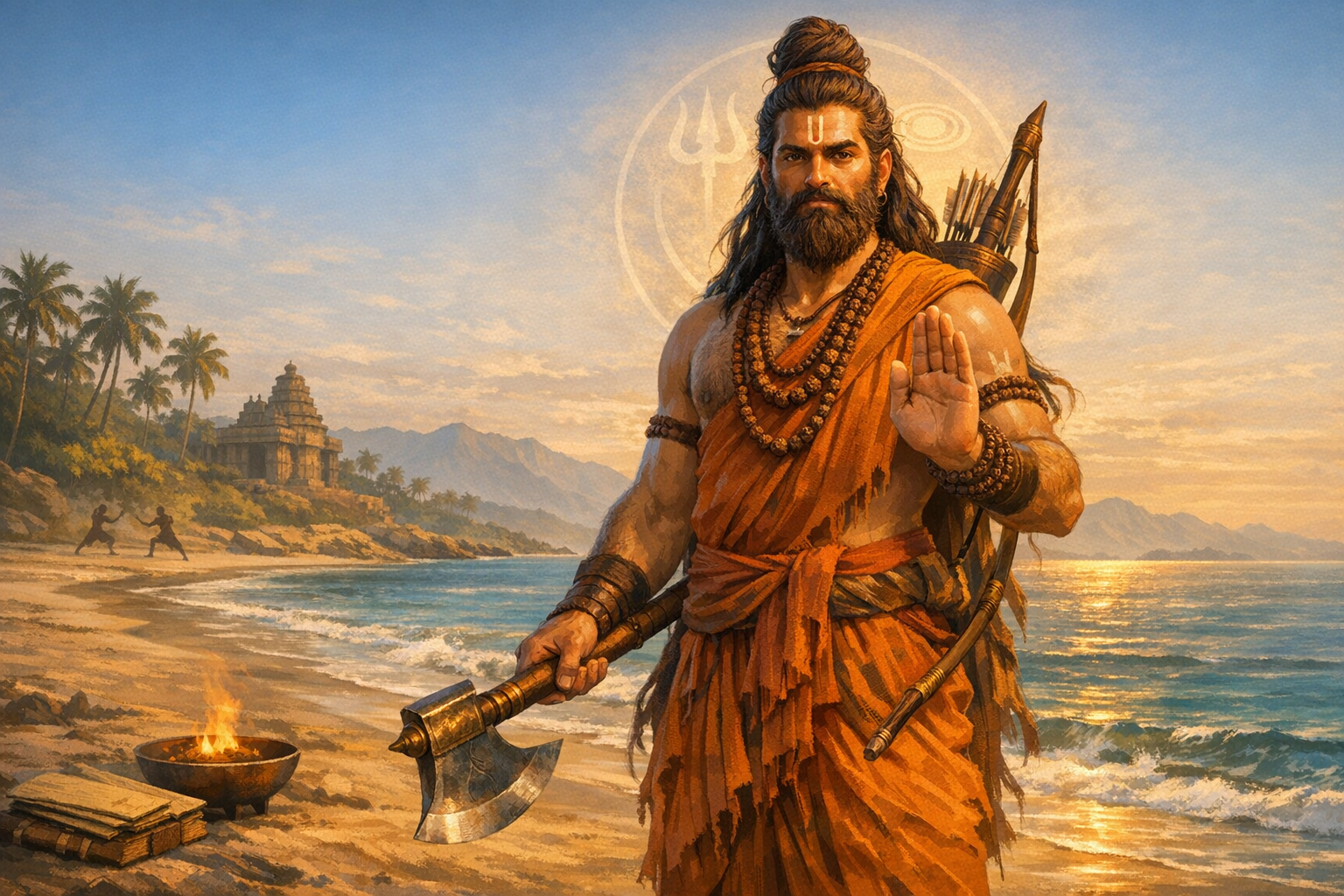
According to these accounts, Parashurama was born into the Bhargava lineage as the son of the sage Jamadagni and the virtuous Renuka. He is often called Rama Bhargava or Jamadagnya. From Lord Shiva he received the parashu (battle-axe) after profound austerities—a symbol of force wholly subordinated to moral ends. Iconographically, he is depicted with the axe, bow, and quiver, matted locks, and a resolute yet restrained demeanor that suggests inner mastery over outer power.
A formative episode in the tradition concerns the testing of obedience and discernment within the guru–shishya ethos. When Jamadagni demanded an extraordinarily difficult proof of detachment, Parashurama complied, and—upon the sage’s subsequent command—revived the harmed with spiritual power. In many interpretive traditions across Hindu philosophical schools, this episode is read allegorically: the severance and restoration signify the cutting of binding attachments (raga) and the reconstitution of rightful relationships under dharma. The emphasis falls not on literalism but on the inner work of self-mastery.
The central public drama of Parashurama’s life unfolds against the abuse of royal and military privilege. Kartavirya Arjuna (Sahasrabahu), exemplifying unrestrained kshatriya excess in some retellings, violated the sanctity of the ashrama and precipitated grave injustice, culminating in the murder of Jamadagni. Parashurama’s vow—described as a series of twenty-one campaigns in the Puranic memory—must be understood as an ethical correction to systemic oppression, not as a war against a community or varna. The texts consistently frame his actions as the restoration of just order where rulers had become predators.
After the restoration, Parashurama is said to have performed solemn rites of expiation and returned sovereignty to the sage Kashyapa before withdrawing to Mahendra Parvat for tapas. This withdrawal after victory is a crucial ethical signal in the epics and Puranas: authentic strength is self-limiting, non-possessive, and ultimately dedicated to tranquility rather than dominion.
In Kerala and along the Konkan littoral, living traditions remember Parashurama as the culture hero who “reclaimed” land from the sea by casting his axe and established sacred settlements. While a mythic motif, this memory has shaped historical identities, temple geographies, and ritual landscapes. Kerala’s classical martial art, kalaripayattu, is also linked in popular lore to his instruction in weapons and discipline, underscoring again that in dharmic thought the martial ideal is inseparable from ethical and spiritual training.
Parashurama’s presence bridges the epics. In the Ramayana (Bala Kanda), he confronts Sri Rama after the breaking of Shiva’s bow. The episode reads less as rivalry and more as transmission: Parashurama recognizes Rama’s divinity and yields the path, modeling deference to truth even by the most formidable ascetic-warrior. The incident teaches that kshatra, to be auspicious, must bow to the higher sovereignty of dharma embodied in Rama.
In the Mahabharata, Parashurama is remembered as the instructor of great warriors such as Bhishma (Devavrata), Drona, and Karna. Each apprenticeship illuminates a distinct ethical facet of kshatra. Bhishma’s vow-bound life reflects the yoking of prowess to self-denial; Drona’s learning from Parashurama after the latter had given away all material wealth highlights the gift of knowledge as the highest dana; Karna’s famed episode—where dissimulation about social identity leads to a curse—warns that the inner integrity of truthfulness is inseparable from the rightful use of celestial weapons. In all cases, Parashurama appears not simply as a teacher of arms, but as a custodian of the moral grammar that must govern power.
Traditions across India venerate Parashurama as a chiranjivi (ever-living), whose continuing presence safeguards the ethical horizons of society. This belief reinforces a perennial admonition: technologies of force and governance evolve, but the obligation to align them with compassion, justice, and restraint does not lapse.
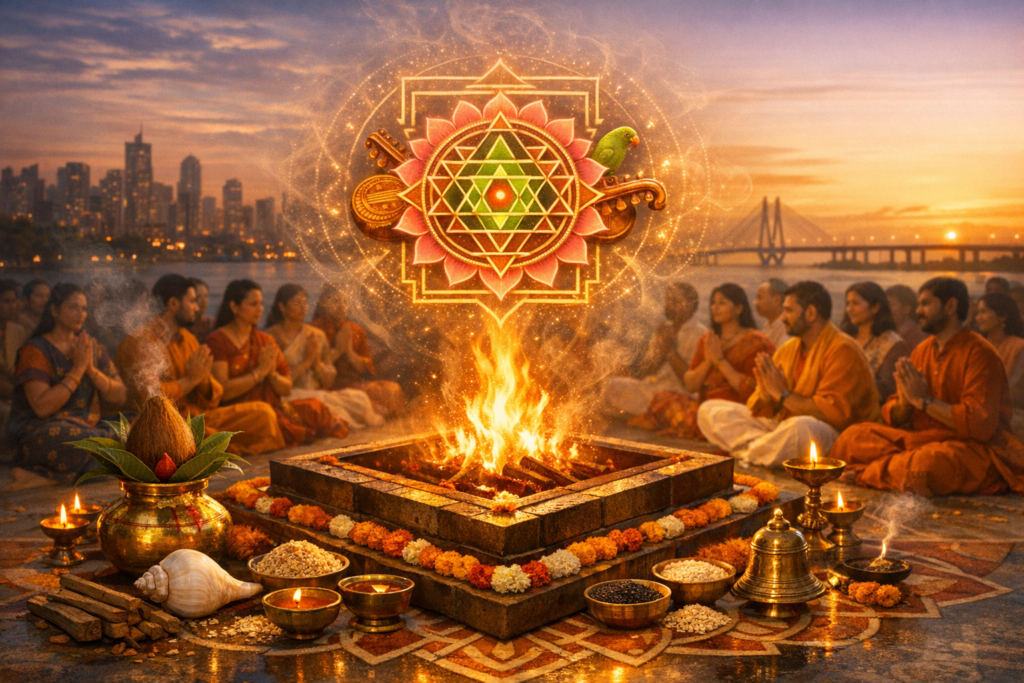
Ritually, Parashurama Jayanti is observed on Vaishakha Shukla Tritiya—the auspicious Akshaya Tritiya—when acts of charity, study, and vrata are believed to yield inexhaustible merit (akshaya). Devotees perform archana with the parashu as the emblematic offering, recite Vishnu sahasranama and select hymns from the Bhagavata Purana, and contemplate the vows that curb anger, pride, and aggression. The alignment of Jayanti with Akshaya Tritiya elegantly unites prosperity with ethical aspiration: strength and wealth become truly inexhaustible only when turned toward dharma.
Temples and sacred sites associated with Parashurama dot the western coast and peninsular interiors. The Parashurama Temple at Chiplun (Maharashtra) is a prominent pilgrimage center, while the Thiruvallam Parasurama Temple near Thiruvananthapuram (Kerala) anchors regional observances connected with ancestral rites and seasonal offerings. These living traditions keep active the teaching that valor and veneration must coinhere.
Philosophically, Parashurama illuminates Kshatra Dharma—the conduct and restraints of those who wield power. The epics insist on guardrails: non-cruelty, truthfulness, promise-keeping, non-possession, and readiness to lay down arms once justice is restored. The cycle of vow, action, expiation, and withdrawal models a jurisprudence of power that speaks as compellingly to modern administrations, armed services, and civic leadership as it did to ancient polities.
For readers navigating contemporary dilemmas—corporate hierarchies, political contestation, or civic activism—the Parashurama ideal suggests a calibrated ethic. Seek strength without arrogance; adopt speed without haste; correct injustice without hatred; and, once order is reestablished, return the “earth to Kashyapa”—that is, relinquish what is not rightfully one’s to keep. In practical terms, this becomes a discipline of transparent decision-making, accountable use of authority, and readiness to step back once institutions function well.
In keeping with the unity of dharmic traditions, Parashurama’s message resonates beyond strict sectarian frames. Buddhism’s vīrya-pāramitā (perfection of energy) commends tireless yet compassionate effort; Jainism’s ahimsa presses for the most restrained and mindful exercise of force; Sikhism’s sant-sipahi (saint-soldier) ideal fuses devotion with protective courage. Read together, these convergences show a shared civilizational insistence: the noblest power is that which protects the vulnerable, tells the truth, and serves peace.
Scholars often note that the Dashavatara sequence can be viewed as a civilizational pedagogy—mapping not only cosmological time but ethical evolution. In this arc, Parashurama stands as the fierce restorer, ensuring that the subsequent avatars (Rama, Krishna) operate within a society chastened into receptivity to subtler, more interiorized teachings. The transition from the axe to the bow to the flute charts a movement from corrective force to principled sovereignty to loving wisdom.
Read with sensitivity, even the more severe episodes in Parashurama’s life serve a clarifying function. The narratives do not license vendetta or glorify destruction; rather, they warn that when the guardians of order betray their charge, rebalancing—tempered by penance and restraint—is a moral necessity. The highest tribute to Parashurama, therefore, is not imitation of his wrath, but embodiment of his discipline: fortitude under vows, clarity under pressure, and humility in victory.
As a devotional and cultural figure, Parashurama links household ritual, temple culture, martial disciplines like kalaripayattu, and pan-Indian narratives of justice. His annual Jayanti during Akshaya Tritiya invites all to reexamine the uses of strength—physical, economic, political, or intellectual—and to consecrate them to the common good. In that consecration lives the promise of inexhaustible merit: power transformed into service, and courage transformed into compassion.
Ultimately, the legacy of Bhagavan Parashurama is a demanding but ennobling ethic. It asks that the axe be lifted only after vows are made, that arrows fly only along the arc of truth, and that the victor walk away with lighter hands and a clearer heart. In this way, the warrior-sage continues to teach that the surest path to collective flourishing is disciplined strength flowing through the channels of dharma.
Inspired by this post on Hindu Pad.