Tag: kalaripayattu

  • Bhagavan Parashurama: Warrior‑Sage Avatar of Vishnu Who Restored Dharma and Balance

    Bhagavan Parashurama: Warrior‑Sage Avatar of Vishnu Who Restored Dharma and Balance

    Bhagavan Parashurama, the sixth avatar of Vishnu and a devoted worshipper of Shiva, embodies the Hari–Hara unity at the heart of Sanatana Dharma. Drawing on the Bhagavata Purana, Vishnu Purana, the Mahabharata, and the Ramayana, this comprehensive essay explains how Parashurama restored ethical order when royal power became predatory, then withdrew in penance to model…

  • Parashurama: The Saint-Warrior Avatar Who Reset Kshatra Dharma and Reclaimed the Land

    Parashurama: The Saint-Warrior Avatar Who Reset Kshatra Dharma and Reclaimed the Land

    Parashurama, the sixth avatar of Lord Vishnu and a devoted bhakta of Lord Shiva, embodies the union of spiritual austerity and disciplined strength to restore dharma. Scriptural accounts from the Bhagavata Purana, Vishnu Purana, Ramayana, and Mahabharata portray his mission as a principled reform of Kshatriya power when it strays into adharma. The narrative explores…

  • 12th State Gatka Championship for Girls: Precision, Courage, and Dharmic Unity on Display

    12th State Gatka Championship for Girls: Precision, Courage, and Dharmic Unity on Display

    The 12th State Gatka Championship for Girls showcased a disciplined, safety-first competition rooted in the Sikh martial tradition, highlighting precision, timing, and ethical strength. Organized with standardized rules and protective equipment, it balanced point-sparring duels with judged demonstrations that rewarded control, coordination, and cultural literacy. Athletes benefited from periodized training, sports medicine awareness, and psychology-informed…

  • Kirata Sastha of Ayyappa: The Divine Hunter-Guardian of Dharma in Kerala’s Living Traditions

    Kirata Sastha of Ayyappa: The Divine Hunter-Guardian of Dharma in Kerala’s Living Traditions

    Kirata Sastha—revered in northern Kerala as Vettakkoru Makan—offers a dynamic, guardian dimension to the Ayyappa (Dharma Sastha) tradition. This analysis traces the kirata (hunter) motif from the Mahabharata to Kerala’s living practices, showing how regional ritual, iconography, and ecology inform a distinctive protector-deity. It explains why Kirata Sastha complements Sabarimala’s Yoga Sastha, uniting inner discipline…

  • ‘Nari Samarthyachi Navi Pahat’ Jalgaon: Actionable Self‑Defence and Dharmic Heritage for Women

    ‘Nari Samarthyachi Navi Pahat’ Jalgaon: Actionable Self‑Defence and Dharmic Heritage for Women

    On 7 March in Jalgaon, Maharashtra, the Ranragini wing of the Hindu Janajagruti Samiti will host “Nari Samarthyachi Navi Pahat,” a women’s empowerment programme focused on self-defence awareness and cultural heritage. The initiative emphasises prevention, de-escalation, and proportionate response, supported by practical movement drills and verbal boundary-setting. Participants benefit from legal literacy on the right…

  • Alidha Stance in Hindu Iconography: Embodied Power, Dharma Readiness, and Sacred Motion

    Alidha Stance in Hindu Iconography: Embodied Power, Dharma Readiness, and Sacred Motion

    Alidha (ālīḍha) is the forward-striding stance in Hindu iconography where the right leg advances and the left draws back, fusing motion with stability to signal dharma-ready power. Rooted in the Nāṭyaśāstra and Dhanurveda and codified in Śilpa-śāstra, it recurs across Shaiva, Shakta, and Vaishnava imagery and in classical dance such as Bharatanatyam. The stance animates…

  • Empowering Safety: Kranti Petkar Calls for Self‑Defence Training for Young Women in Pune

    Empowering Safety: Kranti Petkar Calls for Self‑Defence Training for Young Women in Pune

    At Dance Festival 2025 in Pune, Ms. Kranti Petkar of the Ranragini wing emphasized that self‑defence is essential to women’s empowerment. The focus extended beyond techniques to include situational awareness, assertive communication, and de‑escalation. Framed through shared dharmic values, the message aligned personal safety with a unifying ethos across Hinduism, Buddhism, Jainism, and Sikhism. Traditional…

  • Martial Arts in Sanatana Dharma: A Comprehensive Guide

    Martial Arts in Sanatana Dharma: A Comprehensive Guide

    Sanatana Dharma is a term used to describe the ancient Indian tradition that encompasses Hinduism, Jainism, Buddhism, and Sikhism. These religions share many fundamental principles and values, including the importance of physical and mental discipline, self-defense, and protection of one’s community. Martial arts have played a significant role in the culture and history of Sanatana…

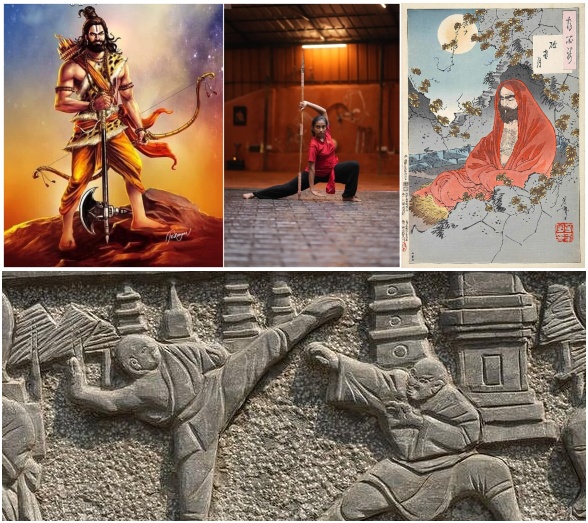
  • Lord Parashuram, Kalaripayattu, Bodhidharma and Kung-Fu

    Lord Parashuram, Kalaripayattu, Bodhidharma and Kung-Fu

    Kalaripayattu is an ancient martial art that originated in the southern Indian state of Kerala, and it is widely regarded as one of the oldest martial arts in the world. The art has been practiced and developed for over 3000 years, and its techniques have been used in warfare, self-defense, and physical fitness. Kalaripayattu is…