Srimad-Bhagavatam stands as a luminous synthesis of Vedic wisdom, integrating the philosophical depth of the Upanishads with the living current of the Bhakti Tradition. Composed in classical Sanskrit and attributed to Veda Vyasa, it distills complex metaphysical insights into narratives that are accessible, transformative, and enduringly relevant. Within this corpus, Canto Eleven offers a compelling pedagogy of liberation by revealing how nature, society, and the inner life function as teachers for spiritual realization. This approach resonates across the dharmic familyHinduism, Buddhism, Jainism, and Sikhismby emphasizing non-violence, self-mastery, compassionate action, and inner freedom.
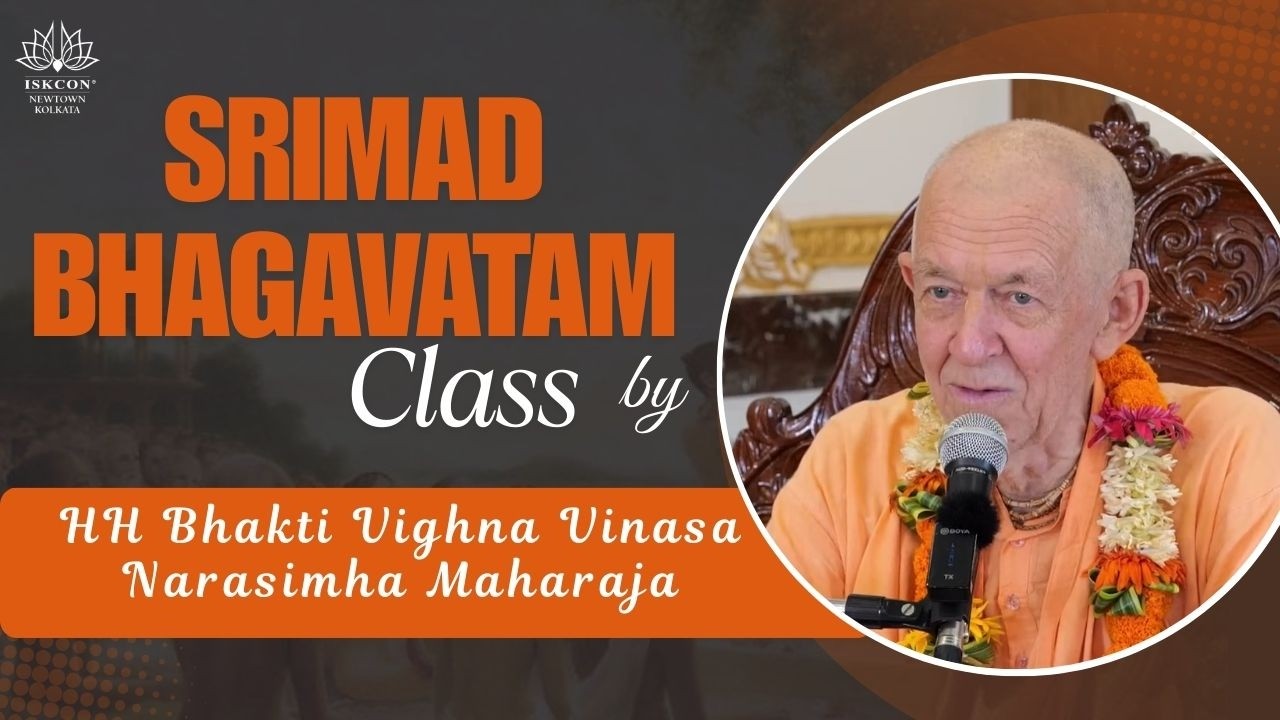
Set within this Canto, Srimad-Bhagavatam 11.9.15 occurs in the celebrated dialogue between the Avadhuta brāhmaṇa and King Yadu, where the sage shares lessons derived from twenty-four teachers found throughout creation. Drawing on the exposition delivered by HH Bhakti Vighna Vinasa Narasimha Swami Maharaj, the following analysis situates SB-11.09.15 in its textual, philosophical, and practical context, highlighting its precise contribution to cultivating equanimity, detachment, and devotion. The result is a method of insight that is rigorous, experiential, and universally applicable to seekers navigating contemporary life.
Textually, SB 11.7–11.9 presents an unconventional yet authoritative pedagogy: the Avadhuta learns from earth, air, sky, water, fire, moon, and sun; from a pigeon, python, moth, honeybee, elephant, deer, fish, and hawk; from a child, a maiden, an arrow-maker, and a serpent; and from a spider and a wasp. In this lattice of teachers, the verse 11.9.15 occurs within a cluster that accentuates composure, restraint of the senses, and inner sufficiency. Classical commentators such as Sridhara Svami and Jiva Gosvami underscore that the Avadhuta’s observations do not merely advocate renunciation; they culminate in steady devotion to Bhagavan, through which knowledge (jnana) and detachment (vairagya) become stable and life-affirming.
Philosophically, the Avadhuta’s method is a disciplined triangulation of pramanadirect observation (pratyaksha), inference (anumana), and scriptural testimony (shabda). He models how measured observation of the world can be transmuted into realizations about the Self (atman) and the Supreme (Paramatman), provided it is anchored in scriptural discernment and a heart oriented toward bhakti. The approach is neither anti-intellectual nor anti-world; it is an integrated epistemology that refines perception, intention, and conduct.
In the sequence surrounding SB 11.9.15, the text stresses equanimity and restraint, analogizing the mind to vast natural forces that remain composed amid constant inflow and outflow. The instruction is not a counsel of passivity. Rather, it is a training in stable awareness: remaining steady when fortune waxes or wanes, when praise or blame arises, and when gain or loss appears. Such equipoise allows devotion to deepen beyond sentiment, knowledge to crystallize beyond concept, and ethical action to arise without compulsion.
The elements become living teachers. From the earth comes forbearance and service despite being repeatedly used and injured; from air, non-attachment, touching everything yet clinging to nothing; from the sky, spacious freedom, ever-pure and untainted by passing clouds; from water, purity that revitalizes others without losing its essence; from fire, the transformative force that consumes impurities; from the moon, the insight that apparent waxing and waning do not alter the substratum; and from the sun, the model of taking from the world without exploitation and returning what is gathered, moving in assigned orbit without pride.
Creatures and natural processes offer cautionary and inspiring models. The pigeon dramatizes how blind attachment can destroy what it seeks to protect; the python signifies contentment with what comes by providence, reducing restlessness and anxiety; the ocean points to composure that does not overflow in prosperity nor recede in adversity; the moth warns against heedless attraction to sensory glitter; the honeybee encourages collecting wisdom from many sources without hoarding; the elephant exemplifies how unguarded desire enslaves strength; the deer displays the peril of distraction; the fish demonstrates that the tongue can bind more tightly than chains; and the hawk shows how grasping invites conflict, whereas letting go brings peace.
Human exemplars and subtle natural lessons refine method and mind. Pingala, the courtesan, discovers profound joy when she renounces feverish expectation and rests in contentment; the child teaches spontaneity and freedom from social vanity; the maiden, working alone to avoid needless noise, models inner quiet through simplicity; the arrow-maker, immersed in craft, shows the power of one-pointed concentration (ekagrata); the serpent suggests unencumbered living that favors inner depth over excessive social entanglement; the spider mirrors creation and dissolution from the Self; and the wasp suggests that one becomes what one consistently contemplates, a sober warning about the formative power of attention.
In this field of instruction, SB-11.09.15 contributes a precise ethical-psychological calibration: equilibrium without apathy, renunciation without aversion, and devotion without fanaticism. Equanimity is framed as the stable platform from which knowledge matures and bhakti flowers. It reframes power not as domination or control, but as mastery over reactive impulses so that cognition, compassion, and courage can be exercised wisely.
The triad of jnana, vairagya, and bhakti serves as the soteriological backbone. Knowledge exposes the contingency of worldly upsurges and downswings; detachment loosens the compulsion to seize, defend, or flee; devotion orients all faculties to the Divine, transmuting clarity and restraint into love-filled service. Seen together, this triad redirects the nervous energy of desire and fear toward presence, prayer, and purposeful action.
Contemporary practitioners recognize how this pedagogy meets modern challenges. The oceanic equanimity invoked around SB 11.9.15 offers an antidote to digital overstimulation, outrage cycles, and comparison-driven anxiety. The arrow-maker’s concentration undergirds deep work in an age of distraction; the honeybee’s non-hoarding ethic informs sustainable consumption; Pingala’s release of expectation challenges burnout by shifting aspiration from results to relationship with the Sacred.
The Avadhuta’s learning also operates as a cross-dharmic bridge. Buddhist cultivation of equanimity (upekkha) and mindful observation (sati) mirrors the composure and attention trained here. Jain aparigraha (non-possessiveness) parallels the lessons of the honeybee, hawk, and fish, while Jain samyama (self-restraint) converges with pratyahara from Yoga and the restraint of the senses emphasized in the Bhagavatam. Sikh teachings on hukam (living in alignment with the Divine Order) and sehaj (natural ease) reinforce the text’s counsel to act without agitation, anchoring ethical service (seva) in inner steadiness. This shared grammar of practice nurtures unity in spiritual diversity.
The method is rigorously practical. In yogic terms, pratyahara (withdrawing the senses) is educated by the moth, deer, and fish; dharana (steady focus) is schooled by the arrow-maker; dhyana (contemplative absorption) is set on a firm base by the earth’s forbearance and the sky’s vastness. The Bhagavatam’s brilliance is to seat these disciplines within relational devotion, so that skill becomes sacrifice, ethics becomes offering, and insight becomes intimacy with Bhagavan.
Attention is destinythis is a keynote inferred from the wasp and arrow-maker. Contemporary cognitive science echoes this, showing that sustained attention reorganizes neural pathways and stabilizes mood. The Avadhuta knew this in lived terms: what the mind steadily contemplates, it gradually becomes. Hence, SB-11.09.15’s emphasis on equanimity protects attention from fragmentation, allowing it to serve discernment and devotion rather than reactivity.
Ethically, the text commends a restorative relationship with the world. The sun and honeybee teach non-exploitative participation; the water and earth embody purification and generosity; the ocean’s restraint becomes a civic virtue, modeling how communities can respond to prosperity and crisis without volatility. This aligns with dharmic environmental ethics that treat nature as a teacher, not a resource to exhaust.
Two misreadings deserve correction. First, the python’s contentment is not an excuse for indolence; it counsels freedom from anxiety, not abandonment of duty. Second, equanimity is not emotional numbness; it is responsive steadiness that enables timely compassion, courageous speech, and principled action. In the Bhagavata horizon, such steadiness culminates in loving service, not withdrawal from society.
Practically, several disciplines flow naturally from this section of the text. Daily recitation and contemplation of Srimad-Bhagavatam stabilize purpose; japa and breath awareness refine attention and calm the nervous system; mindful consumption and simplicity honor aparigraha; periodic silence and solitude allow the sky-like mind to reappear; and sat-sangacompany that upliftskeeps knowledge, detachment, and devotion balanced.
In pedagogical terms, the Avadhuta offers a powerful template for lifelong learning: read the world symbolically, test insights through disciplined practice, verify them against scripture and the counsel of realized teachers, and then integrate them through service. HH Bhakti Vighna Vinasa Narasimha Swami Maharaj’s teaching on SB-11.09.15 highlights this arc, encouraging seekers to audit daily life for lessons hidden in plain sight, and to convert observation into realization through steady bhakti.
Finally, the section advancing and including SB 11.9.15 invites a civilizational ethic of humility, dialogue, and shared practice across dharmic paths. When equanimity steadies vision, differences in doctrine cease to be barriers to friendship and collaboration. The Avadhuta’s twenty-four gurus thus become more than a spiritual curriculum; they become a charter for unity in spiritual diversity, guiding societies toward wisdom, compassion, and enduring peace.
Inspired by this post on Dandavats.