-
HG Daivi Shakti Mataji revives Srila Prabhupada-lilamrita: Devotion, Method, Dharma Unity

This Vrindavan-focused analysis of Srila Prabhupada Lilamrita—framed by insights associated with HG Daivi Shakti Mataji—shows how a well-sourced spiritual biography can simultaneously inform scholarship and deepen sadhana. It outlines the text’s historiographical method, balancing documentation with a devotional register rooted in Gaudiya Vaishnava theology. Readers gain clarity on key narrative arcs, from the Jaladuta voyage…
-
All Faiths Share Core Values – So Why Convert? A Deep, Dharmic, Evidence-Based Guide

This long-form, evidence-based guide explains why religious conversion persists even when core values—compassion, truth, service, and self-discipline—are widely shared. It distinguishes ethical convergence from deeper differences in metaphysics, salvation, and institutional identity that often drive conversion debates. Drawing on Hinduism, Buddhism, Jainism, and Sikhism, it highlights Dharmic pluralism through ideas like Ishta and anekantavada, showing…
-
The War They Could Not Win: Dharmic Unity vs. Empire’s Cultural Offensive (Part 1)

This long-form analysis reframes the nineteenth century as a hybrid struggle—military, legal, economic, educational, and narrative—between an expanding empire and a resilient, plural civilization. It situates the 1857 War of Independence within deeper structural transformations led by the British East India Company and subsequent Crown rule. The discussion explains how revenue settlements, legal codification, and…
-
Sanatana Dharma Beyond Labels: A Scholarly Guide to Universal, Compassionate Spirituality

This essay clarifies why sanatana-dharma is a universal, practice-oriented framework rather than a sectarian label. It distinguishes dharma from the modern category of “religion,” showing how Vedic principles guide ethical life, contemplative practice, and social harmony for all communities. It integrates perspectives from Hinduism, Buddhism, Jainism, and Sikhism to demonstrate a shared commitment to truth,…
-
Is Life Easy or Difficult? Dharmic wisdom unites dukkha and ananda with practical tools

The longstanding paradox—Buddhism’s dukkha versus the claim that life is joy—resolves when viewed through dharmic frameworks that distinguish conventional from ultimate truth. Buddhism names the instability of conditioned life, while Vedanta points to ananda as the intrinsic nature of consciousness; Jain Anekantavada and Sikh Chardi Kala further harmonize these insights. This synthesis is practical, not…
-
MP High Court Declares Bhojshala a Hindu Temple: Landmark Ruling, Ayodhya Principles, ASI Proof

The Madhya Pradesh High Court has declared the disputed precinct within the Bhojshala complex a Hindu temple, expressly invoking the Supreme Court’s Ayodhya principles. This long-form analysis explains what the ruling means in constitutional and heritage law, how courts distinguish historical “religious character” from mere possession, and why archaeology and epigraphy matter. It unpacks the…
-
Udhayanidhi Stalin’s anti-‘Sanatan’ remarks: outrage, constitutional limits, and a call to unity

Udhayanidhi Stalin’s renewed anti-‘Sanatan’ remarks in the Tamil Nadu Assembly have reignited a national discussion on religious freedom, constitutional limits, and the ethics of political speech. This analysis clarifies what Sanatan Dharma signifies within the broader Dharmic family, separating critique of social evils from denigration of faith. It maps the constitutional terrain—Articles 19 and 25–28,…
-
Organized Religion Reconsidered: Safeguarding Dharma Without Losing the Sacred Pulse

This essay examines the enduring paradox of organized religion in the dharmic traditions: the need to institutionalize sacred insight without extinguishing its contemplative core. Drawing on historical patterns from the Buddhist sangha, Hindu mathas and ashramas, Jain fourfold communities, and Sikh gurdwaras, it shows how organization can preserve wisdom, expand seva, and protect sacred spaces.…
-
Beyond Sectarianism: Dharmic Wisdom for an Inclusive, Boundless Vision of the Divine

This essay examines the insight that a sectarian mind yields a defective image of the Divine, drawing on Hindu philosophy and the wider Dharmic traditions. It traces Vedic and Upanishadic roots of pluralism, explains the Bhagavad Gita’s inclusivism, and shows how Ishta, Advaita, Vishishtadvaita, and Dvaita approach the One-and-many problem without mutual negation. It integrates…
-
Vasudhaiva Kutumbakam and Dharma: A Powerful Blueprint for Shared Global Peace

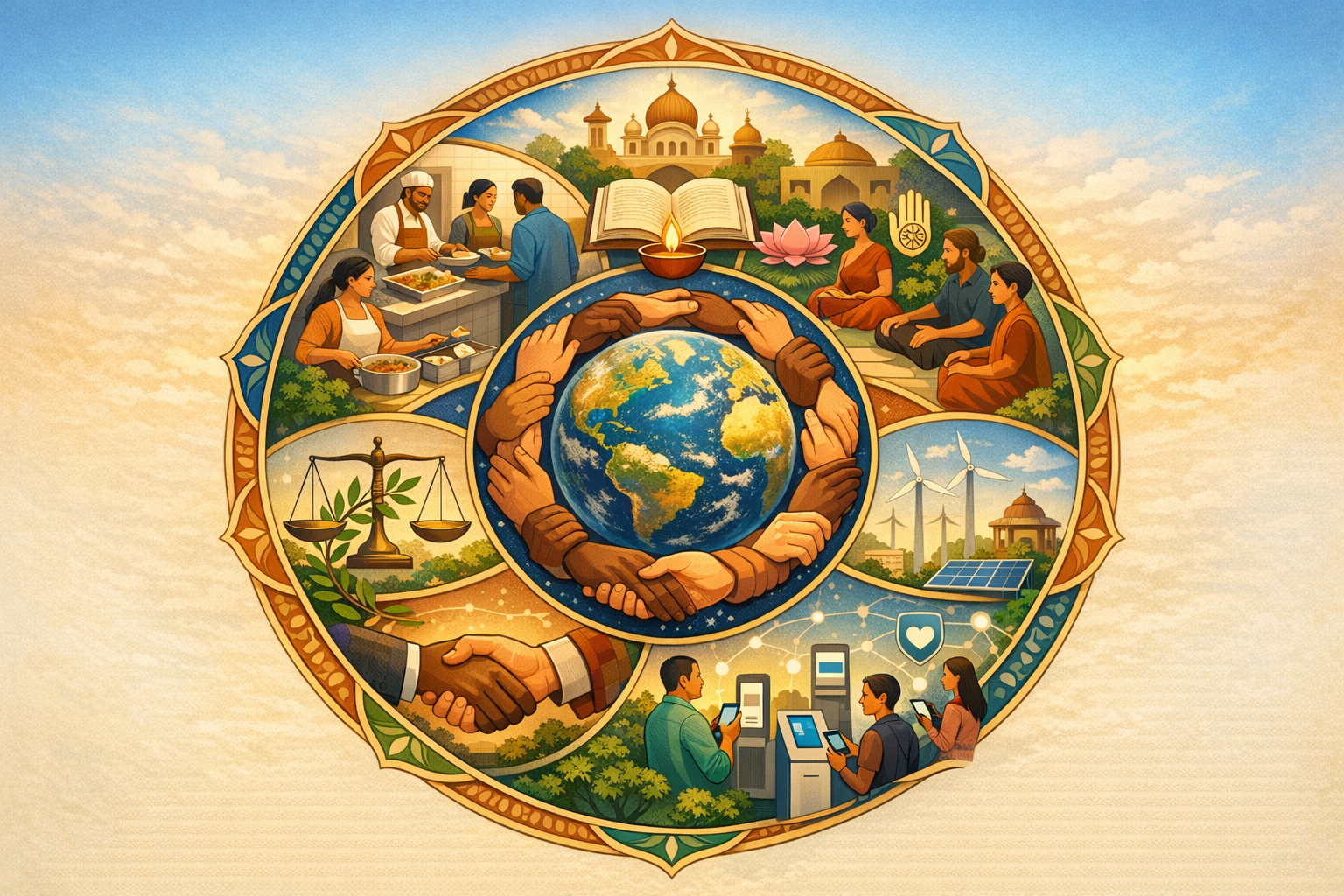
Vasudhaiva Kutumbakam frames global peace as a disciplined practice of shared responsibility rooted in Rta, Dharma, and the ethics of ahimsa and karuna. The essay explains how loka-samgraha in the Bhagavad Gita links personal virtue to social welfare through reciprocal duty. It outlines pluralism across Hinduism, Buddhism, Jainism, and Sikhism as a practical foundation for…
-
Avatar vs Prophet: Decoding Sacred Roles, Divine Presence, and Dharma Across Faiths

This in-depth analysis explains the core difference between a Hindu avatāra and an Abrahamic prophet by examining ontology, revelation, soteriology, and ritual life. It shows how the avatāra is the Divine Presence entering the world to restore dharma, while the prophet is a human messenger who conveys God’s guidance. The piece nuances the comparison by…
-
Panaji Police HQ Protest: Hindus Demand Equal Action on Hate Speech, Uphold Rule of Law

Hundreds of citizens gathered outside the Panaji Police Headquarters in Goa, contending that laws on derogatory religious speech are being enforced unevenly. Protesters cited the swift arrest of Gautam Khattar over remarks about St. Francis Xavier and demanded similar urgency when Hindu deities and traditions are mocked. The analysis situates their demand within India’s constitutional…
-
Hinduism’s ‘330 Million Gods’ Demystified: Unity, Ishta, and the Logic of Many Paths

Why Hindus follow many gods is not a contradiction but a cornerstone of Sanatan Dharma. This essay clarifies the famous “330 million gods” as a later linguistic and devotional interpretation of the Vedic 33 categories (koti) of deities, grounding the discussion in the Vedas, Upanishads, and the Bhagavad Gita. It explains Ishta-devata as a rigorous,…
-
Why India Reveres Its Rivers: Sacred Geography, Living Heritage, and Dharmic Unity

This in-depth exploration explains why India venerates its rivers as living presences that sustain ecology, economy, and ethics. It traces scriptural roots from the Rigveda to the Puranas, highlights major rivers such as Ganga, Yamuna, Saraswati, Godavari, Narmada, and Kaveri, and shows how sacred geography shapes towns, festivals, and civic infrastructure. It demonstrates unity among…
-
Beyond 330 Million Gods: How Hinduism Unites Many Deities into One Supreme Reality

The familiar claim that Hinduism has 33 crores (330 million) gods is a popular misreading; classical sources enumerate thirty-three devas—eight Vasus, eleven Rudras, twelve Adityas, plus Indra and Prajapati. By clarifying the Sanskrit term koṭi (class/category vs. crore), the article shows how Vedic and Upanishadic texts integrate divine plurality within a single metaphysical reality. It…
-
Indian Railways and Religious Dietary Choice: Halal vs Jhatka—A Practical, Respectful Fix

A passenger’s request for a jhatka meat option on Indian Railways spotlighted a narrow but important gap in IRCTC’s otherwise safety-first catering policy: the absence of transparent, method-of-slaughter choice. This analysis explains why food safety compliance, while essential, does not resolve concerns rooted in conscience and religious practice. It defines halal and jhatka in neutral,…
-
Saleem Wastik arrest in 1995 kidnap–murder sparks debate: due process, calm, and unity

Reports indicate that YouTuber Saleem Wastik, who identifies as “Ex-Muslim,” was arrested in connection with a 1995 kidnapping–murder case, prompting public debate and legal scrutiny. This analysis explains how India’s CrPC and IPC govern late-stage arrests, remand, and bail in serious offences, emphasizing the presumption of innocence and evidentiary rigor. It outlines why there is…
-
Beyond the Frame: Why Hindu Deity Images Seem Incomplete—Revealing Infinity and Dharmic Unity

Many observers assume Hindu deity images are incomplete because they appear stylized, aniconic, or schematic. In classical Hindu thought, however, every sacred image is complete in essence (tattva) and intentionally incomplete in form (rupa), a design that honors the Upanishadic insight that the infinite cannot be fully pictured. Shilpa Shastras, temple architecture, and ritual consecration…
-
Yuga Dharma of Unity: How Collective Chanting Heals Divisions Across Dharmic Paths

This article examines Yuga Dharma as a unifying principle for the present age and explores why collective chanting and shared service provide an academically credible, historically grounded path to dharmic unity. Drawing on Gaudiya Vaishnavism’s emphasis on sankirtana and parallel practices in Sikhism, Jainism, and Buddhism, it shows how sacred sound strengthens cohesion without erasing…