The Mahabharata presents the Kurukshetra War as a crucible where dharma and adharma are tested under the harshest conditions of statecraft, kinship, and combat. Within this vast epic, the death of AbhimanyuArjuna’s sixteen-year-old sonemerges as a decisive moral and strategic inflection point. It was not merely that a brilliant young warrior fell; it was the manner of his killing that catalyzed a long, irreversible slide in the Kauravas’ fortunes, altering the war’s tempo, psychology, and legitimacy.
Set on the thirteenth day of the Kurukshetra War, the episode unfolds against a carefully engineered Kaurava plan. With Bhishma already fallen, Drona assumed command and sought to force a breakthrough by deploying the Chakravyuha, a rotating, multi-tiered battle array famed for its complexity. The operational objective was clear: breach the Pandava lines and seize Yudhishthira. To neutralize the one combatant most capable of disarming such a formation, the Trigarta contingent (the samshaptakas) lured Arjuna away under a suicidal vow of single-minded combat, fracturing the Pandava command structure at a decisive hour.
To appreciate the stakes, it helps to understand, at least in outline, how the Chakravyuha functioned. Classical Indian warfare treated vyuhas as mobile geometries of power, integrating cavalry, chariots, infantry, and elephant corps into shifting patterns of offense and defense. The Chakravyuha’s spiraling rings required precise knowledge to penetrate and, crucially, to exit. According to tradition preserved in multiple recensions, Abhimanyu had learned the technique of entry while still in the womb, but the lesson of egress remained incomplete. Even so, his training, composure under pressure, and rathi-to-atiratha caliber made him uniquely positioned to attempt the breach in Arjuna’s absence.
Abhimanyu spearheaded the assault on the formation’s outer ring, with Bhima, Satyaki, and other Pandava heroes poised to follow through the gap he created. At this exact juncture, Jayadratha intervened and held the Pandava thrust at bay. Commentarial traditions relate a boon enabling Jayadratha to check the four Pandavas (but not Arjuna) for one day, and he used it to devastating effect, sealing Abhimanyu inside the rotating maw of the Chakravyuha and isolating him from reinforcement.
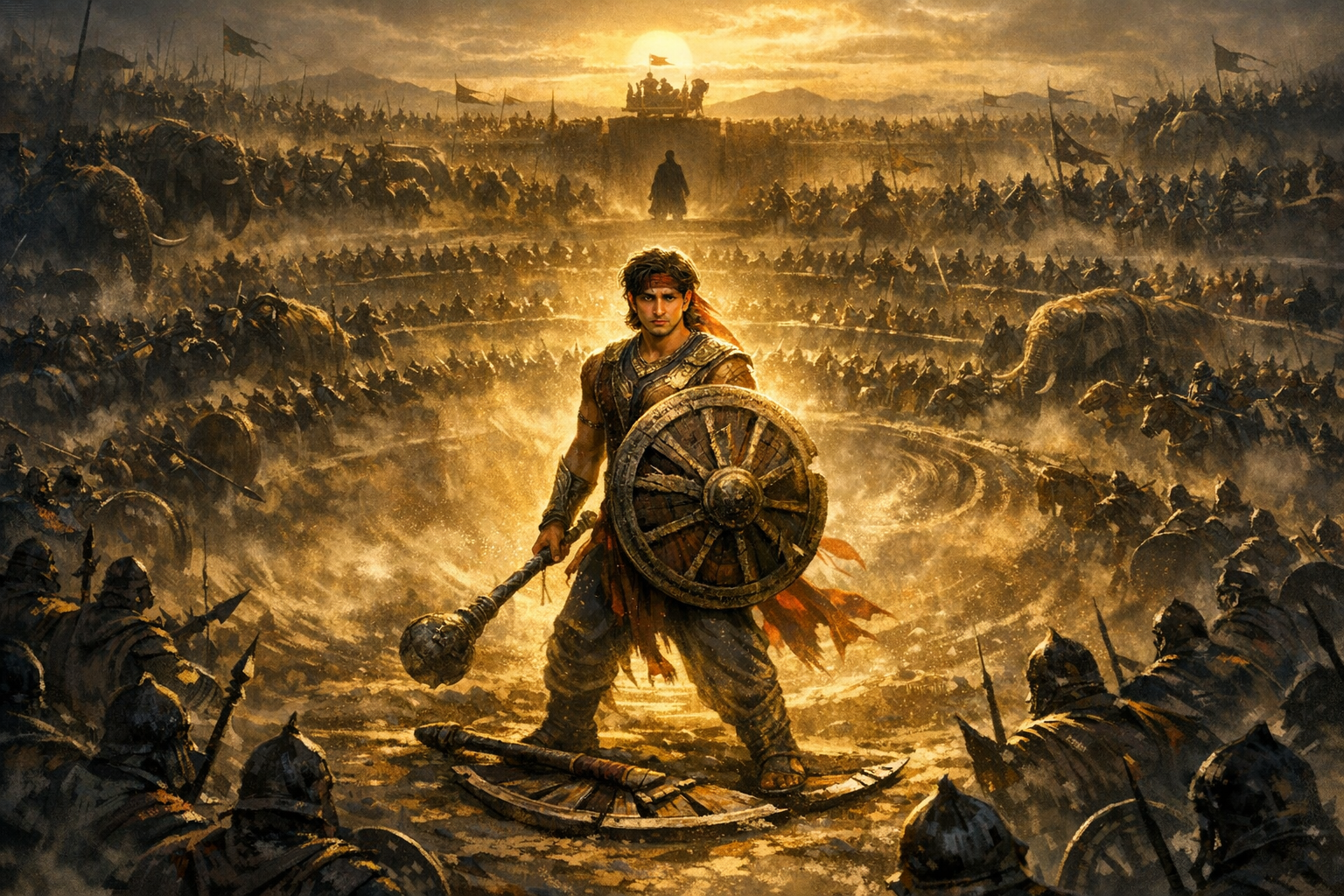
Once inside, Abhimanyu’s performance was as luminous as it was tragic. He shattered successive layers of resistance, unhorsed elite warriors, and broke chariot after chariot with an audacity that disordered Kaurava lines. Several sources record that he slew illustrious princes, including, in many recensions, King Brihadbala of Kosala. The young warrior’s aggressive tempo and calm violencehallmarks of refined Kshatra Dharmamomentarily inverted the Kaurava advantage from within their own formation.
That inversion triggered a sequence of decisions that now occupies the heart of the epic’s moral discourse on Dharma-Yuddha. Confronted with Abhimanyu’s relentless pressure, the Kaurava leadership abandoned the etiquette of single combat and converged on a many-on-one assault. Karna severed Abhimanyu’s bowstring; others shattered his chariot and weapons in rapid succession. As the fight collapsed into close quarters, the weaponless youth seized a wheel as an improvised shield and then a mace, continuing to resist. The episode culminated when Duhshasana’s son struck Abhimanyu down with a blow to the headan end that the epic frames unambiguously as adharma.
The codes of Dharma-Yuddha, often articulated by figures such as Bhishma and embedded in the epic’s narrative ethics, prohibit simultaneous ganging up on a lone combatant, attacking from behind, or striking the unarmed. They also proscribe fighting after the day’s end and harming noncombatants. In breaching these norms to eliminate Abhimanyu, the Kauravas gained a tactical kill yet forfeited something harder to recoup: the moral ballast that sustains legitimacy in a protracted conflict.
The immediate psychological shock was profound. Pandava forces reeled not simply from bereavement but from the felt desecration of the battlefield’s sacred compact. Yudhishthira, who had sanctioned the breach to protect the army’s center, experienced grief interlaced with remorse. Across the Pandava camp, the fall of Abhimanyuyouthful, valiant, and manifestly wrongedbecame a rallying standard of righteous fury, concentrating diffuse resolve into a single, consuming strategic aim.
That aim took unambiguous form in Arjuna’s vow. Returning at day’s end to find his son dead and the manner of the killing laid bare, Arjuna swore to slay Jayadratha before the next sunset or self-immolate. The vow turbocharged the operational logic of day fourteen: forces, formations, and deception would now be orchestrated around the single axis of penetrating Kaurava screens to reach and destroy Jayadratha.
Day fourteen thus became a study in maneuver warfare under the shadow of time. With Krishna as charioteer and strategic mind, Arjuna drove a relentless wedge through successive Kaurava lines. Multiple traditions describe a late-afternoon stratagemclouds and battlefield dust dimming the light, allowing a feint of sunsetthat drew Jayadratha into momentary exposure. Arjuna’s arrow then severed his head and, in the well-known narrative, carried it to fall upon his father’s lap, fulfilling a prior curse and sealing the act’s karmic closure. Tactically, the Kaurava right collapsed; psychologically, the army confronted the predictable retribution triggered by Abhimanyu’s unjust death.
The cascading effects in the ensuing days were unmistakable. The Kaurava command, already strained by the fall of Bhishma, now lost coherence as Drona’s fate was sealed by the Pandavas’ unyielding momentum. Karna’s ascendancy to command arrived under conditions of attrition and eroding morale. By day seventeen, Karna himself fell; on day eighteen, Duryodhana was mortally wounded. While none of these outcomes can be reduced to a single cause, the thirteenth day set into motion a multi-dimensional shiftfrom confidence to anxiety, from positional patience to reactive hastethat the Kauravas could not reverse.
From an analytical standpoint, Abhimanyu’s death altered the war along three interlocking vectors. First, operationally, it forced the Kauravas to confront an Arjuna unbound by ordinary constraints, whose vow concentrated force, time, and terrain in his favor. Second, in the realm of narrative legitimacy, the breach of Dharma-Yuddha codes drained the Kaurava cause of the moral capital necessary to sustain allies and internal cohesion. Third, psychologically, the Pandavas gained a unifying symbol of sacrifice and injustice that simplified decision-making and stiffened will at every echelon.
The episode also illuminates the deeper architecture of Kshatra Dharma: prowess is inseparable from restraint. For the Pandavas, Abhimanyu embodies boththe capacity to enter the Chakravyuha and the willingness to stand and fight within it despite incomplete knowledge. For the Kauravas, the decision to combine arms against a weaponless youth delivered a near-term advantage at a long-term civilizational price, a lesson the epic underscores with unflinching clarity.
Read through a dharmic lens inclusive of Hindu, Buddhist, Jain, and Sikh insights, the narrative converges on shared ethical intuitions: that means matter as much as ends; that power without self-regulation hollows itself out; and that justice, when violated, rebounds with consequences. Buddhist dhamma emphasizes right action; Jain ahimsa warns against the corrosion that violence without measure inflicts upon the soul; the Sikh ideal of sant-sipahi integrates spirituality with disciplined valor. The Mahabharata’s judgment on the thirteenth day harmonizes with these currents: adharma may deliver tactical gains, but it undermines the very order it seeks to defend.
Textual traditions vary on some particularslists of warriors felled by Abhimanyu, the exact sequencing of blows, and the dramatic details surrounding Jayadratha’s end. The BORI Critical Edition streamlines material to a probable core; the K.M. Ganguli (KMG) translation and later vernacular retellings preserve richer narrative textures. Yet across these witnesses, one consensus holds: it was the unjust manner of Abhimanyu’s killing, not the fact of his death alone, that redefined both the ethics and the outcome of the Kurukshetra War.
For contemporary readers and leaders alike, the episode offers a durable strategic and ethical lesson. Systemsarmies, institutions, communitiesare stabilized as much by perceived justice as by capacity. Violating core norms for expedience often provokes counter-reactions stronger than the initial gain, a dynamic the Pandavas harnessed in the wake of their most grievous loss. Abhimanyu’s fall thus becomes a case study in how moral transgression can serve as an accelerant of strategic defeat.
In sum, Abhimanyu’s courage illuminated the battlefield; the adharma of his killing darkened the Kauravas’ cause beyond repair. The vow it provoked, the operations it shaped, and the spirit it kindled among the Pandavas together marked a pivot from which the trajectory of the Mahabharata’s great war would not recover. The epic’s verdict is austere and enduring: in Dharma-Yuddha, how victory is sought is inseparable from whether it can be kept.
Inspired by this post on Hindu Blog.