
West Bengal’s observance of the 125th birth anniversary of Dr. Syama Prasad Mookerjee on July 6, 2026, became more than a ceremonial remembrance. It developed into a statewide moment of historical reflection, civic participation, and cultural assertion, with Diamond Harbour emerging as one of the most visible centres of commemoration. The anniversary brought together government institutions, educational bodies, cultural organisations, voluntary groups, social workers, and political representatives, creating a layered public tribute to a figure whose life remains central to debates on Indian nationalism, Bengal’s political formation, education, federalism, and national integration.
Dr. Syama Prasad Mookerjee occupies a distinctive place in modern Indian political history. Born in Calcutta on July 6, 1901, he came from a family deeply associated with education, public service, and intellectual life. His father, Sir Ashutosh Mookerjee, was one of Bengal’s most influential educationists, and that inheritance shaped Dr. Mookerjee’s own early career. He became Vice-Chancellor of the University of Calcutta at a remarkably young age and later moved into public life as a parliamentarian, minister, and founder of the Bharatiya Jana Sangh. His legacy therefore cannot be confined to a single ideological label; it belongs equally to the history of Bengal, Indian education, constitutional debate, and the post-Independence search for national cohesion.
The 2026 commemoration gained particular significance because it was described as the first official statewide observance of his birth anniversary in West Bengal. Across the state, programmes were held with patriotic songs, lectures, exhibitions, blood donation camps, public meetings, and cultural presentations. The participation of administrative bodies and civil society institutions gave the occasion a broader meaning: remembrance was not treated merely as ritual homage, but as an opportunity to revisit the intellectual and political questions that shaped Bengal in the twentieth century.
One of the most consequential announcements associated with the anniversary was the reported decision of the West Bengal Government to convert Dr. Mookerjee’s ancestral residence into a memorial and public library. A proposal to install a 125-foot statue of Dr. Mookerjee in Kolkata was also reported. These initiatives, if carried through with scholarly seriousness and public accessibility, could provide future generations with a structured space to study his writings, parliamentary interventions, educational work, and political campaigns. A memorial library is especially important because historical memory becomes durable only when it is supported by documents, archives, books, and open civic discussion.
Diamond Harbour’s role in the commemoration was especially notable. Located not far from Kolkata, the subdivision witnessed a day-long sequence of programmes that moved from social service to formal lectures and cultural performances. This range matters. Public remembrance becomes meaningful when it connects the symbolic with the practical, and the blood donation camps organised in different parts of the subdivision gave the anniversary a service-oriented dimension. At Madan Mohan Bhawan in the Bhagabanpur area of Ward No. 4, the camp drew participation from local leaders, social activists, and representatives associated with public and voluntary life.
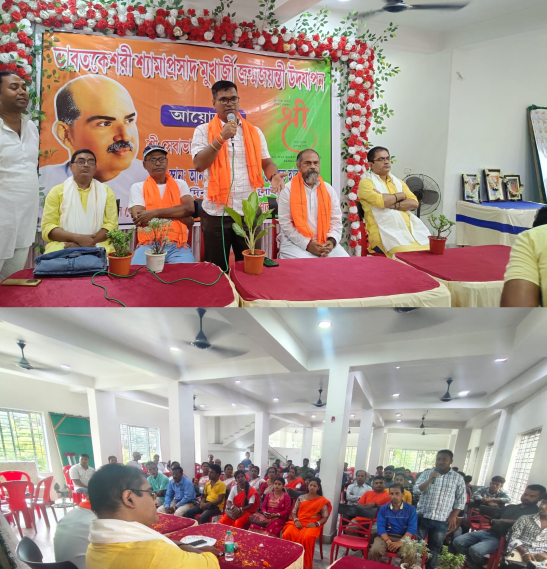
The principal public programme at Anandalok Bhawan, situated beside Punyalakshmi Garden, was organised by Shree Seva Bharati and attended by hundreds of participants. The gathering focused on Dr. Mookerjee’s life and contributions, with speakers addressing his role in Bengal’s political evolution, his concern for national unity, and his continuing relevance in contemporary public discourse. Among those present were Falta MLA Debangshu Panda, Bengal Volunteers President Animintra Chakroborti, Hindu Existence Editor Upananda Brahmachari, RSS Diamond Harbour Nagar Sanghachalak Himangshu Mondal, Hindu OBC Front leader Shiddhananda Purkait, and Calcutta High Court advocate Somak Basu.
The event began with the hoisting of the National Flag, followed by the ceremonial lighting of the traditional lamp. Such rituals carry a layered significance in Bengal’s civic culture. The flag linked the programme to the constitutional and national framework of India, while the lamp invoked the older Indic symbolism of knowledge, clarity, and ethical responsibility. In a dharmic civilisational setting that includes Hindu, Buddhist, Jain, and Sikh traditions, light has often served as a shared metaphor for wisdom, self-discipline, and public duty. The ceremony therefore connected political memory with cultural continuity without reducing either to narrow partisanship.
Several speakers highlighted Dr. Mookerjee’s historical role during the Partition period, especially in relation to the formation and preservation of West Bengal within the Indian Union. The subject remains emotionally charged because Partition was not only a constitutional event; it was a civilisational trauma that reshaped families, languages, borders, livelihoods, and religious communities. For many Bengali families, memories of displacement, insecurity, and reconstruction are still transmitted through stories told at home. In that setting, Dr. Mookerjee’s political interventions are remembered by supporters as part of a larger struggle to protect Bengal’s cultural identity and civic stability during a time of extraordinary uncertainty.
The discussions also placed emphasis on courage, discipline, education, and social responsibility among the younger generation. These themes deserve careful interpretation. In a mature civic framework, courage does not mean hostility, and cultural confidence need not produce exclusion. It can instead mean the ability to study one’s own history honestly, preserve inherited traditions with dignity, serve society through constructive action, and engage disagreements without abandoning ethical restraint. This interpretation is consistent with the broader objective of dharmic unity, where Sanatan Dharma, Buddhism, Jainism, and Sikhism are understood as interconnected streams of civilisational reflection on duty, compassion, truth, self-mastery, and public welfare.
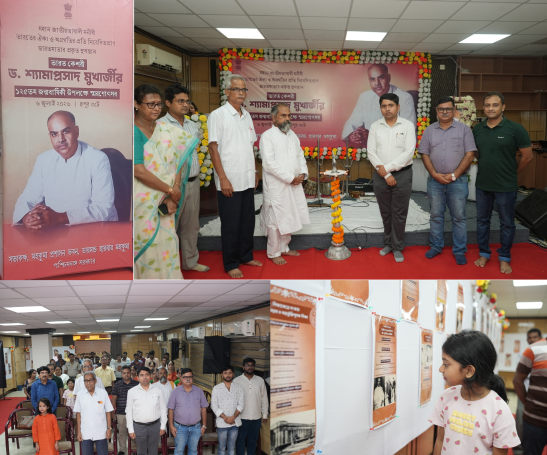
The official commemorative programme organised jointly by the Diamond Harbour Sub-Divisional Administration and the Sub-Divisional Information and Cultural Office added an administrative and academic dimension to the day. The programme included the Dr. Syama Prasad Memorial Lecture and a cultural presentation featuring patriotic songs, dance, recitation, and traditional puppet shows by artists of the West Bengal Government’s Lok Prasar Bibhag. This combination of scholarship and performance was significant because Bengal has historically preserved political memory not only through official records, but also through poetry, theatre, music, recitation, and folk forms.
An exhibition designed by the Union Ministry of Information and Broadcasting displayed rare photographs, documents, and panels related to Dr. Mookerjee’s contributions in education, administration, politics, national integration, and social reform. Exhibitions of this kind serve an important public function. They allow visitors, especially students, to encounter history through visual evidence and chronological narrative rather than through slogans alone. When curated responsibly, such displays can encourage historical literacy by showing how one public figure moved across multiple fields: university reform, legislative debate, ministerial responsibility, political organisation, and national questions such as Kashmir and federal unity.
Diamond Harbour Sub-Divisional Officer Ayan Dutta Gupta, in his inaugural address, reportedly offered a historical analysis of Dr. Mookerjee’s life and work. His appeal to citizens, especially younger people, to study Dr. Mookerjee through reading, research, and discussion was one of the most important messages of the commemoration. Public memory can easily become shallow when it depends only on anniversary speeches. It becomes intellectually productive when schools, colleges, libraries, and community organisations make primary sources, biographies, debates, and critical studies available to readers.
The memorial lecture by Upananda Brahmachari focused on Dr. Mookerjee’s political vision, his campaign concerning Jammu and Kashmir, and his role in the preservation of West Bengal during Partition. Dr. Mookerjee’s Kashmir campaign remains one of the most frequently cited aspects of his political life, especially in relation to the slogan associated with the movement against separate constitutional arrangements: Ek desh mein do Vidhan, do Nishan, do Pradhan nahi chalenge. In academic terms, this campaign is often studied within the wider debate on federalism, national integration, constitutional asymmetry, and the relationship between regional autonomy and national sovereignty.
The lecture also referred to the influence of Swami Pranavananda Ji Maharaj, founder of Bharat Sevashram Sangha, on Dr. Mookerjee’s public life. This connection is relevant because Bengal’s modern political life was shaped not only by parties and legislatures, but also by religious reformers, social service organisations, educationists, monks, writers, and community leaders. The dharmic tradition in Bengal often expressed itself through a synthesis of spirituality and service, and institutions such as Bharat Sevashram Sangha contributed to relief work, social mobilisation, and cultural education. Studying these networks helps explain why political questions in Bengal have so often carried ethical, spiritual, and cultural dimensions.
Advocate Tapan Biswas addressed the historical formation of West Bengal and argued that Dr. Mookerjee played a pivotal role in mobilising public opinion during Partition. He also noted that legislators from diverse political parties, including the Congress and Communist parties, ultimately supported the establishment of West Bengal in the Legislative Assembly. This point is historically valuable because it reminds readers that major constitutional outcomes are rarely produced by a single individual alone. Leadership matters, but so do coalitions, legislative processes, public mobilisation, demographic anxieties, and the difficult compromises of a turbulent period.
The participation of Diamond Harbour MLA and veteran TMC leader Advocate Pannalal Halder further indicated that the commemoration crossed immediate party boundaries at the local level. In contemporary West Bengal, where political discourse is often intensely polarised, such moments deserve attention. A society benefits when historical figures can be studied through evidence, debated with seriousness, and honoured for specific contributions without forcing every act of remembrance into a narrow partisan frame. Dr. Mookerjee’s legacy is undeniably political, but it is also educational, constitutional, and civilisational.
The cultural performances at the end of the programme added a literary and emotional dimension to the day. Recitation artist Chandrajit Pradhan performed poet Partha Sarathi Chattopadhyay’s composition Paschimbanga, while singers, dancers, and puppet artists from Lok Prasar Bibhag presented works inspired by patriotism and Bengali culture. These performances were not ornamental additions. They reflected a deeper truth about Bengal: history is often absorbed through art before it is fully understood through formal scholarship. A poem, a song, or a puppet performance can carry memory into public life in ways that lectures alone cannot.
From a broader historical perspective, Dr. Syama Prasad Mookerjee’s life invites study across at least five major themes. The first is education, particularly his association with the University of Calcutta and the intellectual culture of Bengal. The second is constitutional politics, including his role in early post-Independence parliamentary life. The third is Bengal’s Partition history and the making of West Bengal. The fourth is national integration, especially his campaign on Jammu and Kashmir. The fifth is the emergence of a political tradition that later influenced Indian politics through the Bharatiya Jana Sangh and, indirectly, later formations in the national political landscape.
Any serious commemoration must also acknowledge that historical figures are best understood through complexity rather than simplification. Dr. Mookerjee served in the first Union Cabinet under Prime Minister Jawaharlal Nehru as Minister for Industry and Supply, but later resigned over policy differences. He founded the Bharatiya Jana Sangh in 1951, creating an organised platform for a strand of Indian nationalism that emphasised cultural rootedness, national unity, and opposition to policies it considered divisive. His death in detention in Jammu in 1953 remains a subject of continuing public concern among many of his followers and has repeatedly generated calls for historical scrutiny.
The Diamond Harbour observance therefore should be read not merely as a local event but as part of a wider revival of interest in historical memory in West Bengal. The region has produced reformers, revolutionaries, monks, poets, scientists, educationists, jurists, and political leaders whose contributions are often remembered unevenly. A more balanced culture of remembrance would allow students to study figures such as Dr. Mookerjee alongside other major personalities of Bengal’s intellectual and political life. Such study need not create division; when done responsibly, it can deepen civic maturity and expand historical awareness.
The social service element of the day, especially the blood donation camps, deserves particular emphasis. Commemorations of public leaders can easily become symbolic exercises, but blood donation converts remembrance into direct public benefit. It aligns with the dharmic ideal of seva, or selfless service, which is shared in different forms across Hindu, Sikh, Jain, and Buddhist ethical cultures. Service helps prevent memory from becoming abstract. It allows a community to honour the past while meeting a real human need in the present.
The emphasis on youth education was equally important. Younger citizens often inherit political labels before they encounter historical documents. The 125th anniversary offered an opportunity to reverse that pattern by encouraging research, reading, discussion, and archival engagement. Students studying Indian political history, West Bengal, Partition, national integration, and dharmic civilisational thought can benefit from a careful examination of Dr. Mookerjee’s speeches, institutional work, legislative interventions, and political choices. Such study should include admiration where warranted, critique where necessary, and a disciplined commitment to evidence.
Diamond Harbour’s emergence as a major centre of commemoration also illustrates how historical memory travels beyond metropolitan spaces. Kolkata naturally occupies a central place in Bengal’s political and cultural history, but smaller towns and subdivisions often preserve public sentiment with equal intensity. When local administrations, cultural departments, voluntary organisations, and citizens participate together, remembrance becomes decentralised. It moves from archives and capitals into neighbourhoods, schools, auditoriums, and community halls, where ordinary people encounter history as part of lived civic culture.
The anniversary also raises a larger question about how India should remember political figures in a plural democracy. A responsible approach must avoid both uncritical glorification and dismissive reduction. Dr. Syama Prasad Mookerjee’s ideas should be studied in their historical context: colonial Bengal, the crisis of Partition, the early years of the Republic, debates on minority rights and national identity, the status of Jammu and Kashmir, and the development of organised political opposition in India. Such a framework allows readers to understand not only what he argued, but why those arguments gained resonance among significant sections of society.
For dharmic communities, the commemoration carries another important lesson. Cultural self-respect is most durable when it is joined with scholarship, compassion, and public service. The unity of Hindu, Buddhist, Jain, and Sikh traditions is not built through uniformity, but through shared ethical commitments: reverence for truth, disciplined conduct, respect for learning, service to society, and the protection of civilisational memory. In this sense, the Diamond Harbour programme can be seen as a reminder that historical remembrance should strengthen social cohesion rather than deepen suspicion.
The 125th birth anniversary of Dr. Syama Prasad Mookerjee in Diamond Harbour combined ceremony, scholarship, cultural expression, and public service. It drew attention to his educational career, his role in the formation of West Bengal, his advocacy of national integration, and his continuing influence on Indian political thought. More importantly, it suggested that Bengal’s historical memory remains active, contested, and emotionally alive. When such memory is guided by evidence, civility, and dharmic values, it can become a powerful instrument of education and social renewal.
Inspired by this post on Struggle for Hindu Existence.
