
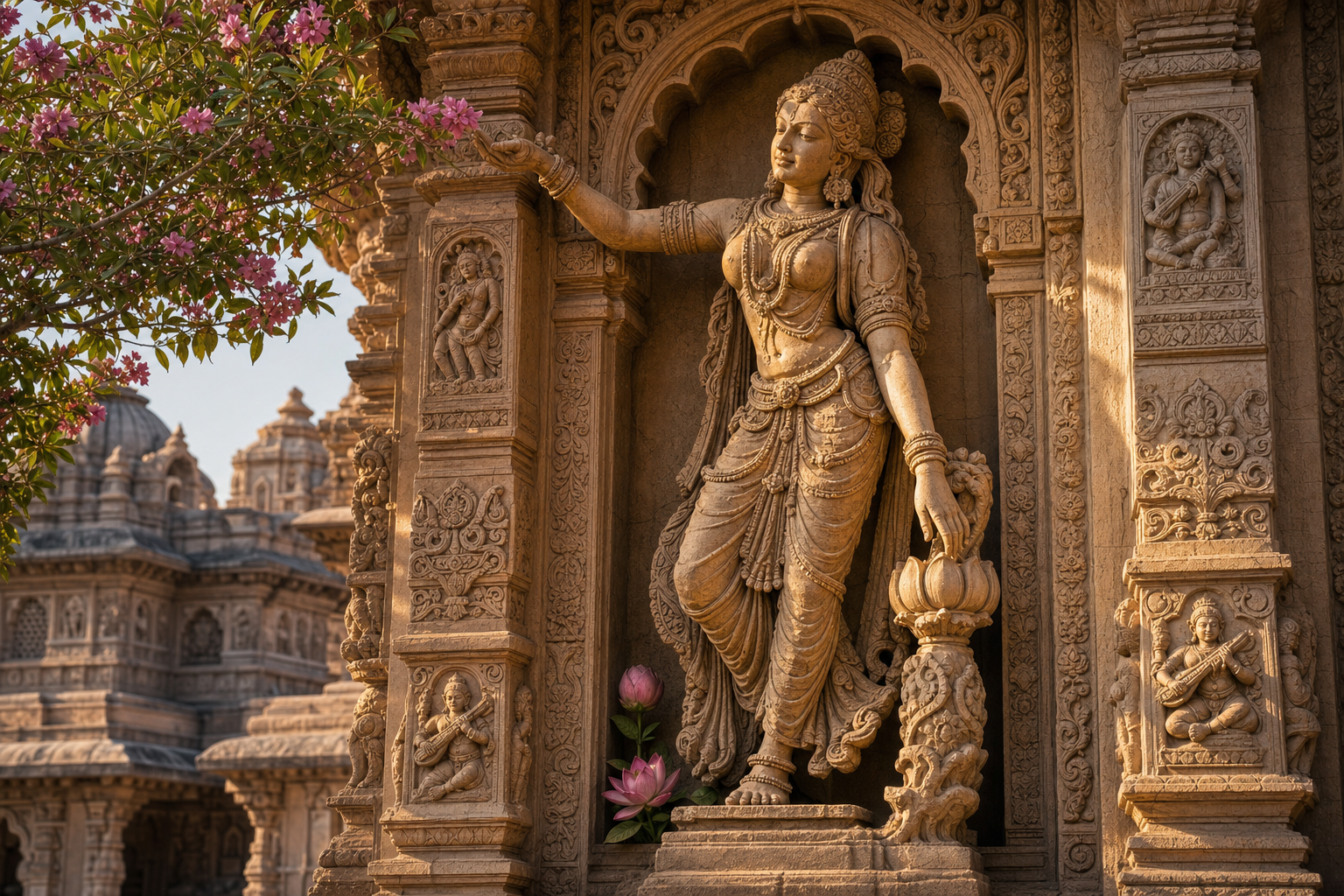
Urvashi occupies a luminous place in the sacred imagination of Hindu civilization. She is remembered in Vedic literature, epic narrative, classical Sanskrit drama, temple sculpture, dance theory, and devotional aesthetics as one of the most celebrated Apsaras, a celestial woman associated with beauty, movement, refinement, music, and the subtle power of attraction. In Hindu temple art, her presence is not always marked by an inscription naming her directly, yet the figure of Urvashi lives through the sculptural language of the Apsara, the surasundari, the devangana, and the graceful feminine form that animates the stone surfaces of mandapas, pillars, niches, gateways, and outer walls.
To study Urvashi in Hindu sculptures is therefore to study more than a single mythological personality. It is to enter a sophisticated visual world where sacred architecture, Hindu philosophy, Indian classical dance, iconography, rasa theory, and temple ritual converge. The Apsara in stone is not an ornament added for superficial beauty. She is a theological, aesthetic, and cultural sign: a reminder that the Hindu temple is designed as a living cosmos, where gods, humans, sages, musicians, dancers, guardians, animals, plants, and celestial beings participate in one sacred order.
The term Apsara is often explained through associations with water, movement, and radiance. In Sanskrit imagination, Apsaras belong to the heavenly realms and are frequently linked with Gandharvas, the celestial musicians. Their world is one of song, fragrance, rhythm, grace, and refined emotion. Urvashi, Menaka, Rambha, Tilottama, and Ghritachi are among the famous Apsaras remembered across Hindu texts. They appear in narratives involving gods, kings, sages, and heroes, but their symbolic meaning extends beyond courtly charm. They embody the power of beauty to disturb pride, awaken longing, test discipline, inspire poetry, and reveal the fragile boundary between heaven and earth.
Urvashi is especially significant because her story is among the oldest and most enduring. The dialogue between Pururavas and Urvashi in the Rigveda presents a deeply human encounter between mortal attachment and celestial freedom. Later tradition expands the story through the Shatapatha Brahmana, the Mahabharata, the Puranic imagination, and Kalidasa’s classical Sanskrit drama Vikramorvashiyam. Across these tellings, Urvashi remains difficult to possess. She belongs to the heavenly order, and her relationship with Pururavas becomes a meditation on desire, separation, longing, and the limits of human control over the divine feminine.
This literary background matters when interpreting Hindu temple sculpture. A sculpted Apsara standing beneath a tree, adjusting an anklet, holding a mirror, playing a musical instrument, dancing in tribhanga, or touching a branch is not merely a decorative woman. She belongs to a larger symbolic vocabulary that includes fertility, auspiciousness, abundance, artistic accomplishment, and the joy of divine creation. When seen through the memory of Urvashi, the figure also suggests the tension between sensual beauty and transcendence. The viewer is invited to see beauty without reducing it to possession.
Hindu temple architecture is built on the principle that the sacred is not isolated from life. The garbhagriha may hold the central murti, but the temple as a whole expresses the vastness of existence. The outer walls may show deities, dikpalas, river goddesses, ganas, mithuna couples, dancers, musicians, narrative scenes, animals, foliage, and celestial women. This layered design reflects a vision in which dharma does not reject the world but orders it, purifies it, and raises it toward spiritual meaning. Urvashi and the Apsara tradition are essential to this aesthetic theology.
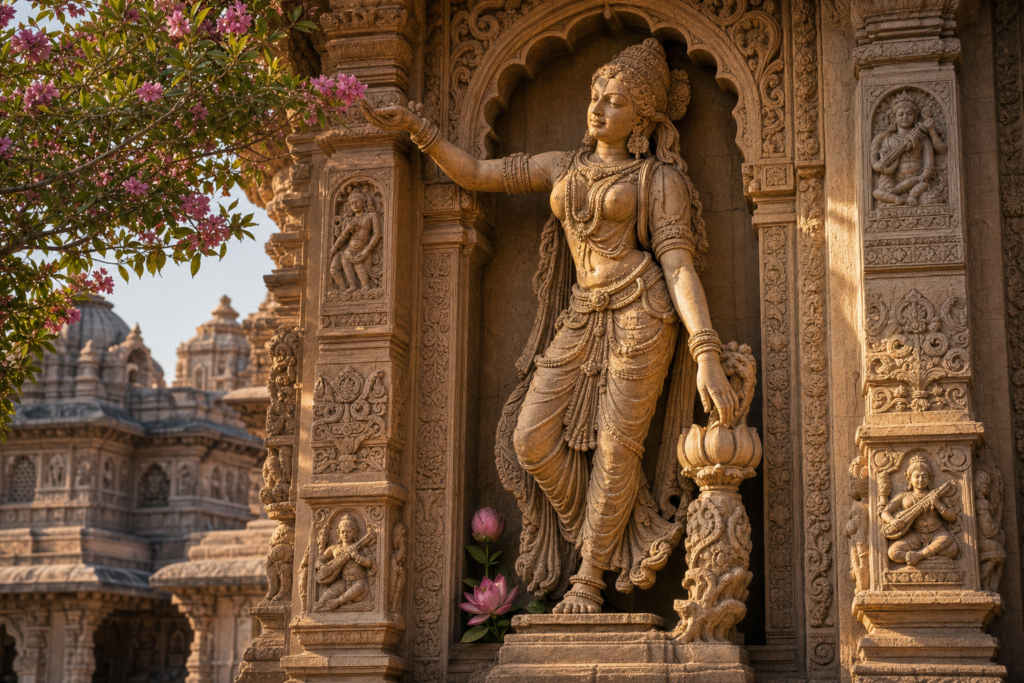
The sculptural figure most closely related to Urvashi is often called a surasundari, literally a celestial beauty, or devangana, a divine woman. In many temples she appears as a shalabhanjika, the graceful woman associated with a tree, whose touch suggests fertility and renewal. This motif has deep roots in Indian art, visible from early Buddhist and Jain monuments to later Hindu temple architecture. The same visual grammar moves across dharmic traditions, revealing a shared Indic understanding of sacred beauty, auspicious presence, and the life-giving feminine principle.
This continuity is important for a broader dharmic reading. The graceful celestial woman appears at Buddhist stupas, Jain temples, and Hindu shrines, not as a sectarian marker but as part of a common artistic inheritance. Bharatiya sacred art repeatedly treats beauty as an instrument of spiritual sensitivity. The human body, when shown with discipline, rhythm, proportion, and symbolic gesture, becomes a vehicle for metaphysical insight. Urvashi in Hindu sculpture should therefore be understood within a civilizational language shared across Hinduism, Buddhism, Jainism, and the wider world of Indian aesthetic thought.
Technically, the sculpted Apsara is a demanding artistic achievement. The sculptor must suggest softness in hard stone, movement in stillness, fragrance in silence, and dance in a fixed surface. The body is often modeled in tribhanga, the three-bend posture in which the head, torso, and hip form a flowing rhythm. This posture is not accidental. It gives the figure a sense of living movement and echoes the grammar of Indian classical dance. The curve of the hip, the bend of the knee, the tilted head, the lifted arm, and the delicately carved ornaments create a visual music that the eye can almost hear.
The relationship between Apsara sculpture and the Nāṭyaśāstra tradition is especially revealing. Indian performance theory does not treat dance as entertainment alone. It is a disciplined art capable of producing rasa, the refined aesthetic experience that transforms emotion into contemplative enjoyment. Urvashi, as a celestial dancer, represents this refined world of gesture, expression, rhythm, and rasa. In stone, her body becomes a frozen moment of performance. The sculpted Apsara is therefore a bridge between temple architecture and the performing arts of India.
Many temple Apsaras are shown with musical instruments, mirrors, anklets, parrots, lotus flowers, or attendants. Each attribute opens a field of meaning. The mirror may suggest self-awareness, beauty, impermanence, or the act of preparation before worship and performance. The anklet draws attention to dance, rhythm, and the sacred sound of movement. The lotus evokes purity rising from water. The parrot may suggest speech, love, memory, and poetic refinement. These objects do not reduce the figure to vanity; they place her within a cultivated universe of art, language, ritual, and symbolic beauty.
Khajuraho is among the most famous examples of this sculptural tradition. The temples of the Chandela period contain numerous celestial women, dancers, musicians, attendants, and graceful female figures carved with extraordinary attention to bodily rhythm and ornament. Some are seen applying makeup, removing a thorn, wringing water from hair, dancing, or interacting with companions. These scenes can be misunderstood when viewed without the framework of Hindu temple symbolism. Their purpose is not crude display. They belong to an expansive vision of life, auspiciousness, rasa, and sacred abundance surrounding the divine center.
At Konark, the Sun Temple’s sculptural program similarly integrates dance, music, celestial movement, and cosmic order. The temple is dedicated to Surya, yet its walls contain a vast artistic world in which dancers and musicians become part of the solar rhythm. Apsara-like figures in such contexts evoke the universe as performance, where time itself moves through rhythm. The presence of female dancers and celestial beauties near sacred architecture reflects the belief that divine worship includes sound, movement, proportion, and joy.
The Hoysala temples of Karnataka, particularly at Belur and Halebidu, offer some of the most refined examples of madanikas and bracket figures. These celestial women stand in elaborate postures, often dancing, playing instruments, or displaying graceful gestures. Their jewelry, hairstyles, garments, and bodily balance reveal a highly technical sculptural culture. The stone appears almost flexible, as if the artist were carving not a block but a living rhythm. In this world, Urvashi is not only a mythic name; she becomes a model for idealized celestial grace.
South Indian temples also preserve the connection between dance, divinity, and sacred feminine presence. The great temples of Tamil Nadu, including those associated with Shiva Nataraja and the Chola artistic tradition, reveal a deep commitment to movement as theology. Shiva’s cosmic dance gives metaphysical dignity to rhythm itself. In such a world, the Apsara and the temple dancer are not isolated figures. They participate in a larger understanding of the cosmos as ordered motion, where creation, preservation, dissolution, concealment, and grace are expressed through divine movement.
In Odisha, Madhya Pradesh, Karnataka, Tamil Nadu, Rajasthan, Gujarat, and other regions, the Apsara motif takes local forms while retaining shared symbolic foundations. Regional ornament, hairstyle, garment style, stone type, and sculptural technique differ, but the essential grammar remains recognizable. The celestial woman stands as a sign of auspiciousness, refinement, cultural confidence, and sacred abundance. The repetition of this motif across centuries indicates that Hindu sculptors and patrons considered such figures integral to temple design, not incidental decoration.
One of the most important interpretive cautions is that not every Apsara sculpture can be identified specifically as Urvashi. Temple inscriptions rarely label every celestial woman, and many figures belong to categories rather than named individuals. A responsible academic reading must therefore distinguish between Urvashi as a textual figure and the broader Apsara iconography that expresses her qualities. When a temple sculpture is described as Urvashi, the identification may be devotional, interpretive, regional, or stylistic unless supported by inscriptional or textual evidence. This does not weaken the connection; it clarifies it.
Urvashi’s symbolic power lies in the fact that she exceeds literal identification. She represents the ideal of celestial femininity in Hindu imagination: graceful, independent, artistically refined, and connected with the divine realm. Her story with Pururavas warns against possessive desire, while her association with dance and beauty celebrates the transformative power of art. In sculpture, these meanings become visual rather than verbal. The stone Apsara does not explain herself; she invites contemplation.
The sacred beauty of Hindu temple sculpture also challenges modern assumptions about spirituality and the body. In many modern frameworks, the sensual and the sacred are treated as opposites. Hindu art often works differently. It distinguishes between uncontrolled desire and refined appreciation, between attachment and rasa, between indulgence and auspicious beauty. The body in temple sculpture is not merely biological. It is rhythmic, symbolic, proportioned, disciplined, and integrated into a cosmic vision. Urvashi in stone teaches that beauty can become a doorway to awareness when seen through dharma.
This is why the Apsara is frequently placed on the outer portions of the temple rather than in the innermost sanctum. The devotee moves through a layered world: from earthly life to symbolic refinement, from sensory encounter to inward concentration, from multiplicity to the focused presence of the deity. The external sculptural program does not distract from the sacred center. It prepares the mind to recognize that the divine pervades the whole field of existence. Beauty, music, fertility, discipline, longing, and joy all find their place before the devotee reaches the garbhagriha.
The iconographic richness of Urvashi and the Apsaras also reveals the high status of artistic culture in ancient and medieval India. Dance, music, poetry, sculpture, architecture, and ritual were not compartmentalized as separate modern disciplines. They formed an integrated sacred culture. A temple patron commissioned architecture; a sthapati planned the structure; sculptors carved stone; dancers performed; musicians accompanied ritual; poets composed hymns; priests conducted worship; devotees completed the living circuit of meaning. The Apsara figure stands at the intersection of all these arts.
The emotional power of these sculptures remains strong because they preserve human experiences in sacred form. Longing, elegance, preparation, joy, anticipation, playfulness, concentration, and self-adornment are all present. A viewer standing before such a figure may feel that stone has remembered life. This emotional response is not outside scholarship; it is part of how Indian art works. The sculpture was designed to be seen, felt, circumambulated, and encountered in changing light. Academic analysis can describe the technique, but the sculpture’s full meaning emerges when visual experience and cultural knowledge meet.
Urvashi also offers an important lens for understanding the sacred feminine. She is not the same as Devi in her supreme theological forms such as Durga, Lakshmi, Saraswati, or Parvati, yet she belongs to the broader field of feminine sacred presence. She is celestial rather than domestic, artistic rather than maternal, alluring yet not submissive. Her independence is central to her mythology. She cannot be permanently bound by Pururavas, and this quality gives her story a philosophical depth that modern readers often overlook.
In this sense, Urvashi is not merely an object of beauty but a figure of agency. She chooses, leaves, returns, speaks, and moves between realms. Her presence in the sacred imagination shows that Hindu literature and art recognized multiple forms of feminine power: the warrior goddess, the mother goddess, the goddess of knowledge, the goddess of prosperity, the devoted queen, the ascetic woman, the poet-saint, and the celestial dancer. The Apsara belongs to this wide spectrum. Her beauty is not passive; it acts upon the world.
From a technical art-historical perspective, Apsara sculptures demonstrate mastery over proportion, surface treatment, relief depth, and spatial rhythm. The sculptor had to balance ornament with anatomy, elegance with structural stability, and movement with the architectural frame. Jewelry could not be carved as random decoration; it had to follow the body’s rhythm. Drapery had to suggest texture without hiding the form. Hair, facial expression, fingers, anklets, girdles, and necklaces required precision. The best examples show a unity of engineering and imagination.
The use of light is another important factor. Temple sculptures were not originally experienced as flat museum objects under uniform lighting. They were seen in sunlight, shadow, oil-lamp glow, monsoon moisture, and the movement of devotees. A deeply carved figure could change expression across the day. Ornaments would catch light; recessed areas would deepen; the curve of the body would emerge and recede. The Apsara in stone was therefore a dynamic visual presence even without physical movement.
Modern conservation adds another layer of responsibility. Many Apsara figures have suffered weathering, iconoclasm, neglect, pollution, theft, or careless restoration. Preserving them requires more than protecting stone surfaces. It requires protecting the knowledge systems that make them intelligible: Sanskrit literature, regional temple traditions, shilpa texts, dance traditions, oral memory, pilgrimage culture, and local devotion. A sculpture without context becomes an artifact; with context, it becomes part of a living heritage.
The dharmic unity reflected in these forms should also be emphasized. Hindu, Buddhist, Jain, and Sikh traditions differ in theology, practice, and historical development, yet they share deep civilizational concerns: reverence for dharma, discipline, compassion, self-transformation, sacred sound, ethical life, and respect for realized wisdom. In the visual arts of ancient India, Buddhist yakshis, Jain celestial attendants, and Hindu Apsaras often speak a shared aesthetic language of auspiciousness and spiritual refinement. This shared heritage can deepen mutual respect rather than narrow identity.
Urvashi in Hindu sculpture therefore becomes a powerful subject for cultural education. She helps explain how Hindu temple art integrates mythology, philosophy, architecture, and aesthetics. She helps correct the mistaken assumption that temple sculpture is either purely decorative or narrowly sensual. She also reveals the sophistication of Indian sculptors, who could transform stone into rhythm and turn myth into embodied presence. Her image belongs to the wider story of Hindu art and culture, Indian classical dance, temple architecture, sacred feminine symbolism, and the enduring spiritual imagination of Sanatana Dharma.
The most accurate way to approach these sculptures is with layered attention. The first layer is visual: posture, gesture, ornament, proportion, and placement. The second is textual: the stories of Urvashi, the Apsaras, Gandharvas, and celestial realms. The third is ritual: the temple as a sacred site where every carved figure contributes to the atmosphere of worship. The fourth is philosophical: the transformation of sensory beauty into contemplative insight. When all four layers are held together, the Apsara in stone becomes one of the most refined achievements of Hindu temple sculpture.
Urvashi’s continuing appeal lies in this union of beauty and meaning. She is celestial yet emotionally recognizable, ancient yet artistically alive, mythic yet deeply human in the feelings her story evokes. The sculpted Apsara reminds the viewer that Indian temples were never silent piles of stone. They were visual scriptures, artistic universities, ritual spaces, and cultural archives. In their carved surfaces, one sees not only gods and legends but a civilization’s confidence that beauty, when disciplined by dharma, can guide the mind toward the sacred.
To stand before an Apsara-like figure and think of Urvashi is to encounter a subtle lesson: the divine is not approached through denial of beauty, but through its refinement. Desire must be understood, art must be disciplined, emotion must be elevated, and the senses must be educated. The temple offers that education through stone. Urvashi, the celestial dancer of the Hindu imagination, continues to move there without moving, holding in one graceful form the memory of water, music, longing, poetry, and sacred beauty.
Inspired by this post on Hindu Blog.




Leave a Reply
You must be logged in to post a comment.