
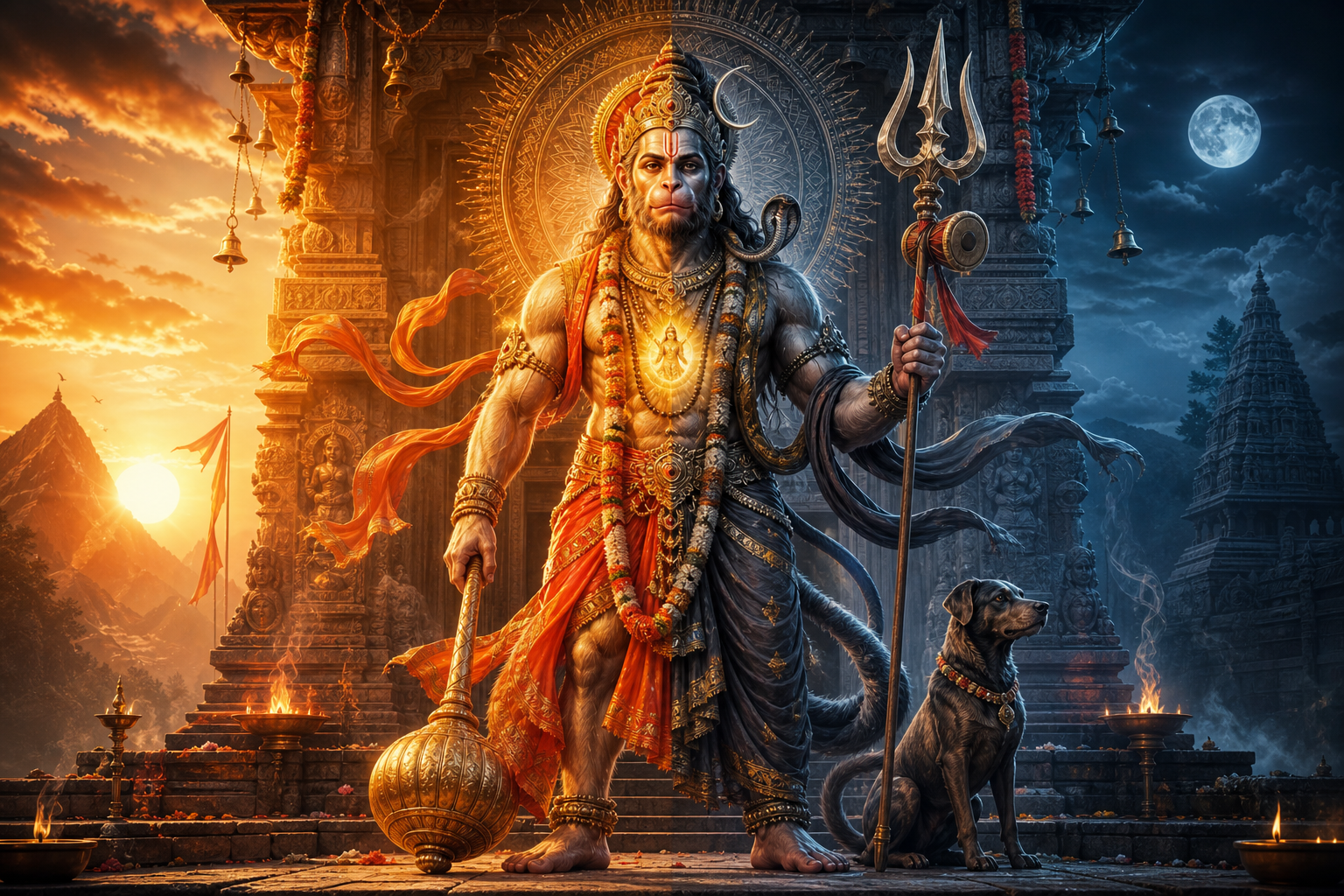
Hanubhairav is a striking devotional and tantric idea: the combined form of Hanuman and Bhairava, bringing together the fearless service of Hanuman and the fierce boundary-guarding power of Bhairava. The form is not as widely standardized in pan-Indian temple worship as Hanuman, Kala Bhairava, Panchamukhi Hanuman, or Ashta Bhairava, yet its symbolism is deeply intelligible within Sanatana Dharma. It belongs to a sacred imagination in which divine forms are not rigid compartments but living theological languages. When Hanuman and Bhairava are contemplated together, the result is a profound image of devotion that does not become passive, strength that does not become egoistic, and tantric force that remains anchored in dharma.
Most devotees first encounter Hanuman as the eternal sevaka of Bhagavan Ram. He is humble, celibate, disciplined, radiant with bhakti, and pure as fire. In the Ramayana and in later devotional literature, Hanuman becomes the embodiment of service without self-importance. He leaps across the ocean not to display power but to serve Sri Rama. He burns Lanka not from personal anger but from righteous commitment. He carries the Sanjeevani-bearing mountain not to acquire fame but to save Lakshmana and protect the larger cause of dharma. His strength is inseparable from surrender.
Bhairava, by contrast, is usually approached through the fierce Shaiva vocabulary of time, protection, dissolution, and spiritual shock. He is a powerful manifestation of Shiva, often linked with Kashi, cremation-ground symbolism, guardianship, and the cutting of pride. In the well-known Shaiva narrative, Bhairava arises when Brahma’s arrogance must be checked. The cutting of Brahma’s fifth head is not merely an act of violence; it is a symbolic severing of false superiority, inflated identity, and speech divorced from truth. Bhairava becomes the force that removes fear by making the seeker face what fear conceals.
Hanubhairav therefore may be understood as a theological bridge between bhakti and tantra. Hanuman represents the purified heart, the disciplined senses, and unwavering loyalty to Rama. Bhairava represents the fierce intelligence that guards sacred space, destroys arrogance, and confronts disorder without hesitation. Their union suggests that the complete spiritual life requires both tenderness and ferocity: tenderness toward the divine, the guru, the vulnerable, and the righteous path; ferocity toward ego, cowardice, exploitation, adharma, and inner confusion.
It is important to treat Hanubhairav carefully and accurately. Unlike major Puranic forms with widely circulated textual narratives, Hanubhairav is better understood as a composite devotional-tantric form rather than a universally codified avatara with one authoritative story. Such composite forms are not unusual in Hindu worship. Panchamukhi Hanuman, Harihara, Ardhanarishvara, Dattatreya, and Vaikuntha Chaturmurti all show how sacred iconography can express theological synthesis. A combined form does not erase the identities of the deities involved; it reveals a shared principle through a new contemplative image.
The story of Hanubhairav can be approached as a symbolic narrative rather than a single fixed episode. In this interpretive telling, the worlds are disturbed not merely by external enemies but by a subtler disorder: devotion has become sentimental in some hearts, while power has become harsh and self-serving in others. Some seekers pray but lack courage; others pursue occult force but lack humility. Dharma requires a form that can restore balance. From the current of Rama-bhakti and the fierce Shaiva stream of Bhairava arises Hanubhairav, a form in which the servant of Rama bears the terror-dispelling authority of Shiva.
This narrative is not meant to replace the Ramayana or the Shaiva Puranic accounts. Rather, it functions as theological meditation. Hanuman’s devotion remains centered on Bhagavan Ram, and Bhairava’s power remains rooted in Shiva. Hanubhairav reveals that these streams are not enemies within Sanatana Dharma. Vaishnava bhakti and Shaiva tantra, when understood in their noblest forms, both aim at purification, self-mastery, divine remembrance, and liberation from ego. The combined form becomes a visual argument for unity among dharmic traditions without flattening their differences.
The first layer of Hanubhairav’s symbolism is fearlessness. Hanuman is already called upon by devotees for courage, protection, and freedom from negative influences. The Hanuman Chalisa describes him as the remover of difficulties, the guardian at the door of Rama, and the one whose remembrance brings strength. Bhairava too is a guardian, especially of thresholds: temple boundaries, sacred geography, the cremation ground, time, and the inner passage from ignorance to awakening. Hanubhairav intensifies this protective quality. He represents courage that is not loud but grounded, not reckless but consecrated.
The second layer is discipline. Hanuman’s brahmacharya is not merely social restraint; it is the conservation and redirection of life-force toward divine service. His mind is not scattered. His speech is purposeful. His body is an instrument of dharma. Bhairava’s tantra, when properly understood, is also discipline. It is not indulgence or spectacle. Authentic tantra requires mantra, initiation, concentration, purity of intent, and the capacity to face intense inner material without collapse. In Hanubhairav, these disciplines meet: the pranic steadiness of Hanuman and the boundary-breaking awareness of Bhairava.
The third layer is the transformation of anger. Hindu thought does not reduce all anger to moral failure. There is destructive anger born of ego, and there is dharmic force that rises to protect truth. Hanuman’s burning of Lanka is not personal revenge; it is a response to injustice and arrogance. Bhairava’s frightening form is not cruelty; it is the form taken by grace when gentler instruction has failed. Hanubhairav teaches that energy must be purified before it is expressed. Anger without bhakti becomes violence; bhakti without courage becomes helplessness. Their union becomes disciplined protection.
The fourth layer is the destruction of ego. Hanuman repeatedly shows that his greatness comes from not claiming greatness. When asked who he is, devotional tradition remembers the famous mood: at the level of the body he is Rama’s servant, at the level of the soul he is part of Rama, and at the highest level he is one with the divine reality. Bhairava cuts the head of arrogance in the Shaiva story. Together, Hanuman and Bhairava reveal two methods of ego-transcendence: surrender and severance. One melts pride through love; the other cuts pride through fierce insight.
The fifth layer is guardianship of sacred space. Bhairava is widely honored as a kshetrapala, a guardian of holy places. Hanuman too stands at entrances, crossroads, village boundaries, wrestling grounds, and temples. Devotees often encounter him not only in sanctums but at thresholds, where the ordinary world meets the sacred. Hanubhairav’s combined symbolism is therefore especially suited to the protection of liminal spaces: the doorway of the home, the beginning of a sadhana, the vulnerable boundary of the mind, and the ethical threshold where a person chooses dharma over convenience.
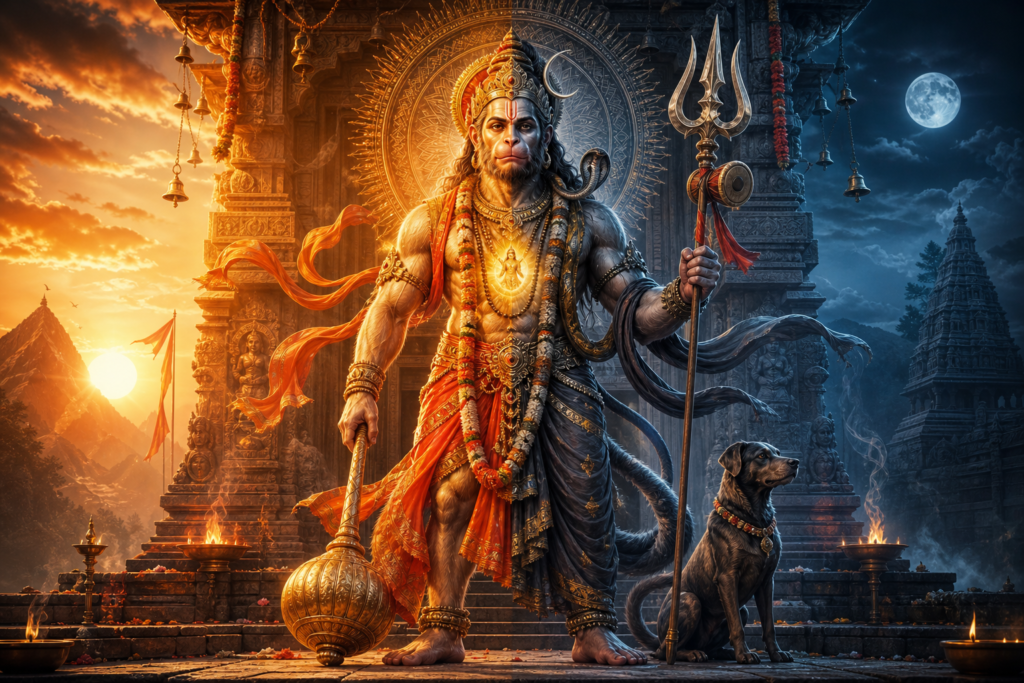
Iconographically, Hanubhairav may be imagined through a careful blending of signs. Hanuman’s form may retain the vanara face, powerful body, folded devotion, or the gada as a sign of strength used in service. Bhairava’s signs may include the trishula, damaru, kapala, sword, serpent ornaments, or association with the dog as vahana. The colors may draw from Hanuman’s saffron and sindoor symbolism as well as Bhairava’s darker, ash-smeared, cremation-ground palette. Yet the most important iconographic point is balance. If the form becomes only terrifying, Hanuman’s bhakti is lost. If it becomes only gentle, Bhairava’s fierce guardianship is weakened.
The connection between Hanuman and Shiva also has a strong devotional basis. Many traditions revere Hanuman as an amsha or manifestation connected with Shiva, born for the service of Rama. This makes the Hanuman-Bhairava synthesis theologically plausible within popular Hindu understanding. Bhairava is Shiva in a fierce mode; Hanuman is often seen as Shiva’s power expressed through perfect devotion to Vishnu’s avatara, Rama. Hanubhairav therefore becomes a compact symbol of Shaiva-Vaishnava harmony: Shiva serving Rama as Hanuman, and Shiva guarding dharma as Bhairava.
This harmony has wider significance for Hindu culture. Sanatana Dharma has always contained many sampradayas, modes of worship, philosophical schools, ritual systems, and regional expressions. A mature understanding of Hindu spirituality does not require every form to be identical, nor does it turn difference into hostility. Hanubhairav reminds the devotee that Bhakti Tradition, Shaiva traditions, Tantra, Yoga, and temple-based worship can be read as complementary streams when guided by dharma. Such a view strengthens unity among dharmic traditions while preserving their distinct beauty.
In a broader dharmic context, the fierce protector motif is not confined to one lineage. Hinduism, Buddhism, Jainism, and Sikhism each preserve, in different ways, the need to protect truth, discipline the mind, and resist forces that degrade spiritual life. Vajrayana Buddhism has fierce protector imagery; Jainism emphasizes conquest of inner passions through restraint; Sikh tradition honors courage joined with devotion and justice. Hanubhairav can be appreciated within this larger civilizational grammar: compassion must have strength, and strength must remain accountable to wisdom.
Tantrically, Hanubhairav can be read as a symbol of prana under awakened command. Hanuman, son of Vayu, is closely associated with breath, vitality, movement, and heroic expansion. Bhairava, especially in the atmosphere of texts such as the Vijñāna Bhairava Tantra, is linked with direct awareness, the shock of presence, and entry into higher consciousness through concentrated methods. When these meanings are brought together, Hanubhairav becomes the disciplined breath becoming fearless awareness. The restless life-force is not suppressed; it is consecrated.
Psychologically, Hanubhairav speaks to a familiar human struggle. Many people want to be gentle but fear becoming weak. Others want to be strong but fear becoming harsh. Hanuman resolves the first problem by showing that devotion can be immensely powerful. Bhairava resolves the second by showing that fierceness must serve truth rather than ego. The combined form suggests an integrated spiritual personality: soft before the divine, firm before injustice, humble in success, alert at boundaries, and fearless in self-examination.
For devotees, the emotional resonance of Hanubhairav is immediate. There are moments when the heart wants the comfort of Hanuman, the assurance that sincere remembrance of Rama can carry one through grief, fear, and exhaustion. There are also moments when the soul requires Bhairava’s uncompromising presence, the force that says illusion must end now and cowardice cannot be allowed to govern life. Hanubhairav brings these two needs into one contemplative frame. He is both refuge and challenge.
In practical sadhana, the form may be approached with restraint and reverence. Hanuman worship is widely accessible through Rama nama, Hanuman Chalisa, Sundara Kanda parayana, Tuesday or Saturday vrata, and simple offerings made with devotion. Bhairava worship, especially in tantric modes, is traditionally more rule-bound and may require guidance from a competent guru. A respectful approach to Hanubhairav should not turn tantra into casual experimentation. The safest and most dharmic emphasis is inner transformation: courage, purity, disciplined speech, protection of the vulnerable, and surrender to the divine.
The mantra dimension also requires care. Public devotional mantras to Hanuman and Shiva are common, but specific tantric mantras associated with Bhairava or composite forms are traditionally handled within lineage contexts. This distinction matters because mantra is not merely sound; it is a disciplined relation to deity, intention, and consciousness. A general devotee can honor the symbolism of Hanubhairav through Rama nama, Om Namah Shivaya, Hanuman Chalisa, or simple prayer for dharmic strength. Technical tantric practice should remain within proper parampara.
The ethical meaning of Hanubhairav is perhaps the most important. Fierce forms in Hinduism are frequently misunderstood as expressions of violence, but their deeper purpose is protection, purification, and awakening. Kali, Narasimha, Durga, Veerabhadra, and Bhairava do not glorify chaos; they restore cosmic and moral order when disorder becomes intolerable. Hanuman too is not merely a warrior; he is the warrior whose every action is governed by devotion. Hanubhairav therefore represents force under dharmic discipline.
In social terms, this symbolism has contemporary relevance. Communities require compassion, but they also require boundaries. Families require love, but they also require moral clarity. Spiritual institutions require inclusiveness, but they also require protection from exploitation and distortion. A Hanubhairav-like ethic would not confuse kindness with permissiveness or courage with aggression. It would ask whether strength is being used in service of dharma, whether devotion is producing integrity, and whether spiritual practice is making the person more truthful.
The form also offers a useful corrective to shallow readings of tantra. Tantra is often misrepresented either as mere ritual power or as antinomian fascination. In its serious forms, it is a rigorous path of transformation that works with body, mantra, visualization, breath, energy, and consciousness. Bhairava is not a symbol of lawlessness; he is the one who stands beyond fear because he stands beyond false identity. When joined with Hanuman’s chastity, service, and devotion, the tantric dimension is purified of sensationalism and placed back in the service of liberation.
Similarly, Hanubhairav deepens the understanding of bhakti. Devotion is sometimes mistaken for emotional softness alone. Hanuman proves otherwise. His bhakti has muscles, intelligence, memory, strategy, restraint, and decisive action. He can speak gently to Sita in Ashoka Vatika, roar before rakshasas, counsel Vibhishana, and kneel before Rama. Bhakti in Hanuman is not escape from responsibility; it is the energy that makes responsibility sacred. Hanubhairav magnifies this insight through the fierce clarity of Bhairava.
Theologically, the combined form also challenges sectarian narrowness. If Hanuman can be honored as Shiva’s energy in service to Rama, and Bhairava can be honored as Shiva’s fierce grace, then the devotee is invited to see the unity of divine purpose beneath diverse names and forms. This does not mean all traditions are identical in doctrine or practice. It means that mutual reverence is possible without erasure. Hanubhairav becomes a sacred reminder that devotion to Rama and reverence for Shiva can strengthen each other.
For students of Hindu symbolism, Hanubhairav is valuable because it reveals how religious images operate on several levels at once. At the narrative level, he may be contemplated as a fierce protector who arises when devotion and power must be reunited. At the ritual level, he points to disciplined worship and guarded spiritual thresholds. At the philosophical level, he expresses the integration of bhakti, jnana, yoga, and tantra. At the psychological level, he represents the union of humility and fearlessness. At the cultural level, he affirms the unity of dharmic diversity.
One of the most moving aspects of this form is that it does not ask the devotee to choose between love and strength. Hanuman’s folded hands and Bhairava’s trishula are not opposites when both serve dharma. The folded hands prevent power from becoming arrogance. The trishula prevents devotion from becoming helplessness. Together, they create an image of spiritual maturity: reverence that can act, strength that can bow, and fearlessness that has been purified by love.
Hanubhairav is therefore best understood not as a curiosity but as a demanding spiritual symbol. It asks whether devotion has become active, whether power has become humble, whether anger has become purified, and whether faith has become courageous. It teaches that the deepest protection is not merely protection from outer danger but protection from inner collapse: pride, fear, forgetfulness, distraction, and spiritual laziness. In that sense, Hanubhairav is a guardian of the inner temple.
The enduring lesson is simple yet profound. Hanuman shows how to love the divine with every breath. Bhairava shows how to cut through fear and falsehood without compromise. Hanubhairav unites these teachings into one fierce, compassionate, dharmic vision. For the modern devotee, scholar, or seeker, this form offers a powerful reminder that Sanatana Dharma is capacious enough to hold tenderness and terror, mantra and service, temple devotion and tantric insight, personal faith and cosmic philosophy. In Hanubhairav, devotion becomes fearless, and fierceness becomes sacred.
Inspired by this post on Hindu Blog.





Leave a Reply
You must be logged in to post a comment.