
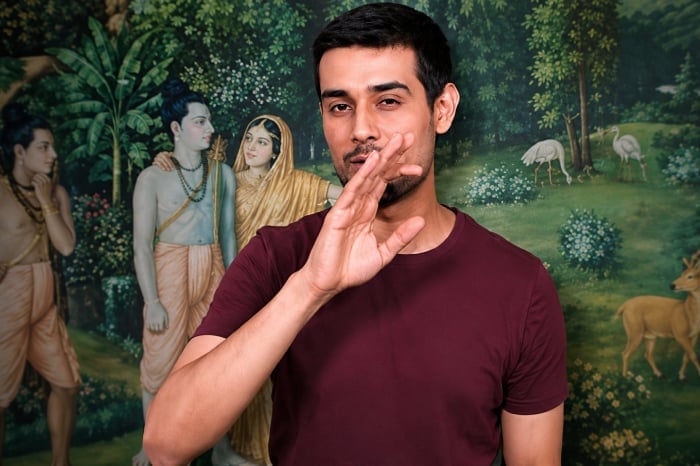
The Delhi High Court’s reported direction to the Centre’s Grievance Appellate Committee, commonly known as the GAC, has brought a sharply contested digital-content dispute into the wider public conversation on law, religious dignity, platform accountability, and free expression in India. Acting on a petition filed by Advocate Amita Sachdeva, the court directed the GAC to decide within 15 days a pending appeal seeking action on a YouTube video by Dhruv Rathee that the petitioner alleges is insulting to Hindu deities. According to the available report, the video is titled “Can Hindus Eat Beef? | Kerala Story 2 Exposed,” and the immediate judicial concern was not a final declaration on the content itself, but the need for the statutory appellate mechanism to act within a defined time frame.
This distinction matters. A High Court direction asking an administrative or quasi-administrative body to decide a pending appeal is not the same as a final ruling that a video is unlawful, defamatory, or sacrilegious. It is, more precisely, a procedural intervention. The court appears to have emphasized that a grievance already placed before the GAC should not remain indefinitely unresolved, especially when the subject involves religious sentiment and public digital communication. In an environment where online content can reach millions within hours, delay itself can become a form of institutional failure, whether the final decision favors removal, retention, age restriction, contextualization, or rejection of the grievance.
The GAC is part of India’s evolving framework for online grievance redressal under the Information Technology (Intermediary Guidelines and Digital Media Ethics Code) Rules, 2021. Its official portal describes it as an online dispute resolution mechanism for users aggrieved by decisions of intermediaries’ grievance officers. In practice, this means that when a user complains to a platform such as YouTube and is dissatisfied with the platform’s response, the user may approach the GAC within the prescribed framework. The GAC’s function is therefore technical and legal: it must examine whether the intermediary handled the grievance according to applicable rules, whether the complaint falls within the scope of platform duties, and whether a remedial direction is justified.
The present controversy also illustrates why digital speech disputes cannot be reduced to slogans. On one side lies the constitutional value of free expression, which protects critique, satire, political argument, historical debate, and even unpopular viewpoints. On the other side lies the equally serious concern that religious communities should not be subjected to demeaning representations of their sacred figures, symbols, or practices. Hindu Dharma, like Buddhism, Jainism, and Sikhism, contains rich internal traditions of debate and interpretation, but that openness should not be confused with a license to trivialize or mock sacred identities in a way that wounds community dignity.
For many Hindus, Hindu deities are not abstract cultural motifs or disposable symbols in an online argument. They are living presences within homes, temples, festivals, vows, music, art, and inherited memory. A family placing flowers before Sri Rama, Sri Krishna, Shiva, Devi, Ganesha, or Hanuman is not performing an empty ritual; it is participating in a civilizational continuity that binds generations. When digital commentary touches such sacred forms, the emotional reaction is not merely political. It is devotional, familial, and deeply personal, even when expressed through legal language.

At the same time, any serious legal analysis must avoid assuming guilt before an institutional decision is made. The petitioner has alleged insult to Hindu deities and has sought removal of the video. Dhruv Rathee, like any creator, retains the right to defend the content, context, intent, and public-interest value of the video. YouTube, as the intermediary, also has its own community guidelines, escalation processes, and obligations under Indian law. The GAC’s task is to examine these layers with procedural fairness, rather than allow a viral controversy to become a substitute for reasoned adjudication.
The Delhi High Court’s 15-day timeline is significant because it recognizes the time-sensitive nature of digital harm. In traditional print disputes, circulation may be finite and correction may be visible. In platform-based media, a contested video can remain searchable, shareable, monetizable, and algorithmically amplified while a grievance remains pending. If the complaint is ultimately found valid, prolonged inaction may deepen harm. If the complaint is ultimately rejected, delay may still leave uncertainty around speech rights and platform expectations. Timely decision-making is therefore essential for both complainants and creators.
The case also highlights the growing importance of India’s intermediary-governance architecture. Digital platforms are not neutral notice boards in any simple sense. They recommend content, moderate speech, apply community standards, process complaints, and often make the first substantive decision in disputes involving religion, public order, defamation, misinformation, and harassment. The GAC framework emerged because platform-level decisions can be opaque, inconsistent, or difficult for ordinary users to challenge. Whether one supports or criticizes this regulatory model, its effectiveness depends on timely, transparent, and legally reasoned decisions.
A technical reading of the dispute requires attention to several questions. Did the complainant first approach the relevant intermediary’s grievance officer? Was the appeal filed within the required time? Did the complaint identify specific portions of the video alleged to be insulting? Did the platform provide reasons for its decision? Does the content fall within protected commentary, or does it cross into targeted religious denigration? Can a narrower remedy, such as contextual labeling, age restriction, editing of specific portions, or a warning, address the concern without requiring full removal? These are not rhetorical questions; they are the kinds of issues a competent grievance appellate process must examine.

Religious sentiment cases in India are especially sensitive because the country’s public sphere is both intensely plural and historically wounded. Hindu, Buddhist, Jain, and Sikh traditions have long coexisted through shared pilgrimage routes, philosophical conversations, monastic lineages, temple cultures, ethical disciplines, and mutual civilizational vocabulary. The goal of public discourse should be to protect this plural heritage without encouraging censorship as the first instinct. Respectful disagreement is not a threat to Dharmic unity; contemptuous representation is. The line between the two is often contested, which is exactly why legal institutions must respond with care rather than haste.
The phrase “insulting Hindu deities” carries strong emotional force, but in legal writing it must be handled as an allegation until determined by the competent authority. This is not a matter of weakening the grievance. It is a matter of strengthening it through precision. A complaint that identifies the exact words, images, edits, tone, and context alleged to be offensive is more capable of being evaluated than a broad objection based only on hurt sentiment. Similarly, a content creator’s defense is stronger when it explains purpose, sources, context, and editorial intent rather than dismissing all religious criticism as oversensitivity.

The controversy also raises a broader cultural question: how should India’s public conversation treat sacred subjects in the age of monetized outrage? Digital platforms reward speed, provocation, and emotional reaction. Complex subjects such as Hindu dietary history, temple traditions, scriptural diversity, regional customs, and Dharmic ethics are often compressed into thumbnails, punchlines, and adversarial framing. This compression may generate attention, but it rarely produces understanding. A mature society must expect better from influential commentators, especially when their content touches sacred traditions followed by millions.
Hindu Dharma has never been intellectually fragile. It has absorbed debate across Mimamsa, Vedanta, Sankhya, Yoga, Nyaya, Vaishnava, Shaiva, Shakta, Smarta, and many other streams. Buddhist, Jain, and Sikh traditions also developed through rigorous argument, ethical discipline, and deep reflection on suffering, liberation, truth, and social responsibility. This shared Dharmic inheritance does not require immunity from critique. It does, however, deserve accuracy, humility, and a refusal to turn sacred beings into instruments of ridicule. Intellectual freedom and civilizational respect can coexist when dialogue is anchored in evidence rather than contempt.

The Delhi High Court’s intervention therefore should be read as part of a larger transition in Indian digital law. Courts are increasingly asked to respond to platform disputes that mix constitutional rights, statutory duties, religious identity, reputational harm, and algorithmic reach. The judiciary cannot and should not become the first moderator of every online disagreement. But it can ensure that statutory bodies such as the GAC do not allow grievances to stagnate. A 15-day direction sends a clear message that digital governance must operate at the speed of digital harm while preserving fairness for all parties.
There is also a civic lesson in the dispute. Communities seeking protection of religious dignity are most effective when they use lawful, well-documented, and disciplined methods. Petitions, platform complaints, reasoned appeals, and court-monitored timelines strengthen the rule of law. They also prevent emotionally charged disputes from spilling into intimidation or disorder. A Dharmic approach to justice is not passive; it is principled. It seeks correction without abandoning restraint, and it defends the sacred without losing sight of Dharma itself.

For digital creators, the matter is a reminder that influence carries responsibility. Commentary on Hinduism, Indian politics, cinema, history, or social practices should be based on research, context, and linguistic care. A creator may challenge claims, expose propaganda, or dispute cultural narratives, but the method matters. When religious figures are discussed in a dismissive or sensationalized frame, the resulting injury is not limited to a debating point. It can be experienced as an attack on identity, family tradition, and sacred belonging.
For platforms, the case demonstrates the need for clearer grievance handling. Users should know whether their complaints were reviewed by humans, which policy provisions were applied, what evidence was considered, and what appeal options exist. Creators should know the basis for any restriction or takedown. A system that simply issues templated responses breeds distrust on all sides. The GAC can contribute to digital trust only if its decisions are timely, reasoned, and consistent with both legal obligations and constitutional values.

The final outcome of the pending appeal will depend on the GAC’s assessment of the complaint, the platform’s response, and the contested video’s actual content and context. Until that decision is made, the most responsible conclusion is procedural rather than accusatory: the Delhi High Court has required the grievance appellate process to move quickly. That procedural clarity is valuable in itself. In a democracy shaped by religious plurality and digital intensity, justice often begins not with immediate punishment, but with timely, accountable decision-making.
The episode should ultimately encourage a healthier standard for public discourse. Sacred traditions can be studied, questioned, and debated without mockery. Creators can exercise free speech without carelessness. Communities can defend religious dignity without abandoning legal discipline. Institutions can protect both expression and reverence by insisting on process, proportionality, and reasoned outcomes. That balance is difficult, but it is precisely the balance required in a civilizational democracy where Dharma, law, and digital speech now meet every day.
Sources consulted include the Times of India report published on July 3, 2026, on the Delhi High Court’s 15-day direction concerning the Dhruv Rathee YouTube video, and the official Grievance Appellate Committee portal at https://gac.gov.in/ describing the GAC’s appellate role under the IT Rules, 2021.
Inspired by this post on Hindu Jagruti Samiti.
