
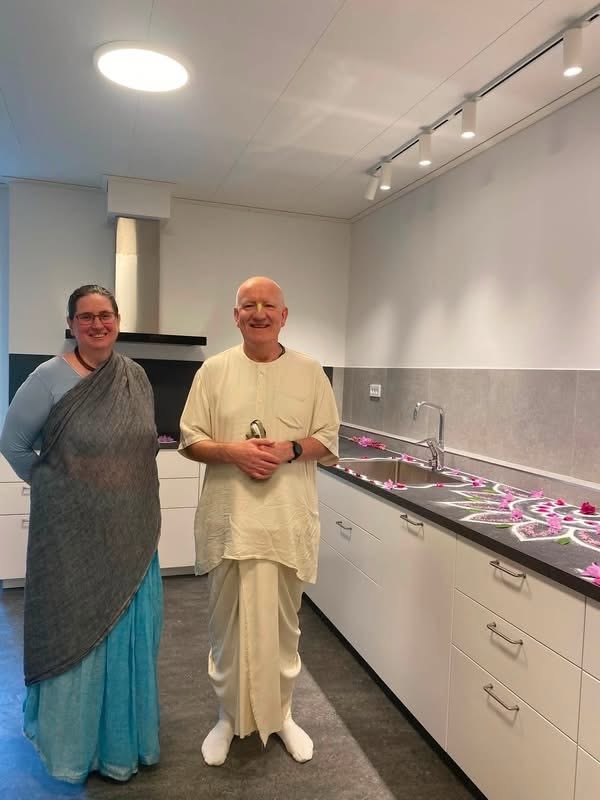
ISKCON Almvik in Sweden marks forty years of continuous service to Sri Sri Panca Tattva, a milestone that reflects both institutional endurance and the quiet discipline of daily devotional life. The community’s recent renovation work highlights how a Hindu temple functions not only as a place of worship, but also as a center of food sanctification, ritual care, cultural continuity, and shared spiritual education. Within the Gaudiya Vaishnava tradition, such service is not incidental to temple life; it is the practical architecture through which devotion becomes visible.
The original announcement from Paramesvari dasi described a community that has served Sri Sri Panca Tattva for four decades and is now entering a new stage of renewal. The first phase of the work has already been completed, including a new Deity kitchen, a new pujari room, and a new sewing room. These spaces may appear modest when viewed only as physical rooms, yet in the technical life of a temple they carry significant ritual, administrative, and spiritual weight.
A Deity kitchen is a specialized sacred workspace where food is prepared for offering before being distributed as prasadam. In Gaudiya Vaishnavism, prasadam is not merely food shared after a ceremony; it is food transformed through devotional offering. The orderliness, cleanliness, and intention of the kitchen therefore matter deeply. A functional Deity kitchen supports purity standards, preparation discipline, safe food handling, and the devotional mood required for offerings made to Sri Krishna and Sri Sri Panca Tattva.
The completion of a pujari room is equally important. The pujari, or temple worshiper, carries out daily Deity service according to established liturgical standards. Such service involves bathing, dressing, decorating, offering food, maintaining sacred items, and sustaining the rhythm of worship. A dedicated pujari room provides the practical conditions for this work: organized storage, respectful preparation, ritual cleanliness, and a quiet environment in which service can be performed with attention rather than haste.
The new sewing room also deserves careful attention. In many Hindu temples, textile work is a significant devotional art. Deity garments, altar cloths, festival decorations, and seasonal offerings are part of the aesthetic theology of worship. Beauty is not treated as decoration alone; it is understood as a form of reverence. The creation and maintenance of sacred textiles allow devotees to participate in seva through skilled hands, patience, and artistic discipline.
The next planned phase concerns the renovation of the big kitchen and the creation of a new altar for Sri Sri Panca Tattva. These two elements point to the twin foundations of temple culture: nourishment and worship. A large community kitchen enables hospitality, festival organization, prasadam distribution, and collective service. An altar provides the visual and theological center of the temple, orienting the congregation toward remembrance, reverence, and shared spiritual identity.
In temple studies, kitchens are often underestimated because they appear ordinary when compared with sanctums, altars, or ceremonial spaces. Yet a community kitchen is one of the most important operational systems in a living temple. It must support hygiene, workflow, storage, heating, cooling, preparation, serving, and cleaning. It also needs to accommodate festival surges, volunteer participation, and the ethical standards associated with vegetarian devotional cooking. When such a kitchen is well designed, it reduces strain on volunteers and allows religious hospitality to function with dignity.
The importance of the altar is different but complementary. A temple altar is a sacred focal point, a ritual threshold, and a visual expression of theology. In the worship of Sri Sri Panca Tattva, the altar draws attention to Lord Caitanya and His associates, whose mission emphasized sankirtana, devotion, compassion, and the distribution of divine grace through the chanting of the holy names. The altar therefore communicates theology through form, proportion, color, placement, ornament, and ceremonial use.
Forty years of service in Sweden also gives ISKCON Almvik a broader cultural significance. Hindu temples outside India often become bridges between generations. They preserve ritual knowledge for families, introduce seekers to dharmic traditions, and create spaces where devotional practices can be learned through participation rather than abstraction. For children raised in diaspora settings, such institutions often provide their first embodied experience of arati, kirtan, prasadam, Sanskrit names, festival rhythms, and collective worship.
The Almvik community also represents the wider history of the Hare Krishna movement in Europe. ISKCON, the International Society For Krishna Consciousness, emerged from the teachings of Srila Prabhupada and developed into a global network of temples, farms, schools, cultural programs, and devotional communities. Its emphasis on Krishna consciousness, kirtan, prasadam, scripture, and disciplined service has allowed Gaudiya Vaishnava practice to take root in diverse social environments while retaining its theological foundations.
From an academic perspective, the renovation of temple infrastructure can be read as a form of cultural preservation. Sacred communities are sustained not only by texts and doctrines, but by kitchens, storage rooms, sewing spaces, worship schedules, volunteer systems, and daily maintenance. A temple that prepares prasadam, dresses Deities, welcomes guests, and marks festivals is transmitting tradition through repeated embodied action. This is how Hindu culture becomes lived heritage rather than a subject preserved only in books.
There is also an emotional dimension that should not be ignored. Communities often build deep bonds around recurring acts of seva. A person who chops vegetables before a festival, stitches a garment, cleans a floor, arranges flowers, or sings during kirtan may experience devotion not as an abstract idea but as shared responsibility. Over forty years, such small acts accumulate into a collective memory. They become part of the spiritual biography of a place.
The reference to Sri Sri Panca Tattva is especially meaningful in a blog committed to unity among dharmic traditions. The theology of Lord Caitanya places strong emphasis on humility, chanting, compassion, and the accessibility of devotion. While Gaudiya Vaishnavism has its own distinctive scriptures, practices, and lineage, its public culture often overlaps with wider Hindu values: reverence for the divine, sanctity of food, respect for sacred sound, disciplined worship, and the pursuit of spiritual transformation through community life.
This broader dharmic framing is important. Hinduism, Buddhism, Jainism, and Sikhism each preserve distinctive philosophical and ritual identities, yet they also share civilizational concerns around ethical living, self-discipline, compassion, sacred memory, and the cultivation of inner refinement. A temple renovation in Sweden may seem geographically distant from the Indian subcontinent, but it participates in the same wider effort to preserve dharmic practice in changing historical conditions.
ISKCON Almvik’s forty-year milestone therefore should be understood as more than an institutional anniversary. It marks the continuity of worship, the resilience of diaspora religious life, and the practical labor required to maintain sacred spaces across generations. Renovating a kitchen or building an altar is not merely a construction project; it is an act of renewal that joins architecture, theology, service, food culture, and community memory.
The completed first phase demonstrates a thoughtful prioritization of the inner systems that sustain worship: Deity service, pujari preparation, and sacred textile work. The planned second phase extends that renewal into spaces that serve the whole congregation: the big kitchen and the altar. Together, these developments show how temple life depends on both visible devotion and the disciplined infrastructure behind it.
For readers interested in Hindu temples abroad, ISKCON Almvik offers a useful case study in how spiritual institutions mature. A living temple does not remain static after its founding generation. It must adapt its facilities, train new participants, preserve standards, and make sacred life accessible to those who arrive later. Such renewal allows tradition to remain faithful without becoming fragile.
At its heart, the story of ISKCON Almvik is a story of seva. It shows how devotion is carried through kitchens, garments, altars, schedules, hands, voices, and shared meals. After forty years of service to Sri Sri Panca Tattva, the community’s renewal work stands as a meaningful reminder that sacred heritage survives through care, organization, humility, and the willingness to serve something greater than individual preference.
Inspired by this post on Dandavats.






Leave a Reply
You must be logged in to post a comment.