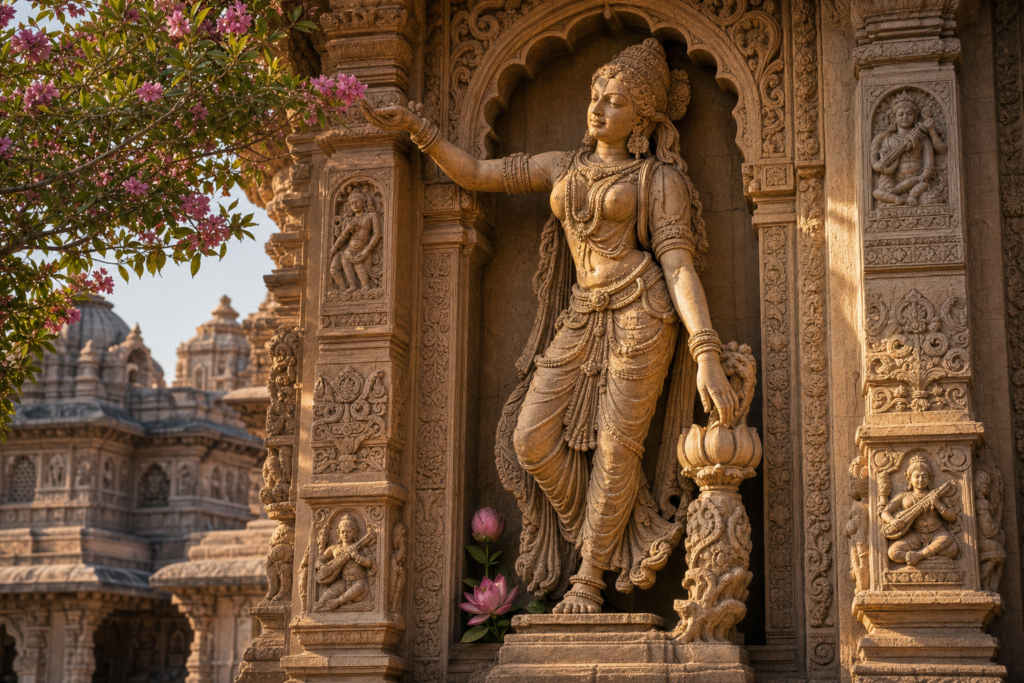
At the end of one cycle of creation in Hinduism, when a terrifying storm rages and day and night are indistinguishable, all that remains is water. Through this boundless ocean, Maa Shakti moves in the Kapalini form, carefully holding the Brahma-substance. From this causal seed, a new world will be articulated. The scene is both austere and precise: dissolution gives way to possibility, and the power that remembers how to begin again stands at the threshold.
Kapalini, the skull-bearing aspect of the Goddess, is associated with this liminal moment that joins the end of one aeon to the birth of another. In Shakta and Shaiva Tantra, the epithet “Kapalini” signals sovereignty over endings, impermanence, and the mysterious continuity that links dissolution to regeneration. The kapāla (skull-bowl) she wields is not a token of morbidity but a vessel of memory and transformation, signifying that what is relinquished becomes the very matrix of renewal.
Iconographically, Kapalini is depicted with implements of cremation-ground power: the skull-cup (kapāla), sometimes a staff crowned with a skull (khaṭvāṅga), and a garland of severed heads (muṇḍamālā). Each element encodes doctrine. The skull is the emptied formmind rendered a lucid receptacle. The khaṭvāṅga is the axis that links the manifest to the unmanifest. The garland of heads enumerates the letters, sounds, and cognitions that arise and subside in cyclic time. By holding these, Kapalini announces mastery over the cycle itself.
Hindu cosmology describes the universe through recurring processes known as the five cosmic acts (pañcakṛtya): Sṛṣṭi (emanation), Sthiti (maintenance), Saṁhāra (withdrawal), Tirobhāva (concealment), and Anugraha (grace). Kapalini is intelligible as the tutelary form presiding over the passage between Saṁhāra and Sṛṣṭithe charged interval where endings become beginnings. The terrifying storm thus functions as a metaphysical diagram: concealment peaks, grace descends, and the seed of creation is activated.
Texts and traditions distinguish multiple dissolutions (pralaya). Nitya-pralaya is the continuous perishability of forms, visible in every moment of change. Naimittika-pralaya is the “occasional” dissolution at the close of a cosmic day (a kalpa). Prākṛtika- or mahāpralaya is the great reabsorption of the elements back into primordial nature. Atyantika-pralaya is the ultimate release (mokṣa), the end of bondage for the individual. Kapalini aligns most closely with the grand hinge of naimittika and prākṛtika dissolutions, where cosmic order is reset.
The Brahma-substance named in the narrative can be read as brahma-tattvathe undifferentiated causal matrix from which names and forms (nāma-rūpa) condense. In allied vocabularies, this seed is likened to hiraṇyagarbha (the “golden embryo”) or to avyakta (the unmanifest), without reducing Shakti’s primacy as the dynamic potency that sets the entire series of tattvas (principles) in motion. Held within Kapalini’s kapāla, the Brahma-substance is both remembrance and blueprint: it preserves the trace of what has been and the potential of what may become.
Philosophically, the storm expresses a rebalancing of the guṇassattva, rajas, and tamas. In dissolution, composite forms return to equilibrium; in creation, a precise disequilibrium reappears as rajas impels, sattva illumines, and tamas provides substantiality. Kapalini stands where that turn occurs, intimating that wisdom is the art of transiting endings without clinging and entering beginnings without amnesia.
Puranic cosmology offers scalable timeframes that render the cycle intelligible. A kalpa (Brahmā’s day) unfolds through creation and sustenance, followed by naimittika-pralaya during Brahmā’s night; across cycles, universes arise and withdraw like waves on a shoreless sea. The universality of water in the narrative foregrounds this: the ocean is primordial possibility, and Kapalini’s movement across it signals the continuity of law (dharma) even when forms have vanished.
Scriptural resonances are widespread. Shakta narratives speak of the primacy of the Goddess and the waters at the inception of creation; allied Vaishnava tellings recall the cosmic ocean and the divine repose before manifestation. Across Purāṇas, the shared grammar is unmistakable: cyclical time, primordial waters, and a supra-personal agency that composes and decomposes the cosmos with measure and compassion. Read together, these strands form a unified Indic vision rather than competing claims.
Tantric practice gives this cosmology an interior method. The cremation-ground (śmaśāna) is an external symbol of what contemplatives undertake inwardly: allowing the old to die so the subtle body can be re-instrumented for insight. Seed mantras associated with the Goddesssuch as HRĪM or KRĪM in certain lineagestrain attention to abide as Shakti’s vibration rather than the contents of thought. In that discipline, the mind becomes Kapalini’s cup, receptive to brahma-tattva rather than overflowing with residues of past cycles.
Yogic hermeneutics connect this to experiential anatomy. When the winds of attention are quieted and prāṇa balances along suṣumṇā, the practitioner encounters a lucid voidness not of negation but of capacity. That capacitous stillness is structurally akin to the narrative ocean at pralaya. From that stillness, insight (prajñā) articulates new patternsethical, aesthetic, and intellectualmirroring the re-emergence of order from the Brahma-substance in Kapalini’s keeping.
Parallels across dharmic traditions strengthen the sense of a shared civilizational grammar. Vajrayāna Buddhism venerates charnel-ground ḍākinīs holding the kapāla, signifying fearless engagement with impermanence and the transformation of defilements into wisdom. Jain cosmology describes vast upward and downward arcs (Utsarpiṇī and Avasarpiṇī), affirming that dissolution and regeneration are law-like. Sikh teachings center Ik Onkar and the sovereignty of Hukam, through which worlds arise and subside without exhaustion. Read together, these visions emphasize continuity, compassion, and responsibility within cyclic time.
Practitioners often report that contemplating Kapalini softens fear of endingsgrief, change, or the loss of certaintiesby framing them as sacramental thresholds. The kapāla ceases to be an emblem of dread and becomes a teaching about the right use of emptiness: when emptied of fixation, the mind can hold the causal clarity from which wise action proceeds. That shift cultivates steadiness in crises and discernment in renewal, precisely the virtues needed when a stormcosmic or personalerases familiar horizons.
Ethically, the water-bound tableau commends humility and ecological care. If existence is rhythmic and resources cyclical, prudence in consumption and reverence for interdependence follow. Kapalini’s assurance that “what ends can seed” encourages repair, reuse, and regeneration in culture and environment alike, translating metaphysics into measurable stewardship.
In sum, the Kapalini form of Goddess Shakti illuminates the cycle of creation not as a simple restart but as a memory-infused renewal. The terrifying storm is the world scrubbed of residue; the indistinguishable day and night are the cessation of partial views; the waters are capaciousness; the Brahma-substance is intelligible potential; and Kapalini is the fearless wisdom that bears it forward. Seeing these together invites a unified appreciation of Hindu, Buddhist, Jain, and Sikh contemplative insights, strengthening a shared dharmic commitment to truth, compassion, and continuity.
Inspired by this post on Hindu Blog.