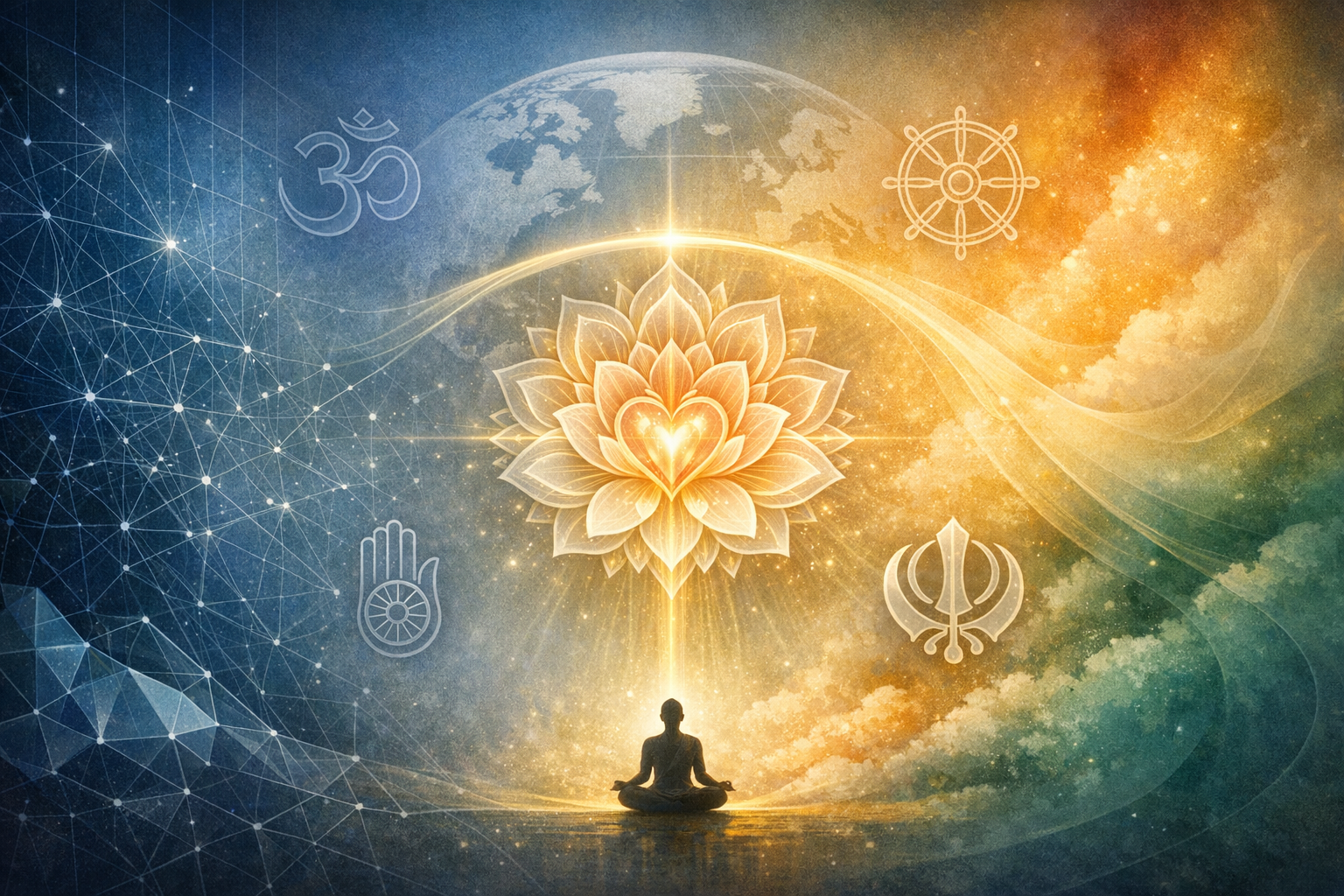
Universality stands at the core of spirituality. It shifts concern from the narrow orbit of self-interest toward an expansive identification with all beings. In contrast to an individuality-conscious mind that evaluates experience through personal gain, a universal orientation reframes thought, emotion, and conduct in alignment with the welfare of the larger whole. This is not the erasure of individuality but an ethical and experiential enlargement of identityan ascent from “me” to “we.”
Within this movement, reason and intuition occupy distinct but complementary roles. The reasoning mind is analytical, discriminative, and detail-oriented, ensuring clarity, rigor, and accountability. The intuitive mind, by contrast, is integrative and all-embracing, discerning patterns and wholes rather than parts. Spiritual maturity does not discard analysis; it refines it until reason becomes a reliable guide that can hand over, at the right moment, to an intuition capable of grasping unity without losing precision.
The transition from reasoning to intuition is therefore a deepening, not a negation. Reason interrogates, compares, and tests; intuition synthesizes, harmonizes, and unifies. In the Dharmic traditions, this synergy appears as viveka (discernment) preparing the ground for prajñā (insight). When discernment becomes steady and ethically grounded, intuition is not guesswork; it is clear seeing. The analytical mind stops getting “caught” in details, because details are now held in a wider field of meaning.
Dharmic sources articulate this universality with striking clarity. The Upanishadic intuition ekam sat vipra bahudha vadanti affirms one reality approached in many ways, while the civilizational maxim Vasudhaiva Kutumbakam envisions the world as one family. In the Bhagavad Gita, the expansion from egoic action to loka-sangraha (the welfare and cohesion of the world) signals the move from self-enclosure to universal responsibility. These formulations showcase how Hindu spirituality ties inner realization to outward, inclusive conduct.
Buddhist thought reaches a similar convergence via anatta (non-self) and pratītyasamutpāda (dependent arising). As perception becomes less entangled with a fixed “I,” compassion (karuṇā) and loving-kindness (mettā) naturally extend beyond familiar circles. The Bodhisattva ideal epitomizes universality in action: liberation is pursued inseparably from the liberation of all beings. Contemplative training in mindfulness and insight stabilizes attention so that empathy and ethical clarity can reliably shape behavior.
Jain philosophy offers a rigorous epistemic foundation for universality through Anekantavada. Reality is many-sided; each viewpoint catches a facet. When held with intellectual humility (syādvāda) and ethical discipline, this perspective disarms dogmatism and anchors ahimsa as a non-negotiable. The result is not relativism but responsibilityan obligation to honor partial truths without elevating any single one into an exclusive absolute.
Sikh teachings resonate with this synthesis. Ik Onkar affirms the unity of the divine, while sarbat da bhala orients aspiration toward the well-being of all. Simran (remembrance of the Naam), kirtan (devotional singing), and seva (selfless service) cultivate humility and dissolve rigid self-other boundaries. In daily life, the institution of langar turns metaphysics into practice, allowing the experience of equality and universal dignity to be lived, not only affirmed.
Contemporary cognitive science helps clarify why the transition from analysis to intuition supports universality. Dual-process frameworks describe a dialog between slower, reflective cognition and faster, integrative appraisal. Mindfulness and focused attention training (dhyana) are associated with improved executive control, reduced cognitive rigidity, and enhanced empathic processing. As attentional stability increases, the mind is less captured by self-referential bias and more capable of nuanced, inclusive appraisal.
Physiologically, practices that calm and focus the mind often co-activate pathways associated with social engagement and prosocial affect. Enhanced vagal tonereflected in healthier heart-rate variabilitycorrelates in several studies with emotional regulation and compassion. While such findings do not “prove” spiritual claims, they align with the experiential report across traditions: a quieter, steadier mind tends toward wider concern and more universal ethics.
Ethical frameworks in Dharmic traditions operationalize universality. Yamas and niyamas in Yoga, the Buddhist precepts (sīla), Jain mahāvratas, and the Sikh Rehat Maryada all convert insight into conduct. Ahimsa, satya, aparigraha, and seva function as practical tests: if contemplative attainment does not widen empathy and reduce harm, it remains incomplete. In this way, ethics and insight serve as mutual correctives, ensuring that intuition remains grounded and reason remains compassionate.
Hindu yogic psychology charts a methodical bridge from analysis to intuition. Through pratyahara (sensory regulation), dharana (one-pointedness), and dhyana (stable meditation), attention matures from scattered reactivity to steady clarity. Over time, vichara (inquiry) and nairantarya abhyase (unbroken practice) align buddhi (intellect) with a more spacious awareness, enabling a felt sense of unity that does not collapse distinctions but contextualizes them.
In Buddhism, mindfulness (sati) and insight (vipassanā) progressively reveal the constructed nature of experience. Clinging softens as the impermanence and interdependence of phenomena become evident. The intuitive mind here is not sentimental; it is precise, perceiving the flux of causes and conditions. From this clarity, mettā and karuṇā flow less as ideals and more as spontaneous dispositions.
Jain samayik (equanimity practice) and pratikraman (reflective repentance) refine attention and ethical sensitivity simultaneously. As reactivity decreases, the many-sidedness of situations is easier to perceive without hostility. This posture makes space for non-violent resolution and dialogue, demonstrating how epistemology (Anekantavada) and ethics (ahimsa) reinforce each other in lived practice.
In Sikh practice, simran and kirtan entrain attention to the Naam, while seva turns inner orientation outward. The interplay dissolves egoic centrality and embodies universality in concrete, communal forms. The resulting humility is neither self-denial nor passivity; it is clarity about the larger field of life in which each person participates.
Sound epistemic guardrails ensure that intuition remains trustworthy. Classical Indian thought balances pramāṇaspratyaksha (direct experience), anumana (inference), and śabda (reliable testimony). This triad avoids two extremes: narrow empiricism that cannot accommodate trans-conceptual awareness, and unexamined intuition that drifts into credulity. Properly held, reason checks intuition’s excesses, and intuition prevents reason’s fragmentation.
Universality also has social and civilizational implications. Pluralism is a natural extension of inner expansiveness, not a reluctant compromise. When practices cultivate a wider identity, interfaith respect and collaboration become the default stance. Dialogue across Hinduism, Buddhism, Jainism, and Sikhism is then not an optional extra, but the social expression of a spiritual fact: truth is vast, and pathways are many.
To honor this plurality, Dharmic discourse benefits from resisting any claim that a single method or tradition exhausts the truth. Anekantavada provides a rigorous philosophical basis for such humility, while the Upanishadic and Sikh affirmations of oneness supply its metaphysical heart. This does not produce sameness; rather, it invites complementary enrichmenteach lineage contributing strengths that temper the blind spots of others.
Common pitfalls merit vigilance. Spiritual bypassing can masquerade as universality, evading concrete ethical responsibility. Conversely, anti-intellectualism can mistake intuition for license, sidestepping disciplined inquiry. A balanced path continually tests insights against ethical outcomes and shared wisdom, ensuring that inner claims translate into outer care.
A practical roadmap follows naturally. Begin with steady attention trainingbreath awareness, mantra japa, or mindfulnessuntil one-pointedness stabilizes. Pair this with ethical commitments that reduce harm and increase service. Add regular self-inquiry to examine motives, assumptions, and biases, and sustain inter-tradition dialogue that stretches comfort zones. Over time, analysis grows supple, intuition grows reliable, and conduct grows inclusive.
Meaningful indicators of progress include reduced reactivity, clearer moral reasoning, an expanded circle of concern, and the ability to hold differences without hostility. Many practitioners report that as attention steadies, a quiet warmth and availability to others becomes easier, even in disagreement. In this sense, universality is not merely believed; it is felt, verified in relational life.
Across history, Dharmic exemplars have embodied this arc. Swami Vivekananda’s articulation of Ishta allowed multiple approaches to the divine without dilution. The Buddha’s compassion extended liberation beyond personal attainment. Mahavira’s uncompromising non-violence and Guru Nanak’s vision of shared dignity each affirm that inner realization and universal ethics are two sides of one coin.
Universality is thus both criterion and culmination of spirituality. It confirms that insight is genuine, because it reliably blossoms into care that crosses boundaries of caste, creed, community, and species. The analytical mind remains indispensable, but it now serves a larger synthesis. When reason and intuition converge in this way, the result is not vague idealism but a disciplined, compassionate universality capable of sustaining harmony among the Dharmic traditions of Hinduism, Buddhism, Jainism, and Sikhismand, by extension, with the wider human family.
Inspired by this post on Hindu Blog.