
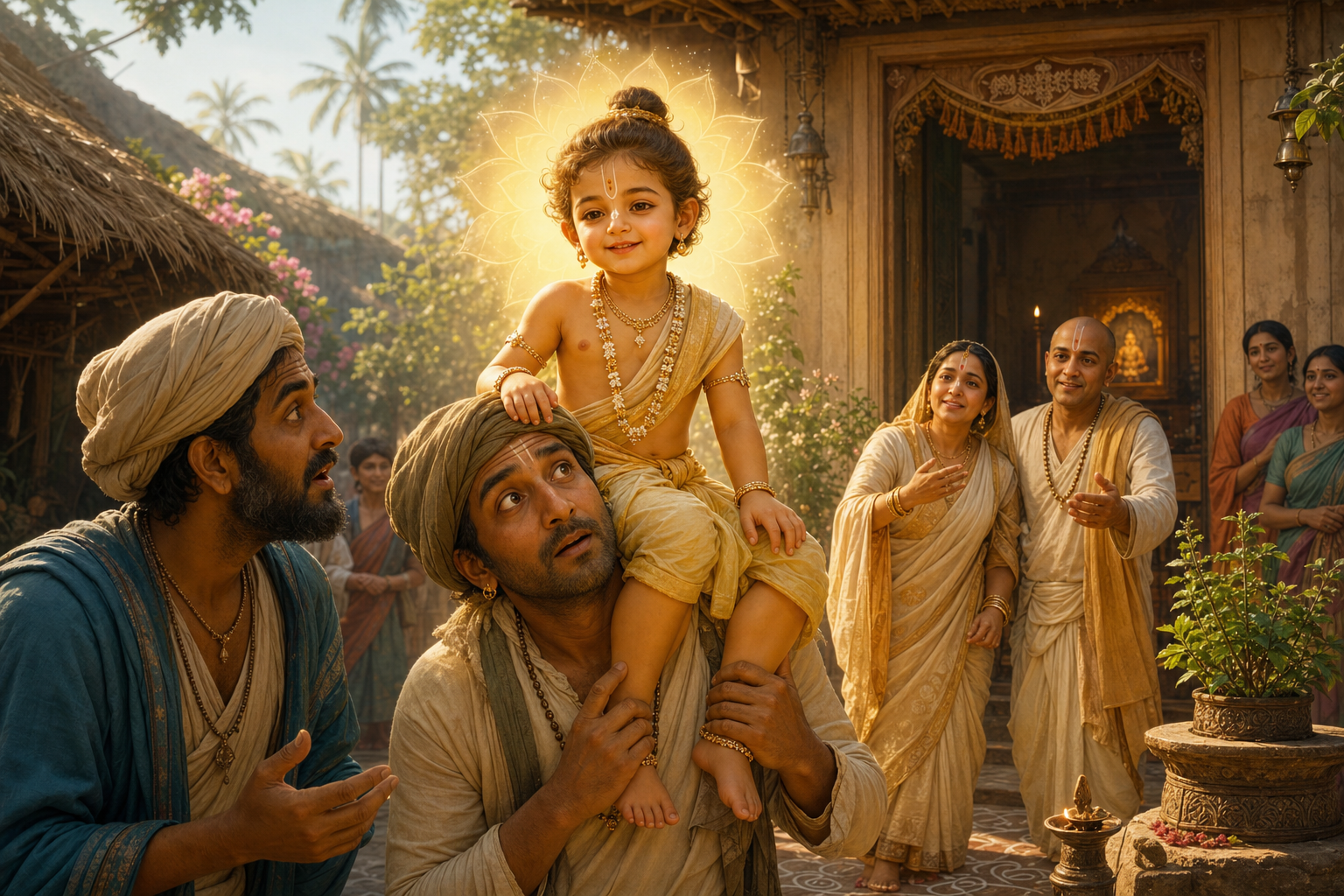
Caitanya-caritāmṛta Ādi-līlā 14.38 presents one of the most memorable childhood pastimes of Lord Caitanya Mahāprabhu, known in His early life as Nimāi. The verse belongs to the fourteenth chapter of Ādi-līlā, where Śrīla Kṛṣṇadāsa Kavirāja Gosvāmī describes the early years of the Lord in Navadvīpa. Though the scene appears simple at first glance, it carries profound theological, ethical, and devotional meaning within the Gaudiya Vaishnava tradition.
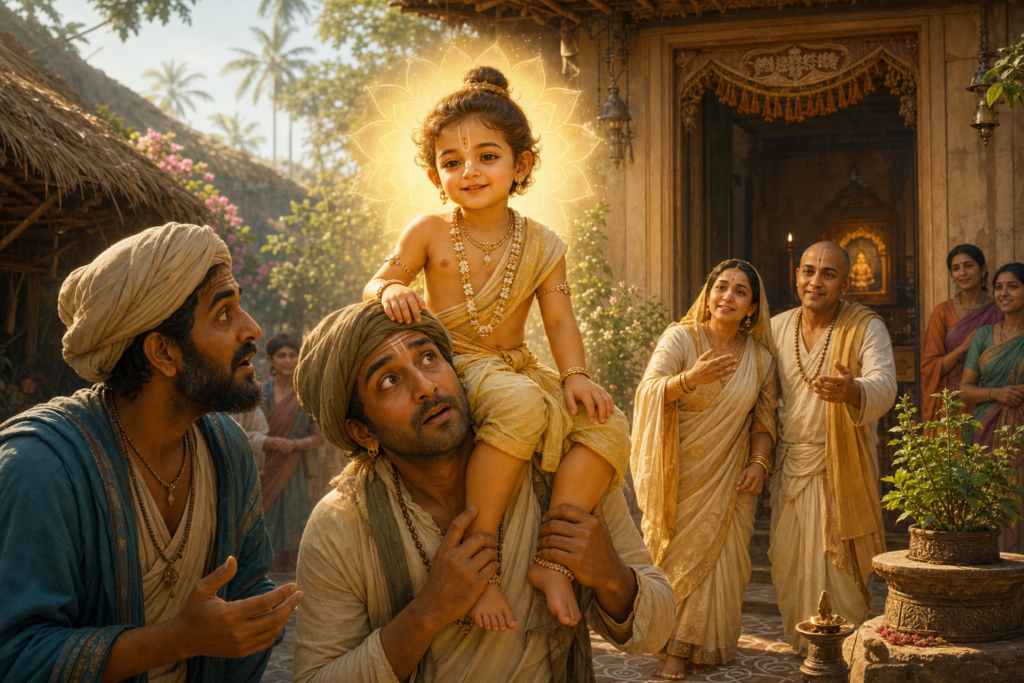
The Bengali verse reads: চোরে লঞা গেল প্রভুকে বাহিরে পাইয়া । তার স্কন্ধে চড়ি’ আইলা তারে ভুলাইয়া ॥ ৩৮ ॥ Its transliteration is: core lañā gela prabhuke bāhire pāiyā tāra skandhe caḍi’ āilā tāre bhulāiyā. The narrative describes how two thieves found the child Lord outside His home, carried Him away with the intention of stealing His ornaments, and yet, through divine bewilderment, returned Him to the very house from which they had taken Him.
At the literal level, the episode is a charming childhood story: a beautifully adorned child is seen playing outside, two opportunistic thieves attempt to exploit the moment, and the child is safely returned home. Yet in the language of sacred biography, the incident is not merely a domestic anecdote. It becomes a theological lesson on divine agency, māyā, innocence, protection, and the mysterious ways in which the Supreme guides even those who approach Him with impure motives.
The setting is important. Navadvīpa in the life of Caitanya Mahāprabhu is not treated simply as a historical town of Bengal, but as a sacred landscape of learning, devotion, family life, and divine play. Jagannātha Miśra and mother Śacī appear as deeply loving parents, and their household becomes the center of intimate devotional experience. In this verse, the anxiety of the parents and neighbors is as meaningful as the Lord’s playful self-possession. The community searches in fear, while the child quietly turns danger into revelation.
The thieves represent a familiar human tendency: the desire to possess beauty without understanding its source. They see ornaments, value, and opportunity. They do not see divinity. This distinction is essential to the spiritual psychology of the passage. In many dharmic traditions, the movement from greed to reverence begins when perception is purified. A person may first approach the sacred with calculation, fear, curiosity, or even selfishness, yet the sacred can transform that approach into a moment of awakening.
In Gaudiya Vaishnavism, this transformation is linked to the Lord’s inconceivable potency. The thieves believe they are carrying Nimāi away, but the narration reverses the direction of power. They are not controlling the child; the child is directing them. Their bodies walk, their minds calculate, and their intentions remain worldly, but the final destination is chosen by the Lord. This is a subtle but powerful teaching: divine will may operate quietly beneath the surface of ordinary events.
The theme of bewilderment, or spiritual redirection, is central here. Māyā is often discussed as illusion that binds the living being to mistaken identity and desire. In this episode, however, divine bewilderment becomes protective. The same category of illusion that can entangle the conditioned mind is used by the Lord to prevent harm, restore the child to His family, and expose the futility of selfish intention. The thieves are confused, but that confusion saves them from a deeper offense.
The verse also echoes a broader pattern found across Hindu scriptures: when the Divine appears as a child, apparent vulnerability becomes the stage for supreme power. Krishna’s childhood pastimes in Vṛndāvana repeatedly overturn normal expectations. Pūtanā comes with murderous intent and receives liberation; Tṛṇāvarta carries Krishna into the sky and is destroyed; the cart demon and whirlwind demon are defeated by a child who seems dependent on His caretakers. Caitanya Mahāprabhu’s childhood līlā continues this devotional grammar, not through violence in this case, but through merciful misdirection.
This is why the episode should not be read as a mere miracle tale isolated from theology. It teaches sambandha, the nature of relationship between the living being and the Divine. The thieves relate to the Lord as an object of exploitation, while mother Śacī relates to Him through love, concern, and surrender. The same child stands before both, but their consciousness determines what they perceive. Sacred literature repeatedly returns to this principle: the Divine is revealed according to the quality of one’s approach.
From an ethical perspective, the incident exposes the instability of greed. The thieves are not portrayed as powerful villains; they are spiritually disoriented persons. Their plan is precise, but their consciousness is weak. In modern terms, this has continuing relevance. A society that values possession over reverence gradually loses the ability to recognize sanctity. The ornaments attract the thieves because they see wealth before they see personhood. The story therefore becomes a critique of instrumental thinking, where living beings are reduced to what can be taken from them.
The devotional reading goes further. Lord Caitanya does not merely escape danger; He allows Himself to be carried. This detail is tender and philosophically rich. The Supreme, who is understood as the controller of all energies, permits the thieves to place Him on their shoulders. For a brief moment, they receive the physical proximity that saints yearn for through lifetimes of devotion. Yet because their motive is impure, they cannot taste the fullness of that contact. Proximity without devotion does not become realization.
For many readers, this detail creates an emotional pause. The Lord is close, but the thieves are absent to that closeness. This is not only their story; it is a mirror for ordinary spiritual life. Sacred opportunities may be near, yet distracted consciousness may fail to recognize them. A mantra may be heard as sound only, prasadam as food only, a temple as architecture only, and scripture as literature only. The passage invites a deeper way of seeing.
The role of mother Śacī also deserves attention. Her anxiety is not weakness; it is the natural intensity of vatsalya, parental affection. In bhakti theology, love for the Divine does not erase human emotion. Rather, human emotion becomes purified and elevated when connected with the Lord. The fear of losing Nimāi reveals the depth of maternal devotion. The eventual return of the child becomes not only relief but a renewal of sacred dependence.
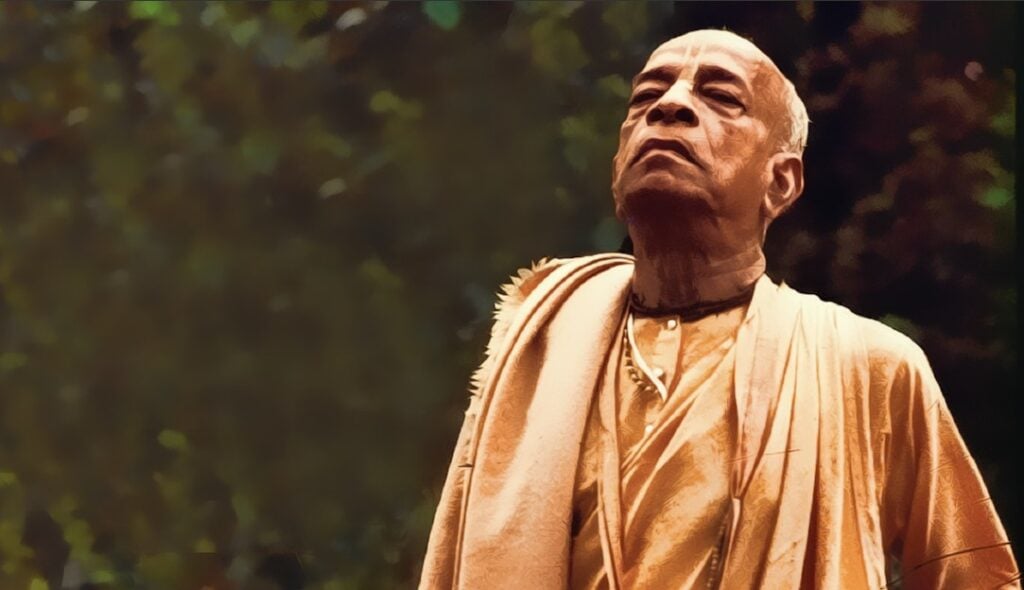
Śrīla Prabhupāda’s presentation of this pastime within the Caitanya-caritāmṛta tradition emphasizes that the child was decorated with ornaments, that the thieves attempted to lure Him, and that the Lord’s own energy brought them back to Jagannātha Miśra’s home. The theological implication is precise: divine protection is not dependent on external strength. The Lord can protect through force, wisdom, circumstance, memory, forgetfulness, or bewilderment. In this case, protection arrives through misdirection.
The reference to Caitanya-bhāgavata is also significant because it shows how the Caitanya tradition preserves the same event across devotional sources. The Caitanya-caritāmṛta is not only a biography; it is a theological synthesis. It gathers earlier memories, organizes them through Gaudiya Vaishnava philosophy, and presents Caitanya Mahāprabhu as the combined compassion and sweetness of Radha-Krishna. Ādi-līlā 14.38 participates in that larger purpose by revealing majesty through childhood intimacy.
Within the broader unity of dharmic traditions, this episode can be appreciated without sectarian narrowness. Hinduism, Buddhism, Jainism, and Sikhism each preserve deep reflections on attachment, intention, moral consequence, and inner transformation. While their theological frameworks differ, they share a serious concern with the purification of consciousness. The thieves’ failure is not merely theft; it is avidyā, a distorted perception of reality. Their rescue begins when divine arrangement interrupts that distortion.
The story therefore speaks to householders, students, renunciants, and seekers alike. It reminds householders of the sanctity of family affection when centered on dharma. It reminds students of scripture that small verses often contain layered metaphysics. It reminds spiritual practitioners that the Lord’s mercy may appear as correction, delay, confusion, or reversal. What seems like obstruction may sometimes be a hidden form of grace.
There is also a subtle lesson in humility. The thieves are confident until they arrive exactly where they did not intend to go. Their intelligence fails because it is separated from righteousness. Dharmic thought repeatedly warns that cleverness without virtue becomes self-defeating. Whether in personal life, social life, or spiritual practice, intention matters. Actions rooted in greed eventually return the actor to a confrontation with truth.
In contemporary life, this verse can be read as a meditation on misplaced desire. People often chase security through accumulation, recognition, or control. Yet the more one tries to possess what is sacred, the more one becomes disoriented. The path of bhakti proposes a different movement: not possession, but offering; not exploitation, but service; not anxiety over control, but trust in divine guidance.
The class by HG Dayal Mora Das on 05.07.2026 can therefore be situated within a living tradition of scriptural reflection. Such classes are not merely explanations of old stories. They function as bridges between text and practice, between Bengali devotional literature and contemporary spiritual life, between historical memory and personal transformation. The value of studying Caitanya-caritāmṛta lies precisely in this capacity to make ancient līlā speak to present human concerns.
Ādi-līlā 14.38 ultimately teaches that divine innocence is not helplessness, divine play is not randomness, and divine mercy is not limited to the visibly pious. Even those who come with confused motives may be turned around. The thieves intended to take the Lord away, yet they were made to bring Him home. In that reversal lies the heart of the verse: the Supreme is never truly carried away by the world; rather, the world itself is carried, corrected, and guided by Him.
For devotees of Lord Caitanya, the incident deepens affection for Nimāi’s childhood pastimes. For students of Hindu scriptures, it demonstrates how narrative, theology, ethics, and rasa work together in sacred literature. For all dharmic seekers, it offers a practical reminder: when consciousness is purified, even ordinary events reveal guidance. When consciousness is clouded, even direct contact with the sacred may go unrecognized. The task of spiritual life is to learn to see rightly.
Inspired by this post on Dandavats.







Leave a Reply
You must be logged in to post a comment.